A lease is ending. The tenant is not ready to sign for another year. The landlord does not want the unit sitting empty while both sides wait on a decision.
That is where a month-to-month tenancy often comes in.
For many Texans, this arrangement is practical. It gives a renter time to finish a home search, relocate for work, or stay in place after a fixed lease expires. It also gives a landlord room to keep collecting rent without locking into a long commitment. But flexibility is only helpful if both sides understand the rules.
Texas landlord-tenant disputes often start with a simple mistake. A tenant assumes they can move out on the last day of the month without proper written notice. A landlord assumes notice must line up with the rent due date. Both assumptions can create holdover claims, rent disputes, or a delayed move-out.
If you are asking what is a month to month tenancy, the short answer is this: it is a rental arrangement that renews each month until one side gives proper notice under the Texas Property Code. The longer answer matters, especially if you are trying to protect your money, your housing, or your property.
Navigating Your Next Move in the Texas Rental Market
A Dallas tenant’s lease ends on June 30. The tenant needs a little more time before deciding whether to relocate. The landlord wants rent to keep coming in, but does not want to be locked into another year if plans change.
That situation comes up all the time in Texas.
A month-to-month tenancy often works well in that gap between a long-term lease and a final decision. It gives both sides flexibility, but Texas law still controls how notice, rent, and lease terms work once the original term ends. Informal assumptions cause problems fast, especially when one side believes a text message, a handshake, or a last-minute conversation is enough.
The practical question is not whether a month-to-month arrangement sounds convenient. The question is whether the parties have handled it in a way that protects their position if the relationship sours.
For tenants, that usually means confirming what notice is required, whether the old lease terms still apply, and whether any rule changes were put in writing. For landlords, it means treating the tenancy like a real legal arrangement with deadlines, records, and enforceable terms, not a temporary favor.
Texas landlords and tenants also make these decisions in a market where flexibility has value. People change jobs, home purchases get delayed, family needs shift, and owners may want the option to re-rent, renovate, or sell. A month-to-month tenancy can meet those needs, but only if the agreement fits Texas rules and the parties understand what carries over from the prior lease. If you need a refresher on the baseline rules that apply to rental contracts, review these Texas lease agreement laws.
Practical point: Flexibility does not remove legal requirements. Clear written terms and proper notice prevent the disputes I see most often in Texas month-to-month cases.
That is why this issue deserves careful attention at the start, not after rent is disputed or move-out plans fall apart.
What Is a Month to Month Tenancy in Texas
A month-to-month tenancy is a rental agreement that lasts for one month at a time and renews automatically each month unless the landlord or tenant ends it with proper notice.
That is the basic answer to what is a month to month tenancy. The Texas version is straightforward in concept, but the legal effect is important. Unlike a fixed-term lease, there is no set final end date built into the agreement. The tenancy keeps going until someone properly stops it.

How a month-to-month tenancy starts
In Texas, this kind of tenancy usually begins in one of two ways:
- A landlord and tenant sign an agreement that is monthly from the start.
- A fixed-term lease expires, the tenant stays, and the landlord accepts rent without signing a new fixed-term lease.
That second situation is common. A tenant stays after the lease expires, pays rent, and both sides keep acting like the tenancy is continuing. In practice, that often becomes a month-to-month arrangement.
Why people use it
The main reason is flexibility.
A tenant may need short-term housing while waiting to close on a house, relocate, or decide whether to renew. A landlord may want to keep income coming in while retaining the option to end the tenancy later with proper notice.
That flexibility has made month-to-month leases a major part of the rental market. In the United States, 31.8% of all leases are month-to-month tenancies, while 59.6% are fixed-term 12-month agreements, according to the Bureau of Labor Statistics housing lease data.
What still applies
A monthly tenancy is not a lesser lease. Core lease terms still matter. Rent, deposits, late fees, maintenance expectations, occupancy rules, and pet policies should still be in writing.
If you want a better sense of how Texas rental agreements are structured, this overview of Texas lease agreement laws is a useful starting point.
Key takeaway: A month-to-month tenancy is flexible on duration, not loose on rules. The agreement still needs to say who pays what, who maintains what, and how notice must be given.
Month to Month Tenancy Versus a Fixed Term Lease
The better lease type depends on what problem you are trying to solve.
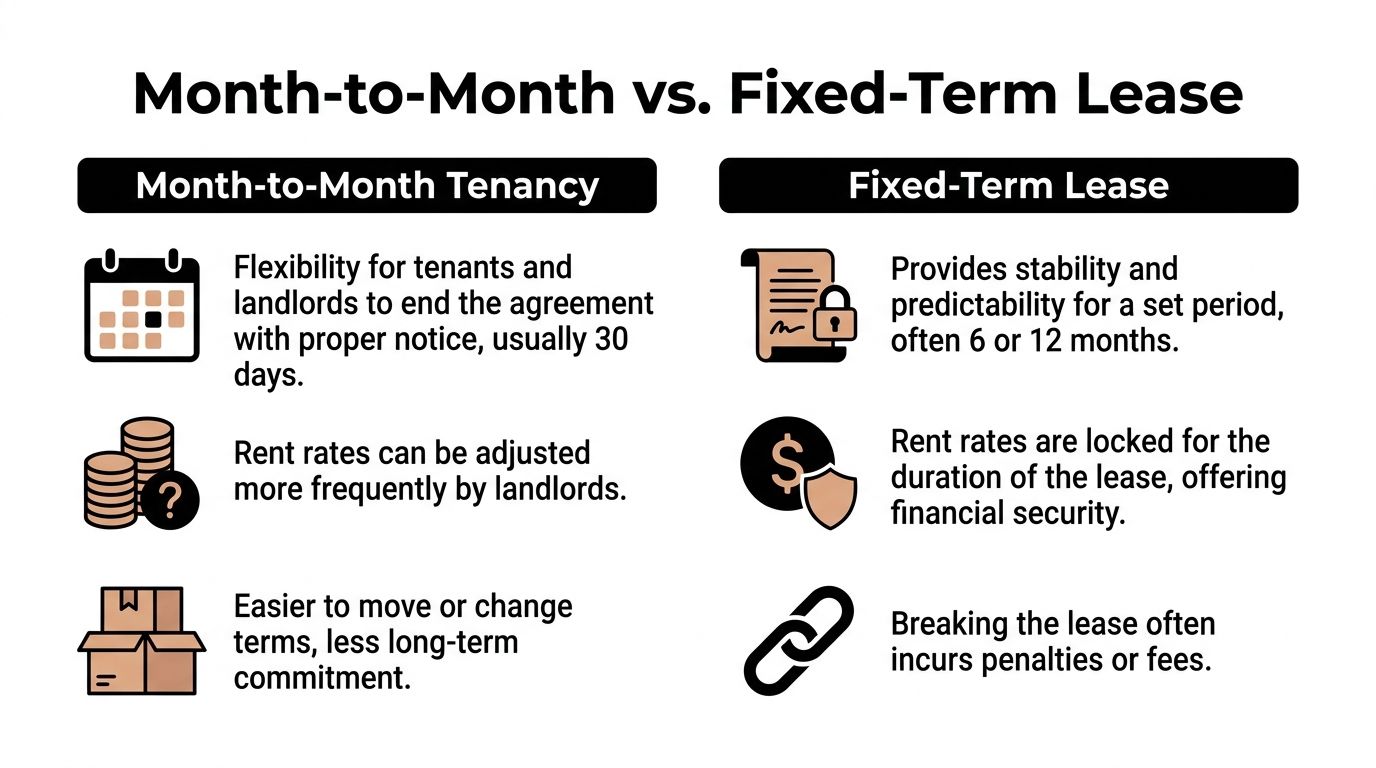
A fixed-term lease is built for stability. A month-to-month tenancy is built for flexibility. Neither is automatically better. Each works well in some situations and badly in others.
The basic trade-offs
Here is the practical comparison:
| Lease type | What usually works well | What often creates problems |
|---|---|---|
| Month-to-month | Short-term plans, uncertain move dates, temporary flexibility | Frequent changes, short notice, less long-term predictability |
| Fixed-term lease | Stable occupancy, predictable rent, longer planning horizon | Harder exit, less flexibility, more friction if plans change |
For tenants
A month-to-month tenancy can help when life is unsettled.
If you are finishing school, waiting on a move, caring for family, or shopping for a home, a long lease may box you in. A monthly arrangement gives you room to move without the same kind of long commitment.
But that same flexibility cuts both ways. The landlord can also end the tenancy with proper notice. The rent may also change more easily than it would under a fixed term.
A fixed-term lease usually works better when you want predictability. If your job, school district, or family routine depends on staying put, locking in a longer term often reduces stress. You know where you will live and what rules will govern the relationship.
For landlords
Month-to-month tenancy can be useful when you want control over timing.
For example, a landlord may expect to renovate, sell, move into the property, or test whether a tenant is a good fit before offering a longer term. In those situations, a monthly lease gives more room to adjust.
The downside is turnover risk. You may be one proper notice letter away from vacancy. That can create extra work, including showings, screening, repairs, cleaning, and re-leasing.
A fixed-term lease often works better when steady occupancy matters more than flexibility. If your priority is predictable rental income and lower turnover, the longer term usually makes business planning easier.
What works and what does not
Some approaches tend to produce fewer disputes.
What works
- Clear written expectations: Spell out rent, deposit terms, guest rules, pets, repairs, and notice procedures.
- Good communication before the lease expires: Discuss whether the tenancy will renew, convert, or end.
- Written follow-up: Confirm any change in status in writing, even if both sides already discussed it.
What does not
- Assuming old terms no longer matter: Many disputes start when one side thinks an expired fixed lease means all rules disappeared.
- Relying on text messages alone: Texts can help, but formal notice should follow the lease and Texas law.
- Waiting until the last minute: Late decisions create rushed notices, move-out confusion, and avoidable conflict.
Practical point: If both sides want flexibility for a short period, month-to-month can work very well. If both sides want certainty, a fixed-term lease is usually the cleaner option.
Your Legal Rights and Obligations Under Texas Law
Texas month-to-month tenancies are simple in theory, but the legal details matter. The most important rule is notice.
Under Texas Property Code Section 91.001, a month-to-month tenancy ends one month after written notice is given, not necessarily on the last day of the month. Notice given on the 15th ends the tenancy on the 15th of the following month, as explained in this Texas month-to-month tenancy summary.

How termination notice works
Many Texans make mistakes with this.
If rent is due on the first, some people assume notice always has to run from the first through the end of the month. Texas law does not treat it that way for month-to-month termination. The timing is based on when notice is delivered.
A simple example helps:
- Notice delivered on March 15. Earliest termination date is April 15.
- Notice delivered on June 2. Earliest termination date is July 2.
That rule affects move-out dates, final rent calculations, and whether a tenant becomes a holdover occupant.
Why written notice matters
Verbal conversations are not enough protection when a dispute starts later.
A proper written notice should identify:
- Who is giving notice
- The property address
- The date notice is delivered
- The termination date
- A signature or clear written confirmation
Landlords should keep proof of delivery. Tenants should do the same. Certified mail, email if allowed by the lease, or hand delivery with documentation can all become important if the other side later denies receiving notice.
Tip: The safest notice is the one you can prove. If you cannot prove when it was sent and received, you may have trouble proving when the tenancy ended.
Ongoing rights during the tenancy
A month-to-month tenant still has the basic protections of Texas landlord-tenant law. A landlord still has the right to enforce lawful lease terms.
That means the tenancy still includes real duties on both sides.
For tenants
- Pay rent on time: A flexible term does not change the duty to pay as agreed.
- Report repair issues properly: If habitability or repair problems exist, document them and follow lease procedures.
- Respect the property: Avoid damage, unauthorized occupants, and other lease violations.
For landlords
- Maintain lawful lease terms: The agreement still needs workable rules and consistent enforcement.
- Respect quiet enjoyment and privacy: Entry and communication should follow the lease and Texas law.
- Handle deposits and move-out fairly: A monthly tenancy does not create a shortcut around regular legal obligations.
The lease still matters
Many people treat month-to-month housing as informal. That is a mistake.
Even in a monthly arrangement, the written lease should control practical issues such as notices, deposits, late fees, guests, pets, parking, and subletting. A Texas landlord tenant lawyer will often start by reading the lease first, because many disputes turn on wording both sides forgot was still in effect.
How to Handle Rent Increases and Evictions Legally
Rent increases and move-out disputes are where month-to-month tenancies create the most pressure. The good news is that Texas law gives a clear framework if both sides follow it carefully.

Rent increases in a Texas month-to-month tenancy
In Texas, there is no statutory cap on rent increases for month-to-month tenancies. A landlord can raise the rent with 30 days’ written notice under the rules tied to Section 91.001. A tenant can accept the increase by staying and paying, or give notice to terminate instead, as described in this Texas month-to-month rent increase guide.
The practical lesson is simple. A landlord cannot usually announce a new rent amount and expect it to apply immediately. The tenant must get proper written notice first.
A solid rent increase notice should include:
- The current rent
- The new rent amount
- The date the new rent begins
- How and when payment is due
- A statement that the tenant may choose to terminate instead of accept
What tenants should do after receiving a rent increase
Do not ignore the notice.
You usually have two basic choices:
- Accept the new rent and continue the tenancy under the new rate.
- Give your own termination notice and move out before the increase takes effect, if timing allows under the law and the lease.
If the notice is unclear, keep communications in writing. Ask for confirmation of the effective date and save every message.
No-fault termination versus eviction
A landlord does not need an eviction lawsuit just to end a month-to-month tenancy. If there is no lease violation and the landlord wants possession back, the normal path is to give the required termination notice.
Eviction becomes relevant if the tenant does not leave after the tenancy legally ends, or if the tenant violates the lease and does not cure the problem when required notice is given.
That distinction matters:
- Termination notice ends the tenancy.
- Eviction case asks the court to award possession if the tenant remains.
A practical sequence landlords should follow
Here is the usual decision path in plain English:
First, decide the reason.
Is this a no-fault end to a monthly tenancy, or is the tenant violating the lease through nonpayment, damage, or another breach?
Next, give the correct written notice.
For a no-fault end of a month-to-month tenancy, follow the monthly termination rules. For nonpayment or another possession issue, Texas law may require a notice to vacate before filing an eviction.
Then, wait out the notice period.
Do not file too early. Filing before the legal deadline can cause delay or dismissal.
Finally, use the court process if needed.
If the tenant does not move out, the landlord may need to file an eviction case. This overview of the eviction process in Texas gives a useful outline of what comes next.
A short video can also help if you want a quick visual explanation of eviction procedure:
Important: Self-help evictions create serious risk. Changing locks, cutting utilities, removing belongings, or trying to force a move-out without following the legal process can turn a landlord problem into a larger legal dispute.
For tenants, the same point applies in reverse. If you receive a notice, read it carefully and respond promptly. Silence often makes a manageable dispute worse.
Essential Clauses and a Sample Termination Notice
A month-to-month lease should not be bare-bones. The term is short, but the agreement still needs clear rules.
Texas guidance on monthly tenancies reflects that point. A month-to-month tenancy under Sections 91.001 and 92.001 should include the same core terms found in a fixed-term lease, including rules on security deposits, late fees, and subletting, and the landlord must provide a copy of the lease within 3 days of move-in under Section 92.024, as summarized in this Texas month-to-month lease overview.
Clauses that should be in writing
At a minimum, the agreement should address:
- Rent terms: amount, due date, grace period if any, and accepted payment methods.
- Deposit terms: amount held, move-out expectations, and deductions that may apply.
- Use and occupancy rules: who can live there, guest limits, and whether subletting is allowed.
- Property condition and repairs: who reports issues, how notice is given, and what conduct counts as damage.
- Entry and communication: how notices are delivered and how the landlord may contact the tenant.
If you are comparing your options because a renter wants to leave before a longer lease ends, this practical guide on how tenants may terminate the lease early gives useful context on how early termination issues differ from month-to-month notice.
A simple sample notice
Either side can adapt language like this:
30-Day Notice to Terminate Month-to-Month Tenancy
Date: [insert date]
To: [name of landlord or tenant]
Property Address: [insert full rental address]
This letter serves as written notice that I am terminating the month-to-month tenancy for the property listed above. The tenancy will terminate one month after delivery of this notice, on [insert termination date].
Please contact me regarding move-out procedures, return of keys, final inspection, or any forwarding address information that may be needed.
Signed,
[name]
[address or contact information]
Common mistakes to avoid
Some notice letters fail for avoidable reasons.
Wrong date
The sender picks the last day of the month instead of counting one month from delivery.
No proof of delivery
The sender cannot show when the notice was given.
Missing property information
The letter does not clearly identify the rental unit or who is ending the tenancy.
If you want a more detailed drafting model, this guide on how to write a lease termination letter can help you format it clearly.
Get Help from a Texas Landlord Tenant Lawyer
A month-to-month tenancy often goes sideways at the point when someone assumes the rules are simple. A landlord gives the wrong notice date. A tenant moves out too early and expects the security deposit back without a dispute. A rent increase is announced casually, then challenged because the notice was not handled correctly under Texas law.
Those problems are usually fixable early. They get more expensive once an eviction is filed, possession is contested, or a deposit claim turns into a lawsuit.
If you are dealing with a move-out deadline, a rent increase, a notice dispute, repairs, or a possession case, a Texas landlord-tenant lawyer can review the paperwork, confirm what the Texas Property Code requires, and help you choose the next step. Sometimes that means sending a clean notice and documenting delivery. Sometimes it means defending an eviction, pressing a repair claim, or resolving a security deposit dispute before positions harden.
Texas law gives both landlords and tenants room to act, but timing and documentation matter. I often see cases turn on ordinary details: the date notice was delivered, the lease language that carried over after a fixed term expired, or whether the parties can prove what was said and when. Those are practical issues, not technicalities.
If you need help with an eviction, lease issue, or rental dispute, contact The Law Office of Bryan Fagan, PLLC for a free consultation today.