Finding out that your landlord came into your apartment when you weren't there can leave you rattled for days. You may notice a light left on, a closet door open, a maintenance tag on the counter, or just that uneasy feeling that someone was inside your home without your okay. For many tenants, that moment is more than annoying. It feels personal, intrusive, and unsafe.
If you're searching for answers about landlord entering apartment without permission texas, the good news is that you are not overreacting. Privacy matters. Your rental unit is still your home, and Texas law does give you meaningful protection when a landlord crosses the line.
The hard part is that Texas doesn't work the way many renters assume. People often expect a clear statewide rule that says a landlord must always give a set amount of notice before entering. Texas is more lease-driven than that, which means the answer often depends on your lease language, the reason for entry, and whether the landlord acted reasonably.
That makes the first response important. Angry calls and heated texts usually don't fix the problem. Careful documentation, a written notice, and a plan usually do.
Introduction: Your Home Should Be Your Sanctuary
A landlord walking into your apartment without warning can shake your sense of control fast. Maybe you came home and saw that a repair was made you never scheduled. Maybe a leasing agent let a stranger into the unit for a showing. Maybe the landlord says they were “just checking on things.” None of that feels minor when it happens in the place where you sleep, shower, and keep your personal belongings.
Texas tenants often feel confused because the rules aren't always stated in one simple sentence. That confusion benefits careless landlords. It also causes tenants to second-guess themselves when they shouldn't. If the entry wasn't allowed by the lease, wasn't necessary, or happened in an unreasonable way, you may have a valid legal complaint.
A calm response protects you better than an emotional one.
What usually works is treating the situation like a dispute that might later need proof. Save the texts. Take photos. Write down what changed in the unit. Pull your lease and read the entry clause closely. If the landlord keeps doing it, move the issue into writing and create a clean record.
Your goal is not to “win the argument” on day one. Your goal is to build a record that shows exactly what happened, when it happened, and why it violated your rights.
That approach matters whether you're a tenant trying to protect your privacy or a landlord trying to avoid a costly dispute. Texas landlord tenant lawyer cases often turn on the same basic question: what did the lease allow, and what can be proven?
Understanding Your Right to Privacy Under Texas Law
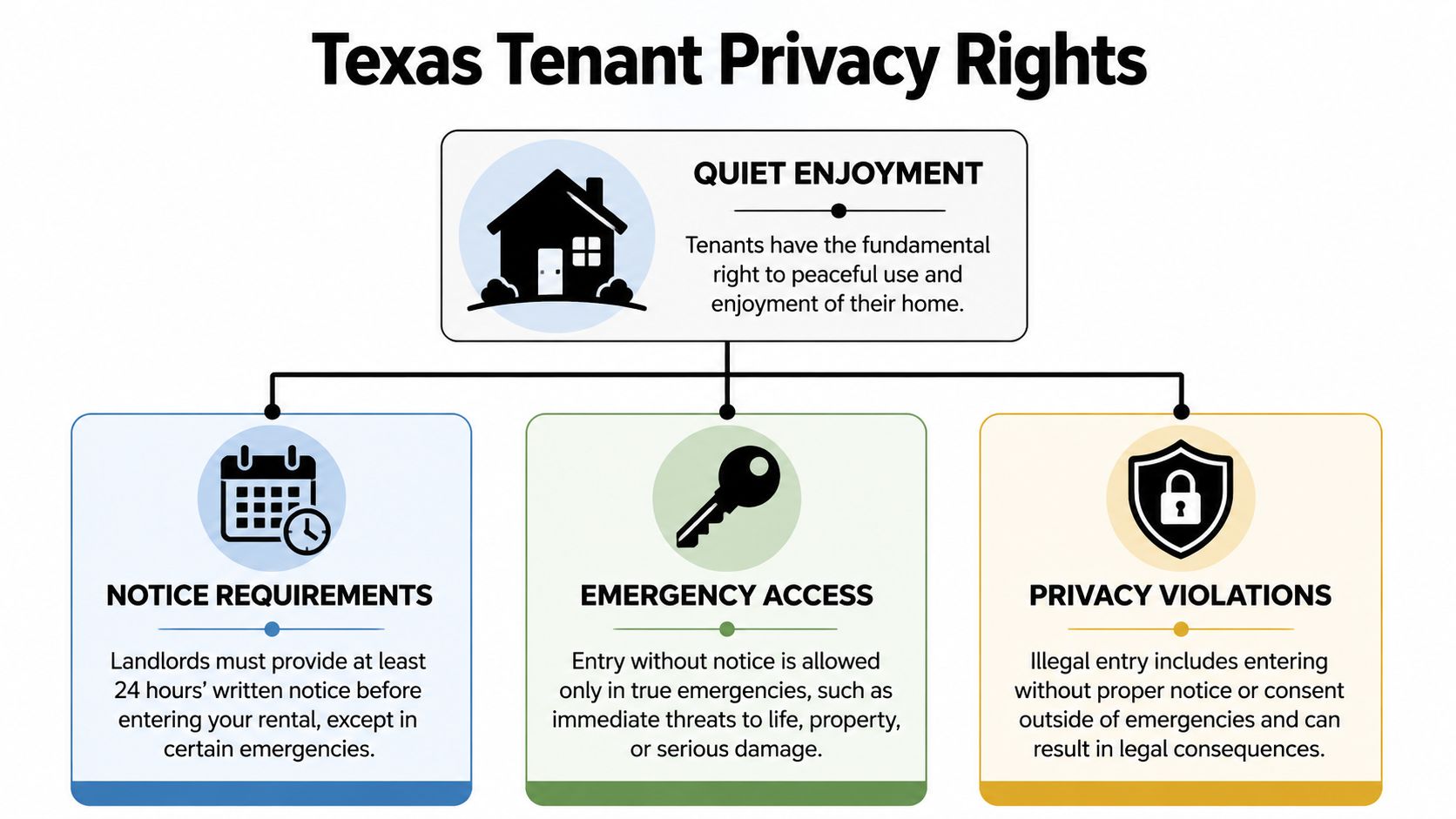
Texas recognizes that a tenant has a right to possess the apartment without unreasonable interference. Lawyers often call this quiet enjoyment. In plain English, it means you're entitled to live in your home without the landlord barging in, hovering over your use of the property, or repeatedly disrupting your privacy.
Before the 2019 enactment of Texas Property Code Section 90.004, no state law directly governed landlord entry. The primary protection was the common law quiet enjoyment doctrine. A 2022 Texas Legal Services Center report noted that over 25% of tenant complaints involved unauthorized entries in a state with over 3.5 million renter-occupied households, according to the Star-Telegram report on Texas landlord entry disputes.
What quiet enjoyment looks like in real life
Quiet enjoyment doesn't just cover loud noise or broken amenities. It also protects your right to exclude people from your home. If a landlord enters because of a true emergency, that's one thing. If the landlord uses a master key to “look around,” check housekeeping, or pop in repeatedly without a valid reason, that's different.
A simple example helps. Suppose your landlord stops by twice in one week, opens the door, and says they wanted to make sure the unit “looks okay.” If your lease doesn't authorize that kind of entry, or if the landlord ignored the conditions in the lease, that can support a claim that your privacy rights were violated.
Texas Property Code Section 90.004 added an important layer by prohibiting entry without tenant consent except in limited situations. Even with that protection, the lease still matters in day-to-day disputes, because many leases define when management may enter and how that access should happen.
Why your lease matters so much in Texas
In many Texas rentals, the lease is the practical rulebook. Standard forms often give landlords broad access for repairs, inspections, and showings, but broad access is not unlimited access. The lease language has to be followed, and entry still has to be reasonable.
If you haven't read your lease since move-in day, now is the time. Start with the sections on entry, repairs, inspections, abandonment, and default. If you need a plain-English starting point for the statute itself, review Texas Property Code Chapter 92.
For tenants who want more day-to-day control over who can physically access common areas and units, building-level access systems can also reduce disputes. In larger properties, resources on Overton Security solutions for apartment buildings can help you understand how controlled entry systems are supposed to work.
Practical rule: In Texas, “no statewide 24-hour notice law” does not mean “the landlord can enter whenever they want.” The lease, reason for entry, and reasonableness still control.
Immediate Steps After an Unlawful Landlord Entry
The first few hours matter more than most tenants realize. People often start with a phone call, but the better move is to preserve evidence before memories fade or the landlord changes their story. If something feels off, assume you may need to prove it later.

A proven five-step methodology for tenants shows a 70-80% success rate in informal resolutions. The first and most important step is immediate documentation, because tenant advocates report that 40% of cases fail due to lack of timestamped evidence. Using an app that preserves metadata can strengthen evidence by up to 90%, as noted by the Texas State Law Library guidance on landlord entry.
Start with a clean evidence record
Write down the date and time you discovered the entry. Note how you know someone came in. Be specific. “Bedroom window was open” is better than “things seemed weird.” “Maintenance tag left on kitchen counter” is better than “landlord must have come by.”
Then photograph anything that supports your account:
- Moved items: Cabinets open, furniture shifted, closets disturbed, or property handled.
- Physical signs: Work orders, business cards, handwritten notes, or repair receipts left behind.
- Entry points: Door condition, lock condition, smart lock log, camera footage, or hallway video if available.
- Communication trail: Texts, portal messages, emails, voicemails, and missed calls connected to the visit.
If a neighbor saw someone enter, ask them to send you a short text or email describing what they saw while the memory is fresh.
If you use your phone for photos or video, don't crop, rename, or heavily edit the files. Original files preserve timing details that can help later.
Downloadable evidence checklist
Use this as your working checklist. You can copy it into Notes, Google Docs, or a printed page and save it with your lease.
- Date discovered
- Approximate time discovered
- Date and time of suspected entry
- Who likely entered
- Reason given, if any
- Whether notice was provided
- Whether you consented
- What changed in the apartment
- Photos or video taken
- Witness names
- Lease section on entry reviewed
- Texts, emails, or portal messages saved
- Any repeat prior incidents listed in order
Review the lease before you confront anyone
This is where many tenants slip. They know the entry felt wrong, but they haven't checked whether the lease allows access for that specific purpose. Read the clause carefully. Look for words like “repair,” “inspection,” “showing,” “reasonable,” and “emergency.”
If the lease is silent, that can help your position. If the lease allows entry, the details still matter. How the landlord entered, when they entered, and why they entered can make the difference between permitted access and a violation of your tenant rights.
How to Formally Notify Your Landlord to Stop Illegal Entry
A spoken complaint rarely creates influence. A written notice does. Once you've documented the incident and reviewed the lease, the next move is to send a clear, professional demand telling the landlord to stop unauthorized entry and comply with the lease and Texas Property Code.
Why written notice works better than arguing
Written notice does three jobs at once. It states the facts. It shows the landlord had actual notice of the problem. It gives you a document to attach later if the dispute turns into a harassment claim, a damages case, or a defense in another landlord-tenant fight.
If you only send emotional texts like “Stop coming in my place,” the landlord can later say they didn't understand what you were complaining about. A precise notice removes that excuse. If you want another example of how formal written demands are used in Texas disputes, review this guide on a Texas demand letter.
What to include in your notice
Keep it short, factual, and firm. Your notice should include:
- The incident details: Date, approximate time, and what makes you believe entry occurred.
- The lease issue: Quote or summarize the lease provision on access, if there is one.
- The legal concern: State that unauthorized entry interferes with your right to quiet enjoyment and your rights under the Texas Property Code.
- The request: Demand that future entry comply with the lease and that you receive reasonable notice unless there is a true emergency.
- The next step: Say that if the conduct continues, you'll pursue available legal remedies.
Send it by certified mail if possible, and also by email if that's a regular communication channel with management. Keep copies of everything.
Sample notice letter
Dear [Landlord or Property Manager Name],
I am writing to notify you that my apartment at [address and unit number] was entered without my permission on or about [date] at approximately [time, if known]. I discovered the entry because [brief factual description, such as “a maintenance tag was left on my kitchen counter” or “items in my bedroom had been moved”].
My lease requires that entry comply with its access provisions, and unauthorized entry interferes with my right to quiet enjoyment under Texas law. I request that you immediately stop entering my apartment except as allowed by the lease and applicable law. If entry is needed for a non-emergency reason, I request advance written notice and coordination at a reasonable time.
Please confirm in writing that future access will comply with these requirements. If unauthorized entry happens again, I will consider further legal action to protect my rights.
Sincerely,
[Your name]
[Phone number]
[Email]
What doesn't usually help
Calling the office and venting may feel good in the moment, but it often leaves no clear record. Threatening to change locks without understanding your lease can also create a separate dispute. Keep the focus on facts, compliance, and proof.
Legal Exceptions for Landlord Entry in Texas
Not every entry is illegal. That matters, because strong complaints come from accurate complaints. If you accuse a landlord of unlawful entry when the lease clearly allowed the visit, you may weaken your position.
Common situations where entry may be allowed
Standard Texas Apartment Association leases, widely used across the state, permit landlord entry for reasons such as emergencies, repairs, and showing the property to prospective buyers or renters. But even when the reason is permitted, the entry still must happen in a reasonable manner and time, and 35% of entry disputes are deemed breaches because the entry was not conducted reasonably, according to the Gigafact review of Texas landlord entry rules.
Here is the practical breakdown:
| Situation | Usually allowed | What tenants should watch for |
|---|---|---|
| True emergency | Yes | Fire, major leak, flood, or urgent safety issue |
| Requested repair | Usually | You asked for service, but access should still match the repair need |
| Necessary maintenance | Often | Management shouldn't use repair access as a pretext to inspect unrelated areas |
| Showing to renters or buyers | Often if lease allows | Notice and timing should be reasonable |
| Inspection | Sometimes | Depends heavily on lease wording |
| Random “check-in” visit | Often problematic | Especially if the lease doesn't authorize it |
The real trade-off
Landlords do need access sometimes. Pipes burst. Air conditioning units fail. Prospective tenants need to tour a unit near move-out. Those are normal parts of property management.
The line gets crossed when a valid reason becomes an excuse for careless behavior. A repair visit that turns into an unscheduled walkthrough of your bedroom is different from a technician fixing a leak. A showing at a reasonable time after notice is different from staff letting themselves in through the door while you're showering.
Reasonable access serves the property. Unreasonable access disrupts your possession of the home.
If you're unsure whether an entry was lawful, compare three things side by side: the lease language, the reason given, and how the entry happened.
Seeking Remedies and When to Hire a Tenant Rights Attorney
If the landlord ignores your written notice and keeps entering, the issue shifts from frustrating to legally significant. At that stage, you're no longer just asking for courtesy. You're dealing with possible landlord harassment, interference with possession, and a pattern that may justify court action under the Texas Property Code.

Under Texas Property Code §92.0081, tenants can sue for remedies, but a critical and often overlooked step is providing written notice of the violation and allowing the landlord time to correct it. If the violations continue and are considered willful, a tenant may recover actual damages, one month's rent plus $2,000, and reasonable attorney's fees. Reports from tenant hotlines also show a 25% rise in entry disputes, and many cases fail because of poor documentation and procedural mistakes, as discussed in this Texas landlord rights to enter overview.
What remedies can look like
Actual damages depend on what the unlawful conduct cost you. In practice, that may include out-of-pocket losses caused by the repeated entries. It can also include the cost of steps you had to take because the landlord would not respect normal boundaries.
Examples may include:
- Security expenses: A camera, replacement of damaged personal property, or related protective measures if the facts support it.
- Lease-related harm: Costs tied to a serious loss of use or a forced move, depending on the circumstances.
- Attorney's fees: Available in the right case when the statute applies and the procedure was followed.
For related patterns of intimidation or repeated pressure tactics, this guide on landlord harassment in Texas may also be useful.
When you should stop handling it alone
Some disputes can be fixed with one sharp letter. Others won't improve without legal pressure. You should strongly consider speaking with a Texas landlord tenant lawyer if:
- The landlord entered again after written notice
- You feel unsafe in the unit
- Management is using entry to intimidate or monitor you
- The landlord is threatening eviction after you complained
- There's a pattern, not a one-time misunderstanding
This video gives additional context on how these disputes can escalate and why procedure matters.
A strong case is usually built from ordinary documents. The lease. The photos. The timeline. The certified letter. The follow-up violation.
If you're dealing with landlord entering apartment without permission texas issues, the best next step is often simple: gather your records before the next incident happens. That gives your attorney something concrete to work with, and it puts you in a much better position whether the dispute settles quickly or ends up in court.
If you need help with an illegal entry issue, lease dispute, tenant rights claim, or other Texas Property Code problem, contact The Law Office of Bryan Fagan, PLLC for a free consultation today. The firm helps tenants and landlords across Texas handle rental disputes with clear strategy, practical guidance, and fast action when the situation can't wait.