Getting a notice to vacate can feel like the floor dropped out from under you. Most tenants who read a defenses to eviction in texas tenant guide are in that exact moment. Rent may be late. The apartment may have serious repair problems. The landlord may be ignoring you until suddenly sending legal papers. Stress makes everything feel urgent and final.
It usually isn't final.
In Texas, an eviction is a court case. Your landlord doesn't win just because they say you violated the lease. They have to prove their case, and Texas law gives tenants real defenses when the landlord skips steps, acts in retaliation, or helped cause the default in the first place. That is where tenant rights, evidence, and timing matter.
Some defenses are technical. Some are based on the landlord's conduct. The strongest cases usually combine both. A tenant who can say, "the notice was defective, I filed an Answer, I kept my repair requests, and I brought photos and receipts," is in a very different position from a tenant who only tells the judge the situation feels unfair.
Understanding Your Rights When Facing Eviction in Texas
A common fact pattern looks like this. A tenant reports a leaking ceiling, mold, or broken plumbing. Days or weeks pass. Rent falls behind because the living conditions get worse or because the tenant is spending money trying to cope with the problem. Then a notice to vacate appears on the door.
That tenant often assumes the case is over before it starts. It isn't.
Texas eviction law is built around court process, not landlord self-help. The landlord must use the legal system, and defenses often turn on whether the landlord followed the rules, whether the tenant has proof of protected activity, and whether the landlord's own actions created part of the problem. If you need a plain-language overview of the statutory repair and retaliation framework, start with Texas Property Code Chapter 92 guidance for tenants.
What your rights look like in real life
Your rights aren't abstract. In practice, they often mean you can challenge an eviction if:
- The landlord gave a defective notice
- The case was filed before the required process was complete
- You asked for repairs or complained to authorities, then got hit with eviction papers
- The landlord's failure to fix serious conditions helped cause the alleged lease violation
- You have documents that show the landlord's story is incomplete or false
Practical rule: In eviction court, the tenant with organized paper proof usually has a better chance than the tenant with a strong story but no documents.
Texas Property Code issues matter here, but so does courtroom reality. Judges in eviction dockets move quickly. They need a clear timeline, a clear defense, and evidence that matches what you're saying. If you're facing a hearing, think less about making every argument and more about making the right argument with proof behind it.
The Texas Eviction Process and Your First Line of Defense
The first defense is usually the oldest one in Texas eviction practice. Did the landlord follow the timeline correctly?
Under Texas practice, most evictions require a written Notice to Vacate before a landlord can file a forcible detainer suit, and the standard notice period is at least 3 days unless the lease clearly states otherwise, according to Texas eviction process guidance for San Antonio landlords and tenants. That sounds simple. It isn't. Cases are often won or lost on dates, delivery, and whether the landlord moved too fast.
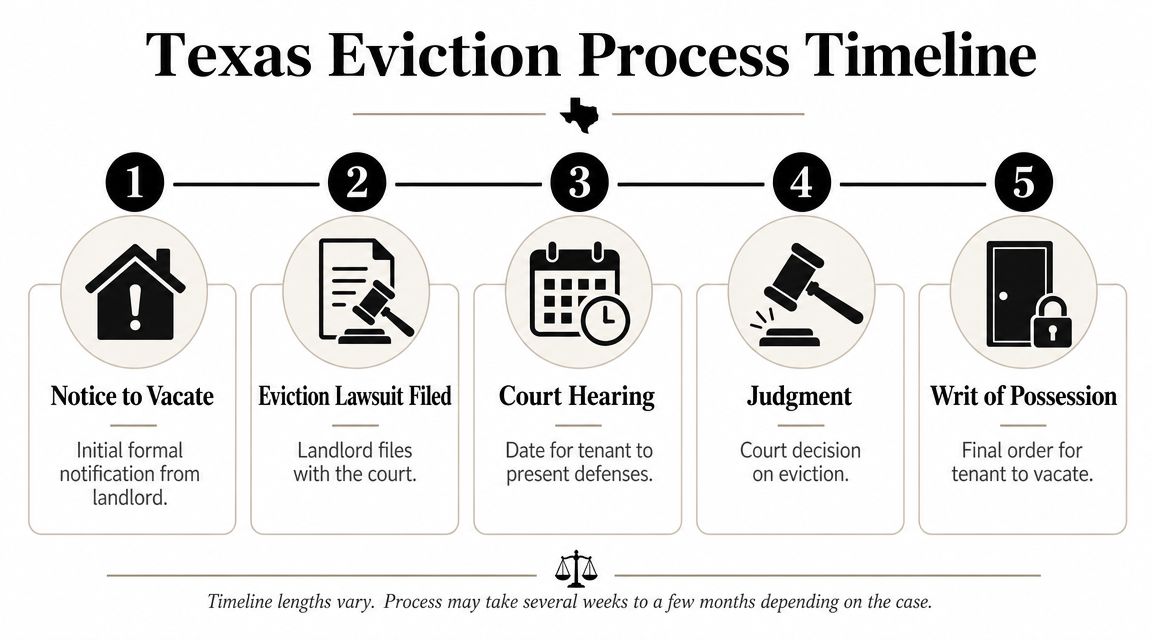
The basic sequence
Think of the eviction process as a chain. If the first link is weak, the rest of the case can fail.
| Stage | What happens | What you should check |
|---|---|---|
| Notice to Vacate | Landlord gives written notice | Date, deadline, lease language, delivery method |
| Court filing | Landlord files forcible detainer case | Was the notice period fully completed first |
| Hearing | Both sides appear in Justice Court | Do you have an Answer and evidence ready |
| Judgment | Judge decides possession issue | Were your defenses clearly raised |
| Writ stage | Removal only happens after court process | Whether the landlord actually obtained the required court order |
Why the notice matters so much
The notice to vacate isn't just a warning. It is the foundation of the landlord's case. If that foundation is defective, the landlord may have to start over.
A strong tenant review of the notice should focus on three things:
- Deadline accuracy: Did the landlord give the time required by law or by your lease?
- Written proof: Do you still have the notice, envelope, text, email, or photo of the posting?
- Sequence: Was the lawsuit filed only after the notice period ran?
Judges often focus on whether the landlord completed the required steps before asking for possession. A tenant who can prove the case started too early may stop the eviction without needing to win every other issue.
What works and what doesn't
What works is a dated paper trail. Save the notice. Save the envelope. Take a photo of where it was posted. Compare the date on the notice to the date the case was filed.
What doesn't work is walking into court saying the landlord "never really warned me" when you threw away the notice and don't know the dates.
If you're reading this defenses to eviction in texas tenant guide after receiving papers, your first move is not to panic. Your first move is to build a timeline.
Procedural Defenses That Can Stop an Eviction Early
Some eviction defenses have nothing to do with whether rent was paid. They ask a narrower question. Did the landlord follow the required procedure exactly?
In Texas eviction litigation, the landlord must prove strict compliance with the notice-to-vacate requirement before a Justice Court can grant possession. Texas Law Help explains that eviction is a forcible detainer lawsuit, the landlord can't evict without filing in Justice Court, and tenants should file an Answer to preserve defenses, as explained in Texas Law Help's eviction overview.
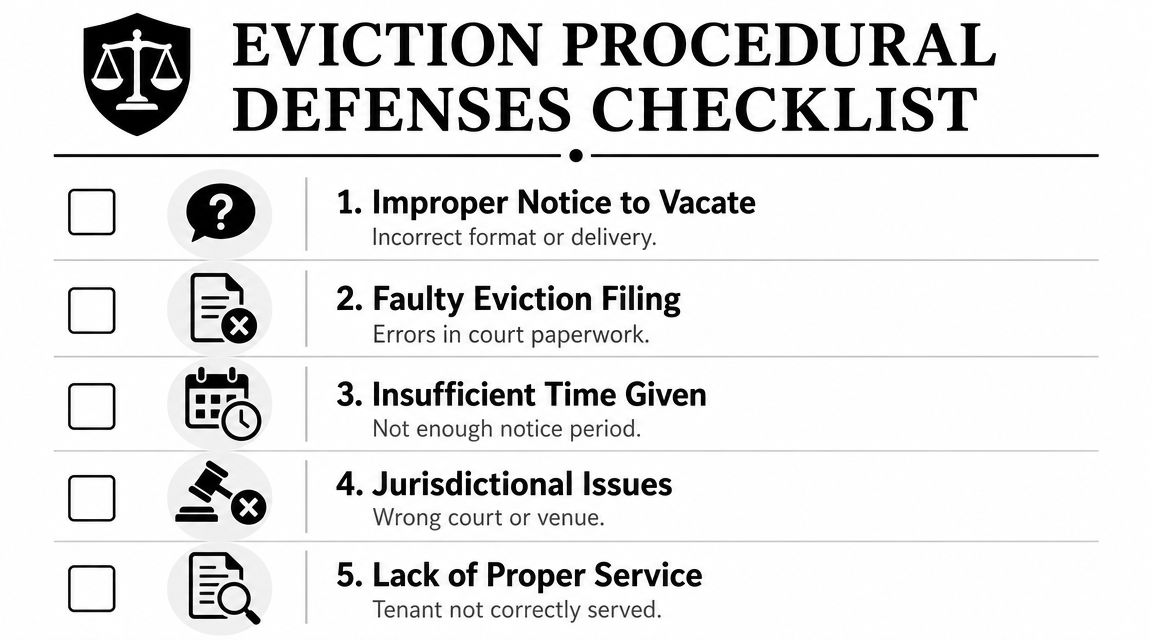
A tenant audit of the landlord's paperwork
Use this like a court-prep checklist.
- Improper notice: The notice was missing, unclear, or inconsistent with the lease.
- Insufficient time: The landlord filed before the notice period was fully completed.
- Service problems: You received the notice or lawsuit papers in a way that may not comply with the rules.
- Court filing defects: The petition names the wrong parties, wrong address, or wrong basis for possession.
- Venue concerns: The case may have been filed in the wrong Justice Court precinct.
The evidence that supports procedural defenses
Procedural defenses succeed when the tenant brings proof, not just objections.
Good evidence includes:
- Photos of posted notices
- Screenshots of texts or emails used to deliver notice
- The lease itself
- The envelope showing mailing date
- Court papers showing filing date
- A written timeline you prepared before the hearing
Here is the trade-off. Some tenants try to argue every possible defect. That can dilute a good defense. If your strongest issue is that the notice period wasn't completed, lead with that. If the service method looks questionable but you did receive the papers and had time to respond, that argument may carry less weight.
Sample Answer language for procedural defenses
You don't need fancy wording. Clear is better.
"Defendant generally denies the allegations and asserts that Plaintiff failed to comply with the notice to vacate requirements and filed this eviction case before satisfying all procedural prerequisites."
Or, if the issue is service:
"Defendant denies that Plaintiff strictly complied with the required notice and service procedures and asks that the case be denied or dismissed."
A filed Answer helps preserve defenses and signals to the court that you intend to appear. It also forces you to identify your best issues early.
Substantive Defenses Based on Your Landlord's Actions
Not every strong defense is technical. Some turn on what the landlord did before the eviction case was filed.
Retaliation is one of the clearest examples. The Texas State Law Library summarizes Texas Property Code Chapter 92 by noting that retaliation protections bar landlords from taking certain adverse actions after a tenant exercises legal rights, including seeking repairs, with remedies that can include one month's rent plus $500, actual damages, court costs, and reasonable attorney's fees, as described in the Texas State Law Library eviction guide.
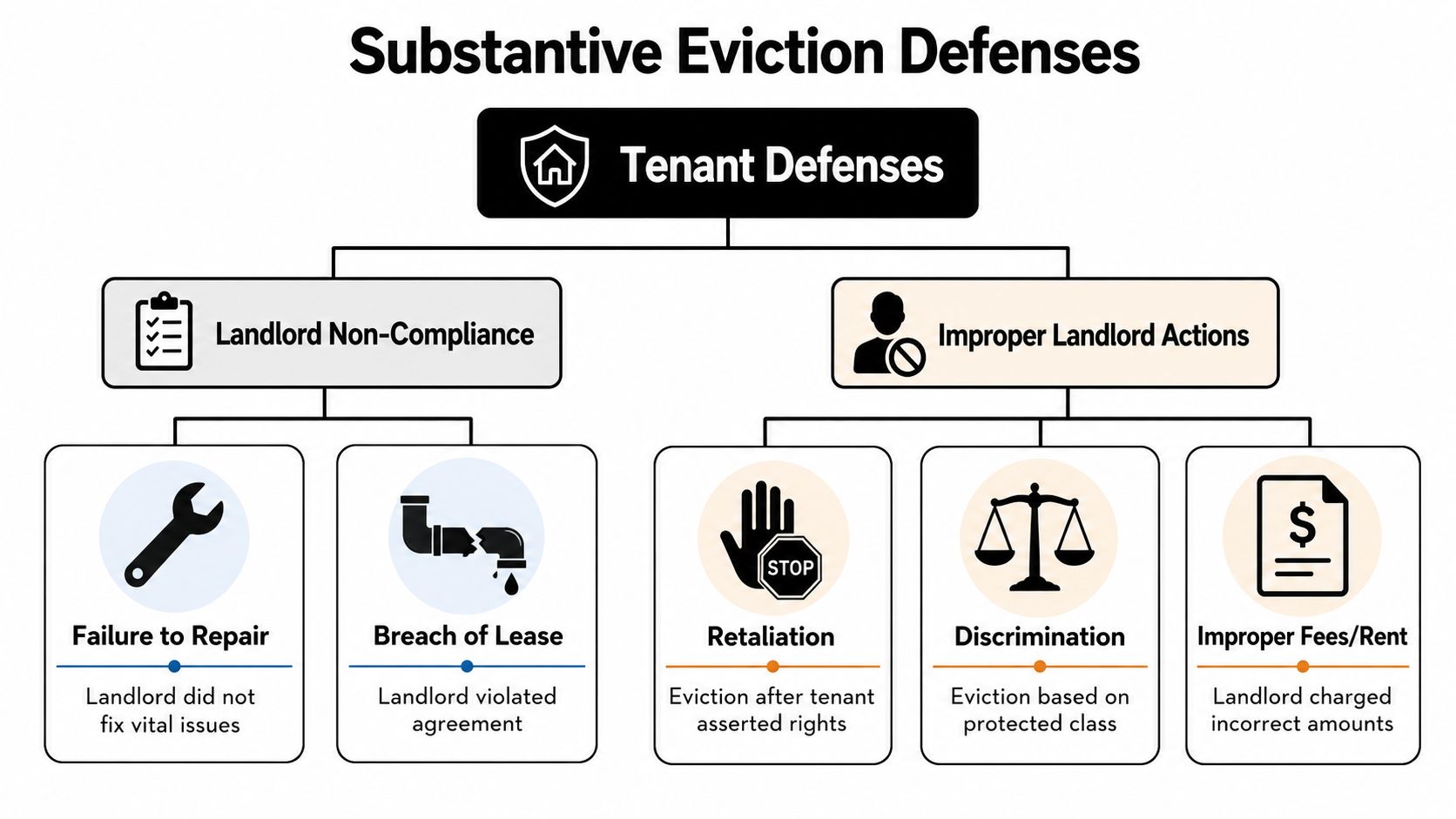
Retaliation after repair requests
If you requested repairs, complained about code issues, or exercised another protected right, and the landlord responded with an eviction move, retaliation may be part of your defense.
What helps:
- Written repair requests
- Inspection or code complaint records
- Texts acknowledging the problem
- A timeline showing the complaint came before the eviction effort
What doesn't help is relying only on oral conversations with no dates and no follow-up message.
Habitability and landlord-caused default
Some of the most misunderstood defenses involve repair issues. Tenants often assume unsafe conditions automatically excuse unpaid rent. Texas law is more careful than that.
A useful defense theory is sometimes not "I stopped paying because the place was bad." It is "the landlord failed to address serious conditions after notice, and that failure supports my defense, retaliation claim, or argument that the landlord caused my default." For tenants dealing with lockouts or pressure tactics tied to these disputes, this related guide on what tenants should do after an illegal eviction in Texas may help.
The strongest repair-based defense is usually a proof chain, not a complaint. Written notice, photos, and evidence of the unresolved condition matter more than anger in the courtroom.
Other landlord conduct that can matter
Texas justice-court materials have long recognized defenses such as waiver and lack of material breach. In plain English, waiver can arise when a landlord acts in a way that undercuts the claimed breach, and lack of material breach argues the tenant's alleged violation wasn't serious enough to justify possession.
A simple example helps. If a tenant has a lease issue but the landlord repeatedly behaved as though the tenancy was continuing without clearly enforcing the issue, that can complicate the landlord's case. Facts matter here. So does consistency.
Sample Answer language for substantive defenses
If retaliation is your issue, keep it direct:
- Retaliation defense: "Defendant asserts that this eviction is retaliatory because Defendant previously exercised protected tenant rights, including requesting repairs or reporting unsafe conditions."
- Repair-related defense: "Defendant asserts that serious repair and habitability issues were reported to Plaintiff, remained uncured, and are relevant to Plaintiff's claim for possession."
- Landlord-caused default defense: "Defendant asserts that Plaintiff's failure to address serious property conditions contributed to the alleged default."
How to Raise Your Defenses in Justice Court Step-by-Step
Knowing your rights isn't enough. You have to present them in a form the court can use.
Texas Tenant Advisor explicitly lists "Landlord caused tenant to default" as a defense, which is a practical reminder that your theory of the case must connect the landlord's conduct to the claimed lease violation, as discussed in Texas Tenant Advisor's eviction defense guide.
Step 1: File an Answer
File a written Answer with the Justice Court handling the case. Keep it simple, readable, and tied to actual facts you can prove.
A basic format can look like this:
"Defendant files this Original Answer and generally denies Plaintiff's allegations. Defendant asserts the following defenses: improper notice to vacate, retaliation, failure to repair serious conditions after notice, and landlord-caused default. Defendant requests that Plaintiff take nothing and that the Court deny possession."
If only one or two defenses apply, list only those. Broad, unsupported accusations usually don't help.
Step 2: Build a hearing packet
Your hearing packet should be organized so a judge can follow it fast.
Include:
- Lease documents
- Notice to vacate and envelope or posting photo
- Rent receipts or payment history
- Repair requests
- Photos of conditions
- Texts and emails with dates visible
- Inspection reports or estimates if you have them
- A one-page timeline
A practical next step for many tenants is reviewing a focused guide on how to fight eviction in Texas while preparing the file.
Step 3: Match each defense to one piece of proof
Often, many tenants lose the thread. They bring a stack of papers, but they don't connect each paper to an argument.
Use a simple model:
| Defense | Best proof |
|---|---|
| Improper notice | Notice copy, lease, filing date |
| Retaliation | Repair request, complaint record, timeline |
| Habitability issue | Dated photos, written notice, responses |
| Landlord caused default | Repair history plus evidence the issue affected performance |
After you've organized your documents, it helps to hear a plain-language explanation of hearing prep and tenant presentation basics:
Step 4: Speak in short, factual sentences
At the hearing, don't tell the entire history of the tenancy unless the judge asks for it. Start with the defense that can decide the case fastest.
Try language like this:
- On notice: "Your Honor, my first defense is that the notice did not comply with the required timeline."
- On retaliation: "I requested repairs before the eviction effort began, and I brought those written requests."
- On conditions: "These photos and messages show the condition was reported and not cured."
Bring the judge to the paper. "This is Exhibit 2, the repair text I sent before the notice." That is more effective than arguing in general terms.
Step 5: Ask clearly for the result you want
At the end, say what you're asking the court to do.
Examples:
- Dismiss or deny possession
- Reset the case if service or notice issues need clarification
- Consider your counterclaims or defenses based on the landlord's conduct
If you can afford help, this is also the point where legal counsel can change the outcome. A Texas landlord tenant lawyer or eviction attorney can help frame defenses cleanly, prepare exhibits, and avoid admissions that weaken your case. The Law Office of Bryan Fagan, PLLC handles Texas landlord-tenant disputes, including eviction defense, lease disputes, and repair-related claims.
Filing Counterclaims Turning the Tables on Your Landlord
Many tenants defend an eviction as if the only question is whether they can stay. Sometimes the better question is whether the landlord created legal exposure by how they handled the tenancy.
A Texas tenant who qualifies under the statutory repair scheme may terminate the lease, repair and deduct in limited circumstances, or seek judicial remedies. At the same time, tenants are prohibited from unilaterally withholding rent, as explained in the Texas Real Estate Research Center landlord and tenant guide. That distinction matters. Counterclaims work best when they are grounded in the statute and supported by written notice.
When a counterclaim makes sense
Counterclaims can be worth considering when the landlord's conduct is part of the dispute itself.
Examples include:
- Repair-related damages: You gave proper notice of serious conditions and the landlord failed to cure.
- Retaliatory conduct: The eviction followed protected tenant activity.
- Wrongful lockout or interference issues: The landlord used pressure tactics outside the court process.
- Security deposit or property-related claims: The eviction case overlaps with other financial disputes.
What works versus what fails
What works is a focused claim tied to documents. If the landlord ignored written repair requests, keep the claim centered on those requests, the conditions, and the harm tied to them.
What fails is using a counterclaim as a way to vent about every unpleasant interaction. Judges sort quickly between legal claims and general frustration.
A counterclaim changes leverage when the landlord expected a simple possession case and instead has to answer for repairs, retaliation, or other violations supported by records.
A practical way to think about counterclaims
Ask three questions:
- Did the landlord violate a legal duty?
- Can I prove notice and their failure to act?
- Does the evidence fit within the court's process clearly enough to present it now?
If the answer is yes, a defensive posture may leave value on the table. In the right case, going on offense is the better strategy.
After the Verdict What to Do Next and When to Get Help
The hearing isn't always the end of the matter. What you do next depends on whether you won, lost, or got a result that only partially addressed the problem.
If you win possession, keep copies of the judgment and confirm the case status with the court. If the landlord later claims you were ordered out when you were not, court paperwork becomes your protection. Also keep paying attention to lease obligations unless the tenancy is ending for another reason.
If you lose in Justice Court
A loss doesn't always mean you should give up. You may have appeal options, and fast action matters.
Use a short post-hearing checklist:
- Read the judgment carefully: Make sure you understand what the court ordered.
- Get the deadline immediately: Ask the clerk what filing steps apply if you want to appeal.
- Preserve your file: Keep every exhibit, text, photo, and copy of the judgment together.
- Get advice quickly: Appeal issues move fast, and waiting can close off options.
If you win but the relationship is broken
Winning an eviction case doesn't always repair the tenancy. Some landlord-tenant relationships are too damaged to continue smoothly.
In that situation, think practically:
| If this happened | Consider this next step |
|---|---|
| You won on notice or procedure | Expect the landlord may try again with corrected paperwork |
| You won on retaliation or repairs | Preserve records in case the conflict continues |
| The unit remains unsafe | Consider legal advice about repairs, termination, or other remedies |
When self-representation becomes risky
Some tenants can handle a straightforward notice defense on their own. Others shouldn't.
You should strongly consider talking to an eviction attorney if:
- Your defense involves retaliation
- Repairs and habitability are central
- The landlord's conduct may support a counterclaim
- There are multiple notices, amended pleadings, or conflicting dates
- You feel confused about what to say in court
A calm, organized presentation can help. But when the case turns on the Texas Property Code, tenant rights, repair remedies, or procedural traps, legal help often becomes the safer choice.
If you need help with an eviction, lease issue, or rental dispute, contact The Law Office of Bryan Fagan, PLLC for a free consultation today. A Texas landlord tenant lawyer can review your notice, identify defenses, help prepare your Justice Court Answer, and advise you on whether to raise counterclaims, appeal, or negotiate a better resolution.