Opening your appraisal notice and seeing a number that feels too high can make your stomach drop. If you own a home, it looks like a bigger tax bill. If you own rental property, it can squeeze cash flow, complicate lease decisions, and add pressure when you’re already dealing with repairs, vacancies, or tenant complaints.
Texas law gives you a way to challenge that value. That process matters because you usually can’t protest the tax rate itself. You can, however, contest the appraised value that drives your bill. For many owners, that is where real relief happens.
This is also where property tax issues overlap with landlord-tenant law more than most guides admit. A landlord dealing with deferred maintenance, habitability complaints, or disputed repair conditions may already have records that help prove the property is worth less than the appraisal district assumes. Tenants have an interest too, especially when rising operating costs can affect rent, renewals, or property upkeep.
Your Guide to Contesting Texas Property Taxes
The first thing to understand is simple. A high appraisal notice is not a final verdict. It is a notice of value, and Texas gives property owners the right to challenge it through a formal protest.
That right is useful only if you act on time. Missing the deadline is one of the most common and costly mistakes. Owners often set the notice aside for a few days, meaning to come back to it later, and then realize the filing window has nearly closed.
Start with the notice, not the tax bill
When clients ask how to contest property taxes in Texas, the answer starts with the appraisal notice itself. Read it carefully. Focus on the stated value, the mailing date, and any instructions for filing a protest. Those details control your next move.
If this is your primary residence, don’t confuse a protest with an exemption. A protest challenges value. An exemption lowers taxable value based on eligibility. If you still need to review that side of the process, this guide to the Texas homestead exemption form is a useful companion.
Practical rule: File first, refine later. If you think the value may be wrong, protect your deadline before you perfect your evidence.
Why this matters for landlords and tenants
For a homeowner, the issue is straightforward. For a landlord, the stakes spread across the whole property. A bloated appraisal can affect operating decisions, negotiations with tenants, and how quickly repairs get done. If a building has real condition problems, the appraisal district may be valuing it as though those problems don’t exist.
That’s why a careful protest can do more than lower taxes. It can line up the legal record with the property’s actual condition. In rental property disputes, that can matter.
Decoding Your Appraisal Notice and Critical Deadlines
The appraisal notice is the most important piece of paper in the process. It tells you what the county appraisal district thinks your property was worth for tax purposes, and it starts the clock on your protest rights.

Under Texas law, property owners have a statewide right to protest their appraisals each year by filing a Notice of Protest (Form 50-132) with the Appraisal Review Board, and the deadline is May 15 or 30 days after receiving the appraisal notice, whichever is later, under Texas Tax Code Section 41.41, as described in this Texas property tax protest overview.
What to look for on the notice
Most owners immediately look at the number and stop there. Read more carefully. The notice usually gives you the value being assigned to the property, identifies the property, and tells you how to protest.
Pay attention to these parts:
- The property description. Make sure the district is valuing the correct property.
- The appraised value. This is the figure you may challenge.
- The mailing or notice date. This date affects your deadline.
- Protest instructions. Many districts list filing options and required forms.
For practical purposes, your protest usually targets the district’s value conclusion. That value is what drives the eventual tax bill.
Market value and equal treatment
Most protests fit into one or both of these ideas:
| Ground | What it means | When it fits |
|---|---|---|
| Market value | The district valued your property above what it would realistically sell for | Your comps, condition, or repairs show the number is too high |
| Equal and uniform value | Your property is valued unfairly compared with similar properties | Similar nearby properties are assessed lower in a way that isn’t justified |
A homeowner might use market value when comparable homes sold lower after adjusting for differences like square footage, age, or features. A landlord might use market value and also argue that the district ignored deferred maintenance, vacancy pressure, or actual property condition.
Don’t let the deadline slip
The filing deadline is firm. If you miss it, you can lose your ordinary right to protest that year’s value. In practice, that means owners should calendar the date the same day the notice arrives.
A simple routine helps:
- Save the envelope or electronic notice record.
- Write down the date you received it.
- Count the deadline immediately.
- File before you finish gathering every piece of evidence.
If you're close to the deadline, submit Form 50-132 first and build the full file after. Losing a strong case on a timing mistake is avoidable.
Filling out Form 50-132 strategically
Many owners overthink the form. The better approach is to be prompt and clear.
When you fill out the protest form:
- Identify the property exactly as listed.
- Select the grounds that fit your case.
- If both market value and unequal appraisal may apply, preserve both.
- Keep a copy of everything you submit.
For landlords, this is also where caution matters with online filing. Portals are convenient, but they aren’t built for every ownership structure. A co-owned rental, inherited property, or multi-owner investment property may trigger filing problems that don’t affect a single-owner homestead.
This short overview gives a useful visual sense of the protest process before you prepare your file:
What the notice doesn’t mean
The notice does not mean you must accept the number. It also does not mean the district has accounted for every issue affecting value. Appraisal districts work at scale. They may not know about roof problems, interior damage, long-delayed repairs, or design issues that reduce what a real buyer would pay.
That gap is where a good protest lives.
How to File Your Protest Form and Choose Your Grounds
A landlord gets the appraisal notice on Monday, opens the county portal that night, and assumes the filing will take five minutes. Then the portal rejects the submission because title is still held in two siblings’ names, the property manager is not authorized to sign, or the parcel is tied to a small LLC with incomplete records. By the time that gets sorted out, the deadline is close.
That problem is common with rentals. Filing the protest itself is not usually the hard part. Filing it in a way that preserves every argument and avoids an ownership or authority dispute is what matters.

Pick the filing method that creates the cleanest record
Texas owners usually protest online, by mail, or in person. For a single-owner home, online filing is often fine. For a rental property, the better question is whether the filing method will accurately reflect the ownership and the person submitting it.
Manual filing is often the safer choice if the property is:
- co-owned
- inherited and not fully sorted out in the deed records
- held in an LLC, partnership, or trust
- managed by someone other than the titled owner
- part of a portfolio with inconsistent county records
Speed is not the only concern. A clean paper trail matters more than convenience if the district later questions whether the protest was timely or properly filed.
If you mail the protest, use certified mail and keep the receipt and full copy of the packet. If you deliver it by hand, get a stamped receipt. If an accountant is helping organize numbers for an income-producing property, coordinate early so the filing and supporting records line up. Many rental owners also work with Tax Accountants before the hearing because income figures, expense treatment, and entity records often affect how the case is presented.
Choose protest grounds with your evidence in mind
Owners often rush through the checkboxes. That is a mistake. The grounds you select shape the case you can make later.
Market value
Choose market value when the appraisal district placed the property above what a typical buyer would have paid for it on January 1, given its actual condition and limitations.
This ground is usually strong when the property has deferred maintenance, functional problems, or rental issues that drag value down in practice, such as:
- roof leaks or water intrusion
- foundation movement
- outdated interiors
- failed HVAC systems
- vacancy tied to unresolved repair conditions
- tenant complaints that reflect physical defects, not management preference
For landlords, lease and repair records can be especially useful. Repeated written notices about mold, plumbing failures, broken windows, or uninhabitable conditions may support a lower value if those records match the property’s actual condition.
Equal and uniform value
Choose equal and uniform when similar properties are appraised lower than yours without a sound reason. This ground can help even when sales evidence is thin.
In practice, I often see this argument matter for small rental properties in older neighborhoods. Two duplexes may have similar age, size, and condition, yet one carries a noticeably higher assessed value. That kind of mismatch deserves attention, especially if the owner has been dealing with the same repair burdens as neighboring landlords.
Use both when both fit
Many owners should select both grounds if the facts support both. There is little advantage in limiting the protest too early. A rental can be overvalued because of condition issues and still assessed less uniformly than nearby properties.
Rental properties bring an extra layer of strategy
A homeowner usually protests based on condition and comparable sales. A landlord often has another set of documents that can help or hurt.
For example, if tenants have complained for months about water damage and the landlord’s own maintenance file shows delayed repairs, those records may support a lower market value. But they can also expose a habitability or lease-performance problem if the property owner has not handled repairs properly. That is the trade-off. Use honest records, organize them carefully, and do not submit documents you have not reviewed for consistency.
The same point applies to vacancy. Vacancy alone does not prove overvaluation. Vacancy tied to documented physical problems, rent concessions, or lease terminations connected to condition can be much more persuasive.
A practical filing checklist
Before submitting the protest, confirm these points:
| Item | Why it matters |
|---|---|
| Correct owner name | Name mismatches can delay the file or create questions about authority |
| Property ID matches the notice | Prevents a protest from being attached to the wrong parcel |
| Grounds are checked clearly | Preserves the arguments you may want to use later |
| Submission proof is saved | Helps if the district disputes whether the protest was received |
| Signer has authority | Matters for rentals owned by multiple people, entities, or trusts |
If ownership is messy, deal with that early. Inherited rentals, family-owned houses, and small investment properties often run into preventable problems because the person filing cannot clearly show authority to act. Owners in that position should review what documents actually prove title or control. This guide on documents that can establish proof of ownership in Texas is a useful starting point.
Building a Winning Case with the Right Evidence
A landlord usually decides whether to protest after opening the appraisal notice and seeing a value that assumes a cleaner property than the one tenants live in. The roof has active leaks. Two units are offline. Rent was discounted to keep a tenant from leaving over repairs. None of that matters unless it is documented in a way the appraisal district and ARB can follow.
The strongest protest files show the property as it stood on the relevant date, not as the owner hoped it would perform after repairs or lease-up. For rental property, that often means pairing traditional valuation evidence with landlord-tenant records that owners tend to overlook.
What evidence usually carries the most weight
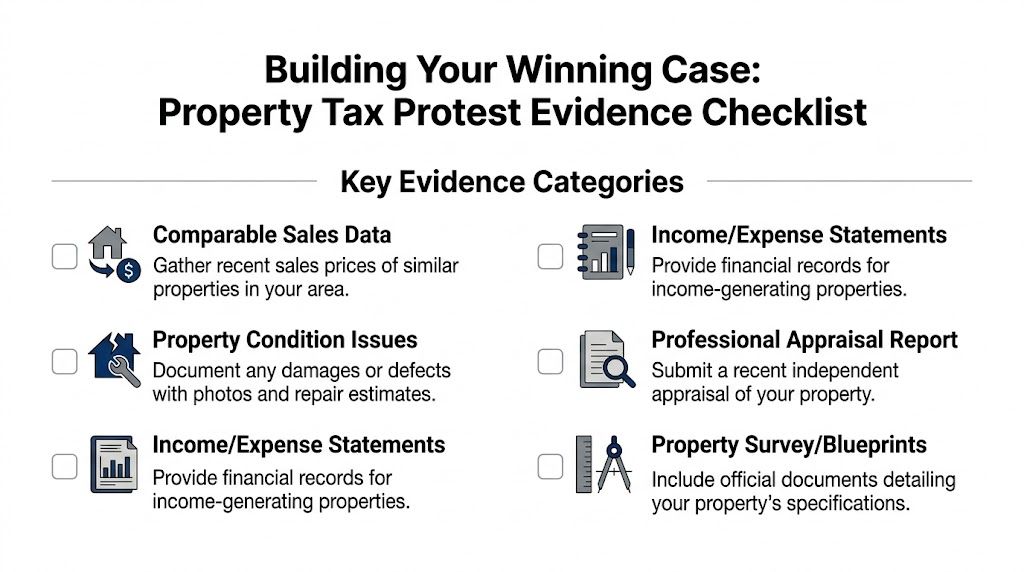
A persuasive file often includes several categories of proof working together:
- Comparable sales that are similar in age, size, location, and condition
- Photos and repair records that show deferred maintenance, damage, or incomplete renovations
- Rent rolls and lease records showing concessions, vacancy, nonrenewals, or units taken out of service
- Income and expense statements that reflect the property’s real performance
- Surveys, floor plans, or county records if the district relied on incorrect physical characteristics
- Independent appraisal support when the value gap is large enough to justify the cost
For owners managing several rentals, clean books matter. A directory of Tax Accountants can help organize income, expense, and rent records before the hearing if your case depends on operating history.
Comparable sales only help if you explain the differences
A sale down the street is not enough by itself. The district may already have better raw sales data than you do. What often changes the result is the adjustment analysis.
If a nearby property sold at a higher price because it had updated interiors, fewer deferred maintenance issues, or stronger occupancy, say that plainly and back it up. If your property is smaller, older, functionally inferior, or burdened by repairs that affect rentability, connect those facts to value. Owners lose good protest points by dropping sales sheets into the packet without explaining why those sales support a lower number.
Rental records can be stronger than owners expect
Landlords often focus on repair invoices and forget the documents generated through day-to-day management. Those records can be persuasive because they were created in the ordinary course of business, often before anyone started preparing for a protest.
Useful examples include:
- tenant repair requests
- notices about leaks, mold, HVAC failure, or plumbing backups
- move-in and move-out photos
- contractor bids tied to specific units or building systems
- lease amendments granting rent concessions
- emails about units being offline, hard to show, or hard to renew
- inspection reports and code-related notices
These documents matter for a simple reason. They help prove the gap between the district’s assumptions and the property’s actual condition and income.
That is especially important for landlords. A repair problem can affect more than maintenance cost. It can lead to shorter tenancies, rent reductions, skipped renewals, and disputes over lease obligations. Those are landlord-tenant issues, but they are also valuation facts if they existed on the relevant appraisal date.
Use landlord-tenant disputes carefully
This is one of the biggest trade-offs I see in rental protests. Records about habitability complaints, delayed repairs, or lease disputes can support a lower value. The same records can also expose management problems if they are incomplete, inconsistent, or worse than the owner realized.
Use them anyway if they are honest and material. Just organize them with care.
A good presentation does not argue, "My tenants were unhappy, so my taxes should drop." A better presentation shows that documented repair issues affected occupancy, concessions, and the market value a buyer would assign to the property in its actual state. That is a valuation argument.
A practical way to assemble the file
Start with a target value and build backward. Then group the evidence into three folders or sections:
- Value support. Comparable sales, prior appraisals, corrected property data.
- Condition support. Photos, bids, invoices, inspection notes, unit-level repair history.
- Income support. Rent roll, vacancy history, concessions, lease terminations, and statements showing reduced performance.
Within each section, sort documents by date and label them clearly. Undated photos, partial email chains, and random invoices tend to frustrate boards because no one can tell what they prove or when.
Evidence that often falls flat
Some items rarely move the value dispute very far:
| Weak evidence | Why it usually fails |
|---|---|
| General complaints that taxes keep rising | The issue is the property’s value, not the tax burden in the abstract |
| Repair estimates with no photos or context | The board may not know whether the work was cosmetic, deferred, or already completed |
| Vacancy by itself | Empty units do not prove overvaluation unless you tie them to condition, concessions, or marketability problems |
| A stack of leases with no summary | Raw documents are less useful than a short rent roll or timeline that explains the pattern |
One more point often gets missed. If title, entity authority, or inherited ownership is still unclear, fix that before the hearing file is finalized. The board is far more likely to stay focused on value if there is no side dispute about who has authority to present the case. If needed, review documents that help prove ownership in Texas and get those records in order before you rely on the rest of your evidence.
Navigating Your Appraisal Review Board Hearing
A common Texas landlord problem looks like this. The appraisal district values a small rental property as if every unit is in average condition and fully marketable, but two units have been tied up by repair complaints, rent concessions, or early move-outs. At the ARB hearing, the board is not deciding who was right in the repair dispute. It is deciding value. The owner who connects those tenancy problems to market value usually does far better than the owner who says, “my taxes are too high.”

What the hearing usually looks like
ARB hearings are formal enough to make people nervous, but they are still value hearings, not full court trials. Board members often hear many protests in one session. They respond best to a short, orderly presentation that ties documents to a specific requested value.
Start with the number you want. Then explain the two or three facts that support it.
A simple opening works:
“I am requesting a value of $___ because the district’s figure does not account for this property’s condition, rent loss, and the comparable properties I submitted.”
That approach keeps the discussion where it belongs.
How to present your case without getting sidetracked
A good hearing presentation usually follows a clean sequence:
- State your requested value.
- Identify the main reason the district overstated value.
- Walk the board through your best exhibits.
- Answer questions briefly and directly.
- End by restating the requested value.
Owners lose ground when they try to argue every grievance tied to the property. If a tenant withheld rent over habitability complaints, or if you gave concessions because a roof leak or HVAC issue lingered, those facts matter only if you show how they affected income, occupancy, condition, or marketability on January 1.
That distinction matters a lot for landlords. The ARB is not there to enforce your lease, resolve a security deposit fight, or decide whether a tenant’s notice was proper. It will listen if those disputes help explain lower rent, deferred maintenance, abnormal turnover, or reduced appeal to buyers.
Ways to appear and the trade-offs
Texas owners may be able to appear in person, through a representative, or by affidavit. The best option depends on how fact-heavy the case is and whether someone needs to answer follow-up questions in real time.
| Option | Advantage | Limitation |
|---|---|---|
| In person | You can explain records, answer questions, and correct misunderstandings on the spot | Takes time and preparation |
| Representative | Useful for technical valuation disputes, multiple parcels, or cases tangled up with lease and repair issues | Requires signed authority and coordination |
| Affidavit | Practical if attendance is difficult | No opportunity to respond if the panel focuses on a weak point |
Affidavit hearings can work for straightforward cases. They are less effective when the district may challenge your repair timeline, rent loss, or the connection between tenant complaints and value. In those cases, live testimony often helps.
If the hearing involves mixed issues, such as deferred maintenance, contested lease obligations, or whether rent levels were depressed by unresolved habitability problems, getting help from a Texas property tax protest lawyer near you can save real trouble.
Questions that help the board focus on weak spots in the district's case
Keep questions short and factual. Long speeches usually blur the point.
Useful examples include:
- Are these comparable properties in similar condition on the valuation date?
- Did the district account for the units affected by documented repair problems?
- Were the compared properties renovated or updated when mine was not?
- Does this valuation reflect the concessions, vacancy, or nonrenewals shown in my records?
- If this is an income-producing property, what market rent assumption was used, and how does it account for the lease issues in my file?
Those questions do one job. They show the board where the appraisal district may be using assumptions that do not fit your property.
What a realistic hearing can accomplish
A well-prepared hearing can reduce an inflated value. Results vary by county, property type, and the quality of the evidence. There is no dependable percentage reduction to expect in every case, and owners should be cautious about anyone promising a specific outcome.
The better measure is whether your proof is credible and tied to value. For landlords, that often means showing that repair disputes, concessions, vacancy, or below-market renewals were not temporary inconveniences. They affected what the property could earn and how the market would view it.
If the result is disappointing
Some owners walk out with only a small reduction, or none at all. That does not always mean the case was weak. Sometimes the evidence was good but too compressed, the presentation drifted into tenant conflict instead of valuation, or the district’s file went unanswered on one key point.
At that stage, the decision becomes practical. Is the amount in dispute large enough to justify more cost and effort? For higher-value properties, multi-unit rentals, or cases where lease terms and repair history directly affect valuation, professional help often makes more sense after the hearing than before it.
After the ARB What to Do If You Disagree with the Decision
If the ARB denies your protest or gives only a modest reduction, you still may have options. The key is to move quickly and preserve your rights.
Under the Texas protest process, post-ARB appeals can include binding arbitration or district court, and owners generally must act within 60 days. Binding arbitration involves deposits ranging from $450-$1,550 based on property value, and owners must pay taxes on the undisputed portion on time to keep the appeal viable. Those rules are discussed in the earlier-cited Texas property tax authorities.
Binding arbitration versus district court
These two paths are not interchangeable. They differ in cost, complexity, and how much professional support you’ll likely need.
| Appeal path | Best fit | Main trade-off |
|---|---|---|
| Binding arbitration | Owners who want a more contained process after ARB | You must make the required deposit and prepare a focused valuation case |
| District court | Larger or more complicated disputes | Higher complexity, more procedure, and greater need for legal strategy |
Arbitration is often easier to understand. District court can be appropriate when the stakes justify formal litigation, but it is not usually the place to improvise.
A limited correction option
Texas law also allows a motion for correction in some situations involving a residence homestead that was overappraised by at least one-fourth (25%) above the correct value, if the owner meets the statutory conditions. That remedy is narrower than a standard protest and doesn’t replace timely filing when an ordinary protest is available. It is best treated as a targeted fix for major errors, not a fallback plan for missed deadlines.
Questions owners usually ask at this stage
Do I have to pay anything while appealing?
Yes. Owners generally need to pay the undisputed portion on time to avoid damaging the appeal.
Should I handle the appeal myself?
Sometimes, but not always. If the value gap is modest and the facts are simple, self-representation may be manageable. If the property is commercial, multi-unit, co-owned, or tied to lease disputes, professional help often becomes the more careful choice.
Where can I find local help if the case is getting more serious?
If you’re looking for legal support, reviewing your options with Texas property lawyers near you can help you decide whether the case belongs in arbitration, court, or a broader property dispute strategy.
The post-ARB stage is where deadlines and procedure become less forgiving. Owners who were comfortable handling the informal phase sometimes discover the next step is a different kind of case.
Frequently Asked Questions for Texas Property Owners
Can a tenant protest property taxes in Texas
Usually, the property owner is the party with the direct right to protest the appraisal. A tenant may still have a practical stake, especially in commercial settings or where lease terms pass through tax costs. In some situations, interested-party or agent arrangements may matter, but the owner’s filing rights remain central.
If I win, is my value frozen
No. A successful protest helps for that tax year, but property values can be reviewed again. Texas owners should expect to evaluate each new notice on its own facts rather than assume a past result controls the future.
Will protesting every year trigger an audit or inspection
Owners often worry about this, but the better question is whether the record supports the protest. Filing a protest is part of the legal process Texas provides. The stronger concern is accuracy and documentation, not fear of using your rights.
What is the difference between a homestead exemption and a protest
A homestead exemption and a protest do different jobs. An exemption reduces taxable value if you qualify. A protest challenges the appraisal district’s value opinion. A homeowner may need one, the other, or both.
What if my rental property has major repair issues
That may help your protest if the problems are documented. Repair logs, photos, contractor bids, and tenant communications can help show the property was worth less than the district assumed. Those same records may also matter under the Texas Property Code in a landlord-tenant dispute, especially where condition and habitability are already in issue.
Do I need an eviction attorney or Texas landlord tenant lawyer for a tax protest
Not always for a simple protest. But if the property tax issue overlaps with tenant rights, repair disputes, lease enforcement, or broader property litigation, speaking with a Texas landlord tenant lawyer or eviction attorney can help you avoid making one problem worse while trying to solve another.
If you need help with a property tax dispute that overlaps with repairs, lease terms, habitability issues, tenant rights, or other Texas Property Code concerns, contact The Law Office of Bryan Fagan, PLLC for a free consultation today.