Dealing with rising property taxes in Texas can be stressful — but understanding your rights under Texas law can make all the difference. You work hard to afford your home, and one of the most powerful tools available to reduce your tax burden is the Texas homestead exemption.
Filing this one form is a straightforward, essential step to slash your property tax bill. It’s not a loophole—it’s a right guaranteed to every Texas homeowner under the Texas Property Code. But if you don’t claim it, you’re leaving money on the table. This guide will walk you through the process step-by-step, providing clear, practical guidance to help you secure the savings you deserve.
Secure Your Home, Protect Your Wallet
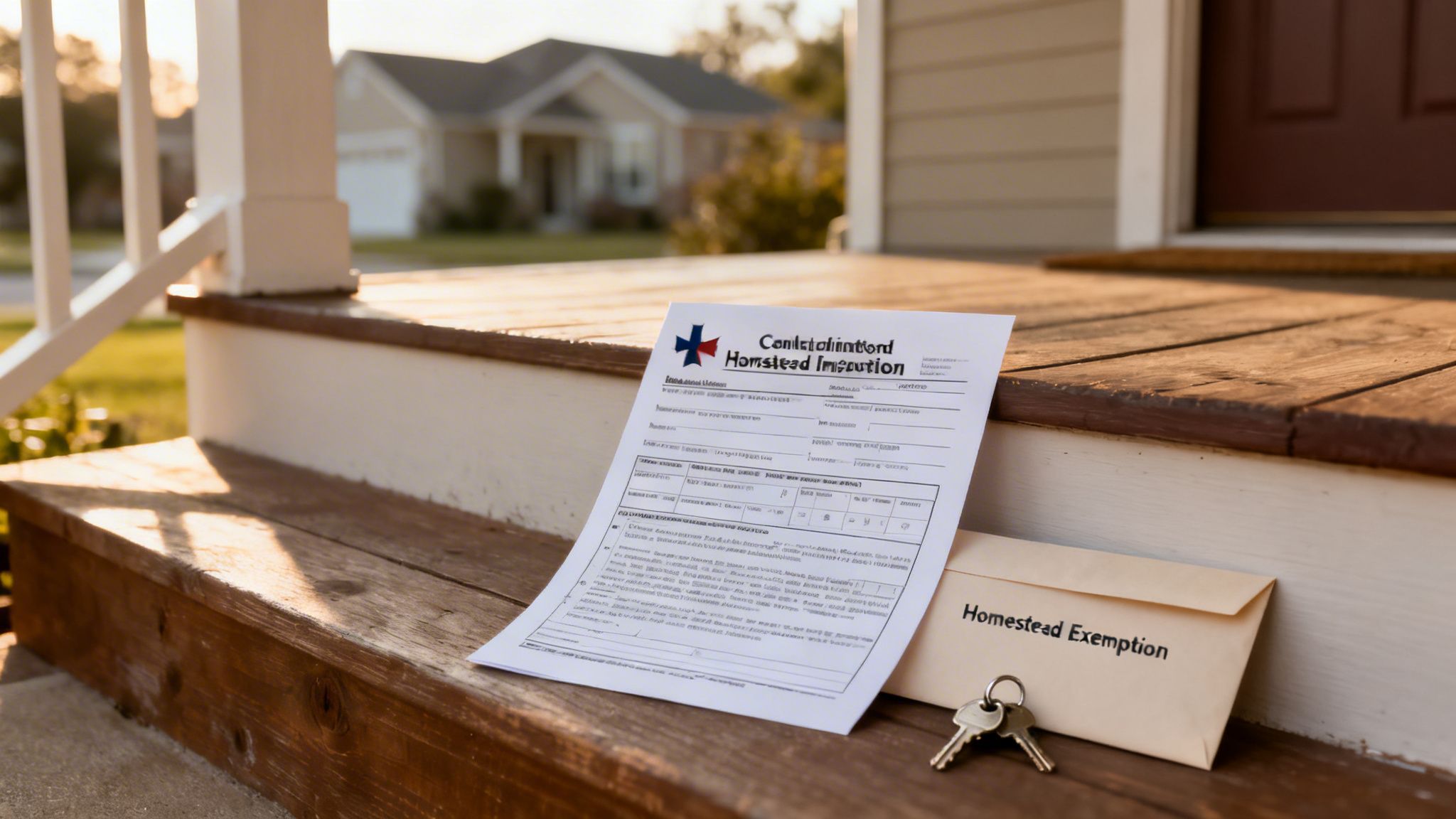
In Texas, your home isn’t just an investment; it’s your family's foundation. The homestead exemption is designed specifically to protect that foundation from crushing tax burdens and help you keep your home affordable.
It doesn’t matter if you’re in a hot market like Austin or a quiet suburb. When property values go up, so do your taxes. The homestead exemption gives you a much-needed break by lowering your home's taxable value, making it a critical tool for every homeowner.
So, How Much Can You Actually Save?
Think of it as a discount applied to your home's value before the tax rate hits. The state requires every school district to offer a $100,000 exemption.
Real-World Scenario: If your home is appraised at $400,000, your school taxes are only calculated on $300,000 of that value. That’s a huge chunk of savings right there. Many cities, counties, and special districts offer their own additional exemptions on top of that, further reducing your bill.
This isn’t just about filling out a form; it's about exercising your rights as a Texas homeowner. Protecting your home can take many forms, from lowering taxes to defending against claims that could threaten your ownership. If you're facing liens from creditors, it’s critical to understand how they impact your property rights. You can learn more in our guide to the Texas Abstract of Judgment.
Key Takeaway: Your homestead exemption isn't automatic. You have to apply for it with your county appraisal district. If you don't file, you're missing out on significant savings every single year.
More Than Just a Yearly Discount
A smart financial strategy means looking at the big picture of homeownership. Beyond cutting your annual property taxes, it's wise to plan for what happens down the road. That includes understanding capital gains tax on home sale for when you eventually decide to sell. Being informed on all fronts is the best way to protect your investment.
This guide is designed to walk you through the entire homestead exemption process, step-by-step. We'll cut through the jargon and give you the clear, actionable advice you need to complete the form and claim the savings you’re entitled to under Texas law.
What the Texas Property Code Says About Eligibility
Before you touch a single form, let's talk about what really matters: making sure you actually qualify. The rules for a Texas homestead exemption are straightforward, but they are also non-negotiable. Getting this right from the start is the difference between a smooth process and a rejected application.
At its core, a homestead in Texas is simply your main home—the one you own and actually live in. You can’t claim this tax break on a vacation house, a rental property, or any other second home. The state is crystal clear on this point: the exemption is only for your principal residence.
The Two Golden Rules of Eligibility
To get the general residential homestead exemption, you have to meet two core requirements under the Texas Property Code. There are no exceptions.
- You must own the property. Your name has to be on the deed. Simple as that.
- You must use it as your principal residence as of January 1 of the tax year you're applying for.
That January 1 date is everything. For example, if you bought and moved into your new home in Houston in October 2025, you are eligible to apply for the exemption for the 2026 tax year. But if you bought that same house in February 2026, you missed the cutoff. You’ll have to wait until January 1, 2027, to become eligible.
How to Prove Your "Principal Residence" to the Appraisal District
So, how do you prove it's your main home? The appraisal district isn't just going to take your word for it. They need proof. The single most important document is your Texas driver's license or state-issued ID.
Crucial Tip: The address on your driver's license or ID must exactly match the address of the property you're claiming the exemption for. If it doesn't match, your application will be denied.
If you just moved, make updating your address with the Texas Department of Public Safety your top priority. You literally cannot complete the homestead application without it. Think of it as the key that unlocks thousands in tax savings.
What if I Own Other Properties?
This is a question we get all the time. Owning other real estate doesn't automatically disqualify you, but there's a huge catch: you can only claim the homestead exemption on one property—your primary home. Trying to claim exemptions on multiple properties in Texas can lead to fines and legal trouble.
For a deeper look into the powerful legal protections this status offers, you can explore our complete guide on Texas homestead laws. An experienced Texas landlord tenant lawyer can also help clarify these complex rules. Once you’ve confirmed you're eligible, it’s time to gather your documents and tackle the form itself.
Step-by-Step Guide to Filling Out the Homestead Exemption Form
That stack of paperwork that comes with a new house can feel overwhelming. But one document stands out as your ticket to serious property tax savings: the Residential Homestead Exemption Application, also known as Form 50-114.
It might look like just another government form, but don't be intimidated. Getting this right is one of the smartest financial moves a Texas homeowner can make. Let's walk through it, section by section, so you can file with confidence.
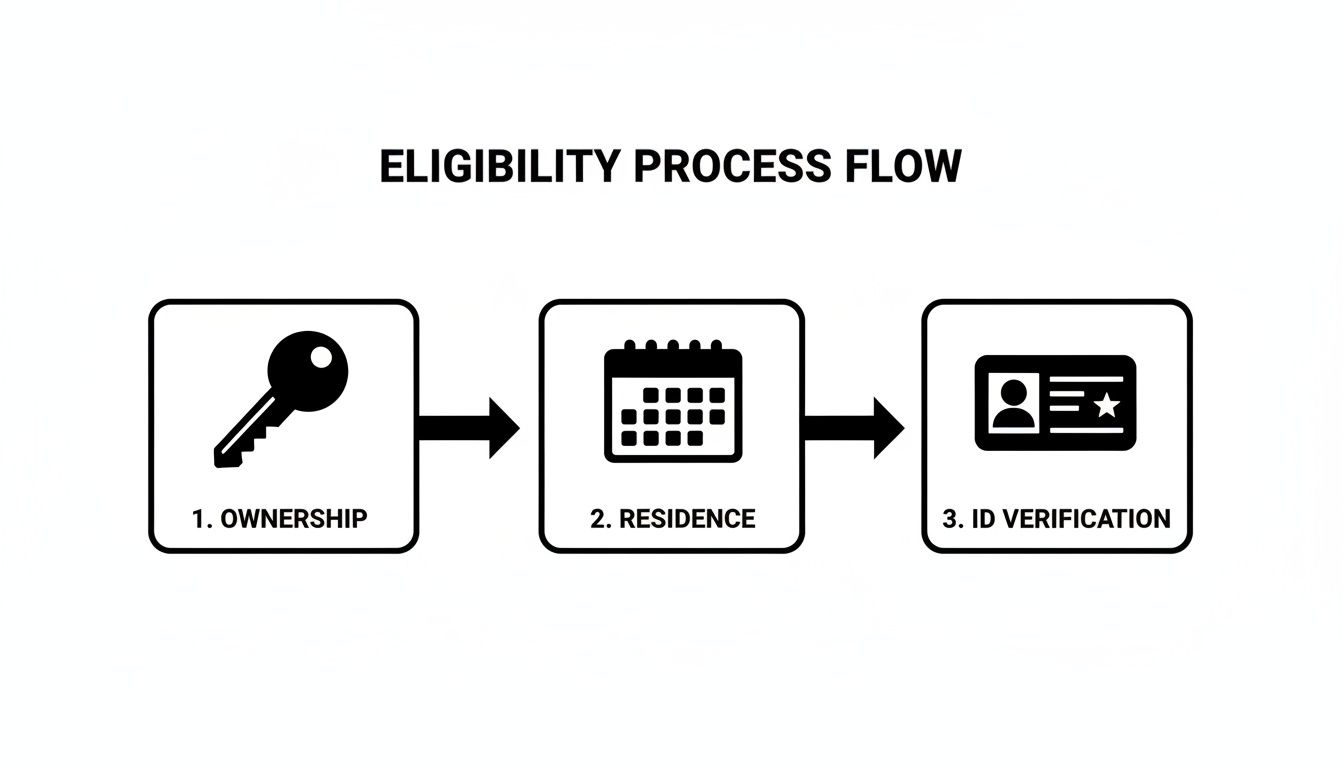
Simply put: you have to own the home, you have to live in it as your main residence, and your Texas ID has to prove it. Before you even start filling out boxes, gathering the right documents will save you a world of headaches.
Your Homestead Exemption Application Checklist
Gather these key documents and pieces of information before you start to ensure your application process is smooth and successful.
| Item | What It Is | Where to Find It |
|---|---|---|
| Appraisal District Account # | The unique ID for your property's tax account. | Your appraisal notice, tax bill, or the county appraisal district (CAD) website. |
| Legal Description | The property's official identifier (lot, block, subdivision). Not the street address. | Your property deed, appraisal notice, or the CAD website's property search. |
| Texas Driver's License or ID | A copy of your valid, unexpired Texas ID. | Your wallet! Make sure the address on it matches your homestead property. |
| Residence Start Date | The date you officially moved in and made the property your primary home. | Your own records—this is the day your life at the new address began. |
With these items on your desk, you're ready to tackle the form itself.
Section 1: General Information
This first part is all about connecting you to your property. You'll fill in the tax year you're applying for, along with your name, phone number, and mailing address.
The most critical pieces here are your property's two main identifiers:
Appraisal District Account Number: This is the number your county uses to track your specific property for tax purposes. You can pull it directly from your latest appraisal notice or find it by searching your address on your county appraisal district's website.
Legal Description: This is not your mailing address. It's the formal description—think lot, block, and subdivision—that pinpoints your property on a map. You'll find this on your deed or, again, on the appraisal district’s online property search.
Section 2: Your Property and Exemptions
Now you'll tell them exactly which property you're claiming and what exemptions you're asking for. Start by entering the physical street address of your homestead.
Next comes the easy part: checking the boxes. Every homeowner should check the box for the General Residential Homestead Exemption. This is the standard exemption that gives every qualified Texan a baseline tax break.
We see it all the time: clients who qualify for extra savings but don't know to ask. If you're over 65, have a qualifying disability, or are a 100% disabled veteran, you must check those boxes here. The tax benefits are massive, and we’ll cover them in detail next.
Finally, you have to list the date you started living in the home as your primary residence. This date is non-negotiable—it's what establishes when your eligibility officially began.
Section 3: The Documentation That Makes or Breaks Your Application
Pay close attention, because this is where most applications get rejected. To approve your exemption, the appraisal district needs proof. That proof is a copy of your valid Texas driver's license or state-issued ID card.
And here's the golden rule: the address on your ID must match the address of the homestead you are claiming. No exceptions. If your license still shows your old apartment across town, your application is dead on arrival.
Before you even think about hitting "submit" or sealing the envelope, pull out your license. Does the address match the home you're filing for? If not, get it updated with the Texas DPS first. This one simple check will save you from the most common and frustrating reason for denial.
Once your information is entered, your ID is copied, and you've double-checked every field, you're ready to sign, date, and submit the application. Most counties now offer online filing, which is usually the fastest and easiest way.
Filing your homestead exemption is a right you've earned as a Texas homeowner. But when life gets complicated—divorce, inherited property, or disputes with the appraisal district—the process can become a legal minefield. If you're facing a complex property tax issue, an experienced eviction attorney or real estate lawyer can provide the guidance you need.
If you need help with a complex property issue, Contact The Law Office of Bryan Fagan, PLLC for a free consultation today.
Meeting Deadlines and Unlocking Special Exemptions
When it comes to claiming your homestead exemption, timing is critical. In Texas, the main window to get your application filed is between **January 1 and April 30** of the tax year. Hitting this deadline ensures your exemption kicks in for that year’s tax bill, locking in your savings right away.But life happens. What if you completely missed the April 30 cutoff? Don't assume you've lost out on the money you were owed.
Missed the Deadline? It’s Not Too Late
The Texas Property Code is surprisingly forgiving on this point. It gives homeowners a generous window for late filing. You can submit a late homestead exemption application for up to two years after the date your property taxes would have become delinquent.
Real-World Scenario: Let's say you qualified for an exemption in 2024 but forgot to file the paperwork. You can still apply as late as early 2027. Once approved, the appraisal district corrects the record, and you’ll get a refund for the taxes you overpaid. It’s a powerful second chance to get back money that is rightfully yours.
This idea of providing substantial relief isn't just a Texas thing. In Philadelphia, Pennsylvania, for instance, their homestead exemption can cut a home's taxable value by $100,000, saving homeowners up to $1,399 a year starting in 2025. You can see how Philadelphia handles it on their official city website.
Step-by-Step: How to Claim Special Exemptions
While every Texas homeowner should claim the general homestead exemption, some people qualify for even bigger tax breaks. These special exemptions can dramatically lower—or even completely wipe out—your property tax bill. You must apply for them specifically and provide the right documentation.
Age 65 or Older Exemption: The year you turn 65, you're entitled to an extra $10,000 off your home's value for school district taxes. But the real game-changer is the tax ceiling. This freezes the amount of school taxes you pay. Your school tax bill will not go up for as long as you own and live in that home, no matter how much its value increases.
Disability Exemption: Homeowners with a qualifying disability can also get the additional $10,000 school district tax exemption and the same valuable tax ceiling that freezes their school taxes. You'll just need to provide proof, like an official award letter from the Social Security Administration.
A Life-Changing Benefit: The biggest relief is reserved for our 100% disabled veterans. A veteran with a 100% service-connected disability rating from the U.S. Department of Veterans Affairs is entitled to a 100% exemption from all property taxes on their homestead. That means their property tax bill is zero.
Real-World Scenario: A Veteran's Exemption
Picture a disabled veteran in San Antonio who just received a 100% disability rating. Before, they were paying over $8,000 a year in property taxes—a huge financial burden. By filing the homestead exemption form, checking the box for "100% Disabled Veteran," and attaching their VA disability letter, their entire property tax bill is gone. For that homeowner, this isn't just a small tax break. It's a life-altering financial event that provides tremendous relief.
Knowing these deadlines and special exemptions is the key to maximizing your property tax savings. Don't leave your hard-earned money on the table. Make sure you claim every single exemption you are legally entitled to.
Common Mistakes That Get Your Application Denied (And How to Fight Back)

You filled everything out, sent it in, and waited. Now you’re staring at a denial notice, wondering what went wrong. It’s a frustrating position to be in, but don't panic. A denial isn't the final word, and understanding your rights can make all the difference.
More often than not, an application is rejected for a simple, avoidable mistake. The single biggest error we see? A mismatched address between your driver's license and the property.
Expert Tip: The fastest way to get a rejection is a mismatched address. The address on your driver’s license must match the property address on your homestead application. If you just moved, get your license updated with the Texas DPS before you file.
How to Get It Right the First Time
Getting your application approved is all about precision. A few extra minutes of double-checking can save you months of headaches and appeals. Before you submit, make sure you haven’t fallen into these common traps:
- Sloppy Property Details: Your appraisal district account number and the property's legal description need to be perfect. Copy it directly from your most recent appraisal notice or deed.
- Missing Out on Extra Savings: Don't just check the "general" exemption box. If you’re over 65, have a disability, or are a qualifying veteran, you must check those specific boxes. Leaving them blank means you're leaving significant money on the table.
- Ignoring the Deadline: Yes, Texas lets you file late. But filing between January 1 and April 30 gets the exemption applied to the current year’s tax bill without any fuss.
How to Legally Resolve a Denial Notice
A denial letter feels like a closed door, but it's really just a roadblock. You have the right to challenge the appraisal district’s decision. First, read the letter. It is legally required to state the exact reason for the denial. That reason is the key to your entire appeal.
If it was a simple mistake—like you forgot to attach a document—you can often fix it by contacting the appraisal district and providing what was missing. But if you believe the denial was wrong, you must file a formal protest.
Here’s a step-by-step guide to formally appealing a denial:
- File Your Protest Immediately: You must file a written protest with the Appraisal Review Board (ARB). The deadline is usually 30 days from the date the denial notice was mailed. This is a hard deadline. Miss it, and you lose your right to appeal.
- Build Your Case: An appeal is won with evidence. Gather everything that proves your claim: your deed, a copy of your updated driver's license, utility bills in your name at that address—anything that proves the property is your principal residence.
- Show Up for the Hearing: You'll get a date to appear before the ARB. This is your chance to calmly explain why the denial was incorrect and present the proof you’ve gathered.
Using tools like the homestead exemption is a key strategy for homeowners to protect their financial stability. This concept works in other states, too. For instance, New York's homestead exemption provides powerful protection against creditors. You can learn more about how those protections work in this detailed look at New York's homestead rules.
An ARB hearing can feel intimidating. If you're up against a complex denial or the process feels overwhelming, getting legal advice from an experienced Texas landlord tenant lawyer is the smartest move you can make.
Common Homestead Exemption Questions Answered
Even after you've filled out the form, life happens. What about when you inherit a home, refinance your mortgage, or decide to move? These common situations often create confusion and leave homeowners wondering if their tax savings are at risk. Let’s clear up these common questions to protect your tenant rights and homeowner benefits.
What Happens If I Inherit a Home?
Inheriting a family home is an emotional and complicated process. The last thing you need is a massive, unexpected property tax bill on top of everything else.
Thankfully, Texas law provides a safety net. Under Texas Property Code Section 11.43, an heir can often maintain the existing homestead exemption by filing a special affidavit. This prevents a sudden tax spike right after losing a loved one.
But there’s a critical catch: the inherited property must become your principal residence. You can't live in Dallas and keep the exemption on an inherited house in San Antonio that you only plan to visit. It has to be your home.
Do I Need to Reapply if I Refinance My Mortgage?
This is a huge point of confusion for homeowners, but the answer is refreshingly simple: No, you do not need to reapply for your homestead exemption just because you refinanced.
Your exemption is tied to your ownership and residency, not your loan. As long as you continue to own the property and live in it as your main home, your exemption is safe. The appraisal district isn't concerned with your mortgage details.
What if I Sell My Home and Buy a New One?
When you move, your homestead exemption doesn't move with you. It’s tied to the specific property.
If you sell your old home and buy a new primary residence in Texas, you must file a new homestead exemption application for the new property. The exemption does not automatically transfer. Keep the timing in mind. To qualify for the exemption in a given tax year, you must own and occupy the new property as of January 1. So, if you sell your old place in May and buy your new home in August, you’ll file for the exemption on your new home the following January.
Navigating property tax law can get messy, especially when dealing with inheritance, divorce, or complicated family trusts. If you need help with a complex homestead issue, lease issue, or rental dispute, you don't have to navigate it alone. The experienced team at The Law Office of Bryan Fagan, PLLC is here to protect your property rights.
If you need help with an eviction, lease issue, or rental dispute, contact The Law Office of Bryan Fagan, PLLC for a free consultation today.
Contact us for a free consultation today. No pressure. No jargon. Just straight answers and real solutions.