
Dealing with a landlord dispute or eviction can be stressful—but understanding your rights under Texas law can make all the difference. Receiving an eviction judgment from a Justice of the Peace (JP) court can feel like a final blow, but it's critical to know this isn't necessarily the end of the road. Texas law provides a clear path for tenants to challenge the ruling by appealing, giving you a second chance with a brand-new trial in a higher court.
Understanding Your Rights After an Eviction Judgment
When a JP court judge rules for your landlord in what’s called a forcible detainer suit, the immediate result is a court order granting them the right to reclaim the property. This judgment doesn't mean you have to be out tomorrow, but it does mean a critical clock has started ticking on your rights.
You have the right to appeal the decision to your county's County Court. Filing an appeal is a powerful move—it freezes the eviction process and grants you a "trial de novo," which is a legal term for a completely new trial.
Your Second Chance: The Trial de Novo in County Court
A trial de novo isn't just a review of what happened in the JP court. It’s a complete do-over. The County Court judge will hear the entire case from scratch, without being influenced by the previous ruling. This is your opportunity to present evidence, bring witnesses, and make legal arguments that might have been overlooked the first time.
An appeal is more than just a delay tactic; it’s a strategic reset. Here’s why it’s so valuable for protecting your rights:
- It stops the eviction: Once you properly file your appeal, your landlord cannot get a Writ of Possession to have the constable remove you. The eviction is on hold while your appeal is active.
- It buys you valuable time: The appeal process gives you more time to prepare. You can gather more evidence, consult with an experienced Texas landlord tenant lawyer, and build a much stronger case.
- You get a fresh perspective: A different judge will hear your case, providing a fresh set of eyes on the facts and the law, which can make all the difference.
An eviction judgment can damage your credit and make it incredibly difficult to find another rental. It's also crucial to understand how a landlord can enforce that judgment financially. You can learn more about the Texas Abstract of Judgment and how it works. An appeal is your single best tool to fight the judgment and protect your future.
Step One: Meeting the Five-Day Appeal Deadline
Once a Justice of the Peace (JP) court rules against you in an eviction case, the clock starts ticking—and it moves fast. Under Texas law, you have a very short, non-negotiable five-day window to file your appeal.
This is a hard deadline. If you miss it, you lose your right to appeal, and the landlord can get a Writ of Possession to have you legally removed from the property.
Knowing how to count these five days is everything. The clock starts the day after the judge signs the judgment. The five-day period includes weekends and holidays, but with one critical exception: if the fifth day falls on a day the court is closed (like a Saturday, Sunday, or a legal holiday), your deadline is pushed to the next day the court is open.
Let's walk through a real-world scenario. Say the judge signs the eviction judgment on a Tuesday. Here’s how you count the days:
- Day 1: Wednesday
- Day 2: Thursday
- Day 3: Friday
- Day 4: Saturday
- Day 5: Sunday
Since Sunday is not a business day, your deadline automatically moves to Monday. You have until the end of business hours on Monday to get your appeal filed with the JP court clerk.
Securing Your Appeal: The Three Paths Forward
To make your appeal official, you must file the right paperwork and provide a financial guarantee to the court. This is designed to protect the landlord from losing rent while your appeal is pending. You have three main options.
This flowchart shows the basic journey from a judgment in JP court to getting a new trial on appeal.
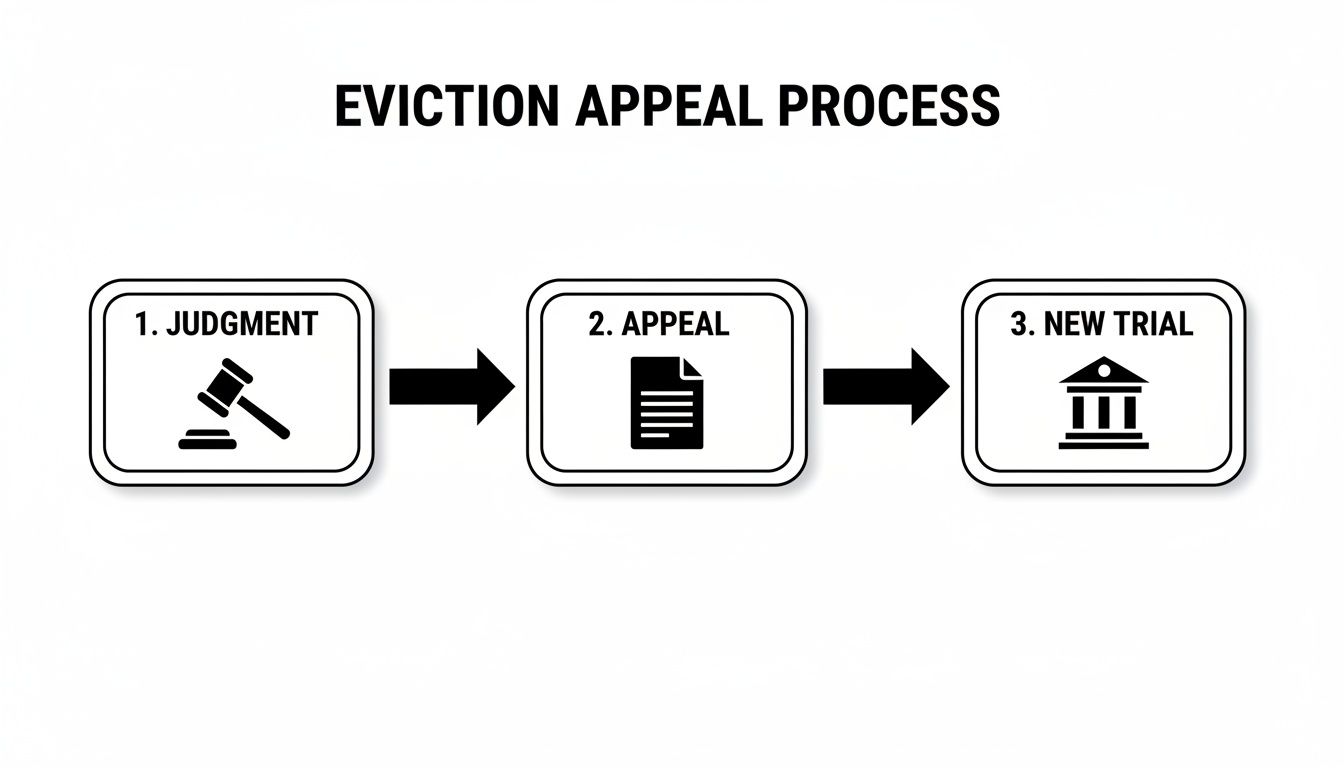
As you can see, filing the appeal is the crucial step that connects the first court’s decision to your second chance in County Court.
Here are the options available to secure that second chance:
- Surety Bond: This is like an insurance policy you buy from a bonding company. You pay them a premium, and they guarantee the full bond amount to the court. The judge sets this amount, which typically covers court costs and one month’s rent.
- Cash Deposit: The most direct option. You pay the full bond amount directly to the JP court clerk with cash, a cashier's check, or a money order. If you win your appeal, you get this money back. If you lose, it's used to pay the landlord what you owe.
- Statement of Inability to Afford Payment of Court Costs: If you cannot afford a bond or cash deposit, you can file this sworn document, often called a "Pauper's Affidavit." This is an essential lifeline for tenants with limited financial means.
The table below breaks down these deadlines and options for quick reference.
Texas Eviction Appeal Deadlines and Bond Options
| Requirement | Deadline | Key Details |
|---|---|---|
| Notice of Appeal | Within 5 days of judgment | File the official appeal paperwork with the same JP court that issued the eviction order. |
| Appeal Bond | Within 5 days of judgment | You must post one of the three options: a Surety Bond, a Cash Deposit, or a Statement of Inability. |
| Rent Payment (with Statement of Inability) | Within 5 days of filing appeal | If using a Statement of Inability, you must pay one month's rent into the court registry. |
| Ongoing Rent Payments | Monthly during the appeal | You must continue paying rent to the court each month as it comes due to keep the appeal active. |
These deadlines are unforgiving. Missing any of them can get your appeal thrown out, so working with an eviction attorney is crucial.
How to Use a Statement of Inability to Afford Court Costs
The Statement of Inability is a powerful tool, but it has strict rules. To use it, you must prove to the court you cannot afford the fees or the bond. You will generally qualify if you receive government benefits based on your income (like SNAP or TANF) or if your household income falls below the federal poverty guidelines.
Be warned: when you file this statement, you are swearing under penalty of perjury that the information is true. The landlord or the court clerk can legally challenge your statement if they believe you can afford the costs.
Filing the Statement of Inability triggers another critical deadline. You must pay one month's rent into the court registry within five days of filing your appeal. You must then continue paying your rent to the court every month while the appeal is ongoing. If you are late, the landlord can ask the judge for a Writ of Possession, which will stop your appeal.
Under Texas Property Code rules, tenants have just five days after a Justice of the Peace court's eviction judgment to file an appeal. Statistics show that while many tenants are evicted, appeals can be effective. You can explore additional insights on Texas eviction trends and statistics. Acting fast is everything.
Step Two: Building a Stronger Case for County Court
Filing the appeal is a huge step, but the real work starts now. Winning your new trial in County Court comes down to solid preparation.
This new trial is a "trial de novo," meaning it’s a complete do-over. The County Court judge will hear the case from scratch as if the JP court trial never happened. This is your second chance, and you need to make it count with a stronger, more compelling argument.
Your success now hinges on the evidence you bring to the table. County Court is more formal than JP court, and the judge will expect a clear, well-supported case. It’s time to proactively prove your side of the story.

Uncovering Key Information with Discovery
Once in County Court, you get access to a powerful legal tool called discovery. This is the formal process where you can demand evidence from your landlord before the trial. It’s your opportunity to see exactly what they have and to get crucial documents that can make or break your case.
Discovery levels the playing field. Your landlord usually holds all the key documents, like the lease, payment ledgers, and maintenance logs. Discovery forces them to show you what's in their hand.
Common discovery tools include:
- Requests for Production: Asking the landlord to provide copies of documents like repair invoices, internal emails, or photos they took of your unit.
- Interrogatories: Written questions you send to the landlord that they must answer under oath. For example, "Provide the names of all employees who entered my apartment in the last six months."
- Requests for Admission: Asking the landlord to admit or deny specific facts in writing. Getting them to admit something saves you from having to prove it at trial.
For example, imagine you’re appealing an eviction for non-payment of rent, and your defense is that the apartment was unlivable due to a serious mold problem. Through discovery, you could demand every maintenance request you submitted, all internal work orders, and any reports from mold inspectors. If those records show they knew about the mold and did nothing, your defense just became much stronger.
Gathering Your Own Powerful Evidence
While discovery gets you evidence from the landlord, you must also build your own. Your goal is to collect clear, credible proof that directly supports your legal arguments. Every claim you make to the judge should be backed up by a document, a photo, or a person.
Start by creating a timeline of events from the day the trouble began. This will help you organize what evidence you need to find.
Here's what works in court:
- Photographs and Videos: Clear, dated photos and videos of property damage, unsafe conditions, or anything the landlord failed to fix are powerful. A video of water pouring through your ceiling is hard to argue with.
- Written Communication: Collect every email, text message, and certified letter you sent to or received from your landlord. This creates a documented paper trail that proves you reported issues.
- Witness Testimony: Statements from neighbors, friends, or even a maintenance worker can be incredibly effective. If a neighbor can testify they saw the problem, it adds significant credibility to your story.
A crucial part of the Texas Property Code is Section 92.056. It gives you the right to have conditions repaired that threaten your physical health or safety. To use this as a defense, you must prove you gave the landlord proper notice first. Your text messages and emails are the hard evidence that shows you did what the law required.
For a deeper dive into your rights, you can learn more about the protections for Texas tenants facing eviction.
Organizing Your Evidence for Trial
Once you have your evidence, organize it into a story the judge can easily follow. Show up with a neat binder with tabs for each category, organized chronologically:
- Lease and Initial Documents
- All Communication with Landlord
- Photos of Unrepaired Conditions
- Repair Requests and Receipts
- Witness Statements
This process forces you to think through your argument and connect each piece of evidence to a specific point. An experienced eviction attorney can be invaluable here, helping you present your case in a way a judge will understand and respect.
Common Defenses That Win Eviction Appeals
A "trial de novo" in County Court gives you a clean slate and a chance to present powerful legal arguments that can turn the case around. Winning an appeal is about proving your landlord failed to follow the letter of the law. A small misstep on their part can become your strongest defense.
What the Texas Property Code Says About Eviction Defenses
Many tenants are surprised to learn how many technical rules a landlord must follow for an eviction to be legal. An experienced tenant rights attorney can identify if your landlord made a mistake.
Improper Notice to Vacate
This is one of the most common and effective defenses. Before a landlord can file an eviction lawsuit, they must give you a formal, written notice to vacate. A text message or phone call is not enough.
Texas Property Code § 24.005 is very clear on the requirements. The notice must:
- Be in writing.
- Give you at least three days to move out (unless your lease specifies a different period).
- Clearly state the reason for the eviction.
- Be delivered correctly—in person, by mail, or posted on the inside of your front door.
If your landlord failed to follow any of these steps, the entire eviction could be dismissed.
Landlord Retaliation
Did your landlord suddenly try to evict you right after you asked for a critical repair or reported them to a housing authority? This could be a classic case of landlord retaliation, and Texas law protects you.
Texas Property Code § 92.331 forbids a landlord from retaliating against you for exercising your legal rights, such as:
- Requesting repairs that affect your health and safety.
- Filing a complaint with a government agency.
- Organizing or joining a tenants' union.
For example, if you sent your landlord a certified letter about a severe mold problem and an eviction notice appeared on your door a week later for a minor issue, you can argue this is retaliation. The key is to show the judge a clear timeline connecting your action (the repair request) to the landlord's eviction filing.
Breach of the Implied Warranty of Habitability
Every residential lease in Texas includes an unspoken promise from your landlord: the property is safe and livable. This is the "implied warranty of habitability." When a landlord fails to fix something that seriously threatens your health or safety, they have broken that promise.
This defense is especially powerful in cases where the eviction is for non-payment of rent. You can argue that your duty to pay rent was excused because the landlord failed to provide a habitable home. To make this defense work, you must prove you gave the landlord proper written notice of the problem.
While your case is governed by Texas law, it can be helpful to see how other states handle similar issues. For instance, looking at California's landlord-tenant and eviction laws offers a broader perspective on common legal defenses. An experienced Texas landlord-tenant lawyer knows exactly what to look for and can help build a compelling, evidence-backed case.
The Final Verdict: What Happens After Your Appeal
The County Court judge's decision will determine what comes next. This is the moment that decides whether you can stay in your home or if the landlord can proceed with the eviction. Let's break down what each outcome means for you.

If You Win Your Appeal
A win in County Court is a huge victory. The judge's ruling in your favor throws out the original JP court eviction judgment. It means you have the legal right to stay in your home, and the eviction lawsuit against you is dismissed.
Depending on your case, the court might even award you damages as compensation for harm caused by the landlord's illegal actions. In some situations, the judge can also order the landlord to cover your attorney's fees.
If the Landlord Wins Your Appeal
If the judge rules in the landlord's favor, they get a judgment for possession of the property. This gives them the green light to take the final step in the eviction process: getting a Writ of Possession. This is the court order that allows a constable or sheriff to physically remove you and your belongings.
Once a writ is issued, things move quickly:
- A constable will post a 24-hour notice on your front door.
- This is your final warning to move out.
- If you are still there when the 24 hours are up, the constable can legally return and force you out.
Facing a Writ of Possession is an urgent and stressful situation. To understand exactly what this means, see our detailed guide on the Writ of Possession in Texas.
The Power of a Negotiated Settlement
A trial isn’t the only way an appeal can end. Many eviction cases are resolved through a settlement agreement, which offers certainty for both tenants and landlords.
One of the most common settlements is a "move-out agreement." You agree on a date to leave, and in return, the landlord agrees to drop the eviction lawsuit.
The single greatest benefit of a move-out agreement is that it can prevent an official eviction from ever appearing on your rental history. A clean record makes it much easier to find housing in the future.
These agreements can also include other helpful terms, like the landlord waiving back rent or giving you more time to move. An appeal can often lead to a positive resolution, with many cases ending in negotiation or dismissal before a final judgment. An eviction attorney can help ensure any agreement is fair and protects your rights.
Common Questions About Texas Eviction Appeals
The eviction appeal process can feel complex, but understanding a few key rules can make a big difference. Here are answers to the questions we hear most often.
Can My Landlord Kick Me Out While the Appeal is Happening?
No. This is one of the most powerful protections the appeal process offers. Once you have correctly filed your appeal and posted the necessary bond (or had your Statement of Inability approved), the Justice Court's ruling is legally on hold. This freezes your landlord's ability to get a Writ of Possession while your case is active in County Court.
Do I Still Have to Pay Rent During an Appeal?
Yes, absolutely. But you won't pay your landlord directly. The Texas Property Code requires that if you filed a Statement of Inability, you must deposit one month's rent into the court's registry within five days of filing your appeal. After that, you must continue paying your rent to the court every month on your regular due date for as long as the appeal is ongoing.
This is critical. Failing to make these payments on time is a fatal mistake for your case. If you're late, your landlord can immediately ask the County Court for a Writ of Possession, which effectively ends your appeal and allows the eviction to move forward.
What if I Can't Afford a Lawyer for My Appeal?
You have the right to represent yourself, but it's a difficult path. An eviction appeal involves formal court rules that can be tricky to navigate. Having a tenant rights attorney dramatically improves your chances of winning.
If a private lawyer is not an option, look into local legal aid organizations, which often provide free or low-cost help to qualifying tenants. Your local bar association can also refer you to attorneys who might offer payment plans or affordable consultations. Protecting your home is what matters most, and a good eviction lawyer can give you a realistic assessment of your case and guide you through the system.
If you need help with appealing an eviction in Texas, a lease issue, or a rental dispute, contact The Law Office of Bryan Fagan, PLLC for a free consultation today.