Skip to content
Dealing with a landlord dispute or eviction can be stressful—but understanding your rights under Texas law can make all the difference. Getting an eviction notice can throw your whole world into chaos, but here's the first thing you need to know: in Texas, a landlord can't just kick you out.
They have to follow a strict legal process, step by step. A landlord cannot legally change the locks, shut off your utilities, or toss your belongings on the curb without a court order. Understanding your rights as a tenant is the single most powerful tool you have to protect yourself and your home.
Your Rights in the Texas Eviction Process

The Texas eviction process is not an instant event. It's a series of legally required steps laid out in the Texas Property Code, and your landlord has to get every single one right.
Any mistake they make—a missed deadline, an improperly worded notice, a skipped step—can become a powerful piece of your defense. You are not powerless in this situation. This guide will walk you through what to expect, from the first notice to the courtroom, so you can stand up for your rights with confidence.
The Sobering Reality of Evictions in Texas
If you're facing an eviction, you are far from alone. Texas has seen a massive spike in eviction filings, especially after the protections from the pandemic era expired.
Landlords in major cities like Houston, Dallas, and Austin filed a staggering 177,000 eviction cases in 2023 alone. This isn't just a number; it's a trend that shows how tough the rental market has become for tenants across the state. With courts this busy, it's more critical than ever to be vigilant and defend your rights.
Your Fundamental Protections as a Tenant
Texas law provides a shield against illegal or unfair removal. These aren't just suggestions for your landlord; they are legal mandates. Here are the core rights you have:
- The Right to Formal Notice: Before anything else, your landlord must give you a formal, written "Notice to Vacate." A text message, a verbal warning, or a sticky note on the door won't cut it.
- Your Day in Court: You can't be evicted without a judge's order, period. This guarantees you the chance to go to court and tell your side of the story.
- The Right to Fight Back: You have the legal right to file a formal answer with the court and present defenses that challenge the landlord's claims.
- Protection Against Retaliation: Your landlord is legally barred from evicting you simply because you exercised a legal right, like requesting they fix a broken AC unit or a leaking roof.
Knowing the timeline and the specific rules for each of these steps is everything. For a more detailed look, check out our in-depth guide on the eviction process in Texas. The more you know about the rules, the easier it is to spot when your landlord breaks them—and that’s how you start building a strong defense.
What the Texas Property Code Says About the Notice to Vacate
A legal eviction in Texas doesn’t start with a threatening text message or a knock on the door. The process must kick off with a formal, written document called a Notice to Vacate. This piece of paper is the starting gun for any eviction lawsuit, and if your landlord doesn’t handle it by the book, their case can fall apart before it even begins.
This notice officially tells you what lease rule you’ve allegedly broken (usually not paying rent) and gives you a strict deadline to either fix the problem or move out. For tenants, understanding the legal fine print of this document is your first line of defense.
The Three-Day Rule and Its Exceptions
Under the Texas Property Code, Section 24.005, the standard timeline is a three-day notice for non-payment of rent. This means the landlord has to give you at least three full days to pay up or move out before they’re legally allowed to file an eviction lawsuit.
But that three-day window isn't set in stone. Your lease agreement is the ultimate rulebook here.
- Your Lease Can Change the Timeline: Always check your lease. It might give you more time, like a 10-day notice, or it could shorten the window to as little as 24 hours. What’s written in your signed Texas lease agreement laws is what usually counts.
- No Lease or a Verbal Agreement: If you don't have a written lease, the law defaults to the standard three-day notice for non-payment of rent.
This is a tight turnaround, which means you have to act fast the moment you receive one of these notices.
Your Right to Cure the Issue
That notice period isn’t just a countdown to getting kicked out—it’s your chance to stop the eviction cold. This is known as your right to "cure" the violation.
Example Scenario: Let's say your rent is due on the 1st, but you haven't paid. On the 2nd, your landlord gives you a 3-day Notice to Vacate. If you can pay the full amount you owe on the 3rd, 4th, or 5th, the landlord generally cannot move forward with the eviction. The problem is "cured." Always get a receipt—that’s your proof.
This simple flowchart breaks down how the process is supposed to work.
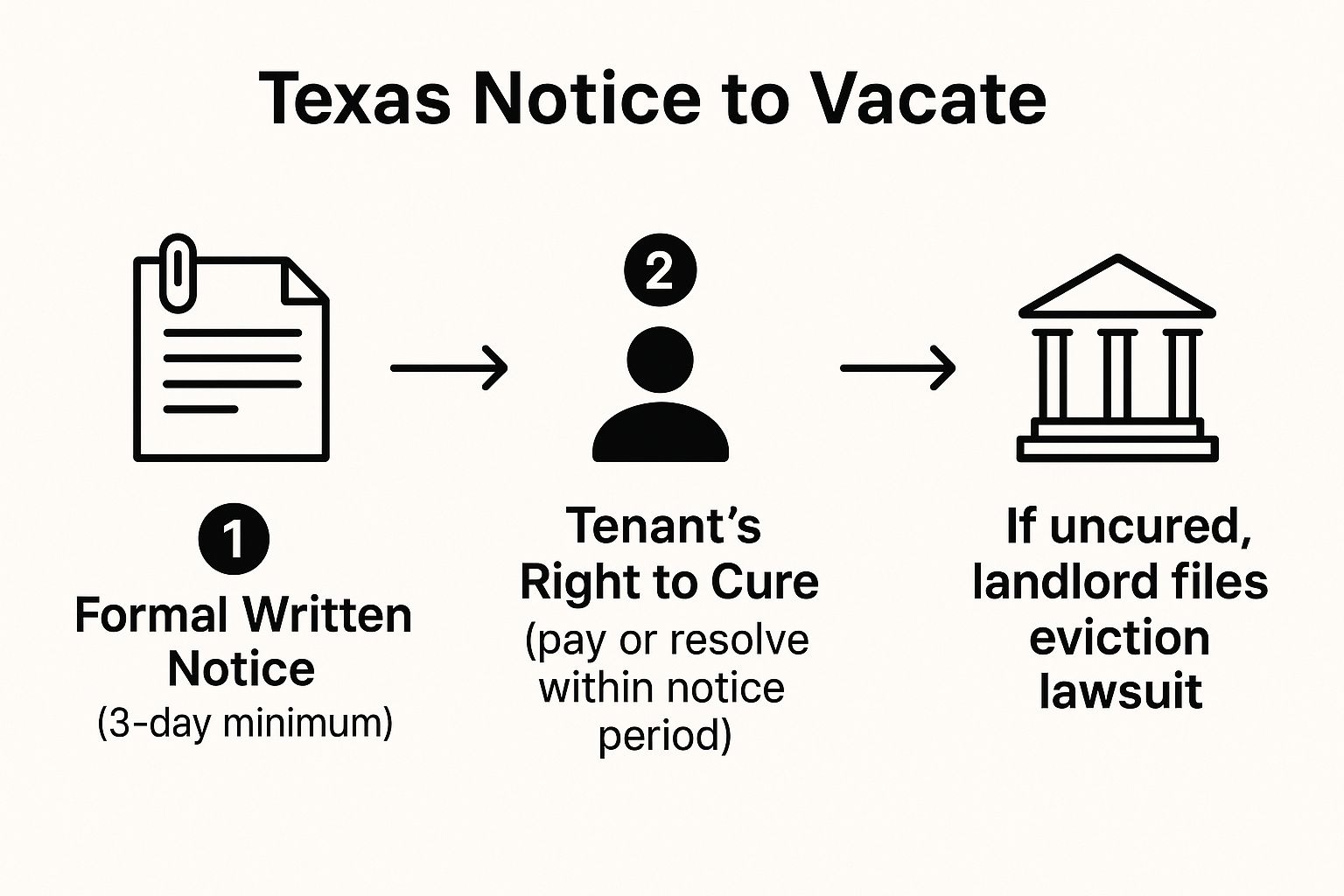
The takeaway here is that the law gives you a protected window to fix the problem. It’s a critical opportunity to prevent the situation from escalating into a full-blown court case.
Key Elements of a Valid Texas Notice to Vacate
This table outlines the essential components that a landlord's Notice to Vacate must contain to be legally valid under the Texas Property Code. Any missing element could be grounds for a defense.
| Required Element | What It Means for Tenants | Example of an Error |
|---|---|---|
| Be in Writing | Verbal warnings, text messages, or emails don't count. It must be a physical or properly delivered electronic document. | A landlord calls you and says, "You have three days to get out." |
| State the Reason | The notice must clearly say why you are being asked to leave (e.g., "for non-payment of rent for the month of May"). | The notice just says, "You have violated your lease agreement." |
| State the Move-Out Date | It must give you a specific date and time by which you need to vacate the property if the issue isn't cured. | A notice that says, "You need to move out as soon as possible." |
| Be Delivered Properly | The landlord must follow strict delivery rules set by the state, as detailed below. | The landlord slips an unsealed note under your door. |
| Unconditional Demand | It must clearly demand that you leave the property. Phrasing like "we might evict you" is not enough. | A letter that says, "Please consider moving out if rent isn't paid." |
A mistake in any of these areas is more than just a typo—it can be a serious legal error that gives you a solid defense in court.
How the Notice Must Be Delivered
How you get the notice is just as important as what it says. Texas law is very particular about this. Here are the legally sound ways a landlord can deliver it:
- Personal Delivery: Handing the notice directly to you or to anyone living there who is 16 years or older.
- By Mail: Sending it via regular, certified, or registered mail. If they use this method, they need to request a return receipt to prove you got it.
- Posting on the Door: Taping the notice to the inside of your front door. If they can’t get in, they are allowed to post it on the outside, but only if it's placed somewhere secure where it won't just blow away.
This process is rigid for a reason—it’s designed to ensure you actually receive the warning and have a fair chance to respond.
Step-by-Step: Navigating the Eviction Lawsuit

If you haven’t moved out or cured the issue by the time the notice period ends, your landlord can file an eviction lawsuit.
In Texas, this lawsuit is officially called a "forcible detainer" suit. It’s filed in a local Justice of the Peace court (JP court). This is where a judge—not your landlord—will make the final call on whether you can be legally forced to leave. Once that lawsuit is filed, the clock starts ticking. What you do next can make all the difference.
Step 1: Receiving the Lawsuit Papers
After filing the suit, your landlord has to make sure you're officially notified. This is a formal process called being "served" with court papers. A constable or a sheriff's deputy will deliver a "citation," which is the legal term for the lawsuit papers.
This citation is a legal summons. It will tell you which JP court is handling the case and, most importantly, the exact deadline for you to respond.
Crucial Warning: Do not ignore these papers. This is the biggest mistake you can make. If you miss the deadline to respond, your landlord can win automatically with a "default judgment." You won't even get a chance to tell your side of the story.
Step 2: Filing a Written Answer
To defend yourself, you absolutely must file a written "Answer" with the court clerk before your deadline. An Answer is usually a simple document that tells the court you’re fighting the eviction. It doesn't need to be full of legal jargon.
The deadline can be tricky, so it's best to call the court clerk listed on your citation and ask for the exact date.
Filing an Answer accomplishes two critical things:
- It stops a default judgment. This guarantees your landlord can't win just because you didn't show up.
- It gets you a court date. The court will schedule a hearing where you and your landlord can present your cases to the judge.
Step 3: Preparing for Your Day in Court
Once your hearing is on the calendar, it’s time to get your defense ready. Think of it as telling your story to the judge, but with proof to back it up.
Example Scenario: Imagine your landlord claims you didn't pay rent, but you know you tried to pay and they refused your money. Here’s how you would get ready for court:
- Gather Your Proof: Find every text, email, or letter showing you tried to pay. Print them out. A judge needs to see physical evidence.
- Line Up Witnesses: Was a friend or family member with you when you tried to pay? Ask them if they’re willing to come to court and tell the judge what they saw.
- Get Your Financials: Bring a bank statement showing the rent money was in your account on the day you tried to pay. This proves you had the funds.
At the hearing, you and your landlord will each get a turn to speak. Presenting your case clearly and calmly shows the judge you’re taking this seriously. Navigating this process with an experienced eviction attorney can completely change the outcome. To understand how a legal expert can build your case, you can learn more about professional eviction defense services.
Common Legal Defenses Against Eviction in Texas

An eviction lawsuit can feel like the end of the road, but that's rarely the case. Texas law gives every tenant a set of powerful legal defenses. The law has a checklist, and your landlord has to tick every single box perfectly. If they messed up even one step, their entire eviction case could be thrown out.
This isn’t about finding a loophole. It’s about holding landlords accountable to the same laws that you’re expected to follow. Let's look at the most common and effective defenses.
Improper Notice to Vacate
This is one of the most frequent mistakes landlords make—and one of the strongest defenses for a tenant. Common mistakes include:
- Wrong Timeline: The landlord didn't give you the full 3 days (or whatever time your lease requires).
- Incorrect Delivery: They just texted it to you or left it on your porch without following the specific delivery rules.
- Missing Information: The notice was vague, failed to state a clear reason, or didn't give you a firm move-out deadline.
If you can show the judge the notice was flawed, they may dismiss the lawsuit. The landlord can start over with a correct notice, but this buys you invaluable time.
Landlord Retaliation
The law is clear: your landlord can't evict you just because they're mad you stood up for your rights. This is called retaliation, and it's illegal. Section 92.331 of the Texas Property Code is designed to protect you from this exact kind of payback.
Example Scenario: Your AC dies in the middle of a brutal Texas August. You send a formal, written request for repairs. A week later, instead of a repair person showing up, you get a Notice to Vacate. You can argue the eviction isn't really about a lease violation but is direct punishment for requesting a necessary repair.
Other legally protected actions include:
- Reporting code violations to a city housing authority.
- Joining or organizing a tenant union.
- Using any right given to you in your lease agreement.
To make this defense stick, you need to connect the dots between your action and the eviction. Keep copies of every email, letter, and text to build your case.
Waiver: The Landlord Accepted Rent
Here’s another powerful defense called "waiver." It comes into play when a landlord accepts your rent payment after sending you a Notice to Vacate for non-payment. When they take your money, the law says they have "waived" their right to proceed with that specific eviction.
For example, you're late on rent, and your landlord tapes a three-day notice to your door. On day four, you bring them the full amount, and they accept it. Their acceptance cancels out the notice, and they can't use that past-due rent as a basis to evict you anymore.
Failure to Repair and Maintain the Property
In certain situations, you can defend against an eviction for unpaid rent if your landlord has ignored critical repairs that threaten your health and safety. This is a complex defense with strict rules you must follow under the Texas Property Code.
You can’t just withhold rent because the faucet drips. For this defense to be considered, you must have:
- Sent the landlord a formal, written notice about the needed repair.
- Been current on your rent at the moment you sent that notice.
- Given the landlord a reasonable time to actually make the repair.
If you did all of that and the landlord still did nothing, their failure to repair can be a valid defense. Given the complexity, this is a situation where getting advice from an experienced eviction attorney is critical.
What Happens After the Eviction Hearing
Losing an eviction case in Justice Court can feel like the end, but it’s not. Texas law lays out a clear, step-by-step process for what happens next, giving you a critical window of time to protect yourself. The judge's ruling is a serious setback, but it’s not the final word.
A judgment against you doesn't mean a constable is showing up that afternoon. Instead, it kicks off a new, time-sensitive phase where you still have options.
Your Right to an Appeal
If the judge sides with your landlord, your most immediate tool is the right to appeal. An appeal moves your case out of the JP court and up to a County Court for a brand-new trial. You get to present all your evidence and make your arguments all over again before a new judge.
You have a very strict, five-day window to file that appeal after the judgment is signed. This includes weekends and holidays. Miss that deadline, and the opportunity is gone. Filing an appeal immediately freezes the eviction, stopping your landlord from taking any action to remove you until the new trial is over.
How to File Your Appeal
To start an appeal, you must file paperwork with the same JP court. Usually, this involves posting a bond. But what if you can't afford that?
You can file a "Pauper's Affidavit," also known as a Statement of Inability to Afford Payment of Court Costs. It's a sworn statement explaining you don't have the money for court fees. If the judge approves it, you can move forward with your appeal without paying those costs upfront.
The Final Step: The Writ of Possession
So, what happens if you don't appeal within five days? Or what if you lose the appeal? That's when your landlord can get the final court order needed to remove you. It’s called a Writ of Possession.
This is the legal document that authorizes a constable or sheriff to physically remove you and your belongings from the property. Harris County saw a staggering 80,000 eviction filings in 2022, a number about 30% higher than before the pandemic. These aren't just statistics; they represent families facing this critical final stage. You can read more about the historic levels of evictions in Harris County on kinder.rice.edu.
Even with a writ, the constable can’t just show up and kick you out. The law requires them to post a written notice on your front door at least 24 hours before they come back to execute the writ. This notice will state the exact date and time they plan to return. That 24-hour period is your absolute last chance to move out on your own terms.
Common Questions About Texas Eviction Rights
Even after you've learned the basics, you probably still have questions. Let's tackle some of the most common ones we hear from tenants.
Can My Landlord Evict Me for Being One Day Late on Rent?
Technically, yes. If your lease agreement doesn't have a grace period, your landlord can give you a three-day Notice to Vacate the day after your rent is late.
However, check your lease first. Most leases do include a grace period of a few days. If you do get a notice, remember your right to "cure" the problem. Paying the full amount you owe within that notice period should stop the eviction process. Always get a written receipt as proof of payment.
What Happens to My Security Deposit if I Am Evicted?
A landlord can't just pocket your security deposit. Under the Texas Property Code, a landlord can only deduct from your deposit for two things: unpaid rent and property damage that goes beyond normal wear and tear.
If they withhold any of it, they must give you a written, itemized list of every deduction. They have 30 days after you move out to either return your full deposit or provide this list. This rule only applies if you've given them a forwarding address in writing.
Key Takeaway: Always give your landlord a forwarding address in writing when you move out. It’s a simple but critical step to protect your security deposit rights.
Can My Landlord Change the Locks or Shut Off Utilities?
Absolutely not. This is an illegal "self-help" eviction, and it is strictly forbidden by Texas law. Your landlord cannot take matters into their own hands to force you out.
This includes illegal actions like:
- Changing the locks on your doors.
- Removing your personal belongings from your home.
- Shutting off essential utilities like electricity, water, or gas.
If your landlord does any of these things, you can sue them to get back into your home and even recover financial damages. This is a major violation of your tenant rights, and you should contact an experienced Texas landlord tenant lawyer the moment it happens.
Will an Eviction Ruin My Rental History Forever?
An eviction filing can make it tougher to find a new place to live, as these lawsuits are public court records. But an eviction on your record isn't necessarily a permanent black mark. You have options:
- Win Your Case: If the judge sides with you, the case is dismissed. You can then petition the court to have the record expunged, which seals it from public view.
- Settle Before Judgment: You can often work out a deal with your landlord, like agreeing to move out by a specific date if they agree to drop the lawsuit. This prevents a final judgment from being entered against you.
An experienced eviction attorney can be a huge asset in exploring these paths and protecting your rental history.
If you need help with an eviction, lease issue, or rental dispute, contact The Law Office of Bryan Fagan, PLLC for a free consultation today.