Dealing with a landlord dispute can be stressful—but understanding your rights under Texas law can make all the difference, especially when your car has been towed from your own apartment complex. It’s a gut-wrenching feeling, but you are not powerless.
In Texas, you have strong, specific rights designed to protect you. Getting your car towed isn't just bad luck; it’s a legal process. And if your landlord or their towing company didn't follow the rules to the letter, that tow was likely illegal, and a Texas landlord tenant lawyer can help you fight back.
Your Car Was Towed at Your Apartment. Now What?
It's easy to feel powerless when your car vanishes from your own home. But you're not. Both the Texas Property Code and the Texas Occupations Code lay out a strict set of rules that apartment complexes must follow before they can even think about calling a tow truck.
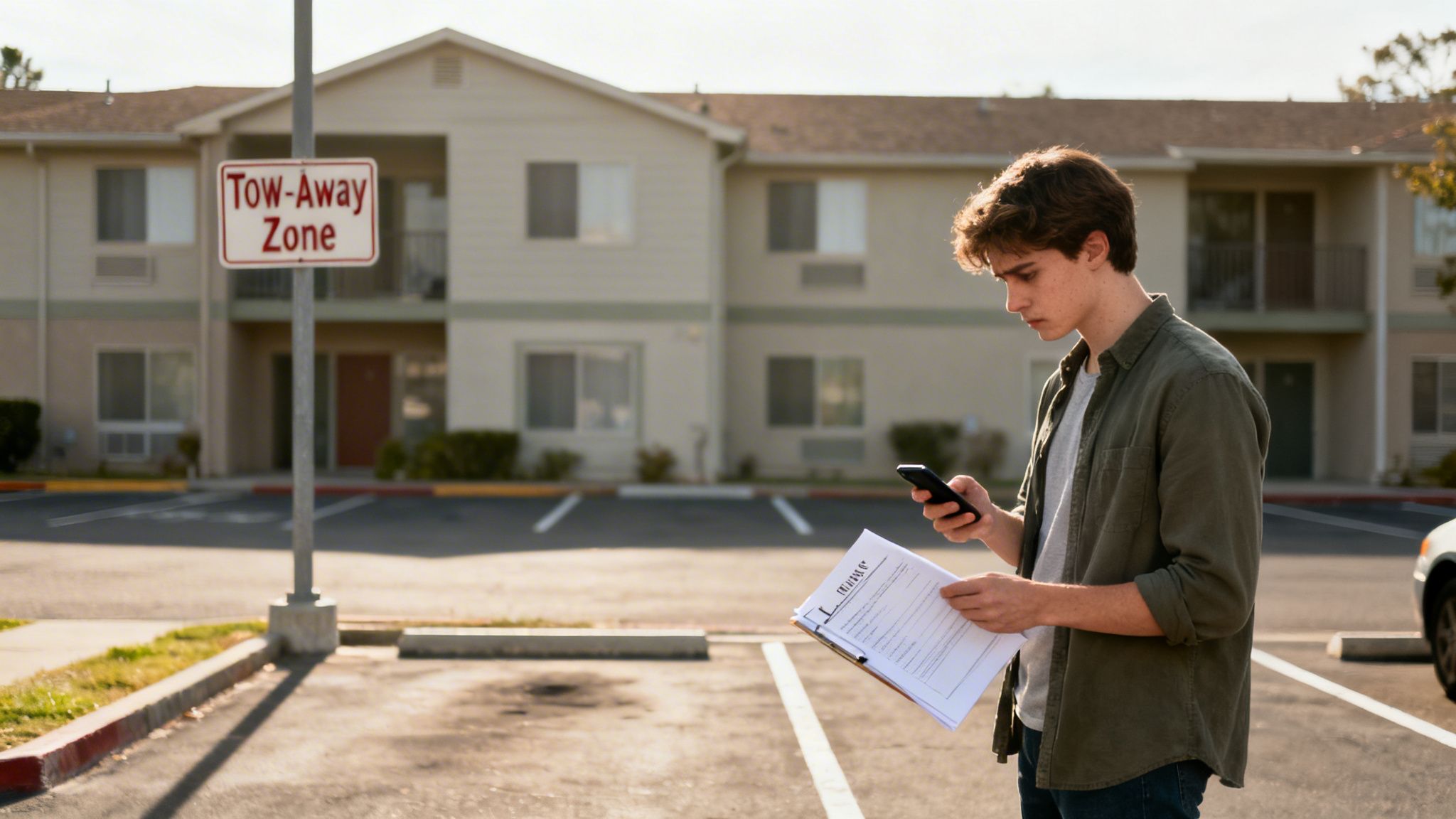
This guide will break down those rules in plain English. We’ll show you how to figure out if your rights were violated and provide step-by-step information for what to do next. It's time to turn that frustration into action.
What the Texas Property Code Says About Towing
Texas law doesn't leave tenants defenseless against predatory towing. It creates several crucial safeguards at apartment complexes. If your landlord skipped any of these, they may have broken the law.
- It Must Be in Your Lease: Any parking rule that could get you towed has to be written directly into your Texas lease agreement or in a specific parking addendum you signed. A new rule posted on a wall isn't enough.
- Signs Must Be Clear and Correct: The property must have legally compliant signs at every entrance. "No sign" almost always means "no legal tow."
- A 10-Day Written Notice is Required for Some Violations: For things like an expired registration or inspection sticker, the landlord can't just tow you. They are required by law to give you a 10-day written warning first.
The bottom line is this: a landlord’s right to keep their parking lot clear is not absolute. They have to play by the rules set by Texas law, which prioritizes clear communication and tenant rights. One mistake on their part can make the entire tow invalid.
Knowing these rules is your first line of defense. An experienced Texas landlord-tenant lawyer can dissect the details of your situation—from the fine print in your lease to the placement of the tow signs—to determine if your landlord acted illegally.
When Can an Apartment Legally Tow Your Vehicle in Texas
That sinking feeling when you walk out to an empty parking spot is awful. It feels like a violation—and sometimes, it is.
Apartment complexes don't get to make up their own rules for towing. They must follow the law, and Texas law is very specific about when a tow is justified. If they don’t have a legally valid reason, the tow is improper. That means you could be entitled to get your money back.
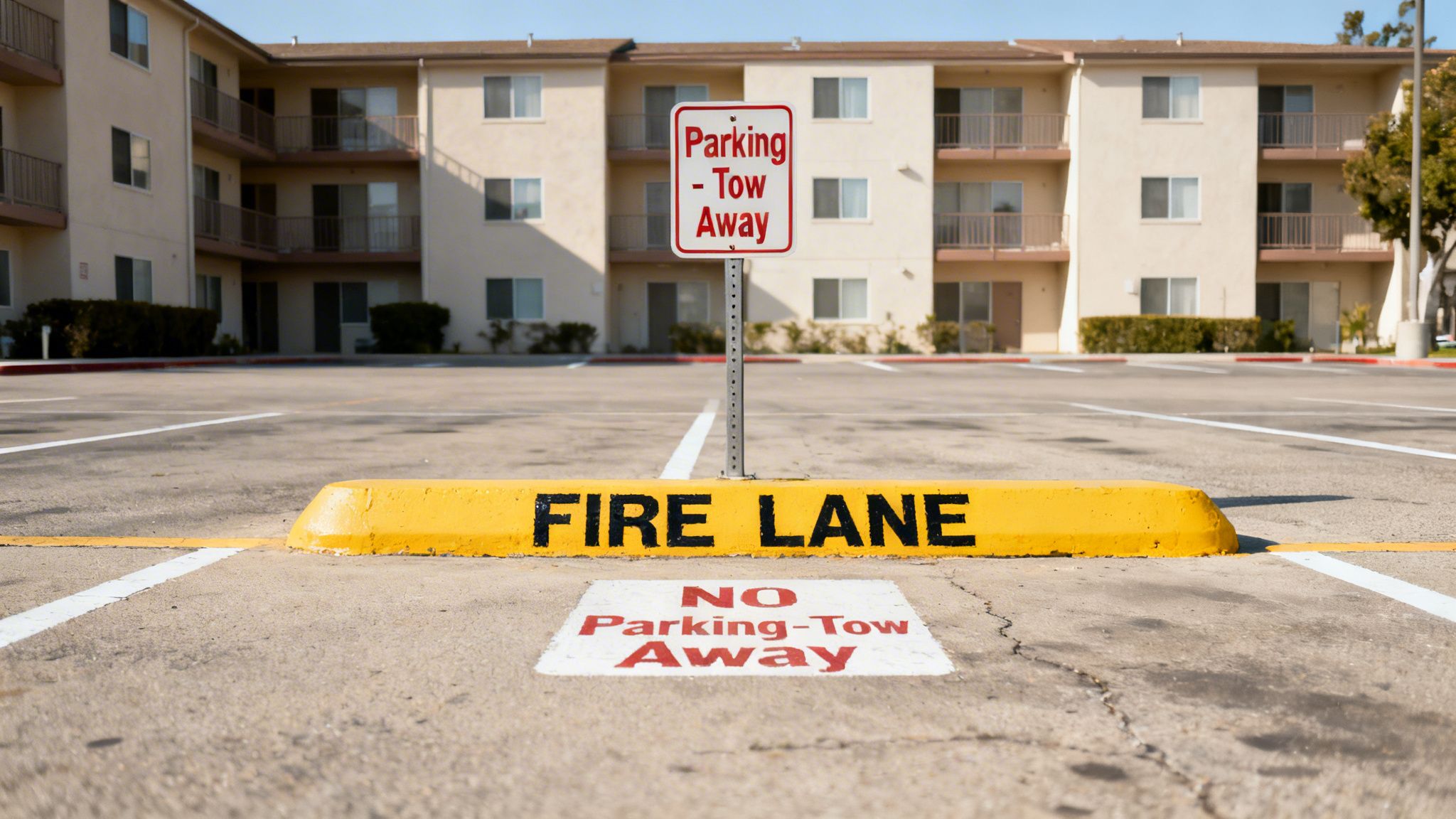
The key statute here is Texas Occupations Code Section 2308.253. This law spells out the only situations that give an apartment complex the right to have your car towed. If your vehicle was towed for any reason not on this list, you probably have a strong case for a wrongful tow.
What the Texas Occupations Code Says About Valid Towing Reasons
The law is built around a simple idea: safety and access. Your apartment can tow your car if it’s parked in a way that creates a hazard or blocks someone or something.
Here are the most common, legally valid reasons for a tow:
- Blocking a gate for either vehicles or people.
- Obstructing access to a dumpster or other trash containers.
- Parking in a clearly marked fire lane.
- Taking up a handicapped-accessible space without the proper placard or plates.
- Parking in a designated tow-away zone that has clear signage.
- Leaking a hazardous fluid like gasoline or oil.
These rules aren’t just about control; they’re about keeping the community safe and functional. A car in a fire lane could have life-or-death consequences during an emergency. A vehicle blocking a gate could trap your neighbors. Many of these specific rules are extensions of the basic rights defined under the Texas Property Code.
Parking in Restricted or Unauthorized Areas
Beyond immediate dangers, property owners have the right to manage their own parking lots. This is where things can get a little tricky.
An apartment complex can legally tow you for parking in a spot designated for a specific use, but only if it’s properly marked. Think of spots reserved for maintenance staff, future residents, or specific office personnel.
Real-World Scenario: Let's say you get home late and the only spot you can find is right by the front office, clearly painted and labeled "Maintenance Staff Only." You figure it's fine for one night. The next morning, your car is gone. In this case, because the spot was clearly marked for a specific, restricted use, the tow would almost certainly be considered legal under Texas law.
This brings up the most critical point in any towing dispute: the signage must be clear. A faded, unreadable sign or a space with zero markings makes it much harder for the property owner to justify the tow. The burden is on them to prove they gave adequate notice. If they can’t, the tow may be illegal.
Your Lease and Complex Signage: The Two Pillars of a Legal Tow
When you find your car gone from its usual spot, your lease agreement instantly becomes the single most important document you own. It’s not just a contract to rent an apartment; it’s the legal rulebook that dictates whether that tow was legitimate.
In Texas, landlords can’t just make up parking rules on the fly. If they want to tow your car for violating a rule, that specific rule must be spelled out clearly in the lease you signed. A note on a community bulletin board or a verbal warning doesn’t count.
Your Lease Is the Ultimate Authority on Parking Rules
The law is incredibly clear on this. Landlords can’t hide towing policies in the fine print and hope you don’t notice.
Under the Texas Occupations Code, any parking regulations that could lead to a tow must be in your lease under a heading like "Parking" or "Parking Rules." And that’s not all. The entire section must be made to stand out—it has to be bolded, underlined, or printed in all capital letters.
If your lease doesn’t have this highlighted, conspicuous section, any tow based on a parking rule is on very shaky legal ground. For instance, if your complex tows you for backing into a space, but that rule isn’t in a properly highlighted section of your lease or a signed parking addendum, the tow was likely illegal. Knowing what your Texas lease agreement actually says is your first and best line of defense.
If the Signs Aren't Right, the Tow Isn't Right
Beyond what’s in your lease, proper signage is an absolute, non-negotiable requirement for any tow from an apartment complex. If the signs are wrong, the tow is wrong. It’s that simple.
Texas law mandates that a compliant tow-away sign must be posted at every single vehicle entrance to the property. One sign at the main gate isn’t enough if there are other ways to drive in.
To be compliant, these signs must include very specific details:
- A clear warning that it’s a tow-away zone.
- The international towing symbol (the picture of a tow truck hooking a car).
- The name and phone number of the towing company they use.
- The hours when you can go and retrieve your vehicle.
Just as businesses must follow strict rules for accessibility notices, like those outlined in these ADA Signage Requirements for Businesses, landlords must follow strict rules for towing notices. If a sign is blocked by a tree, so faded you can't read it, or missing any of the required information, it fails the legal test.
Landlords must get both the lease language and the physical signs right. The table below breaks down exactly what they're required to do.
Towing Notice and Signage Requirements in Texas Apartments
This table summarizes the key notice and signage rules landlords must follow before towing a vehicle from a residential apartment complex in Texas.
| Requirement Type | What the Law Says | Common Landlord Mistake |
|---|---|---|
| Lease Agreement | All parking rules that can result in a tow must be in the lease in a section labeled "Parking" or similar. | Creating "new" rules via flyers or emails that aren't in the original lease or a signed addendum. |
| Lease Highlighting | The entire parking rules section must be bolded, underlined, or in all caps to be conspicuous. | Burying the rules in normal-sized text in the middle of a long, dense paragraph. |
| Sign Placement | A compliant tow-away sign must be posted at every single vehicle entrance to the property. | Placing a single sign at the main entrance but failing to post them at side or back entrances. |
| Sign Content | Signs must include the tow company's name/phone, a towing symbol, and state it's a tow-away zone. | Using generic "No Parking" signs or signs with missing, faded, or incorrect information. |
Failing to meet even one of these requirements can be enough to make a tow illegal. It's not about what seems fair—it's about what the law demands.
A New Shield Against Tows for Expired Registration
A recent and much-needed change in Texas law gives tenants a powerful new protection against tows for expired registration or inspection stickers. In the past, a landlord could have your car towed for an expired "tag" with no warning at all.
That's no longer the case. As of 2022, if your car is legally parked in your assigned spot or a designated resident area, the landlord must give you 10 days' written notice before they can tow it for expired registration.
This notice has to be securely placed on the front windshield of your vehicle. If they tow your car after only nine days, or if they never gave you the written notice to begin with, the tow is illegal. This gives you a crucial grace period to get your registration updated and avoid a bill for hundreds of dollars.
How to Recover Your Towed Vehicle and Your Belongings
Finding your car gone is a stressful experience, but what you do next is critical to protecting your rights. Your first job is to stay calm and act fast. This is your game plan for locating your car and starting the recovery process.

First, you need to confirm it was actually towed. Look for the towing signs posted at the complex entrances. Texas law requires these signs to list the name and phone number of the towing company the property uses. Call that number.
If you can’t find a sign or the number is a dead end, your next call is to the local police non-emergency line. They can check their records and tell you if your vehicle was reported towed and which vehicle storage facility (VSF) has it.
Your Right to Retrieve Personal Belongings
Once you know where your car is, your mind probably jumps straight to the cost. Before you even think about paying, there’s a critical right you have under Texas law.
You have the right to get your personal property out of your vehicle before you pay any towing or storage fees. This isn't negotiable. It includes things like medication, work tools, legal papers, and even your child's car seat.
The VSF cannot hold your personal belongings hostage to make you pay the bill. The only things you can't take are items physically attached to the car, like a custom stereo or rims. Simply show up during their business hours, prove you own the car, and they are required to give you access.
Step-by-Step Information for Vehicle Recovery
Getting your car back from the impound lot is a process. Being prepared will make it go much smoother and give you the evidence you need if you decide to fight the tow later.
Here's exactly what you need to do:
- Gather Your Documents: Before you head to the VSF, get your paperwork in order. You'll need your government-issued photo ID (like a driver's license), proof you own the car (title or registration), and proof of insurance.
- Go to the Vehicle Storage Facility: Arrive ready to pay the fees. In Texas, VSFs must accept cash, debit cards, and credit cards. They are not allowed to charge you an extra fee just for using a card.
- Inspect Your Vehicle Before Leaving: This is crucial. Walk around your car and look for any new damage. Take clear, well-lit photos and videos of every scratch, dent, or scuff that wasn't there before. This is your proof if you need to file a damage claim.
- Get an Itemized Receipt: Do not leave without a detailed receipt. It needs to break down every single charge—the tow fee, daily storage costs, and any other administrative fees. This receipt is your single most important piece of evidence for fighting back against illegal fees.
Documentation is your best defense. Every photo you take and every receipt you save builds your case. If you believe the tow was illegal or the charges are inflated, this is the foundation for fighting back. A Texas landlord-tenant lawyer can use this evidence to protect your rights and get your money back.
Understanding Towing Fees and Spotting Overcharges
That feeling when you see the towing bill—it’s pure sticker shock. It feels overwhelming and, frankly, unfair.
But here’s a crucial piece of information: those fees aren't just random numbers. The Texas Department of Licensing and Regulation (TDLR) puts a hard cap on what a company can legally charge you for a tow from a private lot, like your apartment complex. Knowing these limits is how you can spot an illegal charge.
How Towing and Storage Fees Are Regulated
In Texas, state law puts a ceiling on towing and storage fees specifically to stop predatory pricing. The bill is usually broken into two main parts: the tow fee and the storage fees. The tow fee is a one-time charge for hauling your car to their lot. The daily storage fee kicks in the moment it arrives at the vehicle storage facility (VSF) and adds up every 24 hours.
You are not at the mercy of the towing company. Texas law specifically protects consumers from being gouged. If a fee on your bill looks suspiciously high, it’s worth investigating, as it may be illegal.
State-Mandated Fee Caps in Texas
To protect you, Texas law caps what a tow company can charge for a non-consent tow from an apartment complex. For a standard car, that fee has a strict maximum.
The state caps are based on your vehicle's weight:
- $255 for light-duty vehicles (under 10,000 lbs), which is most cars, SUVs, and small trucks.
- $357 for medium-duty vehicles (10,000-30,000 lbs).
- $459 per unit for heavy-duty vehicles (over 30,000 lbs).
However, many Texas cities have their own local rules that force tow companies to charge even less. For example, major cities like Dallas and San Antonio often set their maximums 20-30% lower than the state caps. Always check your city’s specific towing ordinance to know the real limit. You can explore detailed information on Texas towing laws to see how local rules can change the game.
Common Illegal Fees to Watch For
Unfortunately, some tow companies count on you not knowing the rules. They’ll try to pad the bill with bogus charges, hoping you’ll just pay to get your car back.
Here are the most common illegal fees to look for on your invoice:
- Credit Card Surcharges: The VSF is legally required to accept your credit or debit card. They cannot charge you an extra fee for using it.
- "Gate Fees" During Normal Hours: You should never have to pay a "gate fee" just to get your own car or retrieve personal items during their posted business hours.
- Vague "Admin" or "Paperwork" Fees: A small, regulated notification fee may be allowed. But watch out for fuzzy "administrative fees" designed to inflate the bill past the legal tow and storage rates.
If you see any of these charges on your bill, you have every right to challenge them. An experienced Texas landlord-tenant lawyer knows exactly how to spot these illegal fees and can fight the tow company to get your money back.
Your Step-by-Step Guide to Contesting an Illegal Tow
An illegal tow from your apartment complex isn’t something you just have to accept. Texas law gives you a clear path to fight back, get your money back, and hold the property manager and their tow company accountable.
Here's exactly what you need to do.
The first step feels counterintuitive, but it’s critical: pay the fees and get your car out of the impound lot as soon as possible. This stops the storage fees from piling up, which makes the bill bigger every day. Get the car back first. Then, you can focus on getting that money back.
Step 1: Build Your Case with Evidence
Before you can challenge the tow, you need proof. The strength of your entire case rests on the evidence you gather to show the tow violated Texas law.
Here’s what you need to collect:
- Your Lease Agreement: Pull it out and find the "Parking Rules" section. Is it highlighted or bolded like the law requires? Does it even list the specific rule they claim you broke?
- Photos and Videos: Use your phone. Take pictures of the spot you were parked in, the signs around the property (or the lack of proper signs), and any damage to your vehicle after you get it back.
- The Itemized Towing Receipt: This is non-negotiable. You must get a receipt that details every single charge. It's the primary proof of what you paid.
- All Communications: Save every email, text message, or written notice from your landlord about parking rules or the tow itself.
This evidence is the foundation for every step that comes next. Don't skip it.
Step 2: Request an Official Tow Hearing
You have a legal right to a hearing in a Justice of the Peace (JP) court where a judge will decide if the tow was legal. This is your chance to present your evidence and make your case.
But you have to move fast. You only have 14 days from the day your car was taken to file a request for this hearing. If you miss that two-week window, you lose your right to challenge the tow in JP court. To file, you just need to submit a simple form and pay a small filing fee at the JP court for the precinct where your car was towed from.
This flowchart shows the kinds of fees you’ll be dealing with.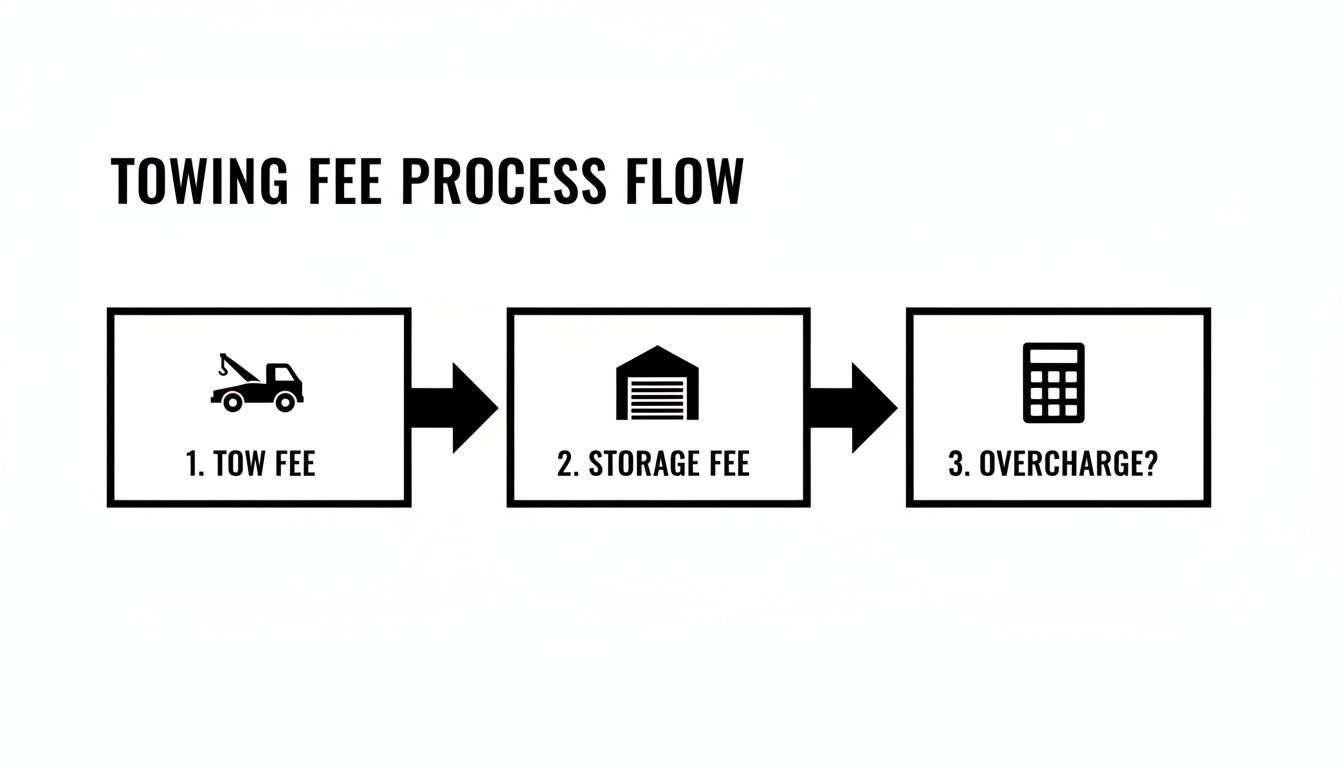
As you can see, the costs add up quickly. At the hearing, you can contest the base tow fee, the daily storage fees, and any other junk charges they tacked on. If you hit a wall trying to decipher complex regulations, an AI legal assistant can sometimes help you find the specific rule or statute you're looking for.
Step 3: File a Complaint With the TDLR
No matter what happens in JP court—win or lose—you should also file a formal complaint against the tow truck operator with the Texas Department of Licensing and Regulation (TDLR). This is the state agency that licenses and polices towing companies.
Filing a complaint is free and easy to do online. This step puts the towing company on the state's radar. If they have a pattern of violations, the TDLR can hit them with fines and other penalties, helping protect other tenants in the future.
If the judge rules in your favor, the law is on your side. The court can order the towing company to refund the full amount you paid for the tow and storage. Sometimes, you might even be awarded extra damages for your trouble, making this a powerful tool for justice.
Fighting an illegal tow can feel like an uphill battle, but you’re not powerless. You don't have to go through it alone, either. An eviction attorney or landlord-tenant lawyer can walk you through every step. And if you're dealing with other problems, understanding how to file a complaint against your landlord can give you a broader sense of your rights.
Straight Answers to Your Texas Apartment Towing Questions
Waking up to find your car gone is a nightmare. You’re left confused, angry, and with a lot of questions. Let’s cut through the noise and get you some straight answers based on Texas law.
Can My Apartment Tow My Car for Expired Tags?
Yes, but they must follow a specific rule first. If your car is parked legally in a spot you're allowed to use, the property manager can’t just call a tow truck for an old registration sticker. Texas law is clear: they must give you 10 days' written notice before they can legally tow it. That notice has to be placed securely on your vehicle's front windshield. If they towed your car without giving you that 10-day warning, the tow was illegal.
What if the Spot I Parked in Had No Signs?
Then you likely have a very strong case for a wrongful tow. The legal responsibility is on the apartment complex to post clear, compliant signage at every entrance. If the spot you used wasn’t obviously off-limits (like a fire lane or handicap space) and there were no "Tow-Away Zone" signs, the tow is probably illegal. A lack of proper signage is one of the most common reasons a tow is thrown out in a Texas court.
Can My Apartment Complex Tow My Guest's Car?
Absolutely. The same rules that apply to you apply to anyone visiting you. If your guest parks in another resident’s assigned space, blocks an emergency lane, or ignores a "resident-only" sign, their car is fair game for towing. It's your responsibility to make sure your guests know the parking rules. The simplest way to avoid this headache is to show them exactly where designated visitor parking is.
If you need help with an eviction, lease issue, or rental dispute, contact The Law Office of Bryan Fagan, PLLC for a free consultation today. Our team is committed to protecting Texans' property rights, and we are here to provide the clear, practical guidance you need. Reach out to us at https://texastenantlawyers.com.