Skip to content
Dealing with a property dispute can be stressful—but understanding your rights under Texas law can make all the difference. It’s one of the worst feelings for a homeowner. You look out your window and realize your neighbor’s brand-new fence isn't just close to the property line—it's on your side of it.
Your first instinct might be to march over there and demand they tear it down.
Don't.
Acting on emotion without the facts is the fastest way to turn a simple property dispute into an expensive, drawn-out legal battle. In Texas, resolving these issues requires proof, not anger. This guide will walk you through the practical, step-by-step process for protecting your property rights.
What to Do When Your Neighbor's Fence Is on Your Property
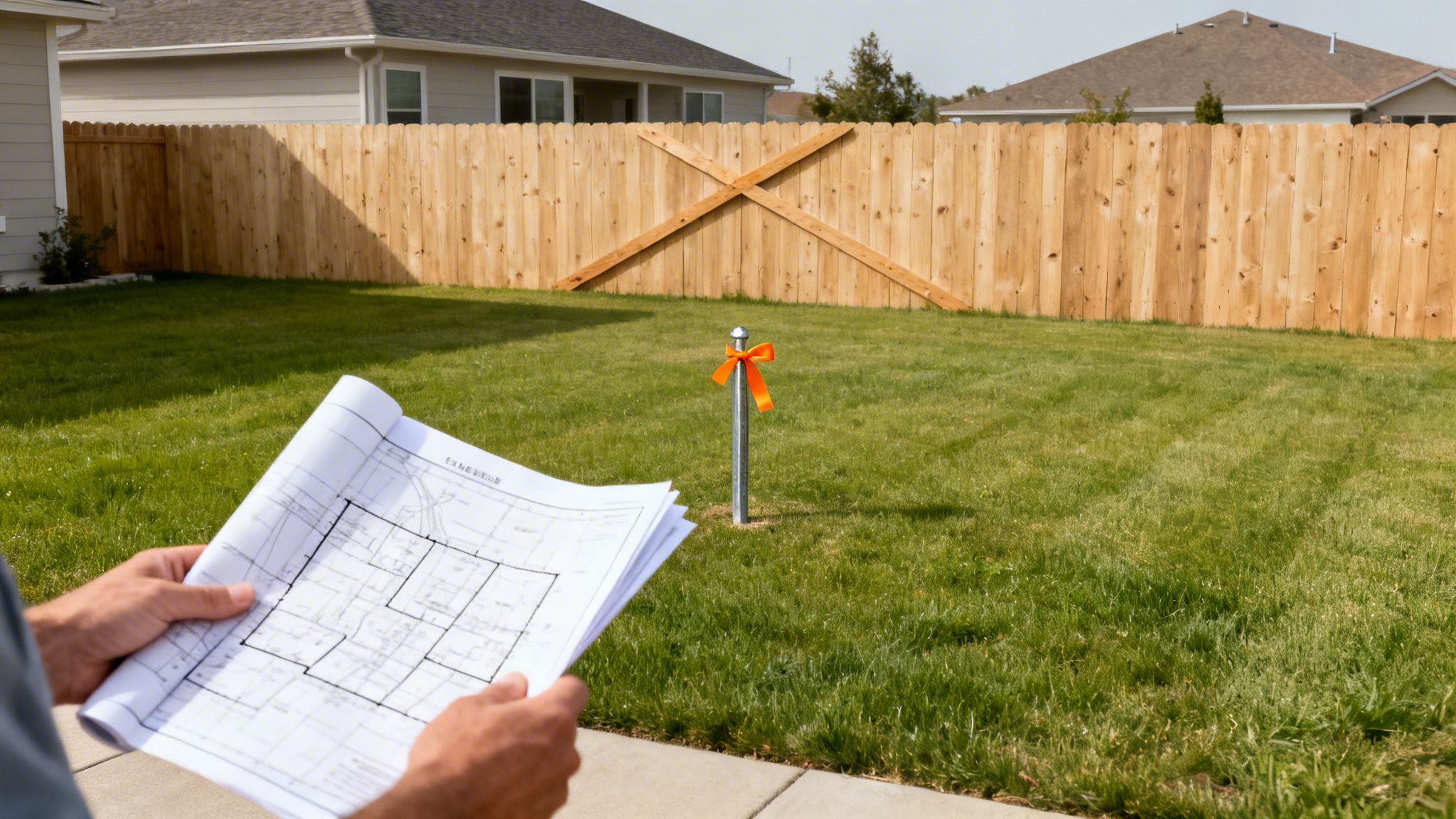
Finding a fence encroaching on your land feels personal. It’s your investment, your space. But before you can protect your rights, you have to know exactly where your rights begin and end.
Guesswork won’t hold up in a legal dispute. You need to build a case, and that starts with cold, hard evidence.
Your First Steps: Get the Facts Straight
This isn’t the time to rely on memory or an old, faded survey from when you bought the house. You need official documentation to protect your rights as a property owner.
The two most important documents you can have are your property deed and a recent, certified property survey. The deed provides the legal description of your lot, but the survey is what maps those words onto the actual ground. It's the visual proof that shows exactly where the boundary line is—and where the fence sits in relation to it.
Property disputes are often won or lost based on the quality of your documentation. A certified property survey is your single most powerful tool in an encroachment case, providing indisputable evidence of your boundary lines.
Getting this survey done before you speak to your neighbor is critical. It moves the conversation from an emotional argument ("I think you're on my land!") to a fact-based discussion ("Here's what a licensed surveyor found.").
This single step protects you, establishes your legal standing under Texas law, and can prevent the entire situation from spiraling out of control.
Was It a Mistake or Intentional?
Believe it or not, many fence encroachments aren't malicious. They’re often the result of an honest mistake during installation.
For example, a neighbor might decide on a weekend project, skip the cost of a survey, and eyeball the property line. It happens more than you’d think. Knowing a little about proper construction can help you figure out if this was an error.
If you want to see how it’s supposed to be done, reviewing a guide on how to install fence posts can give you some useful context. Understanding the process can help you determine if the encroachment was just a simple error.
By being methodical and gathering your facts first, you set the stage for a resolution that’s fair, final, and keeps you out of court.
How to Legally Confirm Your Property Lines in Texas

Before you knock on your neighbor’s door or call a lawyer, your gut feeling needs to become a hard fact. In Texas, winning a property line dispute isn’t about who’s right—it’s about who has proof.
Right now, your thought that "my neighbor's fence is on my property" is just a suspicion. To protect your rights, you must turn that suspicion into indisputable evidence. This is the absolute first step, and everything else depends on it.
What the Texas Property Code Says: Your Most Powerful Tool
While the Texas Property Code doesn't have a specific statute titled "My Neighbor's Fence," it provides the legal framework for property ownership and trespass. The single most important thing you can do to leverage these rights is hire a licensed Texas surveyor to perform a new property survey.
You might have a survey from when you bought the house, but if that document is old, it might not be sufficient. Fences get built, markers get moved, and old surveys can even have mistakes. A brand-new survey gives you a current, legally-defensible map of your property's exact boundaries.
A professional surveyor will come to your property, find the official survey markers, and create a detailed report that clearly shows the legal boundary line and exactly where that fence sits in relation to it.
A certified property survey isn't just a helpful document; it's the strongest piece of evidence you can have. It replaces guesswork with legal certainty and becomes the foundation for every conversation or legal action you take.
Digging Deeper: Your Deed and Plat Map
While the survey is your primary weapon, a couple of other documents will back it up and give you the full picture. You can usually find these in your closing paperwork or get copies from your county clerk's office.
- Property Deed: This legal instrument describes your property in official language, often called "metes and bounds." It's the written definition of what you own.
- Plat Map: This is a map filed with the county that shows how your entire neighborhood or subdivision is carved up into individual lots. It gives you a bird's-eye view of the boundary lines in your area.
Understanding local rules for fence installation permits can also be a game-changer, as permit applications often rely on accurate boundary and setback information.
Once you have a new survey in hand, supported by your deed and plat map, you’re no longer just an upset homeowner. You’re an informed property owner acting from a position of strength, ready to resolve this the right way.
How to Talk to Your Neighbor About the Fence
You have the certified survey in hand. It’s official. The fence is on your property.
Now comes the most critical part—and it’s not a confrontation. It’s a conversation. How you approach this discussion can mean the difference between a simple fix and a costly, stressful legal battle with your neighbor.
Remember, there's a good chance your neighbor has no idea. They might have inherited the fence just like you did. The goal here is to solve a shared problem, not to start a fight.
Starting the Conversation the Right Way
The first words out of your mouth will set the tone for everything that follows. Forget about blame or accusations. You’re simply sharing a surprising discovery.
Try framing it like this:
- "Hey, I had a survey done for a new project, and it turned up something surprising about the fence line. Do you have a minute to take a look at it with me?"
- "Hi there. I was reviewing my property documents and got a new survey, and it looks like the fence might be a bit off. I'd love to show you what I found when you have a free moment."
This approach isn’t aggressive. It frames the encroachment as a mutual issue discovered during a routine task. You’re inviting collaboration, not putting them on the defensive. It's about protecting your property rights while doing everything you can to keep the peace.
Create a Paper Trail (Even After a Friendly Chat)
No matter how well the conversation goes, document it.
A quick follow-up email or a simple letter is all it takes. Summarize what you talked about, when you talked, and what you both agreed to do next. This isn't about being confrontational; it's about creating a clear record of your good-faith effort to resolve this amicably.
Expert Tip: A short, friendly email summary is your best friend if this dispute ever escalates. It should state the date of your chat, the issue you discussed (the fence encroachment), and any next steps. This simple document is invaluable down the road.
If that initial friendly conversation stalls, it might be time to take a more formal step. Understanding how to write a demand letter in Texas is a crucial next move. It formally outlines the problem and the specific action you require, shifting the tone from a neighborly chat to a legal notice.
By handling this first step with a calm strategy, you preserve the relationship and build a solid foundation. You’ve shown that you acted reasonably—something that will only help you if you end up needing a Texas landlord tenant lawyer.
Your Options for Resolving the Fence Dispute
So, the friendly chat didn't work. Your neighbor is either digging in their heels or ignoring you, and their fence is still sitting on your land.
It’s frustrating, but this doesn't mean you have to brace for a full-blown courtroom battle. There’s a smart way to handle this—a path that starts with simple, documented agreements and only escalates if necessary. Here is a step-by-step guide to your options.
Start With Collaborative Written Agreements
If your neighbor isn't hostile—maybe they’re just worried about the cost or hassle—now is the time to propose a solution and get it in writing. A verbal "we'll fix it later" is worth nothing. A signed agreement, however, protects everyone's rights.
Here are a few real-world scenarios and the agreements you can use:
- Boundary Line Agreement: This is the most formal, ironclad solution. You and your neighbor sign a document that officially recognizes the new survey line. Once filed in the county property records, it becomes a permanent part of both your properties’ legal history, binding all future owners.
- Cost-Sharing Agreement: Moving a fence isn't cheap. If your neighbor is willing to move it but can't stomach the cost, offering to split the bill can be a powerful gesture that preserves the peace and gets the fence moved quickly.
- Permissive Use Agreement: This is a more specialized tool. If the encroachment is tiny and doesn’t truly bother you, you can grant your neighbor formal, written permission to leave the fence where it is. This is critical because it stops them from ever making an adverse possession claim. You’re not giving up your land; you’re just giving them revocable permission to use a small piece of it.
This process can be straightforward. You talk, you agree, and it’s solved. Or, if that fails, you seek legal help.
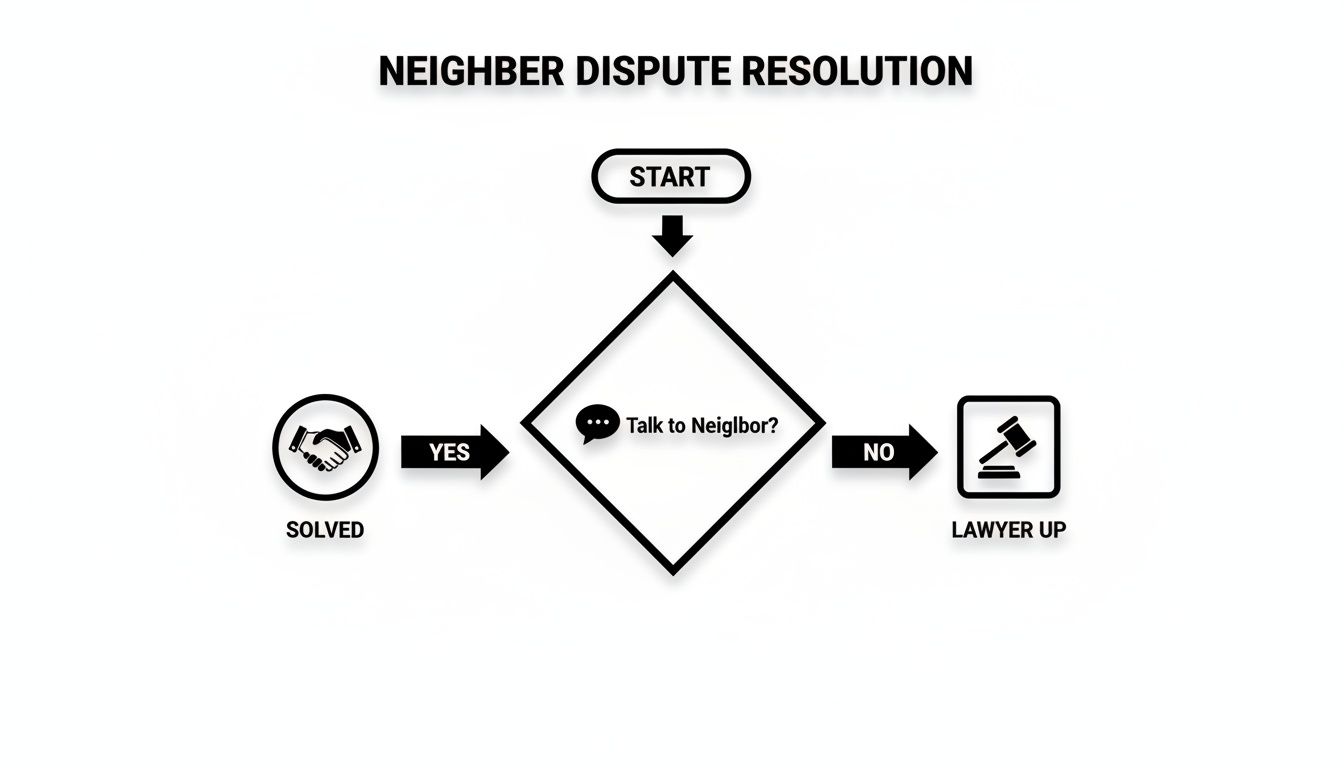
As you can see, the path forks when a simple conversation hits a dead end. That's your cue to formalize your approach.
Escalate to a Formal Demand Letter
When your neighbor just won't cooperate, it's time for an eviction attorney or property lawyer to step in. The next step is a formal demand letter. This isn't just you asking again in a fancy font.
An attorney-drafted demand letter lands with serious weight. It shows you're no longer just asking—you're preparing to enforce your legal rights. It puts them on notice.
When The Law Office of Bryan Fagan, PLLC sends a letter on your behalf, it clearly states the facts backed by your survey, outlines the law of trespass under the Texas Property Code, and explains the legal consequences of their failure to act. Often, this is all it takes.
Consider Mediation Before Litigation
If even a powerful demand letter doesn't produce a result, don't assume a lawsuit is your only option. There's a vital, cost-effective step in between: mediation.
Mediation is a confidential, structured negotiation led by a neutral third party. It’s a chance for you and your neighbor to find a solution without a judge making the decision for you. It is less confrontational and far less expensive than going to court. To see how the process works, check our guide on real estate mediation in Texas.
Comparing Fence Dispute Resolution Methods
| Method | Average Cost | Typical Timeline | Legal Enforceability |
|---|---|---|---|
| Written Agreement | Low (DIY) to $500+ (with attorney) | 1-4 weeks | High (if filed in property records) |
| Demand Letter | $500 – $1,500 | 2-6 weeks | Low (not binding, but signals intent) |
| Mediation | $1,500 – $5,000 | 1-2 months | High (results in a binding contract) |
| Lawsuit | $10,000+ | 6 months to 2+ years | Very High (results in a court order) |
A successful mediation ends with a legally binding settlement agreement signed by both parties. It’s a powerful way to resolve the fence issue for good, all while avoiding the costs and stress of a lawsuit.
When You Need to Take Legal Action

You’ve tried everything: friendly talks, polite written requests, and maybe even mediation. And yet, your neighbor’s fence is still sitting on your land. When informal discussions fail, it’s time to use the full force of Texas law to protect the property rights you’ve worked so hard for.
When a neighbor’s fence is on your property, they are legally trespassing. The Texas court system provides clear, powerful remedies for this situation.
What the Texas Property Code Says About Your Legal Options
When a neighbor simply won't cooperate, a lawsuit is your formal request for a judge to step in and enforce the law. In Texas, you have two primary legal paths for reclaiming your land from an encroaching fence.
- Trespass to Try Title: This is a specific type of Texas lawsuit designed to determine who has superior ownership rights to a piece of land. You're essentially asking the court to make an official declaration: "This strip of land belongs to me, not my neighbor."
- Quiet Title Action: This action is used to clear up any "clouds" on your property's title. An encroaching fence is a classic example of a cloud, and this lawsuit asks a judge to remove it by affirming your undisputed ownership.
Both lawsuits have the same goal: a court order that validates your property survey and legally forces your neighbor to remove the trespassing structure.
The Danger of Waiting: Adverse Possession in Texas
One of the biggest reasons to act decisively is a legal doctrine called adverse possession—also known as "squatter's rights." It’s a real threat, and waiting too long can have permanent consequences for your property rights.
Under the Texas Civil Practice & Remedies Code, Section 16.021, if someone openly occupies and uses property they don't own for a continuous period (often 10 years), they can potentially make a legal claim to own it.
By allowing your neighbor's fence to sit on your property without a formal, legal objection, you could be starting the clock on an adverse possession claim. Filing a lawsuit stops that clock cold and reasserts your ownership.
Real-World Scenario: A landlord in San Antonio discovered that a fence from an adjacent business was blocking access for his tenants. The business refused to move it. The landlord had to file a lawsuit to force its removal. If he had waited several more years, he could have risked losing that part of his commercial lot forever.
Taking action protected his investment and his tenants' rights. For co-owners dealing with similar disputes, our article on partition actions in Texas may also be helpful.
Filing a lawsuit is a serious step, but when facing an uncooperative neighbor and the risk of losing your land, hiring a Texas landlord tenant lawyer is a necessity.
Common Questions About Texas Fence Disputes
When you find a neighbor's fence on your land, it's natural to have questions. As property law attorneys, we've guided countless Texas homeowners through this situation. Here are straight answers to the concerns we hear most often.
How Much Does a Property Survey Cost in Texas?
You can expect a residential property survey in Texas to cost somewhere between $450 and $1,200. The final price depends on the size of your lot, its location, and the complexity of the property lines. While it's an unexpected expense, that survey is the single most powerful piece of evidence you can have. It can save you thousands in legal fees by settling the matter quickly.
Can My Neighbor Actually Claim My Land?
Yes, under a legal concept called adverse possession, or "squatter's rights." For a claim to succeed, your neighbor would have to prove they’ve been using your property openly and without your permission for a long time—usually 10 years in Texas under the Texas Property Code. This is why you can't afford to ignore an encroaching fence. Formally objecting in writing stops their clock and protects your tenant rights and property rights.
An encroaching fence is more than an annoyance. It’s the first step toward a potential adverse possession claim. Taking action, like sending a formal letter, is the best way to protect your land.
What if the Fence Was Already There When I Bought My House?
It doesn't matter. The fence being there when you moved in doesn't change the legal boundary line. It is now your problem to solve. Your first step is still the same: get a new survey to confirm where your property ends. It’s also a good idea to review your title insurance policy. While many policies exclude boundary disputes, some might offer coverage. Either way, you have every right to address the encroachment now.
How Does This Affect Me as a Landlord?
For landlords, a neighbor's fence on your property is also a tenant issue. It can interfere with your tenant's right to "quiet enjoyment" of the property they are paying for. It might shrink their yard, block access, or even create a safety hazard. This can lead to tenant complaints, demands for reduced rent, or even a legal reason for them to break their lease. Under the Texas Property Code, it’s your responsibility as the property owner to fix the boundary issue and deliver what your lease promises.
If you need help with an eviction, lease issue, or rental dispute, contact The Law Office of Bryan Fagan, PLLC for a free consultation today.