Dealing with a landlord dispute or eviction can be stressful — but understanding your rights under Texas law can make all the difference. The stress can be overwhelming, but you have rights laid out in the Texas Property Code. Knowing these rules—specifically Chapters 91 and 92—is your best defense. This guide isn't filled with dense legal jargon. It’s a straightforward breakdown to help you navigate property disputes, leases, and evictions with confidence.
What the Texas Property Code Says About Your Rights
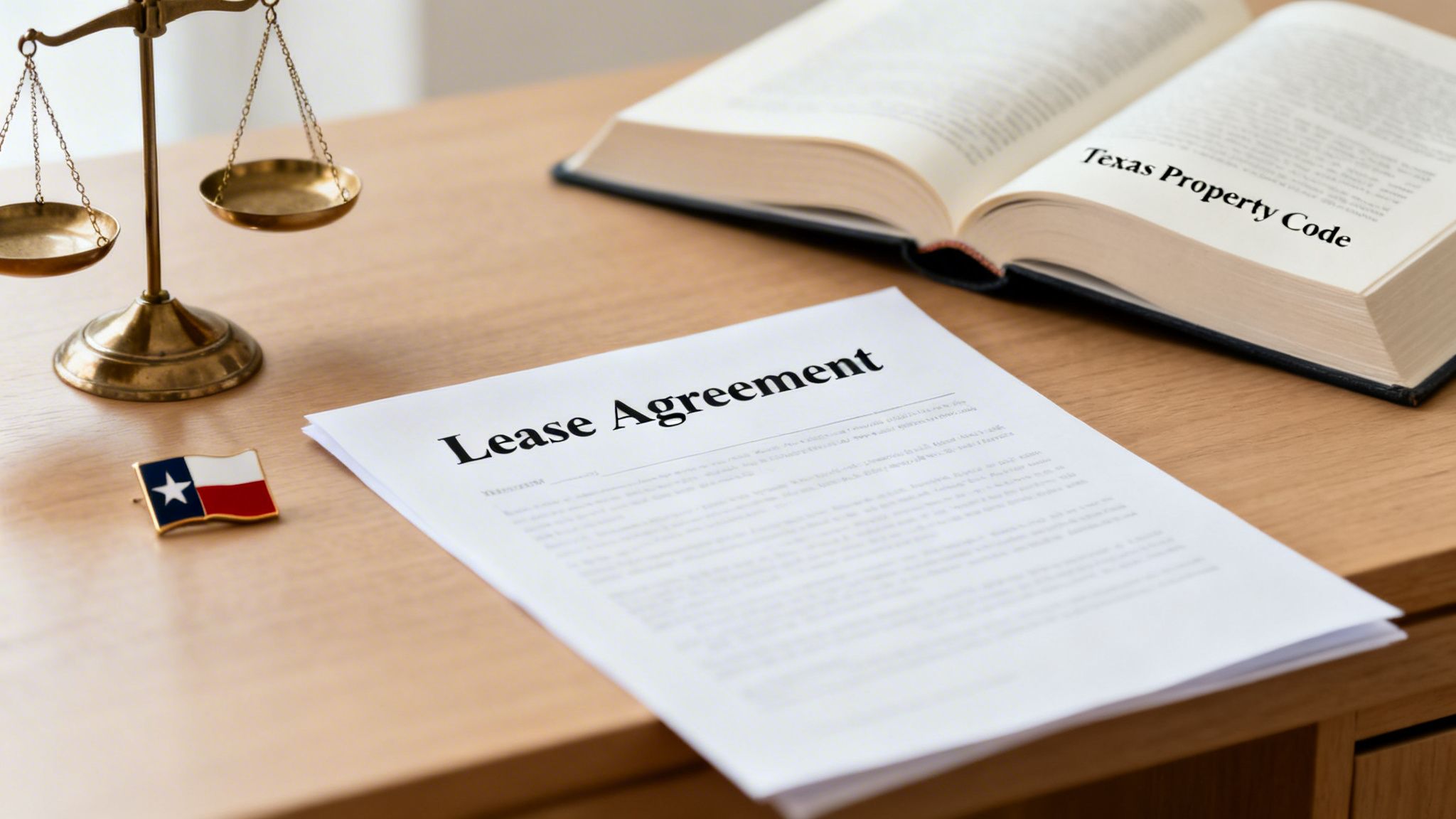
Whether you’re a tenant fighting for your rights or a landlord protecting your investment, the Texas Property Code is the official rulebook for your relationship. It sets clear duties, deadlines, and solutions for the problems that inevitably arise. Trying to handle a legal issue without understanding these rules is a recipe for disaster. One wrong move could cost you your home or your investment.
At The Law Office of Bryan Fagan, PLLC, we’ve seen how quickly these disputes can spiral out of control. Our experienced Texas landlord tenant lawyers believe that understanding the law is the first step to resolving them. This guide is built to give you the practical knowledge you need, whether you’re in Houston, Dallas, or anywhere else in Texas.
What This Guide Covers
Think of this article as your roadmap. We’re breaking down the most critical parts of the Texas Property Code into simple, actionable information. You will learn about:
- Lease Agreements: The key differences between written and oral leases and what makes them legally binding.
- Repairs and Habitability: The proper steps to request repairs and ensure your landlord meets their legal obligations.
- Security Deposits: The strict rules landlords must follow when returning your deposit and what legally counts as "normal wear and tear."
- The Eviction Process: A step-by-step look at the entire process, from the initial notice to the final court hearing.
Real-World Scenarios and Practical Advice
Legal codes can feel abstract until you see how they work in real life. We’ll use clear examples to show you how these laws apply to your situation.
- Scenario: A tenant in Austin has a broken air conditioner in August. What are their exact legal steps to get it fixed?
- Scenario: A landlord in San Antonio needs to deduct from a security deposit. How must they document the damages to comply with the law?
These examples will make your legal options—and the consequences of your choices—crystal clear.
The Texas Property Code isn’t just for lawyers. It’s a powerful tool for every renter and landlord. Knowing simple facts, like the 30-day deadline for security deposit returns or that repair requests must be in writing, gives you a massive advantage in any dispute.
Our firm is committed to protecting the property rights of Texans. We take the knowledge of a seasoned Texas landlord tenant lawyer and make it accessible. As you read, you’ll gain a clearer understanding of your rights and responsibilities. For a deeper dive, you can also explore specific Texas Property Code tenant rights in our detailed article.
If you’re facing an eviction, a lease dispute, or a fight over your deposit, don’t go it alone. An experienced eviction attorney can make all the difference.
How to Legally Handle Leases and Rent in Texas
The lease you sign is more than just paperwork; it is the foundation of your entire relationship with your landlord. Whether you're in Houston, Austin, or a small Texas town, that document lays out the rules for both of you. Getting it right from the start can prevent a world of headaches down the road.
A handshake deal might seem simpler, but it can get messy. While oral leases for a term of one year or less are legally recognized in Texas, they often lead to a "he said, she said" battle. A written lease is your best protection—it’s clear, provable, and leaves no room for confusion when disagreements arise.
The Power of a Written Lease
Imagine this: You agree to a one-year lease in Dallas over the phone. Six months in, your landlord decides they want you out, claiming it was only a month-to-month tenancy. Without a signed document, you're left scrambling to prove the original deal. It’s your word against theirs.
A solid, well-drafted lease avoids this drama by putting everything in black and white:
- The exact length of your lease term.
- Your monthly rent amount and the specific due date.
- Rules on pets, property alterations, or long-term guests.
- Any penalties for paying rent late.
A clear lease doesn't just protect the landlord's property; it protects your right to live there peacefully. This is where a Texas landlord tenant lawyer can be invaluable—they can draft or review a lease to make sure it’s fair, legal, and fully protects you under the Texas Property Code.
What the Texas Property Code Says About Rent and Late Fees
The Texas Property Code has specific rules about when and how a landlord can charge you for paying rent late. Even if your lease says rent is due on the 1st, your landlord can't charge you a late fee on the 2nd.
According to Section 92.019 of the Texas Property Code, a landlord can’t charge a late fee until your rent is overdue by at least two full days. Furthermore, the fee itself must be "reasonable." It’s meant to cover the landlord's actual costs due to the late payment, not to act as a punishment. A fee around 10-12% of the monthly rent is typically considered reasonable.
This means landlords can’t just invent a number. A $500 late fee on a $1,200 rent payment, for instance, is almost certainly excessive and would likely not hold up in court.
Rent Increases and the Lack of Rent Control in Texas
It's critical to understand that Texas does not have rent control. Once your lease term ends, landlords have the right to raise the rent to whatever the current market rate is. For month-to-month renters, Section 91.001 of the Texas Property Code generally requires landlords to provide at least 30 days' written notice before an increase takes effect.
This policy has a significant impact, especially in high-demand markets like Austin and Dallas. The law gives landlords considerable flexibility, preventing cities from capping rent unless a statewide housing emergency is declared—an extremely rare event. This landlord-friendly environment can be a major benefit for property owners, but it also makes it essential for tenants to have leases with clear, fair notice clauses for rent hikes.
If you’re facing a massive rent increase or feel trapped by unfair lease terms, you aren’t alone. An experienced eviction attorney can help you understand your rights and explore your options.
Your Right to a Safe and Habitable Home
There’s nothing more frustrating than dealing with a landlord who ignores your requests to fix a serious problem. You are paying rent, and in return, you have a right to a safe place to live.
Under the Texas Property Code, this is a legal right known as the "implied warranty of habitability." It means your landlord has a fundamental duty to provide a home that is safe, secure, and sanitary. The law is there to ensure the property you rent doesn't put your physical health or safety at risk.
What Is a Landlord Required to Fix?
Texas Property Code § 92.052 states that a landlord must repair any condition that “materially affects the physical health or safety of an ordinary tenant.” This doesn’t cover minor cosmetic issues like scuffed paint. It applies to serious problems that make your home unsafe.
Common issues that legally require a landlord’s attention include:
- A broken air conditioner during a hot Texas summer.
- A leaking roof causing water damage and creating a risk of mold.
- A failed water heater leaving you with no hot water.
- Serious pest infestations, such as roaches, rats, or bedbugs.
- Broken locks on doors or windows that compromise your security.
To prevent these issues, responsible landlords often use a Landlords' Property Inspection Checklist to identify and address problems proactively.
How to Legally Request Repairs in Texas
If you need a repair, a quick phone call or text is not enough to legally protect your rights. This is a critical mistake many tenants make. To trigger your landlord's legal duty to fix the problem, the Texas Property Code requires you to follow a specific process.
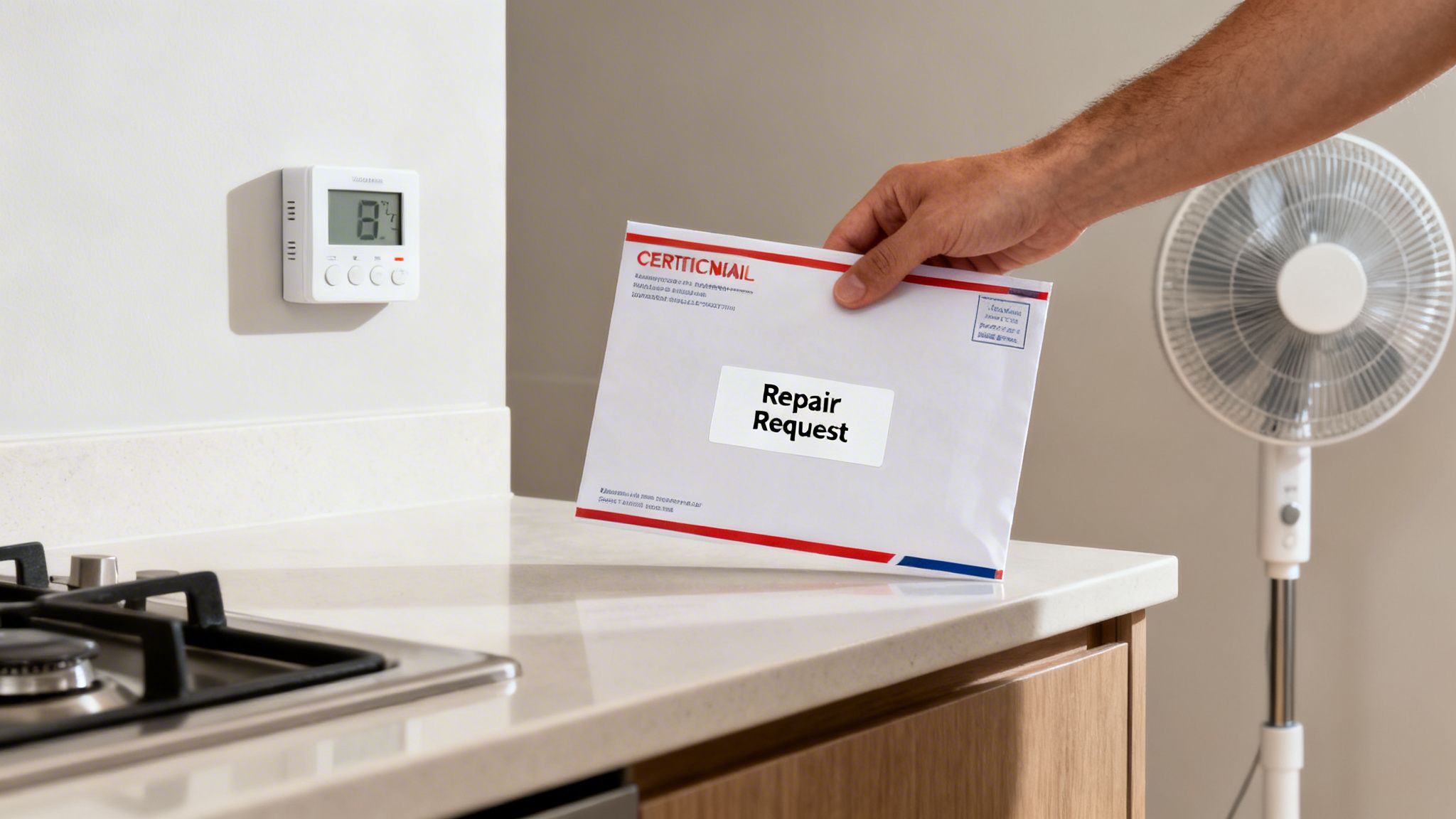
Crucial Step: Your repair request must be in writing. The best method is to send it via certified mail with a return receipt requested. This creates an official paper trail that proves your landlord received the notice and, just as importantly, when they received it.
This receipt is your best evidence if you end up in a dispute. A phone call can be forgotten and a text can be deleted, but a certified mail receipt is hard to deny in court.
Step-by-Step Guide to the Tenant Repair Request Process
Failing to follow the correct legal steps can undermine your rights. Here's the process required under Texas law.
| Step | Action Required | Key Detail (Texas Property Code § 92.056) |
|---|---|---|
| 1. Give Written Notice | Send a formal, written request for repair. | Must be sent via certified mail (return receipt requested) for the strongest proof. You must be current on your rent. |
| 2. Wait a "Reasonable Time" | Allow the landlord a reasonable period to make the repair after receiving the notice. | "Reasonable" depends on the urgency. A week may be standard, but urgent issues (like no heat in winter) require a faster response. |
| 3. Send a Second Notice | If the landlord fails to act, send a second written notice stating your intent to use your legal remedies. | This second notice is a mandatory legal requirement before you can use remedies like "repair and deduct" or lease termination. |
| 4. Exercise Your Remedies | Only after the second notice and another reasonable waiting period can you pursue your legal options. | Options include terminating the lease, suing the landlord, or (very cautiously) using the "repair and deduct" remedy. |
Following these steps is the only way to ensure your actions are legally protected if your landlord continues to neglect their responsibilities.
The Dangers of the 'Repair and Deduct' Remedy
You may have heard that if your landlord won't make repairs, you can pay for them yourself and deduct the cost from your rent. In Texas, this is known as the "repair and deduct" remedy, and it is extremely risky for tenants who do not follow the law perfectly.
Under Texas Property Code § 92.0561, you must meet several specific conditions. For example, the repair cost cannot exceed one month's rent or $500, whichever is greater, and you must have given the landlord a second, follow-up notice. If you get even one step wrong, your landlord can sue you for unpaid rent and begin the eviction process immediately.
Even riskier is withholding rent entirely. You must stay current on your rent payments, even if your landlord is failing in their duties. Refusing to pay rent is a direct breach of your lease and gives your landlord a clear reason to evict you. Don't let a repair issue turn into an eviction notice. A qualified Texas landlord-tenant attorney can guide you toward safer, more effective solutions.
How to Get Your Security Deposit Back in Texas
It’s one of the most common and frustrating experiences for a tenant. You move out, clean the property, and return the keys. Then you wait, only to find out your landlord has kept part, or even all, of your security deposit.
While a deposit protects the landlord, it is not their money to keep without a valid reason. The Texas Property Code provides strict rules they must follow. Knowing these rules is the first step in protecting your money and fighting back if a landlord tries to wrongfully withhold it.
The Landlord’s 30-Day Deadline
Here’s the most important rule you need to know: Under Texas Property Code § 92.103, your landlord has exactly 30 days after you move out to either refund your full security deposit or provide a written, itemized list of deductions. This is a hard legal deadline.
However, to start that 30-day clock, you have one critical task:
You must give your landlord a written forwarding address. This is non-negotiable. If you don't provide it, the landlord’s 30-day obligation is paused. Always send this address via certified mail to create a paper trail and prove you fulfilled your duty.
Once that address is delivered, the ball is in their court. If day 31 arrives and you don’t have your money or a detailed explanation for the deductions, the landlord may be acting in "bad faith," which opens them up to serious legal penalties.
What Can a Landlord Legally Deduct?
So, what is a legitimate reason for a landlord to withhold part of your deposit? Section 92.104 of the Texas Property Code allows deductions for which a tenant is legally responsible. This generally includes:
- Unpaid Rent: Any rent you still owe when you move out.
- Property Damage: This means damage beyond normal use, like large holes in the wall, broken fixtures, or pet stains that have soaked through the carpet.
- Cleaning Costs: A landlord can only charge for cleaning if you leave the property significantly dirtier than you found it, requiring more than a standard turnover cleaning.
Crucially, landlords are legally forbidden from charging you for "normal wear and tear." This refers to the natural decline that occurs from simply living in a property over time. For a complete overview, check out our guide on security deposit laws in Texas.
Real-World Scenarios: Damage vs. Normal Wear and Tear
Understanding this difference is key to getting your full deposit back. Let's compare two scenarios.
| Tenant A (Normal Wear and Tear) | Tenant B (Actual Damage) |
|---|---|
| Carpets: Are slightly worn down in main walkways with minor fading from sunlight. | Carpets: Have large wine stains, cigarette burns, and pet urine spots. |
| Walls: Have a few small nail holes from hanging pictures and minor scuffs near doorways. | Walls: Have a large hole from moving furniture and crayon drawings in the living room. |
| Cleaning: Left the unit "broom clean," with floors swept and counters wiped down. | Cleaning: Left behind trash, rotting food in the fridge, and a filthy bathtub. |
Tenant A's landlord would struggle to justify deductions. Faded carpets and a few nail holes are expected from living in a home. Tenant B, however, caused actual damage beyond normal use. Their landlord can legally use the deposit to pay for repairs and deep cleaning.
If your landlord misses the 30-day deadline or withholds your deposit for what you believe is normal wear and tear, they may be acting in bad faith. Section 92.109 of the code is powerful: a tenant who has been wronged can sue for three times the amount of the wrongfully withheld deposit, plus court costs and attorney's fees. If you're in this fight, a Texas landlord tenant lawyer can help you demand what you're owed.
Step-by-Step Guide to the Texas Eviction Process
Receiving an eviction notice can be a frightening and overwhelming moment. But before panic sets in, it's vital to understand that eviction is a legal process with strict rules laid out in the Texas Property Code.
A landlord cannot simply change the locks or throw your belongings onto the curb. They must follow every step of the law, or the eviction may be invalid. Knowing this process is your first line of defense, whether you are a tenant fighting to stay in your home or a landlord ensuring you are acting legally.
Step 1: The Notice to Vacate
The eviction process always starts with a formal, written "Notice to Vacate." Under Texas Property Code § 24.005, this is a mandatory first step.
The most common reason for eviction is unpaid rent. In that case, your landlord must give you at least a three-day notice to pay what you owe or move out. The day you receive the notice and the day you must leave do not count, giving you three full days to respond.
Other common reasons for eviction include:
- Lease Violations: Such as having an unapproved pet, causing serious property damage, or conducting illegal activity.
- Holding Over: Remaining in the rental after your lease has ended without the landlord's permission.
How you receive this notice is important. It must be delivered in person (to you or someone 16 or older at the home), taped to the inside of your front door, or sent by mail. A text or email is generally not sufficient unless your lease specifically allows it.
Step 2: Filing the Eviction Lawsuit
If you haven’t moved out or resolved the issue by the end of the notice period, your landlord’s next step is to file an eviction lawsuit, officially called a "Forcible Detainer" suit, in court.
This lawsuit is filed in the Justice of the Peace (JP) court for the precinct where the property is located. At this point, the dispute becomes an official legal case.
After the lawsuit is filed, a constable or sheriff will serve you with a citation. This formal court document informs you that you are being sued for eviction and specifies the date and location of your court hearing. You have the right to appear and defend yourself.
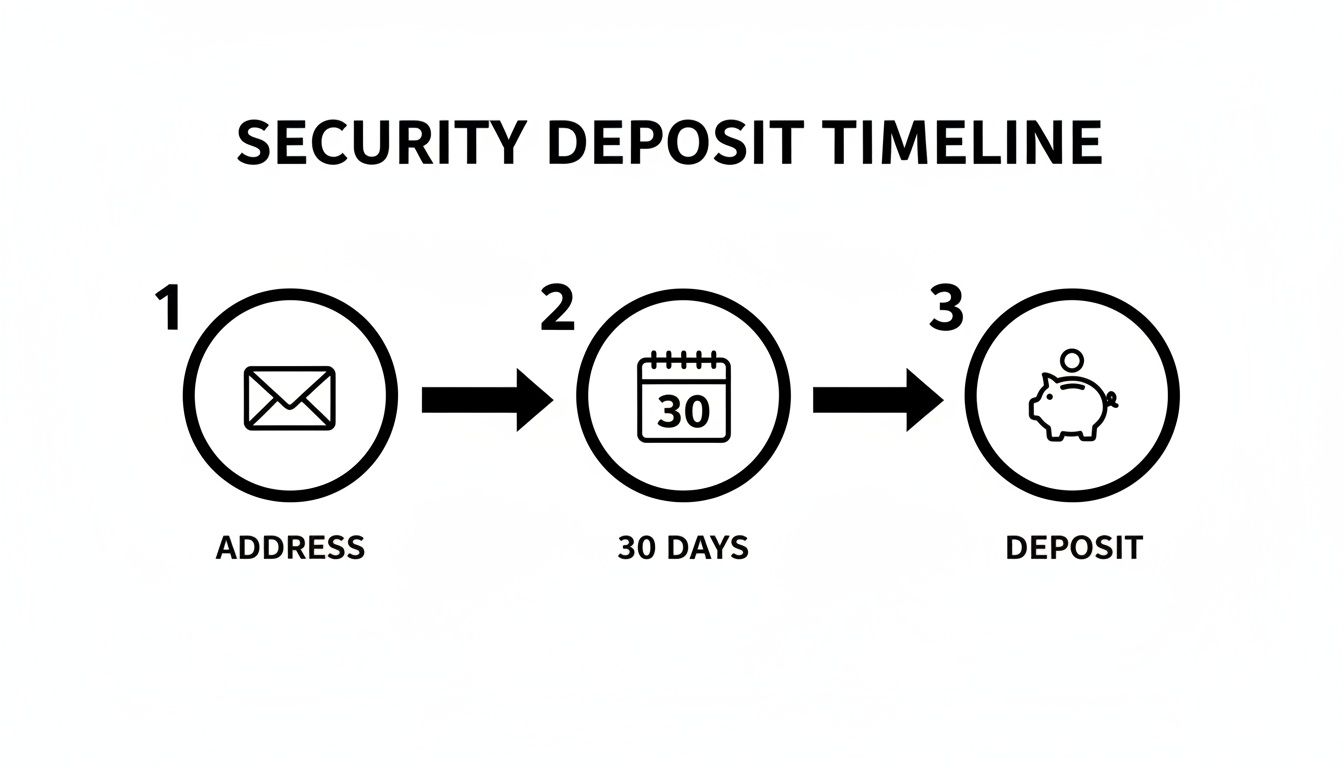
Just as the law dictates strict timelines for an eviction, it also governs other deadlines. The 30-day clock for a landlord to return a security deposit is a perfect example of how these timelines are crucial in Texas landlord-tenant law.
Step 3: The Court Hearing and Judgment
At the hearing, both you and your landlord will present your sides of the story to the judge. The landlord has the burden of proving they have a legal right to evict you. You, in turn, can present any defenses you may have.
For example, you might have receipts proving you paid the rent, or perhaps you can prove the eviction is illegal retaliation for requesting essential repairs. This is your opportunity to make your case.
If the judge rules in the landlord's favor, they will issue a judgment for possession. If you lose, you have five days to appeal the decision. If you do not appeal, the landlord can request a "Writ of Possession," a final court order authorizing a constable to physically remove you and your belongings from the property. You can learn more in our complete guide on the eviction process in Texas.
A major change is coming to Texas eviction law. Starting January 1, 2026, new legislation will dramatically speed up the process. It creates a "rocket docket" requiring trials to occur between 10 and 21 days from filing. It also introduces a "first-time grace rule" for one late rent payment and allows for electronic notices, making solid documentation more critical than ever for both landlords and tenants.
Navigating an eviction alone is incredibly risky. An experienced eviction attorney is your best ally in protecting your rights every step of the way.
What to Do When a Landlord Crosses the Line
Most landlords follow the law. But when one doesn't, it can leave you feeling harassed, helpless, and worried about losing your home.
The Texas Property Code is your shield. Knowing your rights is the single best defense you have when a landlord’s actions feel more like an attack than a simple disagreement. It’s important to recognize when a landlord's actions are not just unfair, but illegal.
What Is Landlord Retaliation?
It’s a situation no tenant wants to face: you exercise your legal rights, perhaps by sending a formal request for a critical repair, and you are suddenly hit with an eviction notice. This is rarely a coincidence. It is often illegal retaliation.
Under Texas Property Code § 92.331, a landlord is explicitly forbidden from punishing a tenant for exercising their legal rights. The law is so clear on this point that if your landlord tries to evict you, raise your rent, or reduce services within six months of you taking a protected action, it is automatically presumed to be retaliation.
This powerful protection applies when you have, in good faith:
- Requested necessary repairs that your landlord is legally required to make.
- Filed a complaint with a government agency about a health or safety violation.
- Established or participated in a tenant organization.
Scenario: Your air conditioner breaks in July. You follow the law and send a certified letter requesting a fix. A week later, you receive a notice terminating your lease for a vague, unfounded reason. A Texas landlord tenant lawyer would immediately recognize this as a classic case of retaliation, giving you a powerful defense to stop the eviction.
Your Right to Privacy and Quiet Enjoyment
Your rental is your private home. A landlord cannot simply enter whenever they wish. While your lease likely gives the landlord the right to enter for legitimate reasons—like emergencies, repairs, or showing the property—they must respect your privacy.
Texas law does not set a statewide, mandatory notice period, but a standard lease will typically require at least 24 hours' notice for non-emergency visits. If your landlord is showing up unannounced, sending harassing messages, or entering without a valid, urgent reason, they are crossing a serious line.
This behavior violates your right to "quiet enjoyment" of your home. If this happens, start a log immediately. Document the date, time, and details of every unannounced visit or harassing communication. This log is your best evidence if you need to take legal action.
The Difference Between a Tenant and a Squatter
It’s also crucial to understand the sharp legal distinction between a tenant with a lease and a person with no right to be on the property—often called a squatter.
Recent changes to Texas law have created faster ways for property owners to remove individuals who are trespassing. However, these laws do not apply to legitimate tenants. If you have a lease, you are protected by the formal eviction process. An eviction attorney can defend your rights and fight back if a landlord wrongly tries to label you an unauthorized occupant to bypass the proper legal procedures.
Common Questions About Texas Landlord-Tenant Law
When you're in a dispute with your landlord, it can feel like everything is on the line. But knowing your rights under the Texas Property Code is the first step to taking back control. Here are clear, practical answers to some of the most common questions we hear from tenants across Texas.
Can My Landlord Charge Any Late Fee They Want?
No. A landlord cannot invent an arbitrary fee to punish you for paying late. Under Texas law, any late fee must be a "reasonable estimate" of the actual costs the landlord incurred because your rent was not on time. While the Texas Property Code doesn't set a hard cap, courts generally consider 10-12% of your monthly rent as the upper limit of what is reasonable. You can challenge an excessive fee.
What If My Landlord Keeps My Security Deposit Past the 30-Day Deadline?
The law is very clear on this. Once you've moved out and provided your landlord with a forwarding address in writing, they have exactly 30 days to either return your full deposit or give you a written, itemized list of deductions. If they miss that deadline, they may be acting in "bad faith." Texas Property Code § 92.109 gives you the right to sue for three times the amount of the deposit they wrongfully withheld, plus your attorney's fees. This is one of the strongest tenant rights protections in Texas law.
Do I Have to Pay Rent If My Landlord Won't Make Repairs?
Yes, you must stay current on your rent. This is absolutely critical. Withholding rent is one of the biggest mistakes a tenant can make, as it immediately puts you in breach of your lease and gives your landlord a direct path to evict you, regardless of their failure to make repairs. To legally address the issue, you must follow the correct procedure, which starts with sending a formal repair request by certified mail. If the landlord still fails to act, you have other legal options, but stopping rent payments without first consulting an experienced eviction attorney will almost always backfire.
If you need help with an eviction, lease issue, or rental dispute, contact The Law Office of Bryan Fagan, PLLC for a free consultation today.