Dealing with a landlord dispute or eviction can be stressful—but understanding your rights under Texas law can make all the difference. When you're facing a rent hike or just trying to figure out what’s "fair," the confusion can be overwhelming. One term you’ll hear is Fair Market Rent (FMR). But what is it, really?
It’s not just some number pulled out of thin air. Think of FMR as an official benchmark—a measuring stick used to gauge reasonable rent prices in Texas, especially when things get complicated. Understanding it can empower you and protect your rights.
What Is Fair Market Rent and Why Does It Matter in Texas?

Whether you're a landlord setting prices or a tenant protecting your rights, understanding Fair Market Rent is critical. It’s a key piece of the puzzle in the Texas rental landscape and a term any good Texas landlord tenant lawyer knows inside and out.
FMR is a figure published by the U.S. Department of Housing and Urban Development (HUD). It’s calculated to reflect the cost of a safe, decent, and modest rental unit in a specific local area. It’s important to know that FMR is not the same as "market rent"—which is simply what a landlord can get on the open market based on pure supply and demand.
What the Texas Property Code Says About FMR’s Role
When you’re dealing with a dispute under the Texas Property Code, FMR becomes a powerful tool. It provides an objective, third-party standard that can bring clarity and fairness to a disagreement, protecting your property rights.
- For Tenants: FMR can be your best defense against a retaliatory rent hike. It's also used to calculate damages if your landlord fails to make repairs and the property becomes uninhabitable. It helps prove what you should have been paying for a safe home.
- For Landlords: This figure helps you prove your rent is reasonable and in line with local standards, protecting you from claims of price gouging. Knowing your area's FMR is also a key part of simplifying landlord bookkeeping and setting sustainable prices.
Real-world scenario: Imagine you ask your landlord in writing to fix a serious mold issue. A week later, you receive a notice that your rent is increasing by 40%. A judge can compare this new rent to the local FMR. If your new rent is far above the FMR, it strengthens your case that the hike is illegal retaliation, not a standard market adjustment.
Getting a handle on FMR isn't just about learning a new term. It's about empowering yourself with the knowledge to make smarter decisions. As you get more familiar with Texas lease agreement laws, you’ll start to see just how FMR fits into the bigger picture of your rights and obligations.
How Fair Market Rent Is Calculated and What It Includes

When you see a Fair Market Rent (FMR) figure, it’s easy to wonder where that number comes from. It isn't just pulled out of thin air. It’s the result of a massive, detailed process run by the U.S. Department of Housing and Urban Development (HUD) to figure out local housing costs. This process ensures objectivity when assessing your rights.
Each year, HUD crunches an enormous amount of data for every single metropolitan area and county in the nation, including every corner of Texas. Their goal? To set a realistic benchmark for what it costs to rent a modest, safe, and clean apartment—not a luxury high-rise. Before we get into the nuts and bolts for leases, it helps to first understand the bigger picture of what determines a property's fair market value.
What Is Included in the Calculation
The FMR number isn’t just about the base rent. It's meant to be an all-in estimate of what you, the tenant, actually pay for basic, livable housing.
Here’s what gets factored in:
- Base Rent: This is the foundational monthly cost a landlord charges just for the unit itself.
- Essential Utilities: The FMR also includes an allowance for the utilities you can’t live without. This typically covers electricity, gas for heating and cooking, and water.
What’s just as important is what’s left out. To keep the focus strictly on affordable housing, things like your cable TV, internet bill, or phone service are not included. HUD also intentionally filters out data from high-end, brand-new, or amenity-packed luxury apartments that would throw off the average.
Fair Market Rent (FMR) is a critical benchmark set by the U.S. Department of Housing and Urban Development (HUD) to represent the 40th percentile of gross rents for standard-quality rental units in a specific area. In simple terms, this means that in any given market, 40% of modest apartments rent for less than the FMR, while 60% rent for more. This provides a solid, realistic gauge of what affordable housing actually costs, which is vital for protecting your tenant rights.
The Data Behind the Number
So, where does HUD get all this information? The main source is the American Community Survey (ACS), a massive, ongoing survey conducted by the U.S. Census Bureau that gathers detailed housing data straight from renters.
HUD takes this raw survey data to establish a "base rent" for a standard two-bedroom apartment in a specific area. But they don't stop there. They make several key adjustments for things like inflation and recent local market trends to make sure the final number is as current as possible.
From that two-bedroom benchmark, HUD then calculates the FMR for other unit sizes, like studios and three-bedroom homes. This systematic approach creates a consistent, data-driven standard that both landlords and tenants can rely on across Texas.
Fair Market Rent vs Market Rent in Texas
It’s one of the most common points of confusion for Texas tenants and landlords—and getting it wrong can cost you. Are “fair market rent” and “market rent” just two ways of saying the same thing?
Absolutely not.
While they sound similar, these terms represent two completely different concepts of a property's rental value. Understanding how they work is critical to protecting your rights and your finances under Texas law.
Think of market rent as the going rate—what a property can get on the open market right now. It’s all about supply and demand. It’s what tenants in a specific neighborhood are willing to pay for a unit with a certain number of bedrooms, similar amenities, and a comparable location. Market rent can swing wildly depending on things like new employers moving to town or a change in school district ratings.
Fair Market Rent (FMR), on the other hand, isn’t about what the trendiest apartment complex can charge. It's a formal figure calculated by the U.S. Department of Housing and Urban Development (HUD). Its purpose is to define the cost of modest, safe, and clean housing in a specific area—not luxury living.
Fair Market Rent vs Market Rent vs Contract Rent
To really get a handle on this, it helps to see all three key rent terms side-by-side. Each one plays a distinct role in a Texas lease agreement and any potential disputes that might come up.
| Term | Definition | How It's Determined | Primary Use in Texas |
|---|---|---|---|
| Fair Market Rent (FMR) | A government statistic representing the cost of modest, safe housing in a metro area or county. | Calculated annually by HUD using census data and local surveys. | A legal benchmark for affordability, used in housing assistance programs and as evidence in tenant-landlord disputes. |
| Market Rent | The going rate for a comparable property in a specific location, based on current supply and demand. | Set by landlords and property managers based on what similar units are currently renting for. It’s what the market will bear. | Landlords use it to set asking prices for vacant units to maximize their return on investment. |
| Contract Rent | The actual dollar amount you are required to pay each month as specified in your signed lease agreement. | The result of a negotiation between the landlord and tenant, documented in the written lease. | The legally binding rent amount that governs the landlord-tenant relationship for the term of the lease. |
Ultimately, market rent is what a landlord wants to charge, contract rent is what you agreed to pay, and Fair Market Rent is what the government considers a reasonable baseline for housing costs in your area.
How This Plays Out in Real Life
So, why does FMR matter if a Texas landlord is free to charge whatever the market will bear? Because in a dispute, FMR provides powerful context. It helps a judge distinguish between a legitimate business decision and an illegal, punitive action.
Let's look at a common scenario.
Real-World Example: You’ve lived in your Dallas apartment for years and are a model tenant. You submit a formal, written request for the landlord to fix a serious plumbing leak. A week later, you get a notice that your rent is increasing by 30% at renewal—a figure that puts your new rent far above the published FMR for your area.
A landlord can propose any rent increase they want. But the FMR gives you a powerful tool to fight back.
An experienced Texas landlord-tenant lawyer can use this discrepancy as evidence. We can build a case arguing that such a steep increase, coming right after you legally exercised your right to request repairs under the Texas Property Code, isn’t a market adjustment. It’s a classic case of illegal landlord retaliation, and the FMR helps prove it by showing just how unreasonable the new rent truly is.
How Fair Market Rent Plays Out in a Texas Courtroom
Most people think of Fair Market Rent (FMR) as just another government number. But when a landlord-tenant dispute lands in a Texas court, that number transforms. It becomes a powerful, objective benchmark a judge can lean on to figure out what’s fair when everything else feels personal and heated.
For both tenants and landlords, knowing how FMR works in a real dispute is crucial. It’s not a hard-and-fast rent cap, but it provides the kind of context that can make or break your case.
Step-by-Step: Calculating What You're Owed for Unlivable Conditions
One of the most common ways we see FMR used is when a landlord fails to make critical repairs. The Texas Property Code, Section 92.052, is clear: landlords have a duty to keep their properties safe and habitable. If they fail to do so, you may be entitled to a rent reduction or even a refund.
Here’s a step-by-step look at how to resolve the issue:
- Give Written Notice: You must provide your landlord with a formal, written notice of the needed repair.
- Allow Reasonable Time: Give the landlord a reasonable amount of time to make the repair.
- Calculate Damages: If they fail to act, you can sue. This is where FMR becomes the judge’s yardstick. A court can look at the rent you actually paid (your contract rent) and compare it to the FMR for a similar, properly maintained unit in your area. The gap between those two numbers often forms the basis for the damages you’re owed.
- Real-World Example: Imagine you’re renting a two-bedroom in Houston for $1,800 a month. The A/C dies in the middle of July, and for a solid month, the landlord does nothing, turning your apartment into a sauna. The FMR for a functional two-bedroom nearby is $1,650. A judge could look at that and decide the property’s value was severely diminished, using the FMR as a guide to calculate your partial rent refund.
Step-by-Step: Fighting Back Against a Retaliatory Rent Hike
FMR is also your best evidence when you suspect a landlord is raising your rent out of spite. Landlord retaliation is illegal in Texas under Texas Property Code Section 92.331. It frequently happens right after a tenant does something they’re legally allowed to do, like requesting a major repair or reporting a code violation.
- Identify the Retaliation: The retaliatory action (like a rent hike or eviction notice) must occur within six months of you exercising a legal right.
- Gather Evidence: Collect proof of your original request (e.g., a copy of the repair letter) and the landlord’s action (the rent increase notice).
- Use FMR Data: An experienced eviction attorney can use FMR data to show the court that the new price has nothing to do with the market—it’s a punishment. A massive increase far above the local FMR is a clear sign of retaliatory intent. If this sounds like your situation, you need to understand how to file a complaint against your landlord to protect yourself.
Fair Market Rent serves as an essential tool for landlords and tenants in rental disputes, offering an objective standard to assess pricing fairness and compliance, particularly in high-stakes Texas markets like Houston, Dallas-Fort Worth, Austin, and San Antonio. Because it’s set at the 40th to 50th percentile of gross rents for non-luxury units, it helps establish a 'rent reasonableness' baseline that can be vital in habitability claims under the Texas Property Code. You can discover more insights about how FMR is calculated on apartmentiq.io.
This works both ways, too. For landlords, FMR can be a shield. If you have to raise the rent because of soaring property taxes or maintenance costs, you can point to FMR data. Showing that your new rate is still fair and in line with the local market is a powerful defense against claims of price gouging.
Fair Market Rent Trends Across Texas in 2026
If you’re a landlord or tenant in Texas, you already know the rental market never sits still. The numbers that track these shifts—Fair Market Rents (FMRs)—aren’t just data points on a chart. They tell the real story of affordability and market pressure in major hubs like Houston, Dallas-Fort Worth, Austin, and San Antonio.
For anyone trying to make smart decisions, understanding these trends is non-negotiable.
A perfect storm of economic forces has sent FMRs soaring. Since 2021, factors like post-pandemic inflation, new migration patterns, and a stubborn housing shortage have pushed rents dramatically higher across the country. Texas cities have been at the epicenter of this surge. This isn't just an abstract economic issue; it has direct consequences for landlords setting lease terms and tenants fighting nonpayment claims or security deposit disputes. For a deeper dive, check out the housing cost findings from LendingTree that paint a detailed picture of these changes.
How These Trends Affect You
For landlords, it might seem like rising FMRs give you a green light for major rent hikes. But it's not that simple. You are still bound by the strict notice requirements laid out in the Texas Property Code. A higher FMR doesn’t give you a free pass to sidestep the law.
For tenants, this upward spiral can be incredibly stressful. It creates real affordability crises and turns lease renewal talks into high-stakes negotiations. If your rent is climbing much faster than your paycheck, knowing the local FMR helps you figure out whether the increase is reasonable or completely out of line with the market.
This data becomes your leverage in a legal dispute.
The infographic below shows just how often FMRs come into play in two of the most common legal battles between Texas landlords and tenants.
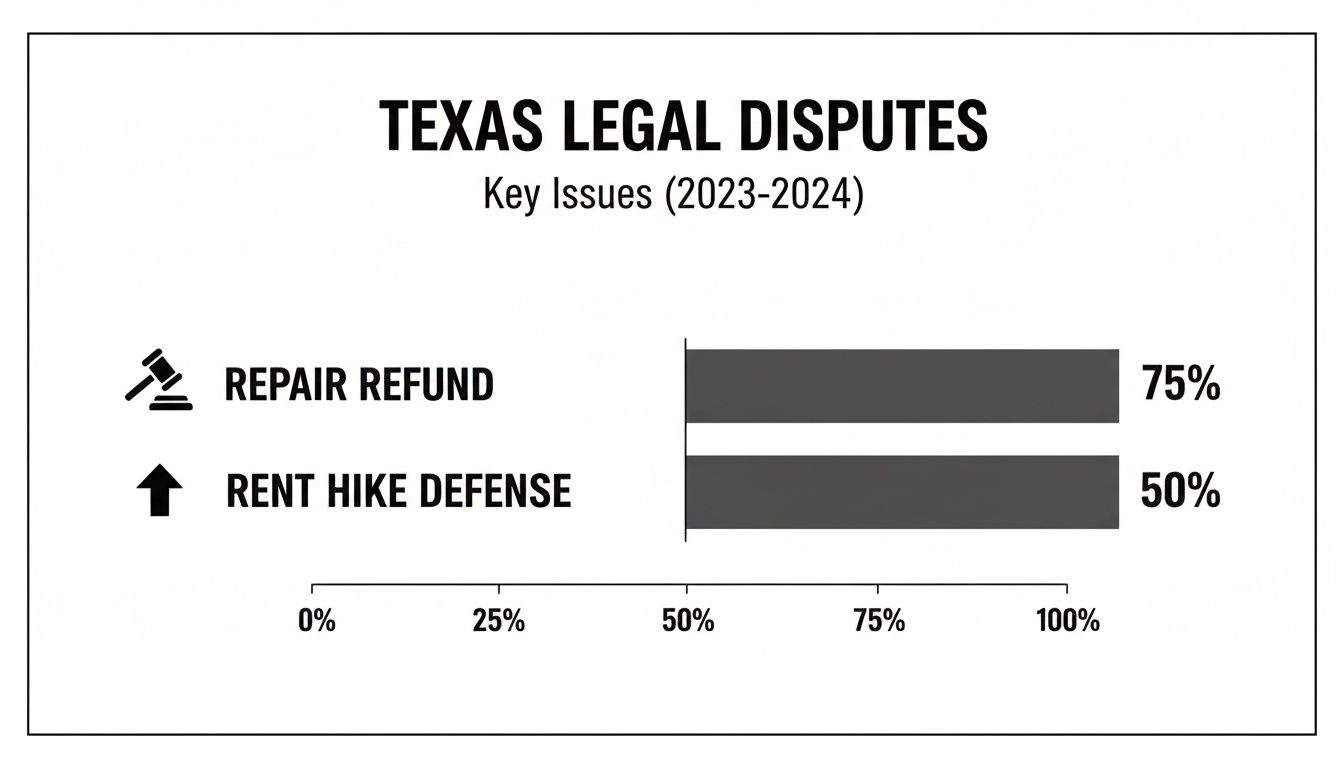
As you can see, fighting for repair refunds and defending against excessive rent hikes are huge pain points. In court, FMR data provides the objective proof needed to argue for a fair outcome.
Whether you're a property owner setting rates for the next year or a renter getting ready to negotiate, the current FMR landscape is a critical part of your playbook. An experienced Texas landlord tenant lawyer can help you make sense of these trends and use them to protect your rights and your bottom line.
When to Consult a Texas Landlord Tenant Lawyer
Knowing the numbers behind Fair Market Rent is a powerful tool. But sometimes, a spreadsheet isn't enough to solve a dispute.
There are moments when a disagreement with your landlord crosses the line from a simple argument into a serious legal fight. This is when knowing your rights isn’t just an advantage—it’s your best defense. If you feel like you’re being backed into a corner, it's time to get an expert in yours.
When Legal Action Is Necessary
Some situations are too risky to handle on your own. An experienced attorney can take FMR data, combine it with a deep knowledge of the Texas Property Code, and build a case that protects you and your home.
It's time to call a Texas landlord tenant lawyer if you're:
- Facing a Wrongful Eviction: Your landlord is trying to kick you out without a valid reason, or maybe they’re retaliating because you asked for repairs. A lawyer can step in and fight to keep you in your home.
- Disputing Unfair Security Deposit Deductions: Landlords can't just invent charges. An attorney can use FMR data to prove their repair costs are overblown and challenge every unfair deduction.
- Fighting Landlord Retaliation: Did your landlord suddenly hike the rent or threaten you right after you exercised your rights as a tenant? That’s not just unfair—it may be illegal retaliation.
- Negotiating a Complex Lease: Before you sign anything, let an expert review it. Our firm provides dedicated lease review and negotiation services to make sure the terms you're agreeing to are both fair and legal.
At The Law Office of Bryan Fagan, PLLC, our job is to level the playing field. We use evidence like FMR data to demonstrate that a sudden rent increase is punitive or that security deposit deductions are unreasonable, providing you with the strategic guidance needed to protect your rights.
You don’t have to face an eviction notice, a lease dispute, or an intimidating landlord alone. Our team is here to fight for you.
Frequently Asked Questions About Fair Market Rent in Texas
When you're dealing with a rental agreement or facing a dispute, the details matter. Here are some no-nonsense answers to the questions we hear most often from Texas landlords and tenants about Fair Market Rent (FMR).
How Can I Find the Fair Market Rent for My County?
The U.S. Department of Housing and Urban Development (HUD) keeps this information public and easy to access. They offer an online tool where you can look up the FMR for any county in Texas.
Just go to the official HUD website, plug in your state and county, and you’ll see the current FMRs for everything from a studio apartment to a four-bedroom house. This data gets updated every year to keep up with the market.
Can a Landlord Legally Charge More Than the FMR?
Yes. In Texas, a private landlord can absolutely set rent higher than the published FMR. Think of FMR as a benchmark, not a legal price cap for private rentals. Landlords are free to charge what the local market will bear—what we call "market rent."
But FMR is still a powerful piece of information. If your rent is wildly higher than the FMR, that fact can be used as evidence in court to argue that a rent hike is retaliatory or that a lease term is unreasonable if a dispute ever arises.
Is FMR Relevant in a Security Deposit Dispute?
Absolutely. When a landlord deducts from your security deposit for repairs, the charges have to be reasonable. Let's say a landlord claims it cost an outrageous amount to replace a basic appliance. A Texas tenant rights attorney can point to FMR data to push back.
Showing a court what’s considered a "modest" rental in the area helps set a baseline for what reasonable repair and replacement costs should look like. It’s a key tool to stop landlords from billing you for luxury upgrades at your expense.
Understanding what is fair market rent gives you crucial context. It helps you see if a landlord's demands line up with local standards or if they’re potentially stepping over the line and violating your rights under the Texas Property Code.
If you're facing an eviction, fighting over a security deposit, or stuck in another rental dispute, having an experienced eviction attorney who knows these rules is not a luxury—it's a necessity.
If you need help with an eviction, lease issue, or rental dispute, contact The Law Office of Bryan Fagan, PLLC for a free consultation today. You can get professional help by visiting us at https://texastenantlawyers.com.