Dealing with a landlord dispute can be stressful—but understanding your rights under Texas law can make all the difference. It's one of the most frustrating moments for any landlord: the keys are on the counter, the tenant is gone, and you’re left with an outstanding balance. When a tenant moves out owing rent, it’s easy to feel like your hands are tied.
But as a property owner, feeling stuck isn't an option. You have a business to run.
The good news is that the Texas Property Code provides a clear path for recovering the money you're owed. The key is to be methodical and professional. You need to document the debt, handle the security deposit by the book, send a formal demand letter, and—if they still won’t pay—take them to small claims court. It’s not just about getting what you're owed; it’s about enforcing the lease agreement your former tenant signed.
Your First Steps for Recovering Unpaid Rent
This isn't a new problem. A national decline in on-time payments has become a major headache for property owners. So, if you're in this boat, you're not alone. The landlords who successfully recover unpaid rent are the ones who treat it like a business process, not a personal dispute.
Your first moves are the most important. They set the stage for everything that follows, especially if you wind up in court. Rushing through these steps or letting your frustration take over can weaken your case before it even starts.
The Landlord's Roadmap to Recovery
Think of it as building a case against your former tenant. You need to prove what you're owed with solid documentation, make a formal and professional demand for payment, and only then escalate the matter legally.
This simple flowchart breaks down the process.
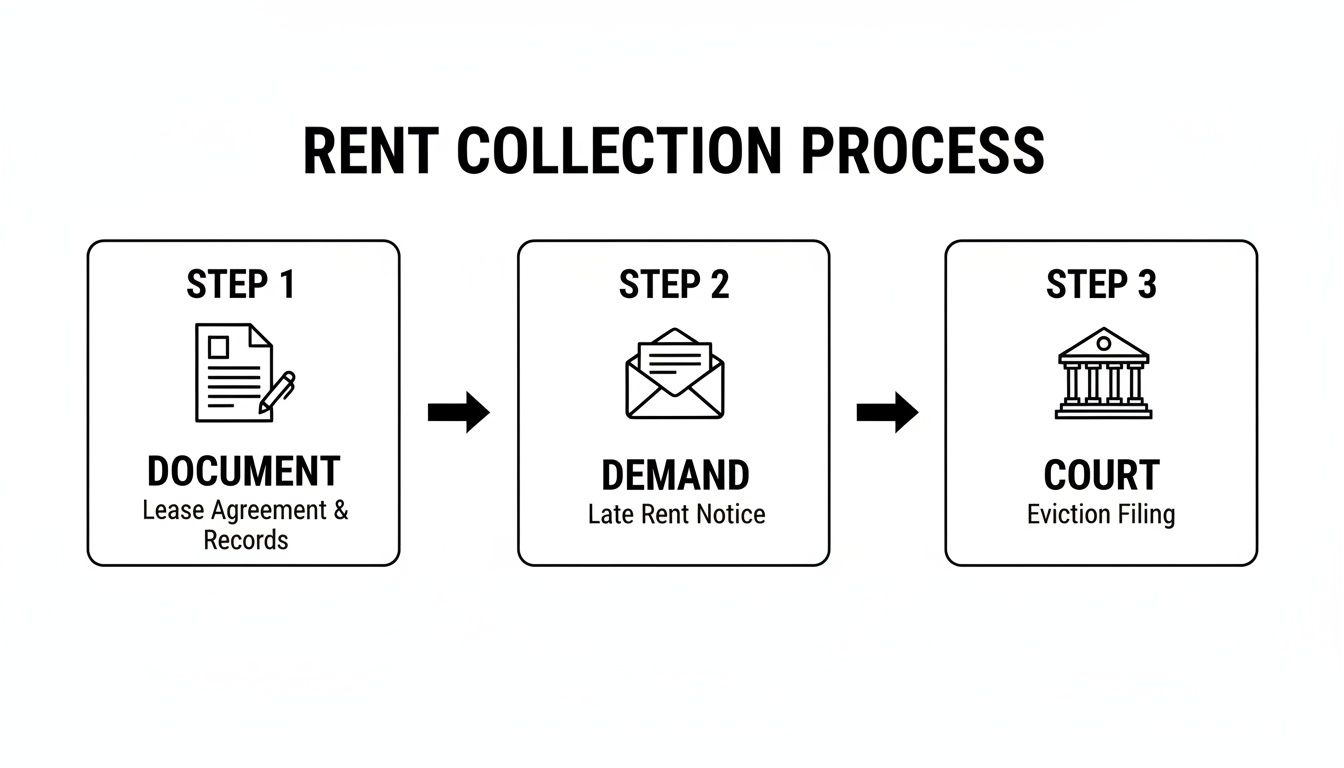
It really is that straightforward: Document, Demand, and File.
A common mistake landlords make is mishandling the security deposit or failing to create a clear paper trail. The Texas Property Code has strict rules, and if you don't follow them to the letter, you could face penalties that wipe out any rent you hoped to collect. A knowledgeable Texas landlord tenant lawyer can help you avoid these pitfalls.
Before you even think about a lawsuit, your job is to create an undeniable record of the debt. This means a final accounting of unpaid rent, any late fees from the lease, and itemized deductions for damages beyond normal wear and tear. This is your foundation.
To get you started, here's a quick reference guide for your immediate next steps.
Quick Guide to Collecting Rent After a Tenant Leaves
| Action Item | Key Consideration | Relevant Texas Law |
|---|---|---|
| Secure the Property | Change the locks immediately to prevent unauthorized re-entry. | Tex. Prop. Code § 92.0081 |
| Document Everything | Take extensive photos and videos of the property's condition as evidence. | Your evidence for court |
| Calculate the Final Balance | Tally all unpaid rent, late fees, and costs for damages. | Must align with lease terms |
| Handle the Security Deposit | You have 30 days to refund the deposit or provide an itemized list of deductions. | Tex. Prop. Code § 92.109 |
Following these initial actions properly protects your right to collect and shows the court you've acted in good faith from the very beginning.
What the Texas Property Code Says About Security Deposits
Before you can pursue a single dollar of unpaid rent, you have to get your paperwork in order. This isn't just about being organized; it's about building an ironclad case that will stand up in a Texas court. Think of it this way: your documentation is the foundation for everything that comes next. Without it, you risk undermining your own claim.

The second your tenant is out, your work begins. You must document the property's condition and create a final account statement that spells out every charge. This includes the back rent, any late fees allowed by your lease, and the cost to repair damages that go beyond normal wear and tear.
The All-Important Move-Out Inspection
Your first job is to conduct a thorough move-out inspection. This is a critical step. Use your smartphone to take time-stamped photos and videos of everything—every room, every closet, every appliance.
Real-World Scenario: A tenant leaves behind three large holes in the drywall where a TV was mounted and deep scratches on the hardwood floors from moving furniture. These are damages beyond "normal wear and tear." Your photos of the holes and scratches, along with a receipt from the handyman you hired for repairs, become crucial evidence to justify deducting costs from the security deposit.
This isn't overkill; it's your proof. Visual evidence is incredibly persuasive and makes it hard for a former tenant to argue. If you end up in court, it’s no longer your word against theirs.
Handling the Security Deposit the Texas Way
Once you’ve documented damages, you must handle the security deposit correctly. Texas law is crystal clear on this, and the timeline is not a suggestion.
Under Texas Property Code § 92.109, you have exactly 30 days from the day the tenant moves out (and provides a forwarding address) to either refund their security deposit or give them a written, itemized list of deductions.
This 30-day deadline is non-negotiable. If you miss it, you can lose the right to withhold any of the deposit. Even worse, a judge could rule you acted in "bad faith."
A bad faith ruling is a landlord's nightmare. It could force you to pay the tenant:
- Three times the amount of the deposit you wrongfully kept.
- $100 in statutory damages.
- The tenant’s attorney fees.
Your final account statement is your shield against these penalties. It must clearly list the total debt, show the security deposit applied as a credit, and state the final balance owed. For a deeper dive, check out our guide on Texas security deposit laws.
Crafting a Demand Letter That Gets Results
Once you've itemized the debt and properly handled the security deposit, it's time to send a formal demand letter. This isn't just a friendly email asking for the money. Think of it as the first official step in the legal collection process—a document that tells your former tenant you are serious about collecting what you're owed.
A well-written, professional demand letter is often all it takes. Many people, when faced with a formal demand outlining the consequences, will pay up to avoid the hassle and cost of a lawsuit.
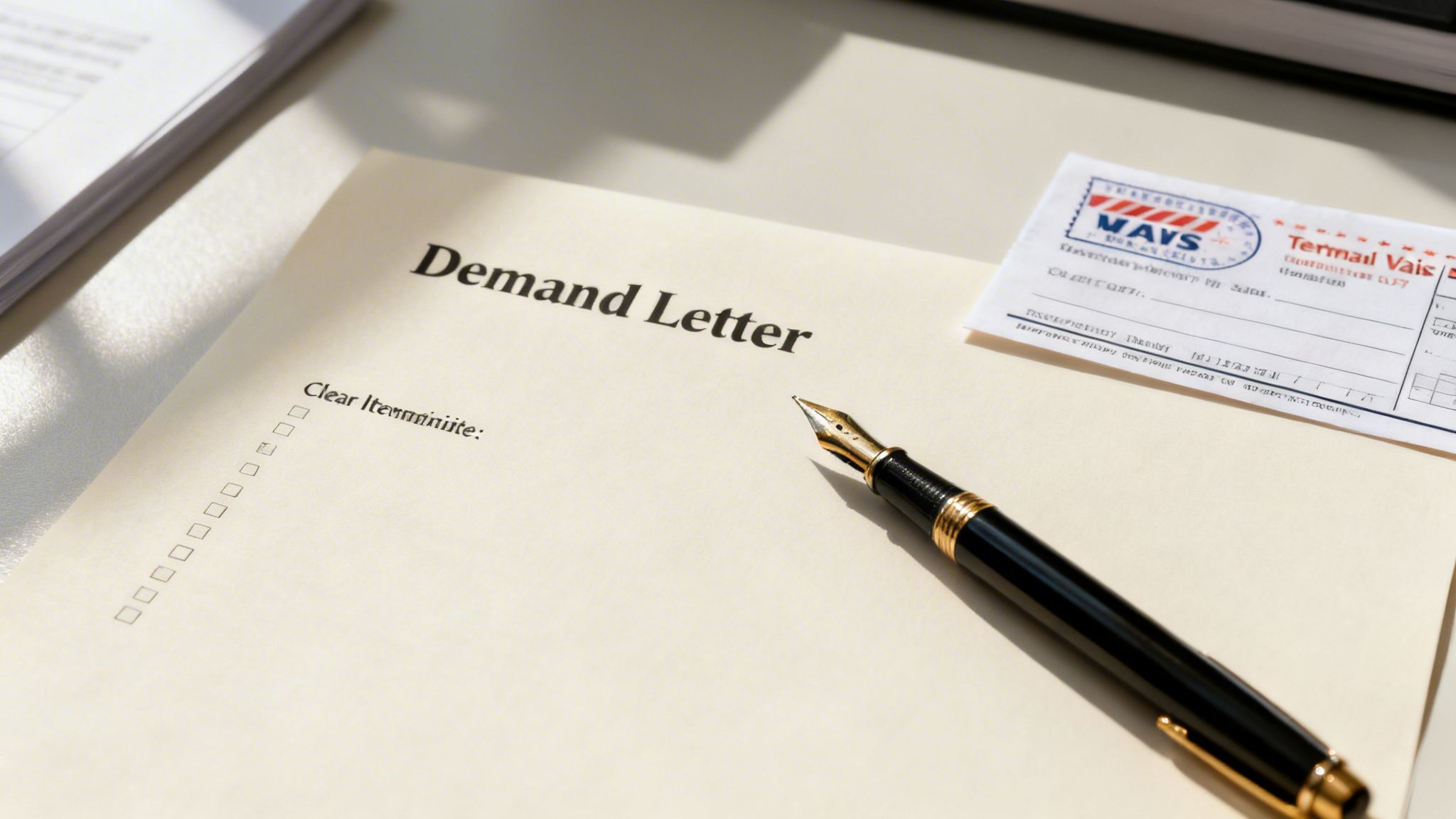
This letter serves two critical functions. It formally communicates exactly what they owe and gives them one last chance to settle the debt. More importantly, it becomes a key piece of evidence for the judge, proving you acted in good faith to resolve the issue before resorting to court.
Step-by-Step: What Your Demand Letter Must Include
Your letter's tone is everything. Any hint of anger or emotion will undermine your credibility. You need to be firm, factual, and professional, leaving no room for misinterpretation.
Here are the essential components:
- A Clear Breakdown of the Debt: Don't just list a total. Itemize every single charge with dates: each month of unpaid rent, any late fees as specified in the lease, and the specific costs for damages that exceeded the security deposit. Reference the final account statement you prepared.
- A Firm Payment Deadline: Create a sense of urgency. Giving the tenant 10 to 14 days to pay is standard practice. It’s a reasonable window that shows you expect prompt action.
- Acceptable Payment Methods: Be specific. Tell them exactly how to pay (e.g., cashier’s check, money order) and the address where the payment must be sent.
- A Statement of Legal Intent: This is the part that gets their attention. You must include a clear, professional statement that you will pursue all available legal remedies, including a lawsuit, if they fail to pay by the deadline.
A well-crafted demand letter is all business. Language like, "Failure to remit payment for the outstanding balance of $X by [Date] will result in our pursuit of legal action to collect the debt," is powerful. It’s not personal; it’s procedural. Your goal is to be taken seriously.
The Critical Step: Sending by Certified Mail
How you send the letter is just as important as what's in it. You must send the demand letter via Certified Mail with a return receipt requested. This U.S. Postal Service feature provides you with a signed receipt confirming the date and time your former tenant received the letter.
That receipt is your golden ticket in court. It’s undeniable proof that the tenant was notified. If they try to claim they never knew they owed money, you have physical evidence that says otherwise. It shows the judge you followed a professional process from start to finish. For more specifics, you can dig deeper into what makes a demand letter effective in Texas.
Taking Your Claim to Texas Small Claims Court
You’ve sent a formal demand letter for the rent they owe, and all you’ve gotten back is silence. Now what? It’s time to stop waiting and start acting.
Filing a lawsuit might sound intimidating, but Texas has a system built for exactly this situation: the Justice Court. Often called small claims court, it's designed for landlords like you to resolve disputes without getting tangled up in the complex and expensive legal web of higher courts.
This is where all your careful record-keeping shines. Your signed lease, final itemized statement, photos of damages, and the certified mail receipt from your demand letter are the foundation of your case.
Step-by-Step: Filing Your Lawsuit
- Find the Right Court: In Texas, you must file in the Justice of the Peace (JP) precinct where your rental property is located. You can also file in the precinct where your former tenant now lives, if you know their address. A quick search on your county’s website will help you find the correct JP precinct.
- Fill Out a "Petition for Debt Claim": This is the official form that starts the lawsuit. It asks for basic information: your details (as the Plaintiff), the former tenant’s name and last known address (as the Defendant), the exact dollar amount you’re suing for, and a brief, clear summary of why they owe you money (e.g., "Unpaid rent and damages for the property at [Address] as per the lease agreement dated [Date]").
- "Serve" the Lawsuit: After you file the petition and pay the court fees, the lawsuit must be officially "served" to the tenant. This is a non-negotiable legal step that notifies them they are being sued. You cannot do this yourself. You must use a neutral third party, like a sheriff's deputy or a licensed private process server, to deliver the papers. If the tenant isn’t served correctly, your case grinds to a halt.
What if you don't know where they moved? This is a common roadblock. A professional process server is your best bet here. They can run a "skip trace" to find a current address. It’s an extra cost, but it's often the only way to move your lawsuit forward.
Preparing for Your Day in Court
Once the tenant is served, the court will set a hearing date. This is your chance to present your case to the judge. Treat it seriously. Dress professionally and have all your evidence organized and ready to go in a binder.
Here’s a checklist of the essentials you must bring:
- The signed Lease Agreement.
- The Final Account Statement you created.
- The Certified Mail Receipt from your demand letter.
- Photos and Videos of the property's condition.
- Invoices and Receipts for any repairs or cleaning services.
- Communication Records like emails or texts about the unpaid rent.
When it's your turn to speak, calmly walk the judge through the facts. The tenant signed a lease, they stopped paying, they moved out owing money, and they ignored your formal demand. Then, present your evidence. Let your organized documentation do the heavy lifting.
How to Enforce Your Court Judgment and Get Paid
Winning your case in Justice Court is a huge relief, but it’s not the finish line. A judgment is a court order saying you are legally owed money. Now comes the real work: turning that paper into actual payment.

Many tenants hope you'll give up after the hearing. Your job is to prove them wrong by using the legal tools Texas provides to enforce your court order. An experienced eviction attorney can be invaluable at this stage.
Using an Abstract of Judgment to Secure the Debt
One of the most powerful collection tools is the Abstract of Judgment (AOJ). Think of it as a public lien that attaches to the debtor. Once the court issues your judgment, you can request an AOJ from the county clerk. You then file this document in the real property records of any Texas county where you think your former tenant owns land—or might buy it in the future.
An Abstract of Judgment creates a lien on all non-exempt real estate the debtor owns in that county. This means they cannot sell or refinance their property without paying you first. It’s a powerful long-term strategy that can secure your debt for up to ten years.
This move puts a legal lock on their property assets. It might not get you paid tomorrow, but it ensures that if they ever try to access the equity in their home, your debt is waiting. You can find specifics in our guide on the Texas Abstract of Judgment.
Actively Collecting with Writs of Garnishment and Execution
If you need to be more proactive, Texas law gives you direct methods for seizing assets.
A Writ of Garnishment is a court order sent to a third party holding money for your former tenant—most often, their bank. If you know where they have a checking or savings account, the court can order the bank to freeze those funds and turn them over to you.
Another potent tool is a Writ of Execution. This is a court order that directs a local constable or sheriff to seize the debtor’s non-exempt personal property, like a paid-off second vehicle or boat. The constable then sells these assets at a public auction, with the proceeds going to pay off your judgment.
Comparing Judgment Enforcement Methods in Texas
Which collection method is right for you? It all comes down to what you know about your former tenant's financial situation.
| Method | What It Does | Best Used When | Key Challenge |
|---|---|---|---|
| Abstract of Judgment | Places a lien on the debtor's real estate. | You believe the tenant owns property or may buy some in the future. | Requires patience; you only get paid when they sell or refinance. |
| Writ of Garnishment | Seizes funds directly from the debtor's bank account. | You know where the tenant banks. | Finding the bank information can be difficult without legal help. |
| Writ of Execution | Allows a constable to seize and sell non-exempt personal property. | The tenant has valuable, non-essential assets like a second car or boat. | Identifying and locating non-exempt property can be complicated. |
Enforcing a judgment takes work, but it sends a clear message that you won’t let the debt disappear. An experienced Texas landlord tenant lawyer can help you navigate these post-judgment remedies effectively.
Knowing When to Hire a Texas Landlord Tenant Lawyer
While many landlords can handle simple disputes on their own, some situations are too complex or high-stakes to go it alone. Trying to be your own lawyer can backfire, leading to costly mistakes and a lost claim.
Knowing when to call a professional is key. If you find out your former tenant has hired their own lawyer, that’s your signal to do the same—immediately. An opposing attorney knows how to use the rules to their advantage, and you need an expert in your corner.
Clear Signs You Need an Attorney
Consider hiring an experienced Texas landlord tenant lawyer if:
- The Debt is Large: Texas Justice Courts cap claims at $20,000. If the unpaid rent and damages exceed that limit, you must file in a higher court where the rules are far more complex.
- The Tenant Declares Bankruptcy: The second a tenant files for bankruptcy, an "automatic stay" halts all collection efforts. You must have a lawyer to navigate the complexities of federal bankruptcy court.
- The Dispute Involves a Commercial Lease: Commercial leases are entirely different from residential ones. The legal and financial stakes are much higher, requiring specialized knowledge.
- You Need to Enforce a Judgment: Winning in court is only half the battle. A lawyer can efficiently pursue post-judgment collection strategies like garnishment and execution, which can be difficult to handle on your own.
In these situations, an eviction attorney isn't just a good idea—it's a necessity. An experienced lawyer can take over, managing all court filings, handling the legal back-and-forth, and pursuing aggressive collection strategies on your behalf.
At The Law Office of Bryan Fagan, PLLC, our team works to recover the money you are rightfully owed, ensuring every action we take is fully compliant with the Texas Property Code and designed to protect your rights as a property owner.
Common Questions About Collecting Unpaid Rent in Texas
When a tenant skips out owing you money, it's natural to have a lot of questions. Knowing your rights—and the timelines you’re up against—is the first step to getting back what you're owed. Here are answers to common concerns we hear from Texas landlords.
How Long Do I Have to Sue for Unpaid Rent in Texas?
In Texas, the statute of limitations gives you four years to sue for debt from a written contract, which includes your lease agreement. However, waiting is almost always a bad idea. Your chances of ever seeing that money drop dramatically with every month that passes. Acting fast gives you the best shot at locating your former tenant and their assets.
What If I Don't Know My Former Tenant’s New Address?
This is one of the most common roadblocks landlords face. You can't start a lawsuit without a valid address to "serve" the legal paperwork. Your best move is to hire a licensed private process server to run a 'skip trace.' This is a professional search designed to locate people for legal proceedings. While it’s an extra cost, it's often the only way to move your case forward.
Can I Report the Unpaid Debt to Credit Bureaus?
Yes, you can—and it can be a powerful tool to motivate a former tenant to pay. However, the process is governed by the federal Fair Credit Reporting Act (FCRA). You must send the tenant a formal notice giving them 30 days to dispute the debt before reporting it. Because the rules are so strict, having a lawyer handle this process can protect you from potential legal trouble. For context, you can read about broader landlord tenant laws to understand the principles governing these disputes.
If you need help with an eviction, lease issue, or rental dispute, contact The Law Office of Bryan Fagan, PLLC for a free consultation today.