Skip to content
A tenant misses rent. You send a text. They promise to pay Friday. Friday passes, then another week. Now they won’t answer, the property still isn’t producing income, and you’re stuck wondering whether to wait, negotiate, or file.
That’s where many new landlords make an expensive mistake. They treat eviction like a pressure tactic instead of a legal process. In Texas, eviction can move quickly, but only when you follow the Texas Property Code with precision. If you skip a step, use the wrong notice, accept money at the wrong time, or can’t prove delivery, the court can dismiss your case and force you to start over.
The texas eviction process for landlords is best approached as risk management. Every document, date, and delivery method matters. Done correctly, the process protects your property rights. Done casually, it creates delay, extra cost, and avoidable exposure. A careful landlord, or a careful Texas landlord tenant lawyer, focuses less on speed at the beginning and more on getting the foundation right.
Navigating Your First Steps in a Texas Eviction
A common first-landlord scenario looks like this. Rent is late, the tenant gives a believable explanation, and you want to be reasonable. You send reminders, maybe offer a few extra days, and hope the account gets brought current. Then the problem widens. The balance grows, communication breaks down, and your choices get harder because the paper trail is messy.
That frustration is real. So is the temptation to act emotionally. New landlords often want to change locks, shut off access, remove property, or post a homemade demand on the door. Those moves usually create more risk, not less. If you need to act, the safest move is a lawful one, backed by records.
For many landlords, the turning point comes when they stop asking, “How do I get this tenant out fast?” and start asking, “How do I avoid a dismissal?” That question leads to better decisions. It also helps you avoid common traps involving rent collection, notice language, and timing.
If the issue started with overdue rent, it helps to understand the broader legal context around late rent payment disputes in Texas. The right next step depends on whether the problem is nonpayment, a lease violation, a holdover tenancy, or a combination of issues.
Practical rule: If you think you may need to evict, start building your file before you send anything. Save the lease, ledger, texts, emails, photos, and notes of every conversation.
A landlord with a clean file usually presents a cleaner case. A landlord with scattered screenshots and shifting explanations often spends court trying to repair preventable damage.
The Critical First Step The Notice to Vacate
A Texas eviction case often rises or falls on the notice, not the hearing. I have seen landlords lose possession cases they otherwise should have won because the notice used the wrong date, named the wrong tenant, or was served in a way they could not prove later.
The Notice to Vacate is the document that starts the formal process and frames the dispute for the court. Under Texas Property Code §24.005, a landlord must give written notice to vacate, and the default notice period is three days unless the lease sets a different period. In some foreclosure-related situations, the period is 30 days. The statute and service rules are laid out in Texas Property Code 24.005 notice requirements.
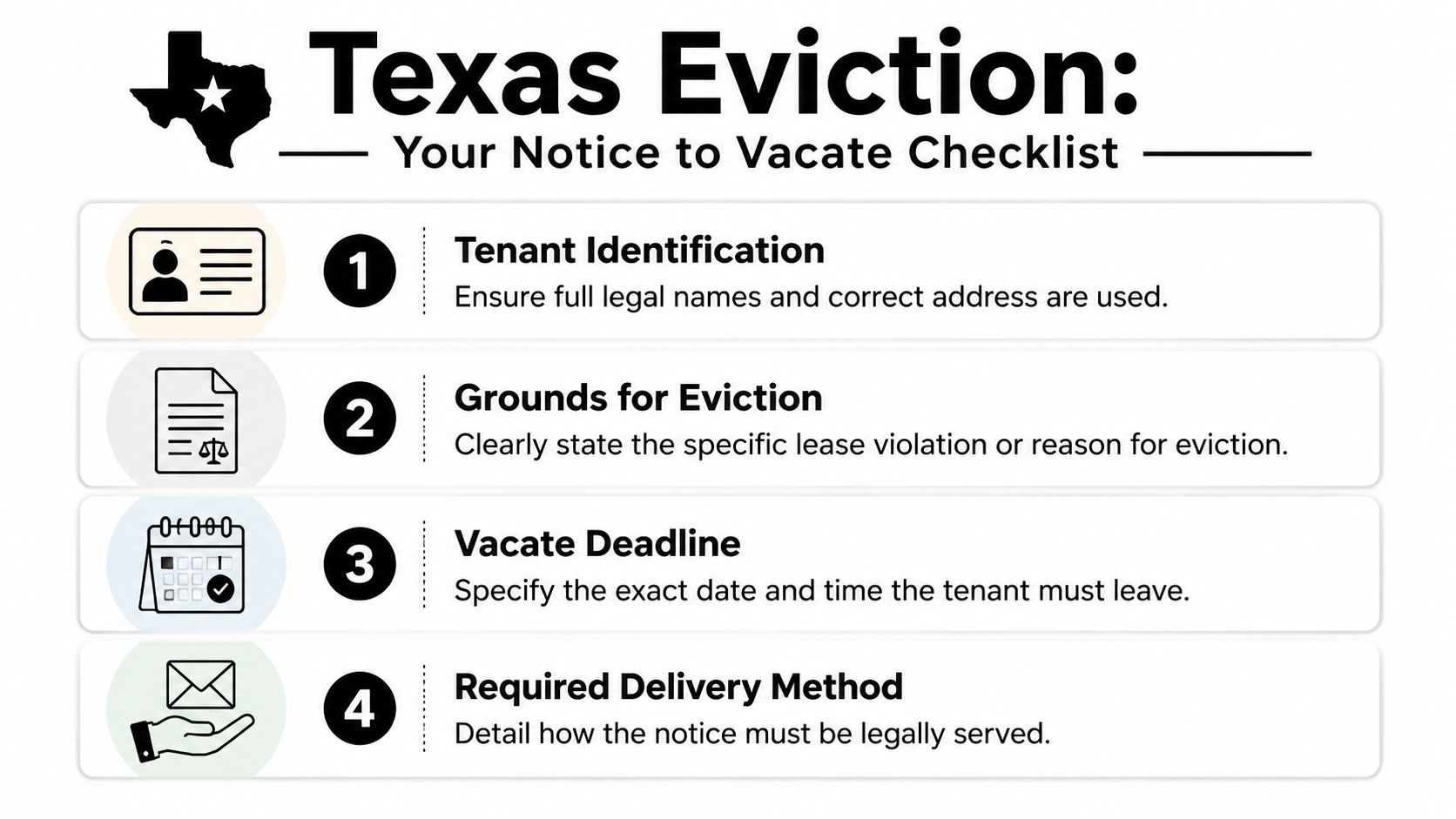
What the notice needs to say
A weak notice creates avoidable defenses. The safer approach is to draft it with the assumption that a judge will read every line.
Include these basics:
- Full tenant identification. Use each tenant’s full legal name and the property address exactly as it appears in your lease and records.
- Specific grounds. State the actual reason for the eviction. “Failure to pay rent for October 2025” is stronger than “non-payment.”
- Exact deadline. Give a clear vacate-by date that matches the notice period required by the lease or statute.
- Contact information. Include the landlord’s or property manager’s contact details.
According to guidance discussing Texas notice requirements and waiver risk, vague notices regularly create dismissal problems. General statements invite argument. Specific statements narrow it.
What landlords get wrong most often
The first mistake is treating the notice like a warning letter instead of a legal exhibit. If the reason in the notice is unclear, or if the dates do not line up with the lease and ledger, the tenant has room to challenge the case before the court ever reaches the merits.
The second mistake is changing course after service. Accepting even partial rent for the month at issue can legally waive the right to evict for that specific nonpayment default. That does not mean payment discussions are forbidden. It means a landlord should decide, before taking money, whether the goal is reinstatement or possession.
That trade-off matters. A quick partial payment may help cash flow this week, but it can force you to restart the notice process and lose time if the tenant still does not cure the default.
If you serve notice for unpaid rent on Monday and accept part of that same month’s rent on Wednesday, you may have undercut the case you planned to file.
Delivery is part of the case
Service problems sink many otherwise valid notices. Courts do not assume the tenant received the notice just because the landlord says it was sent.
Use a delivery method the statute allows, then preserve proof with the same care you would give the lease itself. A clean proof packet usually includes:
- A signed and dated copy of the notice
- Proof showing when and how it was delivered
- Mailing records, if mail was used
- Photos or contemporaneous notes if posting or personal delivery details matter
- A file copy of any related communication with the tenant
That file does two jobs. It helps you prove compliance, and it keeps your story consistent if the tenant disputes timing, receipt, or the reason for eviction.
Landlords sometimes rush to court after posting a notice on the door and keeping nothing else. That is a risk management failure. The notice is not just the first step. It is often the first place a case breaks.
How to File an Eviction Suit in Justice Court
A common landlord mistake happens right here. The notice period ends, the tenant is still in possession, and the landlord rushes to file before confirming the court, the party names, or the paperwork. That kind of haste can cost more time than the tenant’s original default.
Once the notice period has fully expired, file the eviction in the Justice Court for the precinct where the property is located. In Texas, the case is commonly called a forcible detainer action. Filing in the wrong precinct or filing before the notice period ends gives the tenant an avoidable defense and can force you to start over.

What to gather before you file
Treat the filing packet as a compliance file, not a stack of papers. The court will move faster when your petition matches your lease, your notice, and your supporting records without gaps or contradictions.
Have these documents ready before you file:
- The signed lease
- The notice to vacate
- Proof of notice delivery
- A rent ledger, if the case is for nonpayment
- The full property address and tenant names as shown in the lease and your records
Details matter here. If the lease says “Unit B” and the petition says “Apt. 2” without explanation, expect questions. If one adult occupant signed the lease but another is listed in your records and not in the petition, service problems can follow.
A practical filing check looks like this:
| Filing item | Risk if mishandled |
|---|---|
| Correct JP precinct | Dismissal, transfer issues, or delay |
| Accurate tenant names | Service defects or confusion at hearing |
| Eviction ground matches the notice | Credibility problems and possible dismissal |
| Complete supporting documents | Slower filing, weaker presentation, avoidable disputes |
Filing timing controls the rest of the case
After filing, the court sets the hearing and arranges service on the tenant. The timing rules are short, and they leave little room for sloppy paperwork. The Texas State Law Library’s eviction process guide explains that the hearing is generally set 10 to 21 days after filing, and the tenant must be served at least 6 days before the hearing.
That schedule creates a practical rule for landlords. File only when your notice period has clearly expired and your petition is ready to survive scrutiny the first time. An early filing can be dismissed as premature. An incomplete filing can delay service and push the hearing out even if your underlying claim is sound.
Calendar the notice expiration date from the day you serve the notice. Then verify it again before the petition is submitted.
Budget for fees and avoid self-inflicted delays
Filing fees and service costs are part of the process, and they vary by county and by the number of parties served. A landlord who is prepared on the merits but unprepared on fees can still lose time waiting for issuance or service to be completed.
The risk-management point is simple. Have funds ready for filing, service, and any county-specific costs before you go to court or file online. Administrative delay is still delay, and possession cases are won by clean execution as much as legal merit.
For landlords managing more than one property, a standard filing packet helps. Use the same checklist every time, confirm the same data points every time, and do not let urgency override accuracy. In eviction work, procedural discipline is often what keeps a valid case from becoming an expensive reset.
Preparing for Your Day in Court
An eviction hearing is usually short. That surprises first-time landlords. They expect a long explanation to fix earlier mistakes. Most judges want the essentials. Was there a lease? Was there a breach? Was proper notice given? Was the case filed correctly? Can the landlord prove it?

Texas courts are seeing a heavy volume of eviction filings. In 2023, landlords filed more than 177,000 eviction cases across Houston, Dallas, Austin, and Fort Worth, and the broader context has shifted after the closure of the state’s $1.8 billion rent relief program and the end of certain local tenant protections, as reported by The Texas Tribune’s review of eviction trends and housing instability. In a high-volume environment, judges often focus closely on whether the landlord complied with the rules.
Build a hearing file that tells a clean story
Bring paper copies, even if you also keep digital records. Organize them in the order the judge is likely to ask for them.
A strong landlord hearing file often includes:
- The signed lease. This establishes the tenancy and the tenant’s obligations.
- A rent ledger. It should clearly show charges, payments, and the amount claimed due.
- The notice to vacate. Bring the exact notice served.
- Proof of notice delivery. Certified mail records, delivery notes, and related documents matter.
- Communications. Emails or texts can help confirm default, promises to pay, or admissions.
- Photos and inspection records. Use these if the case involves damage or lease violations beyond nonpayment.
If the dispute is about nonpayment, the lease and ledger usually do most of the work. If it’s about unauthorized occupants, property damage, or another breach, your photos and communications become more important.
Know the defenses before the tenant raises them
Tenants don’t need a perfect defense to create a problem. They only need enough uncertainty to make the judge pause. New landlords often lose momentum in court because they hear an argument for the first time at the hearing.
Common defenses may include:
- Improper notice. The tenant says the notice was vague, late, or never delivered correctly.
- Payment dispute. The tenant claims rent was paid, partially accepted, or misapplied.
- Repair complaints. The tenant argues serious property conditions affected the tenancy.
- Retaliation claims. The tenant says the eviction followed a complaint about repairs or rights.
- Factual denial. The tenant says the alleged lease violation never happened.
Your response should stay narrow and document-based. Don’t argue every side issue. Prove the required elements first.
Bring your documents in the order you’ll speak about them. When landlords shuffle papers while explaining dates, judges often lose patience.
A short sequence works best. Start with the lease. Move to the breach. Then the notice. Then the filing. Then the relief requested.
How to present yourself in the courtroom
A calm presentation matters. Address the judge respectfully. Answer the question asked. Don’t interrupt the tenant, even if the story is inaccurate.
These habits help:
- Use dates, not conclusions. Say “Rent for October was not paid” instead of “They never pay.”
- Stick to firsthand facts. If you didn’t see it or document it, be careful.
- Avoid side arguments. Personal frustration can dilute a strong legal case.
- Ask for possession clearly. Make sure the judge understands what relief you are requesting.
Here’s a useful overview of court practice and what landlords should expect in an eviction matter:
What works and what doesn’t
Here’s the trade-off many landlords learn only after one bad hearing:
| Approach | Likely result |
|---|---|
| Organized records, calm testimony, clear notice proof | The judge can follow your case quickly |
| Verbal explanations without documents | The court has little reason to credit your version |
| Overstating claims | Your credibility can suffer |
| Focusing on legal elements | You keep the case where it belongs |
The courtroom doesn’t reward volume. It rewards proof.
Winning the Case and Regaining Possession
You win possession on Tuesday. The locks still cannot be changed on Tuesday.

That is the point many new landlords miss. A judgment gives you the right to possession through the court process. It does not authorize self-help, early entry, utility shutoffs, or a pressure campaign to force the tenant out faster. The period after judgment is short, but it is full of avoidable mistakes.
What happens after the judge rules
After the court signs a judgment for possession, the tenant still has a limited window to appeal. If no appeal is filed and the waiting period expires, the landlord can request a writ of possession from the court. The writ is the document that lets the constable or sheriff carry out the removal. Before physical removal, the officer posts notice at the property.
That sequence matters because landlords often treat the judgment as the finish line. Legally, it is closer to the handoff point between the court and law enforcement.
If you want a clearer look at the enforcement step, review this explanation of the Texas writ of possession process.
Protect the judgment you already earned
Post-judgment mistakes are expensive because they are unnecessary. A landlord who enters too early, removes property without the officer, or threatens an off-the-books lockout can turn a clean win into a dispute about wrongful conduct.
Use a disciplined process instead:
- Wait until the case is final under the court’s timeline. Do not assume the hearing date ends the matter.
- Request the writ through the clerk using the court’s procedure. Ask questions if the local JP court has specific forms or fees.
- Let the constable or sheriff handle the physical possession step. That protects both safety and the record.
- Be present and prepared on execution day. Bring keys, access information, movers if needed, and a camera.
- Create a turnover file immediately after possession is restored. Photograph every room, note visible damage, and secure the property.
The trade-off is simple. Patience for a few more days usually costs less than defending a wrongful lockout claim.
Where landlords still lose ground after a court win
Appeals and enforcement delays usually expose problems that started earlier. If the notice to vacate was defective, service was weak, or the petition asked for relief that does not match the proof, those issues do not become harmless just because the judge ruled in your favor the first time.
That is why I tell landlords to treat every document as if it will be reviewed twice. Once by the JP court, and again by a tenant looking for a procedural opening.
One more practical concern comes up at turnover. If the unit contains hazardous waste, blood, drug residue, or other unsafe conditions, do not send regular cleaners in blindly. Use a documented response plan and review this guide on landlord biohazard responsibilities before re-entry and cleanup decisions.
The timeline is usually slower than landlords expect
Even in a straightforward case, possession returns in stages. First comes judgment. Then the appeal period. Then the writ request. Then officer posting. Then the actual set-out if the tenant remains.
Landlords who understand that sequence make better decisions. They line up vendors, protect records, avoid impulsive contact with the tenant, and keep the file clean until the property is lawfully back in hand. That is how procedural discipline turns an eviction case into actual possession.
Exploring Alternatives and Final Landlord Duties
Not every landlord problem should end in a contested hearing. Sometimes the best business decision is a negotiated move-out. If the tenant is willing to leave voluntarily in exchange for a written agreement and a modest payment, a cash for keys arrangement can save time, reduce vacancy uncertainty, and lower the risk of procedural disputes.
That option isn’t right for every case. If there is serious property damage, repeated deception, or safety concerns, formal court action may still be the better route. But when the issue is mainly possession and turnover speed, a written move-out agreement often works better than a long standoff.
Compare the options before you commit
A quick way to think about the decision:
- Formal eviction. Best when you need a court order, the tenant is contesting the matter, or the record needs to be clear.
- Cash for keys. Best when the tenant will cooperate and you can document the deal in writing.
- Payment plan or dismissal agreement. Best when the tenant can realistically cure the default and you want to preserve the tenancy.
Whatever route you choose, put the terms in writing. Verbal deals tend to collapse when move-out day arrives.
Final duties after possession returns
Once the tenant is out, landlords still have legal obligations. Handle the security deposit carefully, document property condition, and separate normal wear and tear from actual damage. If personal property remains, don’t improvise. Follow the lawful process tied to the circumstances of the turnover and any officer involvement.
If the property needs specialized cleanup because of bodily fluids, hoarding conditions, or hazardous contamination, ordinary turnover vendors may not be enough. In that situation, this guide on landlord biohazard responsibilities is a useful reference for understanding the safety and liability issues that can arise after possession is restored.
A careful closeout protects you almost as much as a careful filing. Good landlords don’t stop managing risk when the tenant leaves. They finish the job with the same discipline they should have used at the start.
If you need help with an eviction, lease issue, or rental dispute, contact The Law Office of Bryan Fagan, PLLC for a free consultation today.