Dealing with a late rent payment is stressful from both sides of the lease. A tenant may be trying to bridge a short cash-flow gap. A landlord may be trying to cover a mortgage, taxes, insurance, and repairs while one missed payment throws the month off course.
The good news is that Texas law gives both sides a structure. The better news is that many late rent problems can be contained before they turn into an eviction case. If you understand the Texas Property Code, use clear lease language, and document every payment decision, you can usually avoid the worst outcomes.
Understanding Late Rent and Grace Periods in Texas
In Texas, late payment issues aren't unusual. The state has 3.5 million renter households, and more than 620,000 spend over half their income on rent. A 2024 analysis also found that 17% of Texas renters reported being behind on payments at some point in late 2021, which shows how common this pressure can be in real life, not just in court files, as discussed by the Texas Observer's reporting on Texas renter fees and arrears.
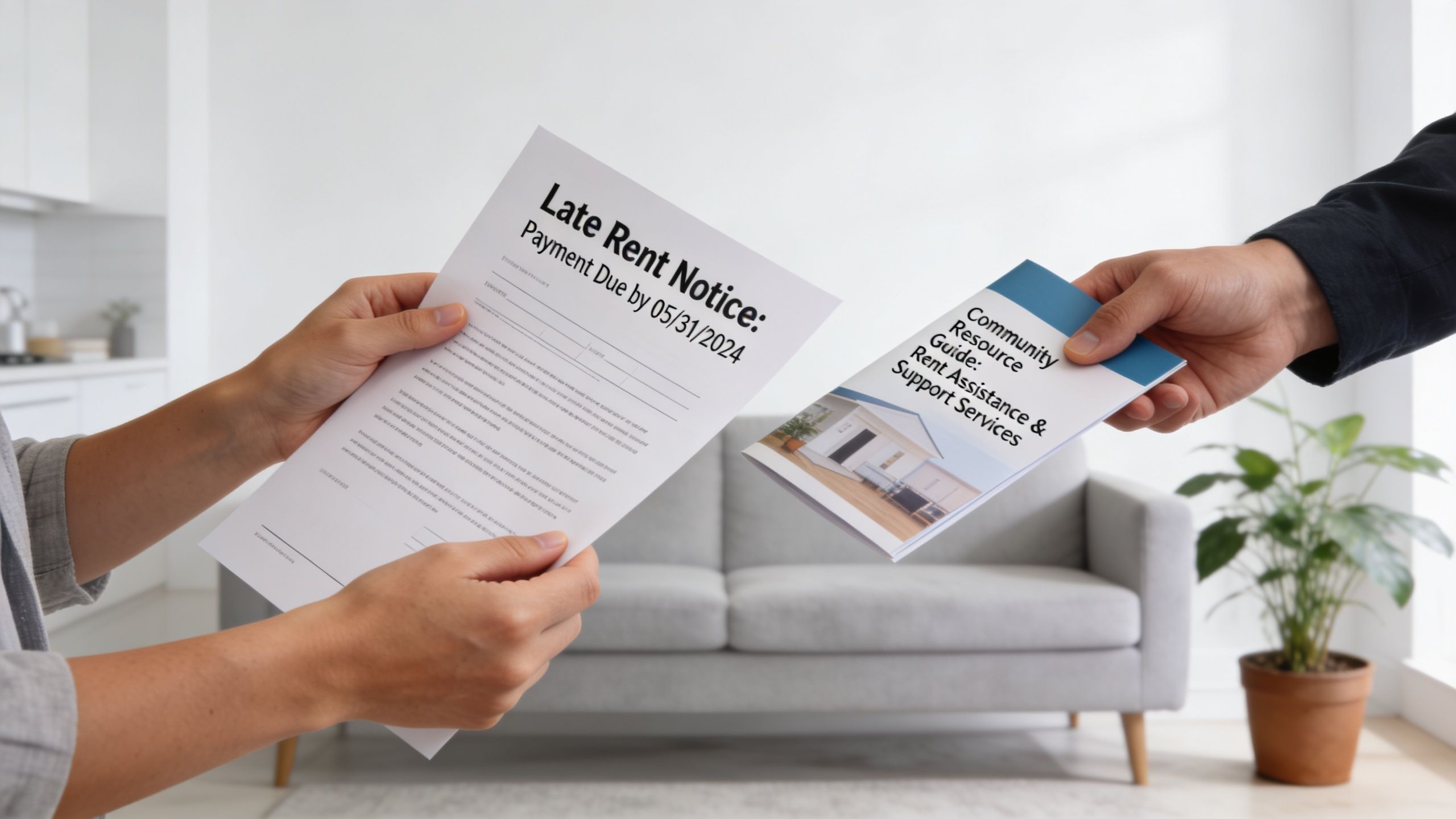
When rent becomes legally late
Many people assume rent is late the moment the clock turns past midnight on the due date. That isn't how Texas handles late fees. Under Texas Property Code §92.019, a landlord can't charge a late fee until two full days have passed after the due date.
If rent is due on the 1st, the tenant gets the 2nd and 3rd as full days. The fee can't be assessed until the 4th. That rule matters because it prevents a landlord from imposing a penalty too early and gives a tenant a short but important legal buffer.
Practical rule: In most Texas residential leases, "due" and "late-fee eligible" are not the same moment.
What that means in practice
A simple example helps. Say a lease says rent is due on June 1. The tenant pays online late on June 3. If the payment covers the full rent and the lease is otherwise compliant, the landlord generally can't jump ahead and charge a late fee on June 2 or June 3.
That doesn't mean the tenant should treat the grace period like an extra due date every month. Chronic delay still creates risk. It affects the landlord's records, may trigger formal notices later, and often becomes the start of a larger dispute over fees, payment application, or default.
Here is the basic timeline most tenants and landlords should keep in mind:
- Rent due date: The lease sets when rent is due, often the 1st.
- Two full days after due date: Texas law requires this waiting period before a late fee can be charged.
- After the grace period: The landlord may assess a lawful late fee if the rent remains unpaid in full.
- Continued nonpayment: The issue can move from a payment problem to a possession problem.
Why this part gets misunderstood
Most conflicts don't start with a dramatic refusal to pay. They start with poor timing, unclear lease language, or a tenant who pays almost all the rent but leaves a small balance unresolved. I often see disputes where one side thinks, "I was only a little late," and the other thinks, "The lease was broken."
Both reactions are understandable. But neither replaces the statute. The first question is always the same: When was rent due, when was it paid, and had two full days passed before the fee was charged?
How Texas Law Regulates Late Rent Fees
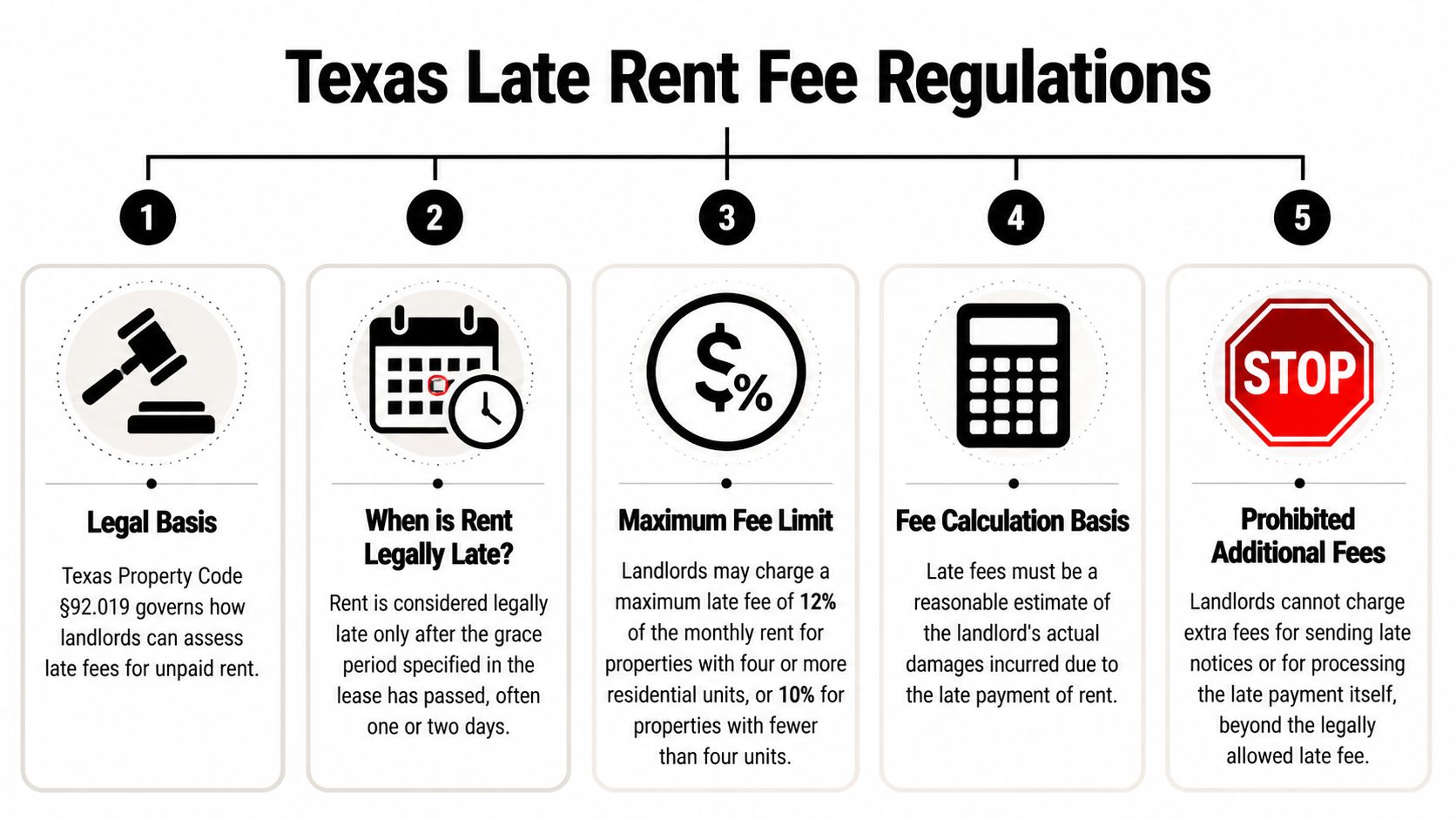
Once rent is legally late, a landlord may charge a fee. But Texas does not let landlords turn late fees into punishment or profit. The controlling rule is reasonableness under §92.019.
Texas law also gives numerical caps. For residential properties with 4 or fewer units, the late fee cap is 12% of monthly rent. For properties with more than 4 units, the cap is 10% of monthly rent. If a landlord charges more than the law allows, the fee can be unenforceable, and the landlord may be liable for three times the improper charge, a $100 penalty, and the tenant's attorney fees, as summarized by the Texas State Law Library guide on rent and late fees.
What a reasonable fee looks like
A lawful fee starts with the lease. If the lease doesn't clearly authorize a late fee, the landlord has a problem before the amount even gets analyzed. If the lease does authorize one, the next question is whether the fee stays within the statutory cap and reflects actual costs tied to late payment.
That is where many DIY leases go wrong. They use a round number that "feels standard" without checking whether it fits the property size, the rent amount, or the statute. A flat fee that sounds modest on one property can be excessive on another.
| Property type | Statutory cap |
|---|---|
| 4 or fewer units | 12% of monthly rent |
| More than 4 units | 10% of monthly rent |
For a deeper plain-English breakdown of the statute itself, review this page on Texas Property Code Section 92.
What doesn't work well
Some landlords try to solve repeated late payment by stacking charges. They add one late fee, another "processing fee," and then a notice fee. That's where enforceability starts to unravel.
A court will usually look at substance, not labels. If the charges function like one oversized penalty, renaming them doesn't fix the problem.
A late fee should compensate for late payment. It shouldn't become leverage to manufacture a larger default.
Another common mistake is copying a policy from a general business billing context into a residential lease. Commercial discussions about overdue invoices can be useful for thinking about structure and clarity. For example, this piece on Resolut on late payment policy is a helpful reminder that payment terms work best when they are written precisely and applied consistently. But residential landlords in Texas still have to follow the specific limits and remedies built into the Property Code.
A real-world example
Suppose a small landlord with a duplex charges a late tenant a large flat fee that exceeds the statutory cap. The tenant pays under protest and later contests it. In that setting, the issue isn't whether the tenant was late. The issue is whether the fee itself was lawful.
That distinction matters. Landlords are entitled to protect cash flow. They are not entitled to write penalties that a court won't enforce. Tenants, on the other hand, shouldn't assume every late fee is illegal. The right question is narrower and stronger: Was the fee authorized by the lease, imposed after the required waiting period, and kept within the statutory limit?
The Eviction Process for Non-Payment of Rent
When unpaid rent isn't resolved, the dispute can shift from money owed to possession of the property. That shift is serious. For tenants, it can mean a court date and the risk of losing the home. For landlords, it means every shortcut becomes dangerous.

Under Texas Property Code §92.019, a landlord can't charge a late fee until two full days have passed after the due date. If rent is due on the 1st, a fee can't be assessed until the 4th. That timing rule matters because it sits at the front end of the default timeline and is part of the legal backdrop before a landlord escalates toward non-payment action, as explained in this discussion of Texas late-fee timing under §92.019.
Step one is usually the notice to vacate
In most residential nonpayment cases, the first formal step is a Notice to Vacate. This is not the court filing. It is the demand that tells the tenant to leave by a certain deadline because the lease has been breached.
A landlord needs to pay attention to the lease and the statute here. If the notice is defective, the eviction case may fail even when rent was unpaid. Common problems include the wrong deadline, poor delivery, or language that creates confusion about what the tenant must do.
Here is the practical sequence:
Confirm the default
Check the lease, ledger, and payment history. Don't rely on memory.Serve the notice to vacate
Deliver it in a legally valid way and keep proof of service.Wait the required period
Don't file too early. Filing early can sink an otherwise valid case.File the eviction case
In Texas, this is usually a forcible detainer action in justice court.
What happens after filing
Once the case is filed, the tenant is served and a hearing is scheduled. At that hearing, the judge isn't deciding every dispute the parties have ever had. The main question is usually possession. Who has the legal right to occupy the property now?
That is why documentation matters so much. A landlord should walk in with the signed lease, payment ledger, notice, and delivery proof. A tenant should walk in with receipts, screenshots, correspondence, and any documents showing improper fees, refusal of payment, or notice defects.
To see the broader court timeline, this guide to the eviction process in Texas is a useful companion.
A short overview can also help if you're trying to visualize how these cases move through court:
What landlords and tenants often get wrong
Landlords sometimes think accepting partial money automatically preserves all eviction rights exactly as before. Not always. Tenants sometimes think a promise to pay later stops the case by itself. It doesn't.
The safest course for both sides is to put every payment arrangement in writing before the case reaches court.
If you're a tenant, don't ignore the notice. If you're a landlord, don't improvise the process. Texas eviction law is procedural. Procedure is often where cases are won or lost.
Your Rights and Defenses as a Tenant
A late rent notice does not mean you have no defense. Tenants often feel defeated too early, especially when the amount owed has grown with fees or returned-payment charges. But courts still require the landlord to follow the lease and the law.
National payment data from 2021 through 2024 shows how quickly this pressure can build. At its peak, 23% of renters incurred at least one late fee in a 12-month period, with an average late fee of about $85 and NSF fees around $40, according to the Consumer Financial Protection Bureau's report on rental delinquencies and fee patterns. That matters in court because a case that starts with one missed payment can turn into a much larger alleged balance very fast.
Defenses that can matter in a real case
Not every frustration is a legal defense. Some are. The strongest tenant defenses usually focus on procedure, payment, or landlord misconduct.
- Improper notice: If the landlord served the wrong notice, used the wrong timing, or failed to follow the lease, the case may have a defect.
- Payment was made or refused: If you tendered the rent and the landlord rejected it without a valid reason, that can change the case.
- Illegal or inflated charges: If the claimed balance includes fees that shouldn't be there, the landlord's numbers may not support possession.
- Retaliation or related misconduct: If the dispute escalated right after a repair complaint or another protected action, the timing deserves close review.
A common technical dispute
One recurring problem is the way payments are applied. A tenant may believe rent was paid because enough money was sent over the month. The landlord may apply part of that money to older charges, small add-on fees, or other items and then claim rent itself remained unpaid.
That is where records become critical. Bank confirmations, portal screenshots, money-order stubs, text messages, and emails can all matter. A tenant who walks into court with nothing but memory is at a disadvantage. A tenant who has a clean timeline is in a much stronger position.
Bring the paper trail. Judges hear a lot of stories. Documents usually carry the day.
Habitability and related issues
Some tenants assume bad conditions automatically excuse rent. That is too broad and can be dangerous. Texas does provide remedies for serious repair and habitability issues, but those remedies have rules, notice requirements, and limits.
Still, habitability issues can matter. If a landlord failed to address major conditions and then rushed into enforcement without following the law, that context may support a broader defense or related claim. The key is to avoid self-help assumptions and get legal advice before withholding money or offsetting costs.
If you're facing court, focus on what you can prove: the lease, the notices, the payments, the condition of the property, and the landlord's responses. A good defense is rarely built on outrage alone. It is built on documents and timing.
How to Prevent and Resolve Late Rent Disputes
The best late rent strategy is boring. Put expectations in writing, communicate early, and document every exception. Unfortunately, these steps are often delayed. By the time they start talking clearly, one side is angry and the other is scared.
Many guides jump straight to eviction, but that skips the most useful tool in many cases: a written repayment agreement. Data discussed earlier shows that about half of renters who incur a late fee later return to on-time payment, often after partial or irregular payments. That is exactly why both sides need a clear plan for how payments are applied and what happens next.
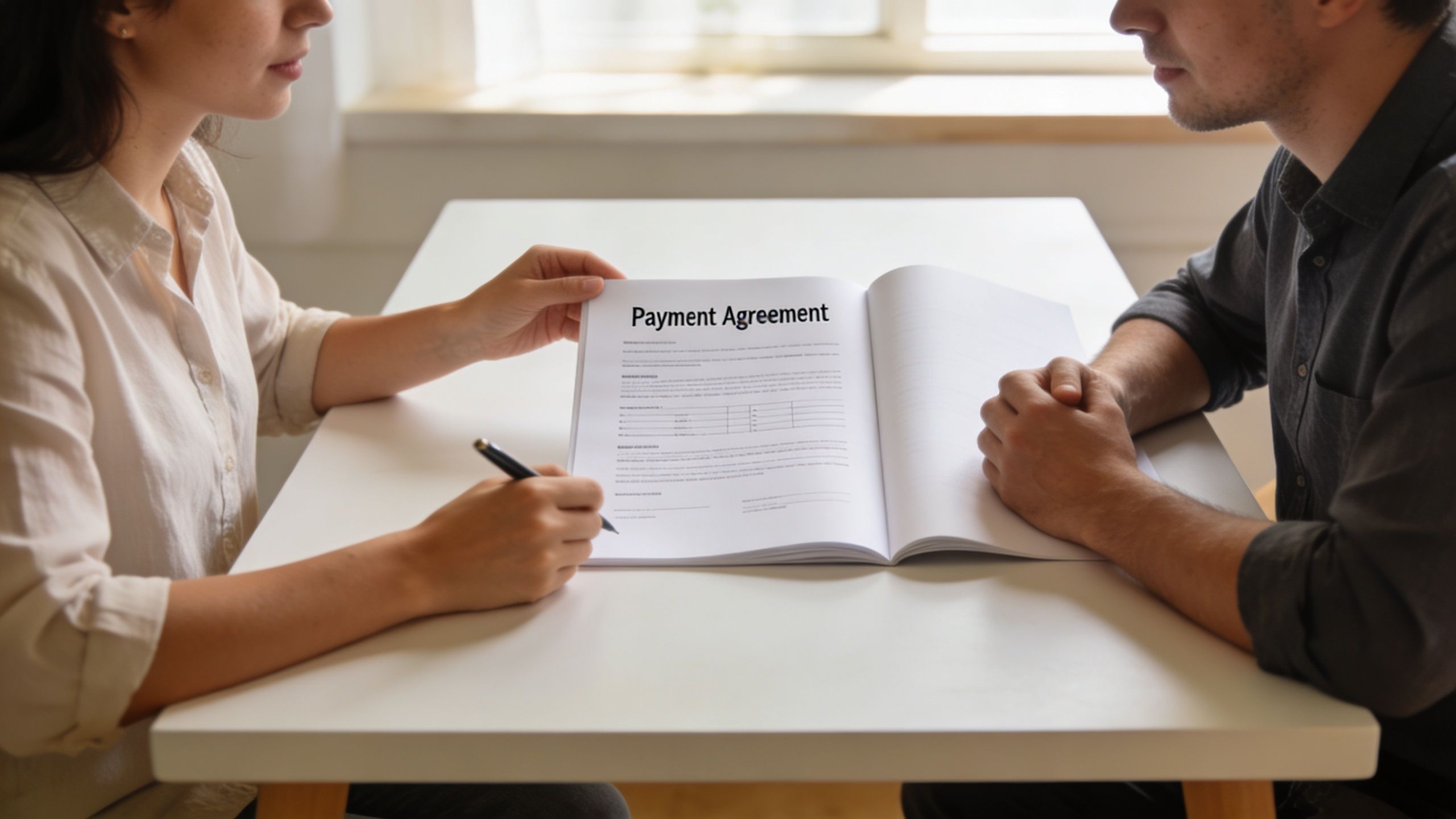
What a workable repayment plan should say
A good payment plan is specific enough that a stranger could read it and know who owes what, by when, and what happens if a payment is missed. A bad one is a vague text exchange that says, "I'll catch you up soon."
Use plain language. Include dates, amounts, and payment application terms. The biggest point of confusion is often whether money goes to current rent first, oldest rent first, or fees first.
A practical agreement usually covers:
The exact balance being addressed
List unpaid rent separately from any other claimed charges.The due dates for each installment
Use calendar dates, not phrases like "next week."How payments will be applied
Say whether money applies to rent first or to other amounts.What happens if the plan is broken
State whether the landlord may resume enforcement.
What works better than threats
For tenants, the most effective move is early contact. Don't wait until after the grace period if you already know the full payment won't be there. Ask for a written arrangement before the account becomes more complicated.
For landlords, consistency matters more than intensity. Sending mixed messages causes problems. If you accept partial payments, document whether that acceptance changes deadlines, waives fees, or pauses filing.
Here is a simple comparison:
| Approach | Likely result |
|---|---|
| Clear written payment plan | Fewer factual disputes about balance and default |
| Verbal promises only | Confusion about dates, waivers, and what was actually agreed |
| Partial payment accepted without terms | Higher risk of court fights over application of funds |
| Prompt written reminders | Better record if the matter later reaches court |
A payment plan should reduce ambiguity. If it creates new ambiguity, it isn't solving the problem.
A simple model
A practical repayment agreement might say that the tenant will pay the current month on the regular due date and an additional fixed amount on a second date each month until the arrears are cured. It should also say whether late fees are being waived, frozen, or preserved under the agreement.
That kind of structure protects both sides. The tenant gets a path to stabilize the tenancy. The landlord gets a cleaner record and a stronger file if the plan fails.
Some tenants also worry about the credit side of a rent default, especially if late payments have affected other accounts or created broader financial strain. For that issue, Superior Credit Repair's late payment guide can help readers think through the credit-reporting side separately from the lease dispute itself.
What to avoid
Don't use a payment plan to hide a legal problem. If the lease language is weak, the fees are questionable, or notices were mishandled, papering over the issue with a rushed agreement can make things worse.
Also, don't rely on a portal note, a voicemail, or a handshake when possession of a home may later be at stake. In my experience, disputes grow when people think they have an agreement but never define the terms that matter most.
When to Contact a Texas Landlord-Tenant Lawyer
Some late rent disputes are manageable with a clear lease and calm communication. Others stop being routine the moment a notice is posted, a payment is refused, or an illegal fee shows up on the ledger. That is when legal advice can save a great deal of time and damage.
For tenants, the warning signs are usually straightforward. You should talk to a Texas landlord tenant lawyer if you've received a notice to vacate, if the landlord is demanding fees that don't match the lease or the statute, if partial payments are being used to create a "technical" default, or if serious repair problems are tied up with the rent dispute.
For landlords, the trigger is often procedural risk. If the tenant has stopped communicating, is disputing the balance, is raising retaliation or habitability issues, or has a payment history that doesn't line up neatly with the ledger, do not assume the case is simple just because rent is owed.
Situations that deserve quick legal review
A notice has already been served
Timing and wording matter immediately.The fee structure may be noncompliant
A bad fee clause can create liability for the landlord.There is a written or verbal payment arrangement
Those agreements need to be reviewed for waiver and enforcement issues.The case involves more than unpaid rent
Repairs, lockouts, privacy issues, or discrimination claims change the analysis.
If you need broader help on lease disputes, enforcement, or defense, this page on working with a Texas rental lawyer is a useful place to start.
Good legal advice doesn't just answer, "Can I win?" It answers, "What is the safest next step under Texas law?"
The eviction attorney or landlord-tenant counsel you speak with should be able to review the lease, the notices, the payment record, and the communication trail quickly. That kind of early review often prevents expensive mistakes that are hard to unwind later.
If you need help with a late rent payment issue, an eviction, illegal fees, or a lease dispute, contact The Law Office of Bryan Fagan, PLLC for a free consultation today. Whether you're a tenant protecting your tenant rights or a landlord trying to comply with the Texas Property Code, clear legal advice can help you act quickly and avoid costly errors.