Living with roommates can turn small problems into daily stress fast. The sink stays full of dishes. One roommate's guest takes over the living room. The bathroom leak gets worse, and nobody agrees on whether it's the tenants' mess to handle or the landlord's repair to fix. By the time management gets involved, people are angry, texts are flying, and someone is threatening to move out.
That's usually the moment people start searching for answers about tenant rights for shared spaces in Texas apartments. They want to know who controls the kitchen, who pays when common areas are damaged, whether a landlord can walk into the unit, and what happens if one roommate stops pulling their weight.
Texas law does give you a framework. But in shared housing, the legal lines overlap. Some issues are between you and your landlord. Some are between you and your roommates. Some depend almost entirely on the lease. If you misread which category your problem falls into, you can quickly diminish your advantage.
Navigating Conflict in Your Texas Apartment
A lot of shared apartment disputes start with something that sounds minor.
One tenant says the hallway clutter is a fire hazard. Another says it's only temporary. The kitchen trash keeps piling up, and now there are bugs. A roommate reports a broken lock on the front door to management, but the others are upset because they think the complaint will “cause trouble” with the landlord. Then the landlord posts a notice, changes a policy, or starts blaming all tenants as a group.
That stress is real. Shared living means you don't just have one relationship to manage. You have a lease relationship with the landlord and a practical day-to-day relationship with the people you live with. Those two relationships often collide in kitchens, bathrooms, balconies, parking spaces, and entryways.
Practical rule: In shared housing, the legal answer usually depends on one question first. Is this a roommate problem, a landlord problem, or both?
That distinction matters more than most renters realize. If your roommate leaves food and trash everywhere, that may be a lease compliance issue inside the tenant group. If the bathroom plumbing backs up because the building has a maintenance problem, that shifts toward the landlord. If the landlord enters a bedroom without permission, that raises privacy concerns that are different from routine control of building hallways or laundry rooms.
The fastest way to protect yourself is to stop treating every conflict like one big argument. Break it apart. Identify the space involved, the lease terms that apply, and who has legal responsibility. That's where workable solutions usually begin.
What Legally Counts as a Shared Space in Texas
When clients talk about “common areas,” they often mean several different things at once. Texas apartment disputes get easier to sort out when you divide the property into three buckets.
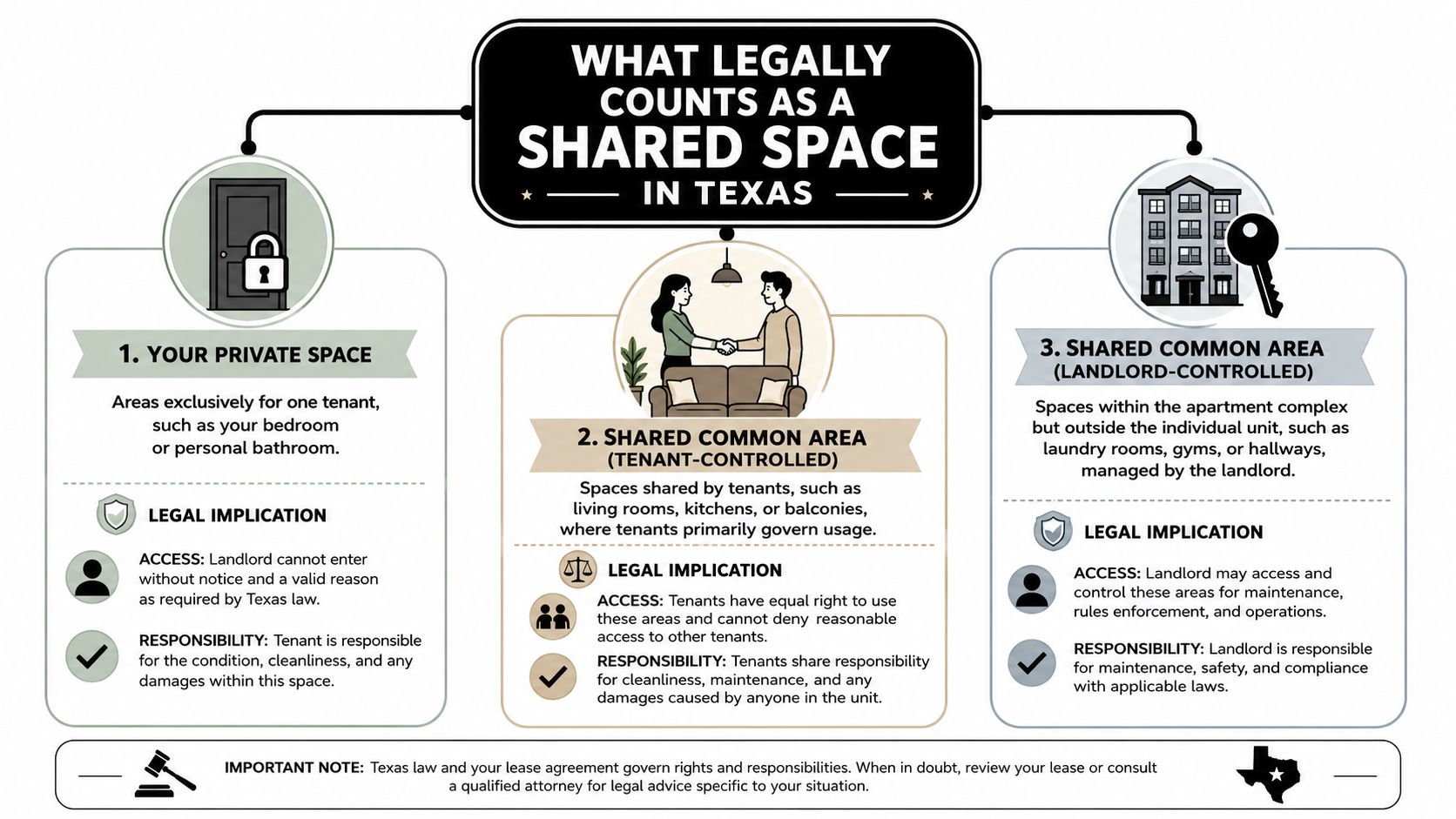
Your private space
This is the part of the property you personally possess as part of the lease arrangement. In some roommate setups, that may be your bedroom. In others, it may include a private bathroom tied to that bedroom.
Your privacy rights are strongest here. This is also the area where arguments about unauthorized entry become more serious. If a landlord or manager treats your private room as if it were just another building area, the analysis changes quickly.
Shared interior space among tenants
This usually includes the kitchen, living room, shared bathroom, balcony, and entry area inside the apartment. These spaces are still part of the rented unit, but the day-to-day use is shared by the tenants.
That creates the most conflict because control is split in practice. The landlord owns the property and may enforce lease terms. But the tenants are the ones using the space together. So if the problem is dishes, noise, overnight guests, or cleaning standards, the first place to look is usually the lease and any roommate agreement, not a broad claim that someone violated “tenant rights.”
Here's a simple way to think about it:
| Space type | Typical example | Main legal question |
|---|---|---|
| Private space | Bedroom, private suite area | Who can enter and under what authority |
| Shared tenant-controlled space | Kitchen, living room, shared bath | How co-tenants must use and maintain the unit |
| Shared landlord-controlled space | Hallway, laundry room, gym | What the landlord must manage and maintain |
Building-wide common areas
These are areas outside your leased interior space but inside the complex. Think hallways, stairwells, laundry rooms, mail areas, or other community spaces. Landlords usually have broader control over these areas because they are responsible for operating the property as a whole.
A dirty kitchen inside your apartment and a broken hallway light outside your apartment are both “shared space” problems, but they are not the same legal problem.
That difference matters because your remedies, your evidence, and your next step won't be the same. A roommate dispute inside the unit may call for written notice between tenants and lease review. A property-condition issue in a landlord-controlled area may call for a repair request and a documented management complaint.
If you want a clear answer, always identify the exact area first. Then ask who controls it, who uses it, and what the lease says.
Your Lease The Ultimate Rulebook for Shared Living
Most shared apartment fights feel personal. Legally, they are often contractual.
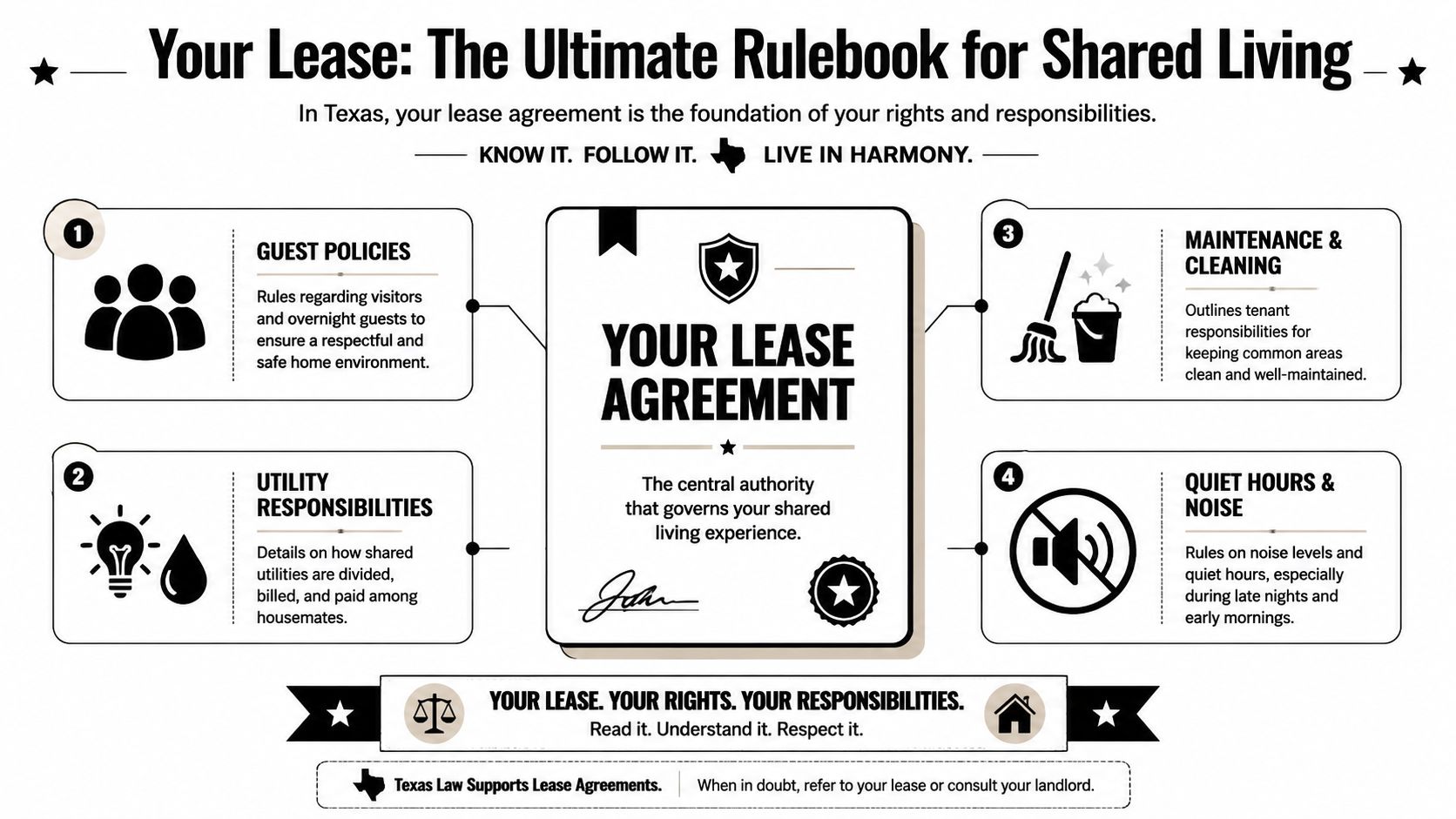
Your lease is the first document I'd review before giving any serious advice. It controls who the tenants are, what spaces they're renting, what rules apply to guests and noise, and what happens when one person stops paying or moves out early. In shared housing, the lease is not background paperwork. It is the operating manual for the whole arrangement.
Why co-tenants are often treated as one unit
Texas tenant guidance states that state law generally limits occupancy to three adults per bedroom, unless fair-housing requirements require a different result, and when multiple roommates sign the same lease, landlords will generally treat them as one tenancy unless the lease says otherwise. That means each roommate can be fully liable for lease obligations if another moves out or fails to perform. You can read that guidance in the Texas Tech Tenant's Rights Handbook.
That's the point tenants often miss. The landlord usually doesn't care about the private deal between roommates unless the lease adopts it. If rent is short, the landlord may pursue the tenancy as a whole. If the unit is damaged, the landlord may charge against the group first and let the roommates fight over internal blame later.
For a closer look at how that works in practice, this guide on roommate lease rights in Texas and who is responsible is a useful companion.
Clauses that decide real disputes
When I review shared-space conflicts, I look for a few clauses right away:
- Guest limits: Overnight guest rules often become a lease issue before tenants realize it.
- Noise and conduct terms: These can affect everyone on the lease, even if only one person is causing the disruption.
- Cleaning and maintenance language: Some leases push basic upkeep of interior shared areas onto tenants.
- Damage provisions: These matter when nobody admits who caused the problem in a common room.
If four people sign one lease, the landlord usually sees one rent obligation, one set of lease promises, and one tenancy problem.
This is also why tenants should be careful about assuming residential and commercial leasing work the same way. Commercial Lease Disputes in Texas involves how Texas treats commercial tenancies differently under Chapter 93, which is a different legal framework from the residential rules most apartment tenants rely on.
What works and what doesn't
What works is reading the lease before the conflict gets ugly. Flag the sections on occupancy, visitors, utilities, repairs, notice, default, and move-out. If the lease is vague, create a written roommate agreement anyway.
What doesn't work is assuming fairness will fill in the blanks. It usually won't. If your lease makes all tenants responsible together, then one roommate's breach can become everyone's problem fast.
Landlord Duties for Common Areas and Tenant Privacy
Landlords have real authority over apartment property. That does not mean they have unlimited access to your living space.
In shared apartment disputes, tenants often confuse two separate issues. First, does the landlord have a duty to address a condition in a common area? Second, does the landlord have the right to enter the occupied unit or a private bedroom to inspect, clean, or investigate? Those are different questions.
What landlords control
A landlord generally has broader control over building-wide common areas than over the interior of your occupied unit. So when the problem involves a hallway, exterior entry, shared laundry room, or another complex-managed space, management usually has stronger operational control and a stronger maintenance role.
Inside the apartment, the line gets narrower. Shared kitchens and bathrooms may still be subject to lease enforcement and maintenance obligations, but the landlord's ownership interest does not erase the tenant's possessory rights. That matters when management wants access for inspection or enters casually because “it's our property.”
What tenant privacy still protects
Texas tenant guidance recognizes a privacy baseline in occupied rental units. A landlord may not enter absent permission or lease-based justification, and while a landlord may have broader control over common areas, entry into a tenant's private bedroom or leased interior space still requires lawful notice or consent according to Texas Law Help's explanation of tenant privacy.
That means you should separate spaces carefully in your own mind. A manager walking a public hallway is not the same as a manager stepping into your bedroom. A maintenance need in a shared bathroom is not automatic permission to search personal space or enter without authority.
If you're dealing with repeated entry problems, review this page on a landlord entering an apartment without permission in Texas.
Document the date, time, who entered, what area they entered, and whether you gave consent. That record often decides whether a privacy complaint has teeth.
Practical examples from shared living
Use this framework when the facts are messy:
- Broken lock on a building entrance: This usually points toward landlord responsibility for a landlord-controlled area.
- Landlord enters a private bedroom during a roommate inspection issue: That raises a stronger privacy concern.
- Messy kitchen caused by tenants: That is often a tenant-use problem first, even if management later enforces lease standards.
- Pest issue tied to sanitation or structure: Responsibility can depend on the cause, the lease, and local facts. If you want a comparison point outside Texas, this breakdown of who pays for Florida rental pest control helps show how these issues are often split between maintenance duties and tenant-caused conditions.
What usually works is a written notice that identifies the exact area involved and the exact conduct at issue. What doesn't work is sending management a vague complaint that says only “the apartment is unsafe” or “they keep coming in whenever they want.”
A Step-by-Step Guide to Resolving Shared Space Disputes
You come home and find the shared kitchen unusable, a roommate blaming management, and management blaming the tenants. By that point, one mistake can cost you your advantage. Stopping rent, firing off threats, or making a vague complaint usually creates a second problem on top of the first.
In shared Texas apartments, the first job is to sort out who controls the space, who caused the condition, and who is legally responsible for fixing it. Those are not always the same person.
Step one and step two
Start with facts. Then send the complaint to the right target.
Document the issue
Take dated photos if the dispute involves damage, blocked access, trash buildup, leaks, broken fixtures, missing keys, or entry into a private area. Save texts, emails, portal messages, notices, and screenshots. If another tenant or guest saw what happened, write down their name and what they observed while it is still fresh.
In shared-space cases, proof needs to answer two questions. What happened, and who had control over that area at the time?
Identify who needs to fix it
If the problem is roommate conduct, such as hogging the living room, leaving the bathroom unsanitary, or letting guests take over common areas, start with the roommate. If the problem involves a landlord-controlled area, a repair issue, building access, or staff entry, send the complaint to management in writing.
Group leases create confusion here. The landlord may treat all tenants as a unit under the lease, even when one roommate caused the problem. Inside the apartment, though, responsibility may still need to be sorted out between tenants later.
A short follow-up message after any conversation helps. “We spoke today about the shared bathroom leak and agreed it would be reported to maintenance” is far more useful than trying to reconstruct the discussion a month later.
Step three and step four
If the problem continues, shift from discussion to formal notice.
- Send a written notice that is specific enough to act on
State the exact area involved, what happened, when it started, how often it has happened, and what you want done. Avoid broad statements like “the apartment is unsafe” if the underlying concern is a broken bedroom-door lock, repeated guest interference in the living room, or a blocked hallway.
If you need a model, this guide to a Texas demand letter for tenant disputes shows how to organize the facts and request a written response.
Build a record that shows the overlap in responsibility
Shared-space disputes often turn on overlap. A landlord may control the hallway lock. A roommate may have damaged it. All tenants on the lease may still receive the violation notice. Your file should make those lines clear.
Client advice: The best records do not just show that a problem exists. They show who controlled the space, who caused the issue, who got notice, and who failed to act.
Step five and step six
Know when Texas law gives you protection. Know when the dispute is no longer safe to handle casually.
Watch for retaliation after a good-faith complaint
Texas law limits retaliatory action after a tenant makes a good-faith repair complaint or reports certain housing problems. The Texas State Law Library's rent and retaliation guidance summarizes those rules and available remedies.
In a shared apartment, this matters fast. One tenant may report a repair issue in a common area, and management may respond in a way that affects everyone on the lease. If rent increases, service cuts, lease termination threats, or eviction activity follow close behind a legitimate complaint, preserve the timeline immediately.
Get legal help when the facts are split between roommate conduct and landlord duties
Bring in a Texas landlord tenant lawyer when the dispute involves threatened eviction, repeated entry problems, property damage charged to the whole household, or a lease that does not match how the unit is being used. An eviction attorney can also help if management is using a shared-space conflict to push the household toward default or removal.
A practical written notice can be simple:
“I am giving written notice of a problem affecting the shared bathroom and hallway area of the apartment. The condition began on [date]. I previously reported it on [date]. Please confirm in writing when it will be addressed and whether management considers this a tenant-caused issue or a maintenance issue.”
That last sentence matters. In shared living disputes, tenants lose ground when nobody pins down whether the problem belongs to a roommate, the tenant group, or the landlord. A legal review early in the dispute can prevent the wrong person from absorbing the blame.
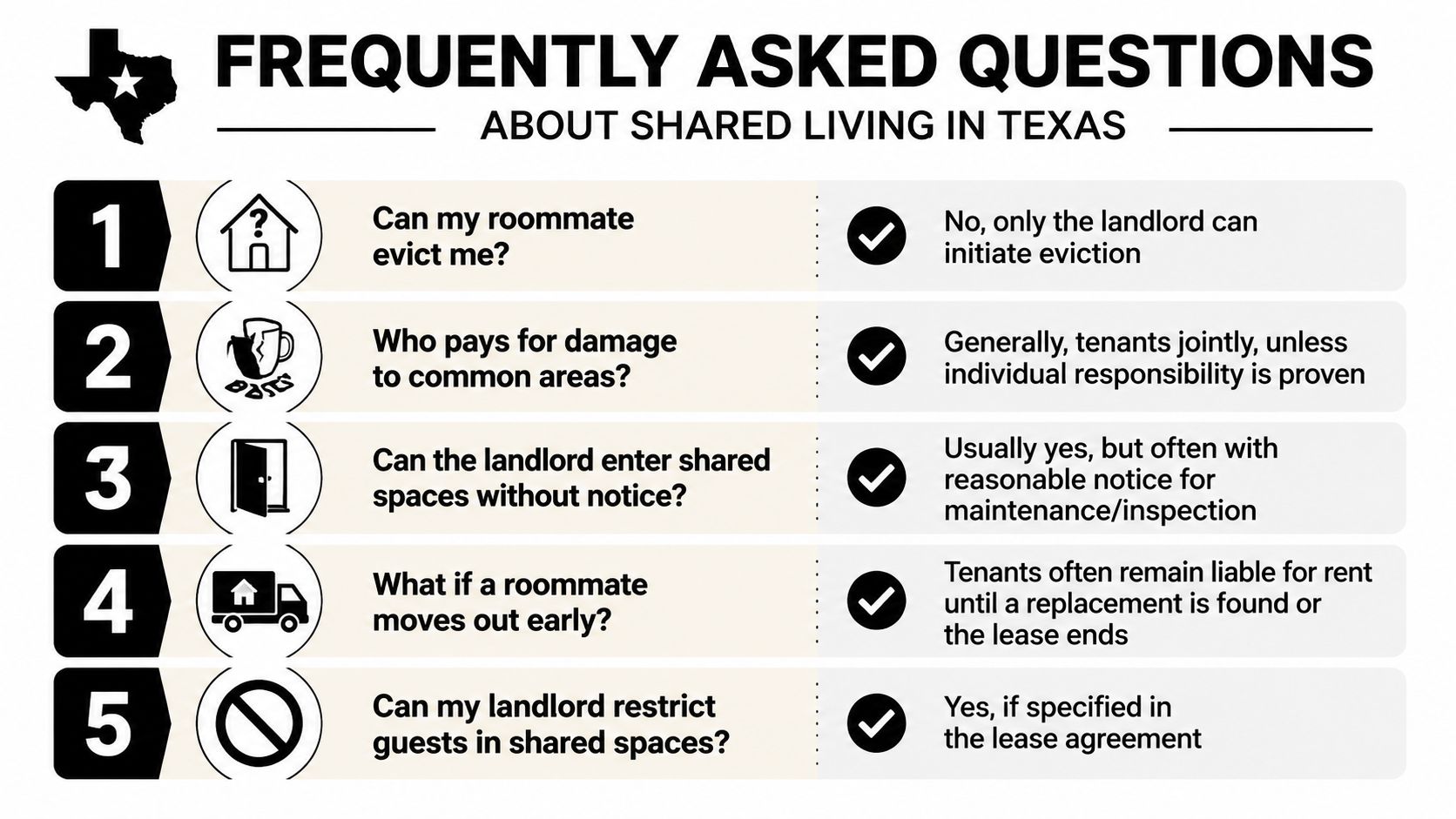
Frequently Asked Questions About Shared Living in Texas
The most stressful roommate disputes usually come down to four or five recurring questions. Here are the answers I give most often.
What happens to the security deposit if one roommate moves out early
Usually, the answer starts with the lease. In many shared leases, the deposit is tied to the tenancy as a whole, not paid out in pieces every time one roommate leaves. If one person moves out before the lease ends, the landlord may wait until the tenancy fully ends before accounting for the deposit.
That means the departing roommate often has to work out reimbursement directly with the remaining tenants unless the lease says otherwise.
Who is responsible if my roommate's guest damages the apartment
Start with the lease, then look at proof. In many shared-tenancy situations, the landlord may first look to the tenants on the lease as a group. Inside that group, the tenants may later argue about who should ultimately reimburse whom.
If you know a guest caused the damage, preserve proof early. Photos, messages, admissions, and witness statements matter.
Can a landlord charge separate utility fees for common areas
That depends on the lease and how the charges are structured. The key question is not whether the landlord labels something a shared-area cost. The question is whether the lease authorizes the charge clearly enough and whether the billing matches the written agreement.
If the utility terms are vague, ask for the written basis for the charge before assuming you have to accept it.
My roommate is breaking the lease, but it doesn't affect me much. Should I stay out of it
Be careful. On a shared lease, another roommate's violation can still become your problem if the landlord treats all tenants as one tenancy. A guest violation, unpaid rent, or property damage may spread risk across the whole group even if you didn't personally cause it.
Silence can weaken your position. If you know there is a problem, create a written record showing what you reported and when.
Can my roommate evict me
Not in the way a landlord can. In Texas, formal eviction is a legal process that goes through the court system. A roommate may create pressure, complain to management, or sue over money, but that is different from personally removing you through an eviction order.
When people share one lease, many disputes that feel personal are still governed by landlord-tenant procedure and the written contract.
What if the landlord treats our whole apartment like one problem
That is common in shared housing. If all tenants signed the same lease, management may issue notices or pursue remedies against the tenancy together. Your defense often depends on documentation showing who did what, what the lease says, and whether the landlord followed the Texas Property Code.
Protect Your Rights in a Shared Apartment
Shared living works best when everyone knows where the legal lines are. Your bedroom is not the same as the hallway. A roommate dispute is not always a landlord violation. And the lease often decides more than people expect.
If you remember three things, remember these. Read the lease closely. Document every serious problem in writing. Identify whether the issue belongs to the landlord, the tenant group, or both. Those steps put you in a stronger position whether you're trying to stop a privacy problem, force a repair, respond to a lease violation, or protect yourself from blame for someone else's conduct.
These cases move quickly. Once notices go out or rent disputes escalate, bad assumptions can get expensive. A Texas landlord tenant lawyer can sort out the overlap between lease rights, privacy, repair duties, and shared responsibility before the situation gets worse.
If you need help with an eviction, lease issue, or rental dispute, contact The Law Office of Bryan Fagan, PLLC for a free consultation today.