You leave your apartment, head to the parking space you use every day, and the car is gone. An immediate feeling of panic often sets in. Was it stolen? Was it repossessed by mistake? Did the apartment office change the parking rules without telling anyone?
That reaction is normal. So is the anger that follows once you learn it was towed.
Texas law gives tenants real protections in apartment towing disputes. This isn't just about whatever the property manager says the rules are. It involves the Texas Property Code, the Texas Occupations Code, and specific procedures that landlords and tow companies have to follow. If they miss those steps, the tow may be wrongful even if the complex claims it had a reason.
The issue I see most often is not a dramatic parking violation. It's a quieter problem. A landlord changes parking policy during the lease, gives weak notice or no proper written notice at all, and then starts towing immediately. That is where many tenants lose money because they assume the apartment complex can do whatever it wants in its own lot. It can't.
If you're dealing with an apartment tow right now, focus on two things. Get your vehicle back as quickly as possible, and preserve your right to challenge the tow before the deadline passes. A Texas landlord tenant lawyer can help with that, but even before you hire counsel, there are steps you can take today.
Your Car Is Gone What Are Your Rights
You walk out for work, coffee in hand, and your car is gone. A few hours later the leasing office says the rules changed last week. Now the lot is permit-only, your tag was not visible enough, or your usual space became a tow-away area. If they cannot show you clear written notice, that is often the first place I would press.
Texas law does not let an apartment complex rewrite parking enforcement in the middle of a lease and start towing first. The dispute usually turns on notice. If management changed the parking policy, changed where tenants could park, or started enforcing a new permit system without proper written notice, the tow may be wrongful even if the office insists the new rule applies.
That is the practical problem many tenants miss. They assume the lot belongs to the complex, so the complex can make any rule it wants at any time. In Texas, that assumption gets people stuck with towing and storage charges they may not owe.
A lease also does not give a landlord unlimited room to override statutory towing protections. If you are reviewing your paperwork now, compare the parking language in your lease, any addenda, and any later notices posted on doors, emailed to tenants, or left on windshields. The gap between those documents often decides the case. Landlords who want enforceable parking terms need compliant Texas landlord agreements, and tenants should expect clear notice when those terms change.
What your rights look like in practice
Start with four questions:
- What exact rule did the complex say you violated?
- Was that rule in your lease, or was it added later?
- Did you receive proper written notice before enforcement began?
- Did the tow company remove the vehicle with legal authority from that specific area?
If any answer is unclear, do not treat the tow bill as automatically valid.
The phrase apartment towing laws Texas tenant rights matters because these cases are often won or lost on paperwork, timing, and proof of notice, not on whoever sounds most confident at the front desk. A tenant who can show the parking policy changed mid-lease without proper notice is often in a much stronger position than the apartment complex first suggests.
When Can an Apartment Complex Legally Tow Your Car
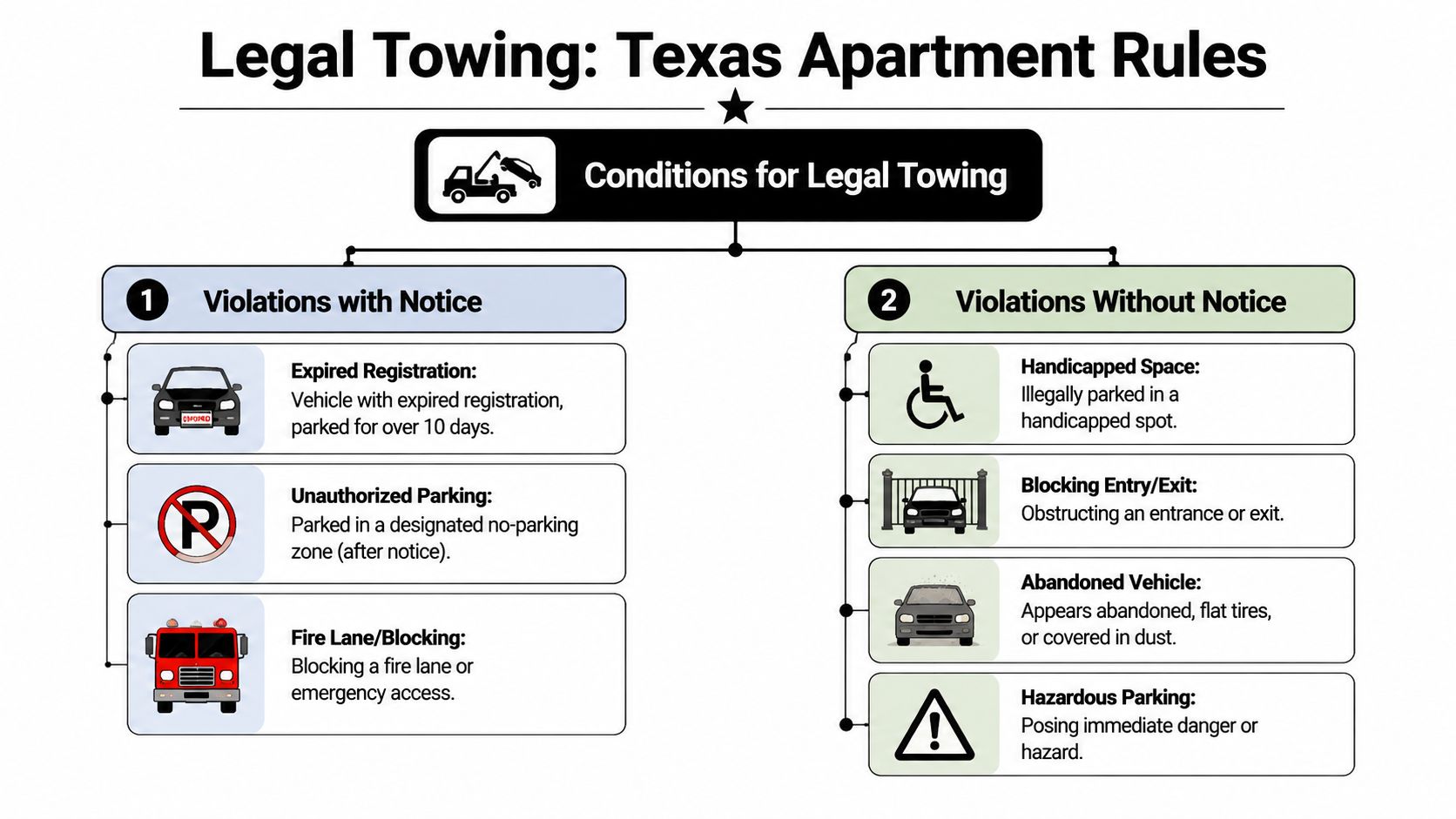
Not every apartment tow is illegal. Texas allows towing in certain situations, but the authority is limited. A landlord can't just decide a car looks out of place and have it hauled off.
Under Texas Law Help's summary of towed vehicle rules, vehicles in apartment complexes may generally be towed only from designated areas when they block walkways, obstruct access to other vehicles or dumpsters, occupy restricted or tow-away zones, or are semitrailers, trailers, or truck-tractors unless the lease specifically allows them. If towing rules are not properly provided, a landlord may be liable for $100 plus any towing or storage costs.
Situations that usually support a legal tow
Some examples are straightforward:
- Blocking access: Your car keeps another vehicle from leaving, blocks a dumpster, or obstructs a walkway.
- Restricted zones: You parked in an area clearly marked as a tow-away or restricted zone.
- Prohibited vehicle type: The vehicle is a trailer or similar equipment the lease doesn't permit in the complex.
- Safety issues: The vehicle creates an immediate problem for access or movement in the lot.
Those situations are different from a case where the apartment suddenly starts enforcing a new permit rule halfway through the lease.
Situations that deserve closer scrutiny
The harder cases usually involve rule changes and weak communication. For example:
| Scenario | Risk level |
|---|---|
| You parked in a fire lane clearly marked for no parking | Tow is more likely to be valid |
| You used your usual spot, but management says a new permit system started this week | Tow needs notice review |
| A guest parked where the office previously allowed guest parking, but signs changed | Tow may depend on written notice and signage |
| Your assigned or customary space is suddenly reclassified | Tow should be examined carefully |
A lot of disputes could be reduced by clearer leases and parking addenda. If you're reviewing or updating parking terms, this guide on compliant Texas landlord agreements is useful for understanding how lease language and policy documents should fit together.
A legal reason to tow is only part of the analysis. The paper trail often decides the case.
Landlord and Tow Company Duties Under Texas Law
A lawful apartment tow in Texas usually turns on paperwork, timing, and notice. In tenant cases, the break usually happens before the truck arrives. Management changes the parking rules mid-lease, posts a sign, sends a vague email, or tells residents at the office counter, then acts as if that was enough.
Your lease does not erase statutory towing protections
A lease can set parking terms, but it cannot cancel protections Texas law gives tenants and vehicle owners. If a landlord relies on a broad clause that says management may tow any vehicle it considers unauthorized, that clause is not the end of the analysis. The tow still has to comply with the governing towing rules, the lease documents, and any notice requirements tied to later policy changes.
Parking disputes also overlap with the larger landlord-tenant duties found in the Texas Property Code Chapter 92 overview. That matters for one practical reason. Apartment parking is often treated like a side issue by management, but courts and towing hearings look at notice, lease terms, and possession rights together.
Mid-lease parking changes cause many illegal tows
This is the pattern I see most often. A tenant has parked in the same area for months. Then the complex rolls out permits, re-labels guest spaces, changes visitor hours, or starts enforcing a rule that sat dormant. A tow follows within days, sometimes the same week.
That is where many landlords create exposure.
If the rule changed after move-in, the first question is not whether the office announced it. The first question is whether the tenant received proper written notice in a form the landlord can prove. A printed sign at the gate may help the landlord. It does not automatically fix a weak lease record or a sloppy mid-lease policy change.
Use this checklist to test the tow:
- Review the full lease packet, including parking addenda and community rules.
- Check whether the towing or parking restriction was part of what you signed at move-in.
- Ask for the exact written notice management claims it sent after the policy changed.
- Ask how that notice was delivered and on what date.
- Compare the notice date to the tow date.
- Confirm whether the property signage matched the rule management says you violated.
One sentence often exposes the problem: show me the written notice that changed the parking rule and proof that it was delivered before the tow.
The landlord has duties, and the tow company has its own
Landlords have to do more than authorize aggressive enforcement. They need clear parking rules, clear signs where required, and a defensible paper trail showing the vehicle was subject to towing under the rules in effect. If the property changed the rules mid-lease and cannot show proper notice, the tow becomes much harder to defend.
Tow companies have separate responsibilities. They need legal authority to remove the vehicle from that property, and they need to be able to justify the tow if challenged. A tow company that acts on bad instructions from an apartment complex can still end up defending the tow.
That is the fundamental trade-off. Property managers want quick enforcement because parking complaints pile up fast. But speed creates mistakes. A same-day rollout of a new permit policy may solve a management headache and create a legal one.
What good compliance looks like
The properties that avoid towing disputes usually do four things well. They attach parking rules to the lease, update those rules in writing, document delivery, and wait long enough for residents to comply before ordering tows.
What fails is informal notice. Verbal warnings at the front desk. A mass text with no record of receipt. A new windshield sticker rule enforced before residents even have a fair chance to get the sticker.
If your car was towed after a sudden parking change, focus less on the argument in the lot and more on the notice trail. In many Texas apartment tow disputes, that is where the case is won or lost.
Your Car Was Towed A Step-by-Step Recovery Plan
When your vehicle is missing, don't spend the first hour arguing with the leasing office. Start with recovery, documents, and deadlines.
A quick visual can help you organize the first steps.
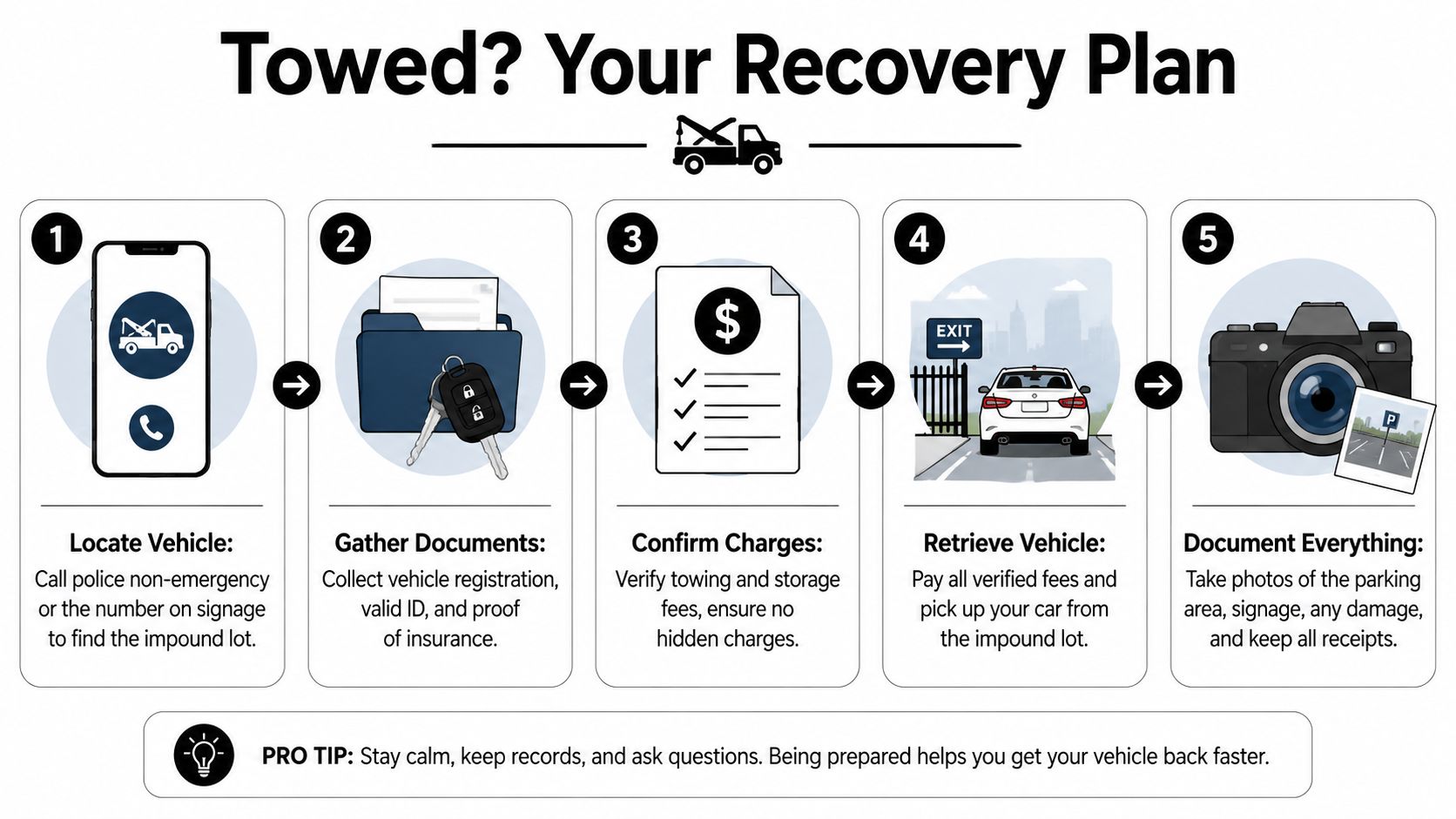
Step one through step three
Locate the vehicle
Call the number posted on the apartment towing sign if one is available. If you can't confirm the tow company quickly, contact local law enforcement's non-emergency line and ask where the vehicle was taken.Get your release documents together
Bring your ID and the documents the storage facility requires to release the vehicle. If you don't have everything with you, ask exactly what the facility will accept before you travel there.Verify the charges before paying
The Texas Department of Licensing and Regulation towing consumer page states that the maximum private-property tow charge is $272 for vehicles up to 10,000 pounds, $380 for vehicles between 10,000 and 25,000 pounds, and $489 per unit for vehicles above 25,000 pounds, with a $978 total maximum. It also lists daily storage charges of $20 for vehicles 25 feet long or less and $35 for vehicles longer than 25 feet, with 2023 adjusted rates of $22.85 and $39.99.
Step four through step five
This video gives a useful overview of the consumer side of the process:
Get the car out, then preserve your claim
In many cases, paying to recover the car is the practical move, especially if storage fees continue to add up. Paying the charges doesn't automatically mean you agree the tow was lawful.Document everything immediately
Take photos of the lot, your parking area, signs, your vehicle, and any damage. Save receipts, tow tickets, gate access messages, and every email or text from management.
If you need to put your objection in writing after the vehicle is recovered, this guide on how to write a demand letter to a landlord in Texas can help you organize the facts and request reimbursement.
Bring a phone charger, take photos before you leave the lot, and keep every piece of paper. Small details win towing disputes.
The deadline you cannot miss
If you believe the tow was wrongful, Texas Law Help says you must request a tow hearing in justice court within 14 days of the tow, and the court must hold the hearing within 21 days of filing, as summarized through the TDLR and Texas Law Help materials already discussed. That filing window is short. Miss it, and you may lose your chance to challenge the tow effectively.
How to Challenge an Illegal Tow and Win
Winning an apartment tow dispute usually turns on proof, not outrage. Tenants often know the tow felt wrong, but justice court needs something more specific. You need to show what rule was missing, what notice wasn't given, or why the tow company lacked legal authority.
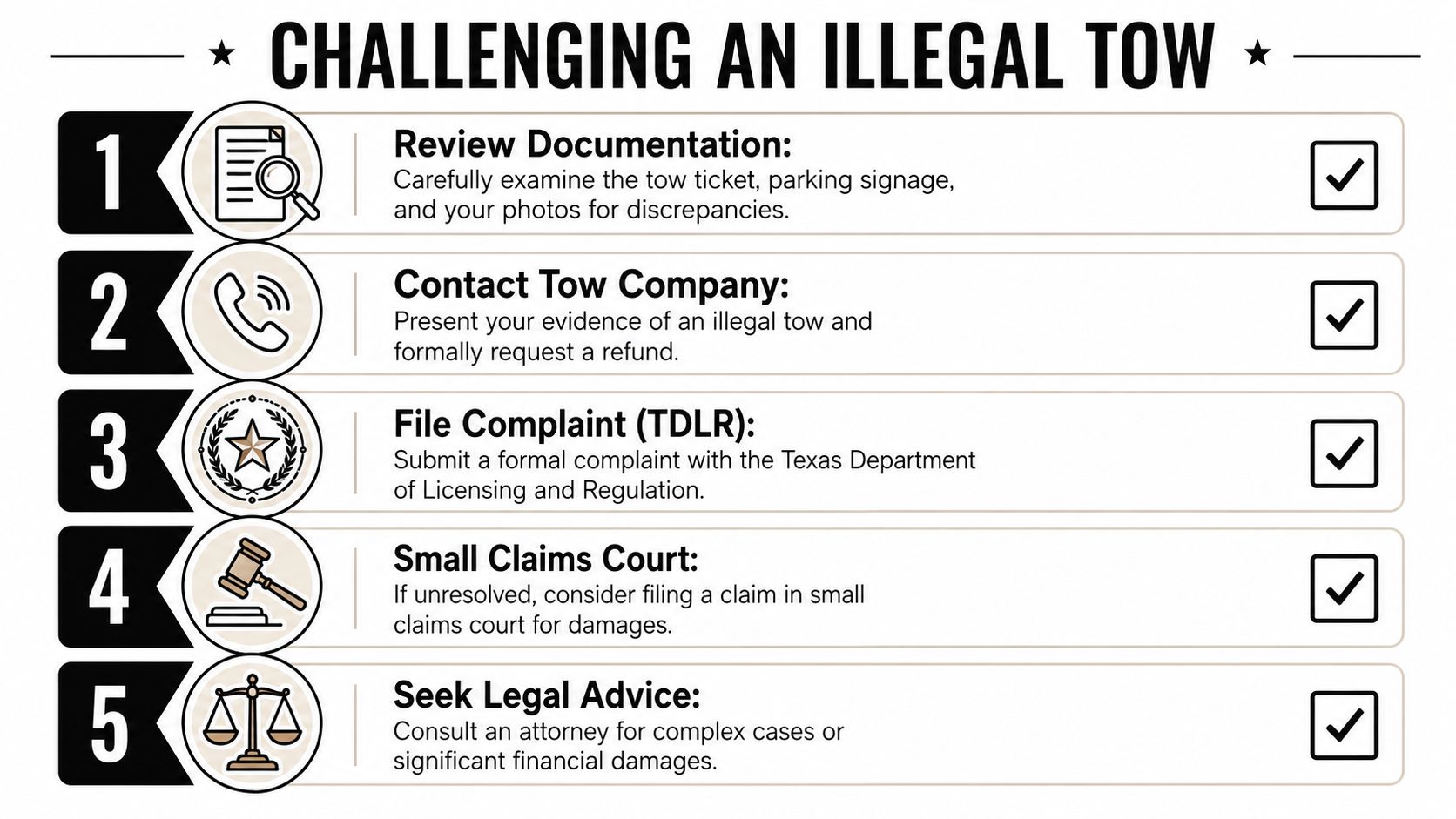
Build the case around the notice problem
The most effective challenge is often narrow and fact-based:
- Your lease included one parking rule, but management enforced a different one
- The complex changed the policy mid-lease
- You never received proper written notice of that change
- The tow happened before tenants had a fair chance to comply
That approach is stronger than making broad accusations about unfairness. Judges want dates, documents, and photos.
Fox 7 Austin reported that TDLR data from 2020-2023 showed 17 administrative orders against Austin tow companies for "illegal tows" and "non-consent, private property tows without legal authority." That doesn't prove every apartment tow is unlawful, but it does show illegal private-property towing is a real issue in Texas.
Evidence that helps in court
Bring a file, not a story. Good evidence includes:
- Photos of the lot: Especially the exact place where you parked and every sign near it.
- The lease and parking addendum: If the complex claims your lease allowed the tow, make them point to the language.
- Management emails or texts: These often show confusion, inconsistent explanations, or lack of notice.
- Tow receipt and storage paperwork: These establish the timeline and charges.
- A timeline you wrote out: Keep it simple and date-specific.
If you're considering a related claim beyond the tow hearing itself, this overview from DFox Law PLLC on small claims is a practical primer on how small claims procedures generally work in Texas.
What usually hurts a tenant's case
Some arguments sound strong but don't help much:
| Weak approach | Better approach |
|---|---|
| "It wasn't fair" | "The complex changed the permit rule and didn't provide written notice" |
| "Everyone parks there" | "The area wasn't properly designated under the policy I received" |
| "The office manager was rude" | "Management cannot produce the notice they claim was sent" |
If the towing issue overlaps with other landlord conduct, such as lockouts or pressure tactics, this resource on illegal eviction in Texas and what tenants should do may help you spot a bigger pattern.
For more involved disputes, one option is legal counsel. The Law Office of Bryan Fagan, PLLC handles Texas landlord-tenant disputes, including lease enforcement and tenant-rights issues, which can matter when a towing case is part of a larger conflict with the property.
Proactive Steps to Prevent Apartment Towing
The best towing dispute is the one that never starts. A few habits can save you a lot of money and stress.
At move-in, document the parking rules
Don't rely on the leasing agent's verbal summary. Ask for the parking policy in writing and keep a copy with your lease. Then take photos of the lot, your assigned space if you have one, guest parking areas, and every tow-away sign you can find.
If the complex later changes the rules, ask for the update in writing. If the office says, "We sent something out," ask them to resend it.
Watch for quiet policy changes
The biggest risk isn't always obvious misconduct. It's gradual changes. New stickers. New guest limits. New painted curbs. New overnight restrictions.
Keep these habits:
- Save all property notices: Emails, door tags, portal messages, and text alerts.
- Photograph new signs: Especially if they appear after you've moved in.
- Ask for written confirmation: If an employee gives you parking permission, get it in writing.
- Keep your vehicle current: Outdated vehicle paperwork often becomes the excuse for enforcement.
Some properties now reduce confusion with better access control and parking management tools. For example, smartphone-controlled entry systems can help properties manage access and guest entry more clearly. Technology doesn't replace legal notice, but it can reduce the gray areas that lead to towing fights.
If a rule matters enough to tow over, it matters enough to put in writing and keep a copy.
Frequently Asked Questions About Texas Towing Laws
Can my car be towed for expired registration or inspection issues
It can become an issue at some properties, but the answer depends on the rule in place and whether the complex properly provided that rule. If management changed enforcement during your lease, the notice question becomes critical.
Are guest parking rules enforceable
Usually yes, if the rules were properly established and communicated. Problems arise when guest parking is poorly marked, inconsistently enforced, or changed without proper written notice to tenants.
Can I be towed from my own assigned parking spot
Possibly, but that should trigger a close review of the lease, parking addendum, and any later notices. Assigned parking disputes often expose communication failures between management, towing vendors, and residents.
What if the tow truck driver damaged my vehicle
Take photos immediately at pickup and before driving away. Get all paperwork from the vehicle storage facility and notify the tow company in writing as soon as possible. Keep your repair records and estimates.
Should I pay first or fight first
In many cases, paying to get the vehicle released is the practical move because storage charges may continue. Preserve your receipts and challenge the tow afterward if you believe it was wrongful.
Do I need a Texas landlord tenant lawyer for a tow dispute
Not every case requires an attorney, but legal help is valuable when the dispute involves a mid-lease policy change, missing written notice, repeated towing, or other landlord misconduct tied to the same tenancy. Those cases often involve more than just the car.
If you need help with an apartment towing dispute, lease issue, or other rental conflict, contact The Law Office of Bryan Fagan, PLLC for a free consultation today. A Texas landlord tenant lawyer can review the notice history, lease documents, and tow paperwork, then help you decide whether to pursue reimbursement, a tow hearing, or a broader claim under the Texas Property Code.