Dealing with a lease issue is stressful enough. It gets worse when a notice appears on your door from a homeowners association you never signed anything with, accusing you of breaking rules you may not have seen before.
That's the core problem behind HOA vs tenant rights in Texas. You have one home, but there may be three sets of rules touching it at once. The confusion usually comes from not knowing which rulebook controls your situation.
The good news is that Texas law does give this conflict a structure. Once you know who can enforce what, and against whom, the panic usually drops fast.
| Issue | Usually controlled by | What matters most |
|---|---|---|
| Rent, late fees, repairs, retaliation, eviction | Landlord and tenant under the lease and Texas Property Code | The written lease and state law |
| Community rules like parking, pets, appearance, amenity use | HOA or POA through recorded governing documents | Whether the rule is valid and whether it was made part of the lease |
| Renting restrictions | HOA governing documents, but only if properly included there and consistent with Texas law | CC&Rs, statutory limits, and newer tenant protections |
| Tenant screening by the HOA | Limited by Texas law | HOA cannot require full application, credit report, or board approval |
| Voucher or payment-method discrimination by HOA | Texas law controls | Starting September 1, 2026, HOAs can't ban renters based on federal housing aid |
An HOA Notice on Your Door? Understanding the Confusion
A common Texas scenario looks like this. You pay rent on time, keep the home clean, and follow your lease. Then a letter arrives saying your vehicle violates a parking rule, your dog isn't approved, or your tenancy itself is a problem because the neighborhood has rental restrictions.
Most tenants react the same way. They ask, “How can the HOA tell me what to do when my contract is with my landlord?”
That question is fair. It also gets to the heart of the problem. In an HOA-governed community, the association usually deals with the owner, but the owner may try to pass the pressure down to the tenant. That's where people get trapped between documents they never negotiated and a lease they did sign.
Why this feels so unfair
The tenant often sees only one rulebook, the lease. The landlord may be operating under another set of documents, usually the subdivision's CC&Rs, bylaws, and rules. If those documents were never clearly folded into the lease, the tenant may have no practical notice of them until a violation notice lands.
A tenant can be living completely in line with the lease and still end up in conflict because the owner failed to line up the lease with the HOA rules.
That doesn't mean the HOA has unlimited power. It means you need to separate the legal relationships instead of treating the whole mess as one dispute.
The first calming point
If you're a tenant, the HOA usually isn't the party that can evict you. If you're a landlord, the HOA usually isn't your shortcut around landlord-tenant law. Those are two different systems, and Texas law keeps them separate in important ways.
The practical question isn't “Does the HOA have rules?” Almost every association does. The better question is: which rules legally apply to you, and through what document?
The Three Parties in Play Landlord HOA and Tenant
Texas treats this like a three-party relationship, but each party gets authority from a different place. If you miss that, every HOA rental dispute feels random.
The landlord owns the property interest
The landlord is the owner. The HOA's direct enforcement power usually runs to that owner because the owner took title subject to the recorded community restrictions. In practice, that means the owner gets the violation notices, hearing notices, fines, and other association pressure.
Texas is heavily shaped by associations. The state has approximately 23,000 active homeowners associations serving nearly 34.3% of households, and 82.4% of new homes sold in 2023 were in HOA communities, according to iPropertyManagement HOA statistics. That's why these conflicts are so common.
The tenant rents under a lease
The tenant doesn't own the lot, unit, or deed-restricted interest. The tenant's main legal document is the lease. That matters because a tenant's day-to-day obligations usually come from the lease and the Texas Property Code, not from an HOA packet sitting in a management office.
A simple way to think about it is this. The owner bought into the neighborhood contract. The tenant rented a home from the owner. Those are related arrangements, but they are not identical.
The HOA or POA governs the community
In Texas, the technical label is often property owners association, or POA, rather than a separate legal HOA category. The association's authority comes from the dedicatory instruments, including the CC&Rs, bylaws, and adopted rules.
Texas doesn't impose a general statewide rental ban for HOA or condo communities. A rental prohibition is enforceable only when it is properly embedded in the governing documents. That document-first approach is why review matters so much.
Working rule: If you want a reliable answer, put the lease next to the CC&Rs. Don't rely on summaries, verbal statements, or a front-gate warning.
For readers dealing with business properties, Commercial Lease Disputes in Texas is a separate topic because Texas handles commercial tenancies differently under Chapter 93.
The Hierarchy of Power Texas Law vs HOA Rules vs Your Lease
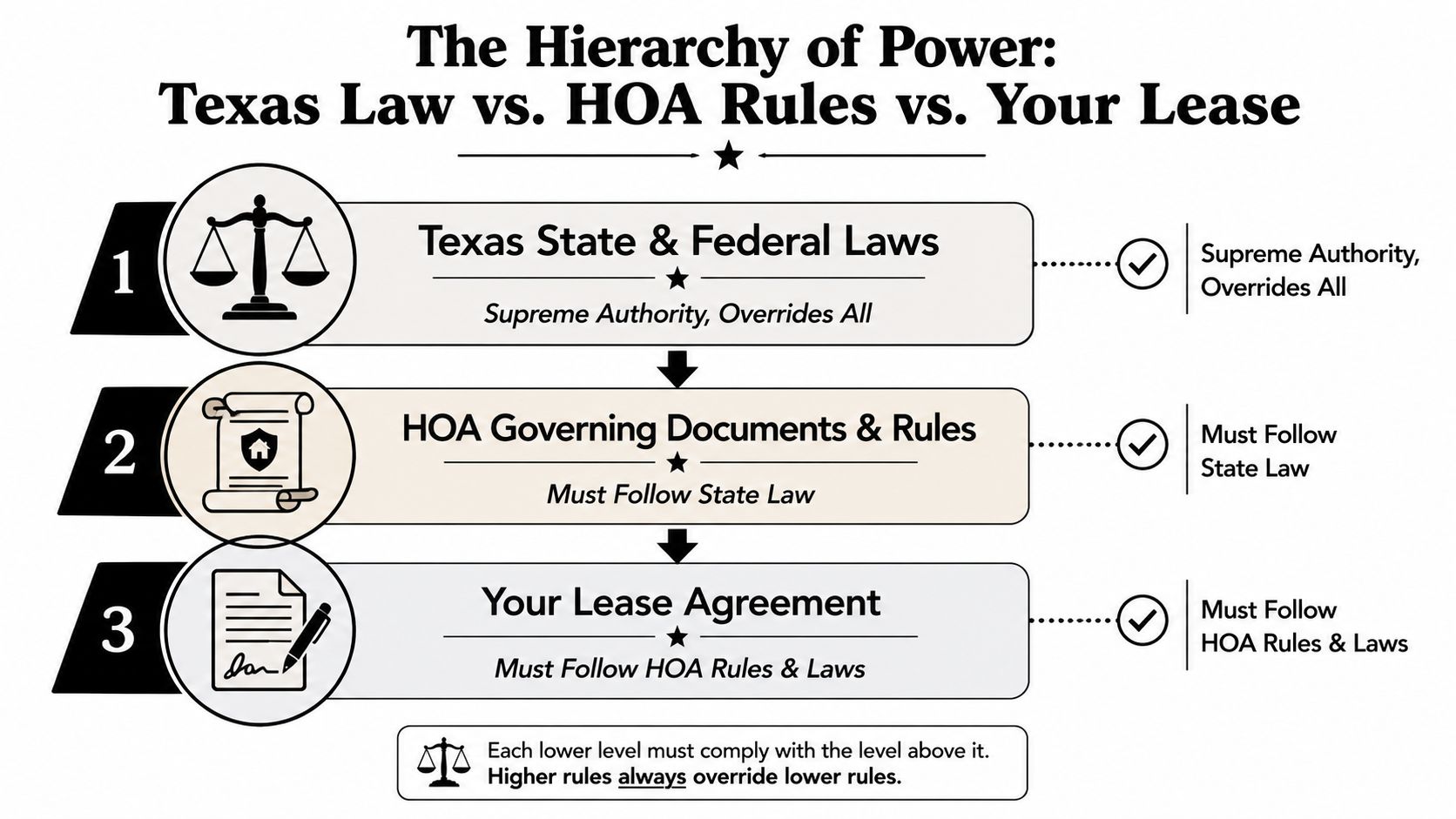
When people ask, “What applies?” they usually expect one winner. In reality, Texas uses a legal hierarchy. The higher source controls the lower one.
First comes Texas law
At the top sits Texas law, and in some situations federal law as well. An HOA rule can't override a statute. A lease can't opt out of protections the law makes mandatory.
That matters a lot in tenant cases because the Texas Property Code controls issues like retaliation, lease enforcement, and what landlords may do when a conflict escalates.
Next come the recorded association documents
Below state law sit the recorded community documents and valid association rules. In Texas, those are the owner-facing rules that often govern leasing, use restrictions, parking, appearance standards, and similar issues.
But those documents have limits.
Core principle: HOA documents can regulate the community, but they still have to fit within state law.
The lease controls the landlord-tenant relationship
For the tenant, the lease is usually the front-line contract. Under Texas law, the controlling documents for a POA are its dedicatory instruments and bylaws, but those documents do not automatically apply to a tenant. The landlord-tenant lease is the primary contract, and a landlord generally can't enforce HOA rules against a tenant unless those rules are incorporated into the lease, as explained by PamCo on property owners associations in Texas.
That point answers many disputes. If the HOA says “no pickup trucks in the driveway,” but the lease says nothing about community restrictions and never attaches the rules, the tenant has a stronger argument that the landlord failed to make that obligation part of the tenancy.
What this means in real life
Here is the practical hierarchy one can use:
- State law wins first.
- Recorded HOA restrictions matter next.
- The lease decides what the tenant promised the landlord.
If a conflict reaches the landlord, the owner can't just shrug and say the HOA made them do it. The owner still has to act within landlord-tenant law. That's one reason some property managers pay close attention to lease drafting and owner liability issues. For a broader management-side perspective, SM Elite Management Ltd explains landlord liability in the context of how lease exposure can become the owner's central risk.
If you want a deeper look at association authority under Texas law, review Texas homeowners association law.
Common Disputes Parking Pets and Payments
Most HOA-tenant fights don't start with a dramatic legal issue. They start with ordinary life. A truck in the driveway. A dog on the patio. A trash can left out too long. Then the owner gets a notice, and everyone starts blaming everyone else.
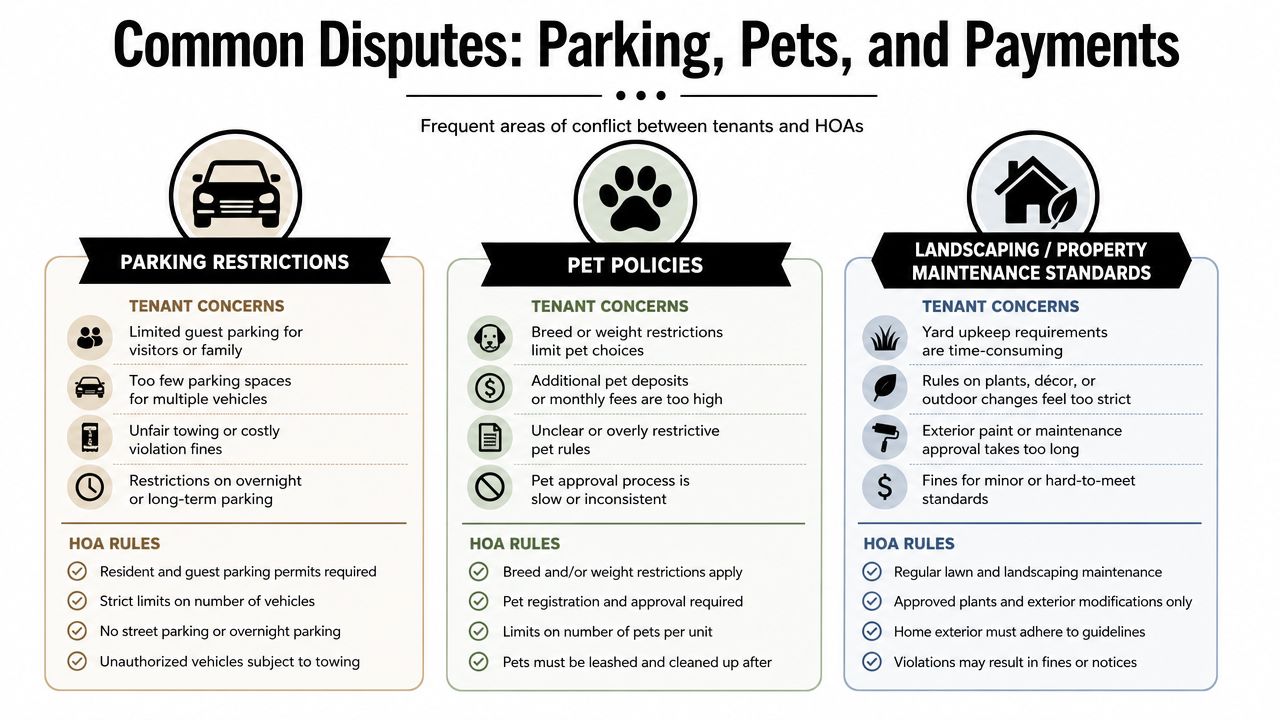
Parking and vehicles
If the lease says, “Tenant must comply with all HOA parking rules,” the landlord usually has a cleaner path to demand compliance. If the lease is silent, things get messier. The HOA may still pressure the owner, but the owner's claim against the tenant is less straightforward if the tenant never agreed to that rule in the lease.
A common example is a work truck, trailer, or guest vehicle. The final answer often turns on the lease language and whether the rule was incorporated.
Pets and use restrictions
Pet conflicts work the same way. The HOA may have breed, number, or location restrictions. The lease may allow a pet generally, but if it doesn't match the HOA rules, the owner created the conflict by drafting a loose lease in a restricted community.
The tenant's strongest practical protection is a written lease that clearly states what is allowed and whether HOA rules are part of the deal.
Yard care and exterior appearance
Landscaping, trash bins, holiday decor, and exterior upkeep are frequent triggers because the HOA looks at the outside of the property while the tenant focuses on living inside it. If the lease assigns mowing, watering, or exterior maintenance to the tenant, the owner may try to recover HOA-related losses from the tenant. If the lease does not, the owner may be stuck handling the issue directly.
A useful outside reference for owner and manager planning is Prestonwood commercial landscaping services, which discusses how HOAs and property managers approach community appearance standards.
Payment method and voucher disputes
The most important 2026 change involves payment discrimination. Starting September 1, 2026, a new Texas law makes it illegal for HOAs to discriminate against tenants based on their method of payment, including federal housing aid like Section 8 vouchers. That law supersedes existing HOA covenants that ban voucher holders, although landlords still retain the ability to screen tenants individually. HOAs also cannot demand a tenant's credit report or full rental application, as described in Texas HOA Laws 2026.
If an HOA rule says “no voucher holders,” that rule does not stay enforceable simply because it appears in old covenants. State law can override it.
The significance of the phrase HOA vs tenant rights Texas what applies extends beyond a mere SEO question. In payment-method disputes, the answer is increasingly clear. The statute controls.
When Rules Are Broken HOA Fines vs Landlord Evictions
An HOA can create a lot of pressure. It can send notices, accuse the owner of violations, and impose consequences allowed by its governing documents and Texas law. But the HOA and the landlord still have different enforcement tools.
What the HOA can usually do
The HOA's direct target is usually the owner. That means fines, owner-account charges, hearing demands, and other association remedies generally land on the landlord, not the tenant. The association may also limit owner privileges under its rules.
What it generally can't do is file a standard residential eviction against the tenant in place of the landlord.
What only the landlord can do
Only the landlord can bring the landlord-tenant dispute into the eviction process. Even then, the landlord has to follow the Texas Property Code and the lease. That includes notice requirements and the limits Texas places on retaliation and bad-faith conduct.
The Texas State Law Library notes that landlords may charge only reasonable late fees if rent is unpaid more than two full days after the due date and the lease gives notice of the fee. The same library also explains that Texas law restricts retaliation, meaning a landlord generally may not file eviction proceedings, cut services, raise rent, end the lease, or materially interfere with tenant rights in bad faith, as outlined in the Texas landlord-tenant law guide on rent.
A landlord can't use an HOA complaint as cover for a retaliatory eviction if the real issue is that the tenant asserted a legal right.
The practical dispute is usually with the owner
That's why tenants should usually deal with the landlord first, not the HOA. The owner is the one caught between community enforcement and lease obligations. If the owner wants the tenant to cure a problem, the owner needs a lease-based reason and a lawful process.
Landlords trying to understand that process can review the Texas eviction process for landlords.
A Tenant's Action Plan for Resolving HOA Conflicts
When an HOA notice appears, speed matters. So does staying organized. Most tenants make things harder by arguing at the clubhouse, ignoring the letter, or relying on phone calls that leave no record.
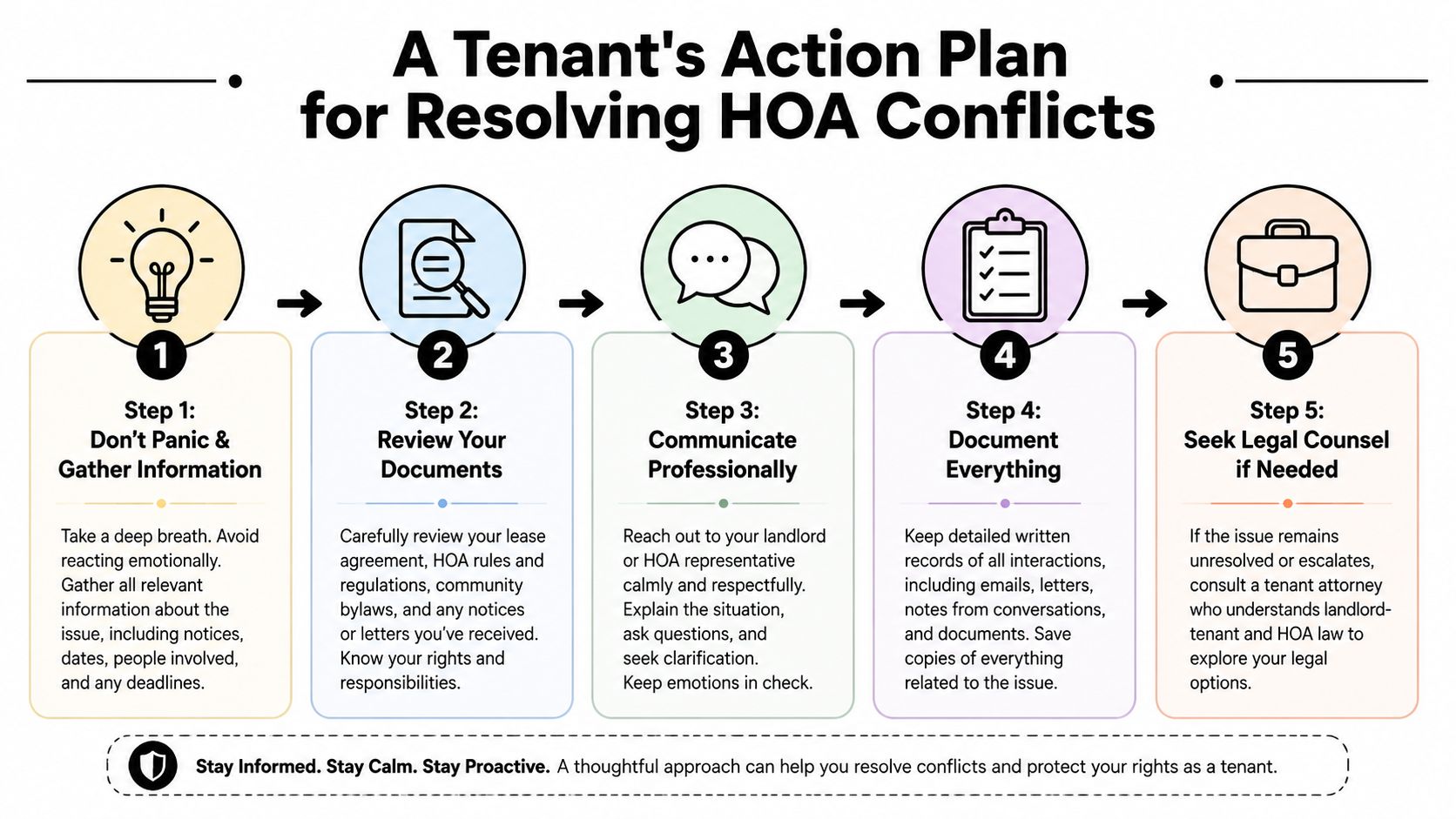
Five steps that usually work better
Read the notice carefully.
Check the date, the alleged violation, and whether it names the owner, the tenant, or both. Many tenants react before they understand what the association is claiming.Pull your lease and every addendum.
Look for language about HOA rules, parking, pets, exterior upkeep, guest conduct, and fines. If the lease never mentions community rules, that fact matters.Write to your landlord right away.
Keep it short. Ask for the exact HOA rule involved, a copy of any incorporated addendum, and the landlord's position on what must be done.Collect proof.
Save the notice, take photos, keep screenshots, and preserve every text and email. If the issue is parking or landscaping, dated photos can change the whole conversation.Escalate in writing if needed.
If the landlord is vague, threatening, or shifting rules mid-lease, send a clear written demand for clarification and compliance.
A short model for your first message
You don't need a dramatic letter at the start. A calm email often works better:
I received an HOA notice about the property. Please send me the lease provision or HOA addendum you believe applies, along with the specific rule involved, and let me know what action you want taken.
That kind of message does three things. It shows cooperation, asks for the actual governing text, and creates a paper trail.
When to get legal help
If the landlord threatens eviction, starts charging unexplained HOA-related fees, or refuses to provide the lease documents, don't wait too long. The State Bar handbook rule noted by the Texas State Law Library is important here: if a landlord fails to provide a copy of the written lease within three days of execution or a tenant request, the landlord can lose the ability to enforce the lease, except for nonpayment of rent, until the copy is provided.
If you need to put your position in writing, a guide on how to write a demand letter to landlord in Texas can help you organize the facts before the dispute gets bigger. The Law Office of Bryan Fagan, PLLC also handles landlord-tenant disputes involving lease enforcement, evictions, repairs, retaliation, and HOA-related rental conflicts in Texas.
A Landlord's Guide to Bulletproof Leases in HOAs
The owner usually pays first when things go wrong. That's why landlords in HOA communities need better lease drafting than landlords in unrestricted neighborhoods.
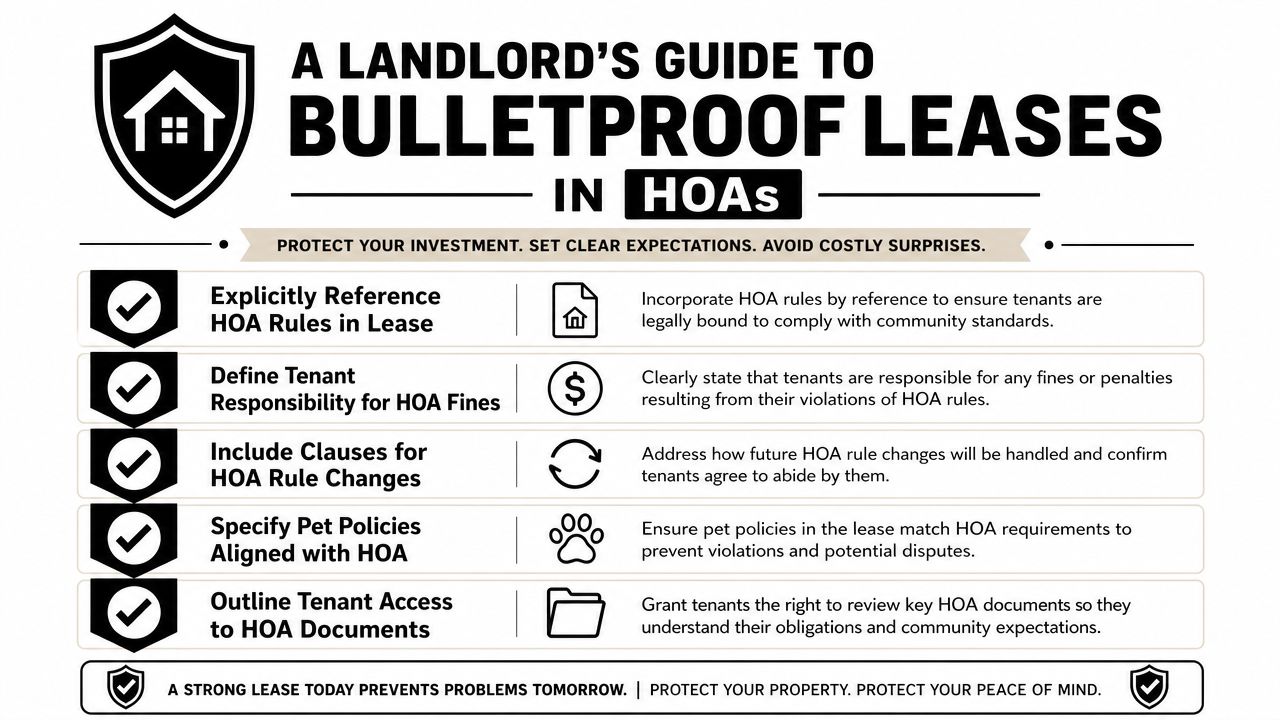
What a stronger lease should do
A good HOA lease doesn't just say “follow the rules.” It identifies them. Attach the current HOA rules or a specific addendum. State that the tenant received them. If the community changes rules over time, address how updated rules will be communicated.
The lease should also assign responsibility with precision. If the tenant causes a parking, pet, trash, or exterior-maintenance violation, the lease should explain who cures it, who pays resulting charges, and how reimbursement works.
Clauses that prevent avoidable fights
- Incorporation language: Make clear which HOA documents are part of the tenancy.
- Violation allocation: State when tenant-caused charges can be passed through.
- Use restrictions: Match pet, vehicle, and guest rules to the actual community standards.
- Document delivery: Keep proof that the tenant received the lease and all addenda.
- Communication procedure: Require prompt written notice if the tenant receives an HOA complaint.
Landlords also need to remember what cannot be outsourced to the association. The HOA is not your screening board, and by the 2026 statutory change discussed earlier, it can't block renters based on federal housing-aid payment methods.
A lease is your best buffer. Without one that fits the community, you create a conflict and then ask a court to untangle it later.
If you need help with an eviction, lease issue, or rental dispute, contact The Law Office of Bryan Fagan, PLLC for a free consultation today. Whether you're a tenant trying to stop an unfair HOA-related threat or a landlord trying to draft a lease that works in a deed-restricted community, a Texas landlord tenant lawyer can help you sort out the Texas Property Code, protect your tenant rights, and build a practical next step before the conflict turns into an eviction case.