Dealing with an eviction notice in Texas can feel like the floor dropped out from under you. Most tenants don't need more panic. They need a plan.
The short answer to what evidence helps tenants win eviction cases in Texas is this: the evidence that directly answers the landlord's claim, the court's timeline, and the judge's first question, which is usually whether the landlord followed the required process and whether you can prove your side with documents.
Justice Court moves fast. Judges often have limited time, and they usually don't want a long story before they see the paperwork. That's why courtroom readiness matters so much. A tenant with decent facts but messy documents can lose ground quickly. A tenant with organized records, clear dates, and calm presentation can make a much stronger impression.
First Understand the Eviction Notice
The hearing often turns on a simple question before anyone discusses rent, repairs, or text messages. Did the landlord give a legally sufficient notice to vacate, and can you show the court exactly what notice you received?
Start there. Save the notice, the envelope, the photo of it taped to your door, the text message, or the email. Keep it in the same form you received it. In Justice Court, tenants lose ground when they can describe the notice but cannot produce it.
Under the Texas Property Code, a notice to vacate is the step that usually comes before the eviction filing. It tells you the landlord's stated reason for demanding possession, and that reason should shape the documents you pull for court. If the notice is unclear, defective, or delivered in a way you can credibly dispute, that can matter.
What the notice should tell you
A notice to vacate usually alleges one of two things:
- Nonpayment of rent
- A lease violation, such as an unauthorized occupant, pet, damage claim, or another alleged breach
That distinction matters because it helps you keep your file focused.
If the notice claims nonpayment, pull records tied to rent. If it claims a lease violation, pull records tied to that specific accusation. Judges usually respond better to a tight set of documents that answer the notice than to a stack of unrelated complaints about the tenancy.
For a plain-English explanation of what this document is and what to look for, review this Texas notice to vacate guide for tenants.
Check these items line by line
Read the notice with a pen in your hand. Mark anything missing, incorrect, or hard to understand.
| Item to check | Why it matters in court |
|---|---|
| Reason for eviction | Tells you what claim you need to answer |
| Date on the notice | Helps you evaluate timing |
| Move-out deadline | Lets you compare the deadline to the lease and Texas law |
| Property address | An incorrect address can weaken the landlord's paperwork |
| Name of landlord or management company | Confirms who is demanding possession |
| Delivery method | May matter if you dispute when or how notice was given |
One practical point. Keep the envelope, screenshot metadata, and any photo showing where the notice was posted. Those details help you explain delivery clearly and quickly at the hearing.
Texas Property Code Section 24.005 generally requires at least three days' written notice to vacate before an eviction suit is filed, unless the lease provides a different notice period. That is why tenants should compare the notice date, the deadline in the notice, and the court filing date.
Turn the notice into a hearing-ready file
Do not stop at reading it. Build a one-page cover sheet for your evidence folder with three headings:
- What the landlord claims
- What proof I have that answers that claim
- What dates the judge needs to see
Then place the notice on top of your packet.
That small step helps in a fast courtroom. When the judge asks, "What is this case about?" you can hand over the notice, state the claim in one sentence, and point to the two or three documents that answer it. That is a stronger presentation than starting with the full history of every dispute you have had with the landlord.
Many tenants want to tell the whole story. I understand why. But in eviction court, the better approach is usually narrower at first. Start with the notice, identify the exact claim, and organize your proof around that claim before adding anything else.
Your Lease and Payment History as Key Evidence
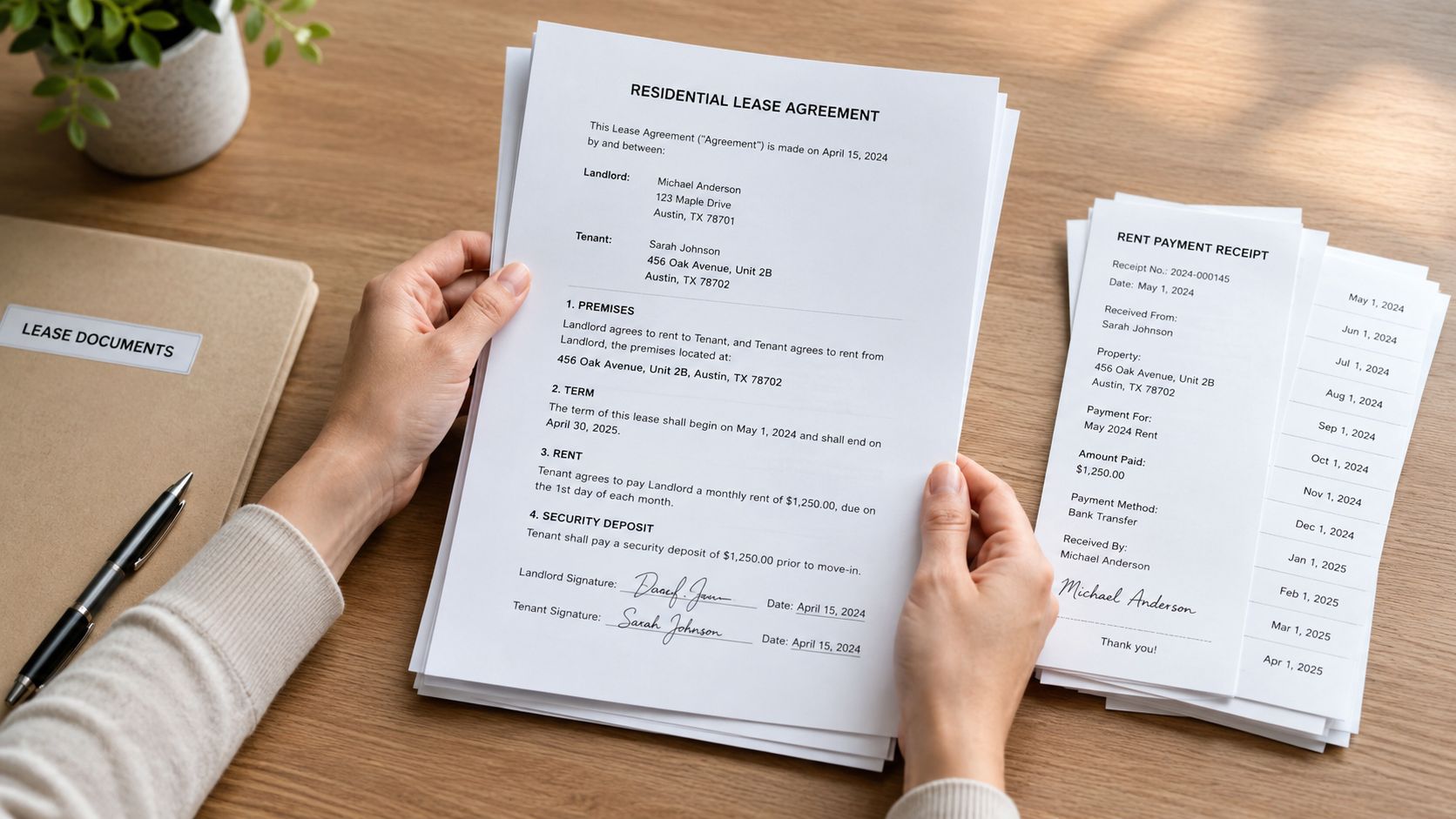
Most eviction defenses begin with two things. The lease and the payment record.
Those documents anchor the hearing in facts instead of memory. When a judge asks what the rent was, when it was due, whether there was a grace period, whether fees were allowed, or whether the landlord accepted partial payments before, the lease usually answers first.
Start with the lease itself
Bring the complete lease, not just the signature page. Include renewals, addenda, payment ledgers from management if you have them, pet agreements, utility addenda, and any written changes.
Look for terms covering:
- Rent amount and due date
- Late fee language
- Notice requirements
- Default provisions
- Grace periods or cure rights
- Rules about partial payment acceptance
A tenant sometimes shows up with screenshots and no lease. That's a problem. The landlord usually has a lease copy, and if your copy has handwritten notes, addenda, or different attachments, those details may help you.
Build a payment file the judge can follow
Payment evidence is strongest when it tells a clear story in date order. Good records include rent receipts, bank statements, canceled checks, money order stubs, online portal screenshots, and texts or emails confirming payment.
The practical value of documentation isn't just common sense. A housing-policy review reports that tenants with full representation won 21% of their cases and tenants with limited representation won 24%, and it also cites a Manhattan study finding that tenant counsel was associated with a 77% decrease in warrants for eviction. The same review emphasizes concrete records such as leases, rent receipts, photos, texts, emails, and proof of repairs requested as key evidence in eviction litigation, as discussed by American Progress on the right to counsel and documented tenant defense.
A simple payment log works well
Create a one-page chart like this and put supporting proof behind each line:
| Month | Amount due | Amount paid | Date paid | Method | Proof attached |
|---|---|---|---|---|---|
| January | As listed in lease | Paid amount | Date | Zelle, check, portal, money order | Receipt, bank record, screenshot |
| February | As listed in lease | Paid amount | Date | Method | Proof |
| March | As listed in lease | Partial or full | Date | Method | Proof |
That chart does two things. It helps the judge understand your file quickly, and it helps you spot weaknesses before court.
Bring paper copies even if everything is on your phone. Courts move faster when you can hand the judge a page instead of scrolling.
Don't overlook communication about rent
Sometimes the strongest evidence isn't the payment itself. It's the landlord's message saying, “Received,” “You can pay Friday,” or “We'll apply this next week.”
Save and print:
- Texts confirming payment
- Emails discussing late rent
- Portal notices
- Messages about payment plans
- Messages rejecting or returning payment
If your eviction is for nonpayment, your case often turns on whether your records are more reliable than the landlord's ledger. Judges tend to trust organized timelines and matching documents. If your bank record, receipt, and text message line up, your credibility improves.
How Landlord Mistakes Can Win Your Case
You show up for a five-minute Justice Court hearing with a folder of rent records, ready to argue about the money. The judge starts somewhere else. When was the notice delivered, what did the lease require, and when was the case filed?
That happens often. In Texas eviction cases, a landlord still has to prove the right to possession through the proper steps. A tenant does not need a perfect rental history to point out a bad notice, an early filing, or an improper attempt to force a move-out without a court order.
The process mistakes that matter most
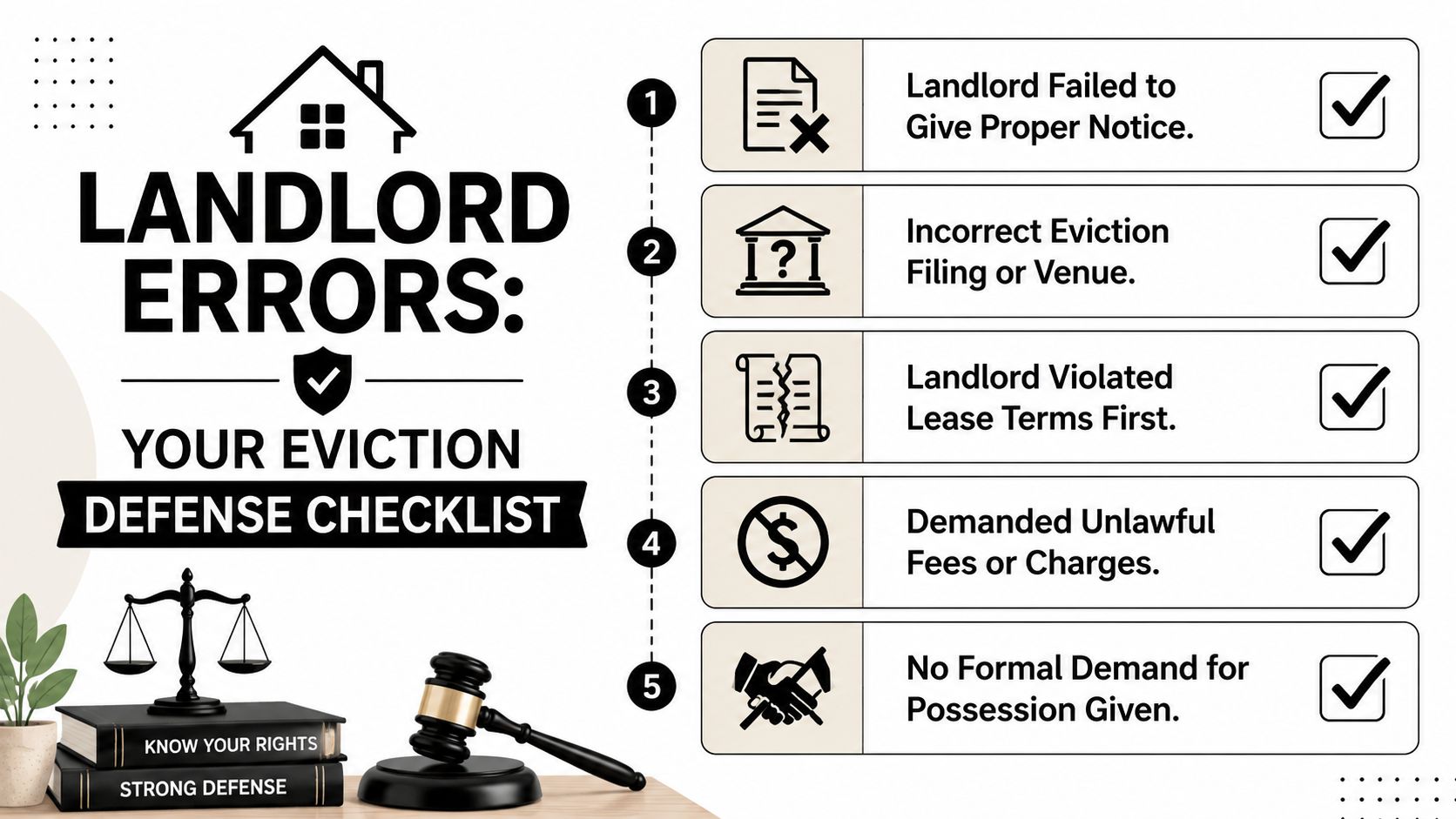
The strongest procedural defenses are usually simple and document-based. The landlord gave the wrong notice. The lease required more notice than the landlord used. The case was filed before the notice period expired. Service was defective. The landlord used lockout threats or utility shutoff pressure instead of going through court.
Judges hear many versions of “I was treated unfairly.” That argument gets stronger when it is tied to dates and papers the judge can verify in seconds.
Focus on proof of these issues:
- The notice did not match the lease
- The landlord counted the notice period incorrectly
- The eviction was filed too soon
- The court papers were not served the way the rules require
- The landlord tried self-help measures instead of waiting for a court order
Build a timeline the judge can follow fast
This part wins hearings more often than tenants expect. Do not bring a stack of screenshots with no order. Put the events on one page.
List the dates in sequence:
- Date the notice was posted, mailed, or handed to you
- What your lease says about notice
- Date the landlord filed the eviction
- Date you received the citation or learned of the hearing
- Any texts or emails showing the landlord's timing or intentions
Attach the supporting document behind each line. If the judge asks, “How do you know it was posted on Tuesday?” you should be able to hand over the photo, text, or envelope immediately.
Evidence that proves a landlord process error
The best evidence is usually ordinary paperwork presented clearly:
| Evidence | What it can prove |
|---|---|
| Photo of the notice on your door | Date, content, and method of delivery |
| Envelope, postmark, or mail receipt | When the notice was mailed and where it was sent |
| Lease paragraphs on default and notice | Whether the landlord had to give more time |
| Petition, citation, or docket printout | Filing date and case sequence |
| Texts or emails from management | Admissions about deadlines, payment extensions, or lockout threats |
| Notes made the same day | Support for your timeline if matched with other records |
A one-page exhibit list helps too. Number each item. Mark the notice as Exhibit 1, the lease page as Exhibit 2, the filing record as Exhibit 3, and so on. In a fast hearing, organization affects credibility.
Common mistakes that can change the outcome
A frequent example is a lease that requires a longer notice period than the landlord gave. Another is a landlord posting a notice and filing before the deadline ran out. In both situations, the dispute may look like a rent case, but the immediate question for the court is whether the possession case was started correctly.
Informal eviction pressure also matters. If a landlord threatened to lock you out, shut off utilities, remove property, or force you out before getting a judgment, preserve those messages. They may not decide every case by themselves, but they can support your timeline, affect credibility, and connect to related issues such as ignored repair complaints. If those problems overlap, this guide on what to do if a landlord ignores repair requests in Texas may help you spot records worth bringing to court.
If your best defense is procedural, say that early. Start with the date problem, hand the judge the timeline, and point to the matching documents. That is often more effective than giving a long story before the court has seen the paperwork.
Using Repair Issues and Retaliation as a Defense
Some eviction cases are really about rent. Others are about conflict after the tenant pushed for repairs or complained about conditions. That's where habitability evidence and retaliation evidence can become important.
Under the Texas Property Code, tenants often ask about repair rights and retaliation protections, including Section 92.331. But in court, the question is not whether the situation feels unfair. The question is what you can prove, and whether that proof helps defeat the landlord's claim for possession.
What repair evidence actually helps
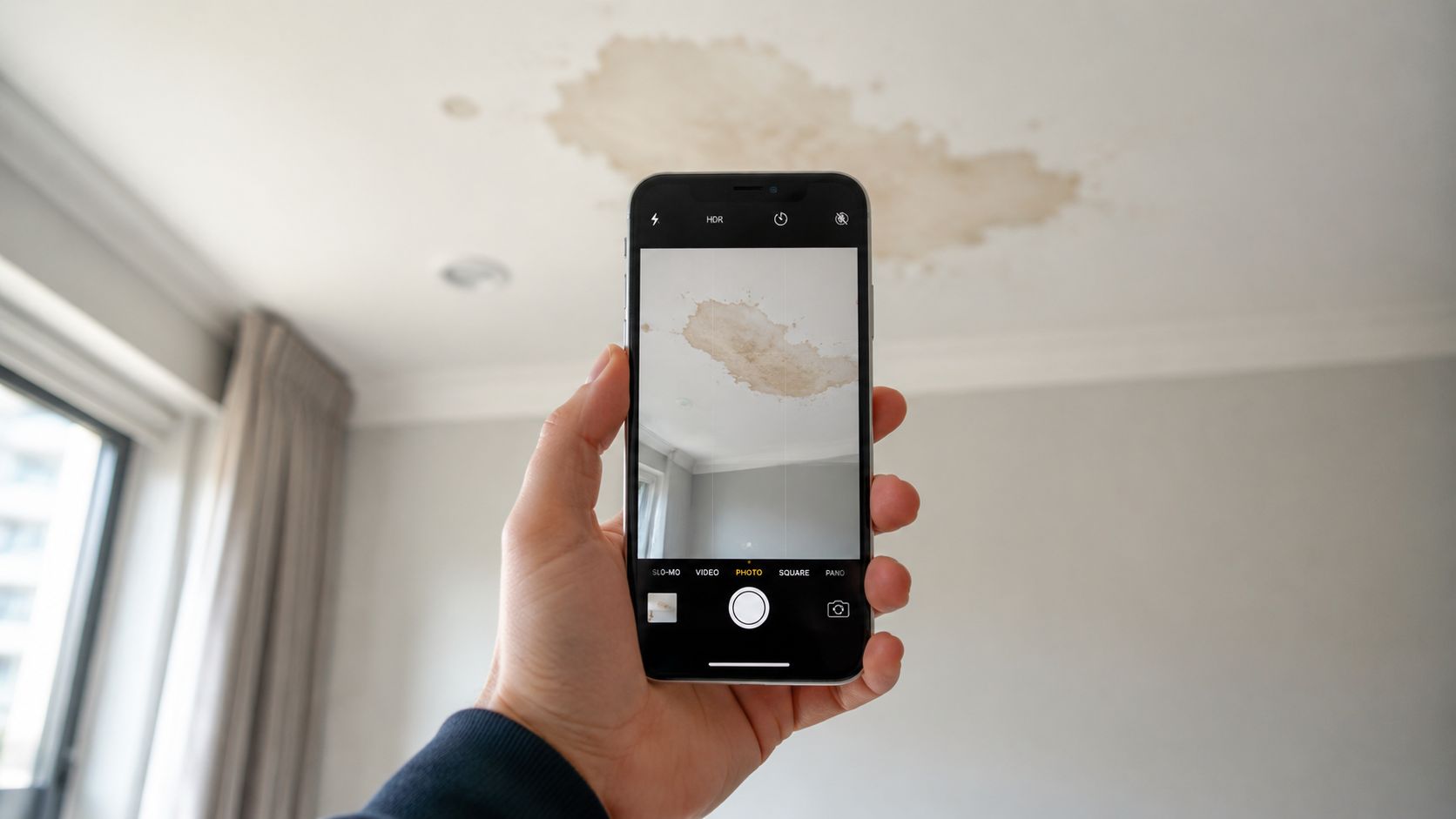
Repair complaints are strongest when they are dated and repeated in writing. Judges are more persuaded by a sequence of records than by a verbal description of bad conditions.
Helpful evidence includes:
- Written repair requests
- Photos and video showing the problem
- Inspection reports or code complaints
- Texts and emails with management
- Witness statements from neighbors or visitors
- Proof you followed lease reporting procedures
If you're dealing with ignored maintenance, this guide on what to do if a landlord ignores repair requests in Texas gives a useful starting point.
The hard part when rent is no longer being accepted
Texas tenant resources note that landlords may reject rental payments after a notice to vacate is given. They also explain that tenants generally can't use counterclaims like repair disputes inside the eviction case itself and may need to file those separately. That's why the immediate challenge is packaging evidence such as repair requests, inspection photos, code complaints, and payment attempts in a way that helps contest possession in a fast-moving hearing, as discussed by Texas Housers on eviction hearing case dismissal issues.
That practical point changes strategy. If the landlord has already stopped taking rent, walking into court and saying, “I tried to pay,” may not be enough by itself.
Instead, organize the file to show a fuller picture:
- Conditions existed
- You notified the landlord
- The timing of the eviction followed your complaints
- You attempted to stay in compliance where possible
Good repair evidence doesn't replace a possession defense by itself. It supports your credibility, your timeline, and in some cases a retaliation theory.
Show the sequence, not just the problem
A strong retaliation presentation usually depends on timing. Example:
| Date | Event | Proof |
|---|---|---|
| June 1 | You reported a leaking ceiling | Email or portal request |
| June 3 | You sent follow-up photos | Photos and text |
| June 10 | City or code complaint made | Complaint confirmation |
| June 12 | Landlord served notice | Copy of notice |
| June 15 | Payment attempt rejected | Screenshot, money order return, text |
That kind of sequence can help the judge understand that the dispute may not be as simple as “tenant didn't pay.”
What doesn't work well
Some tenants bring dozens of random photos with no dates, no labels, and no explanation. Others focus entirely on unsafe conditions but can't connect those records to the timing of the eviction or to any written notice they gave.
Keep it disciplined. Label each photo. Put repair requests in date order. Match every claim to a document. If you have witnesses, make sure they can speak to specific events they saw, not just general opinions about the landlord.
How to Prepare and Present Your Evidence for the Hearing
By the time you reach court, collecting evidence is only half the job. You also need to present it in a way that a busy Justice Court judge can follow in minutes.
Courtroom readiness means reducing clutter. Your file should tell one clean story.
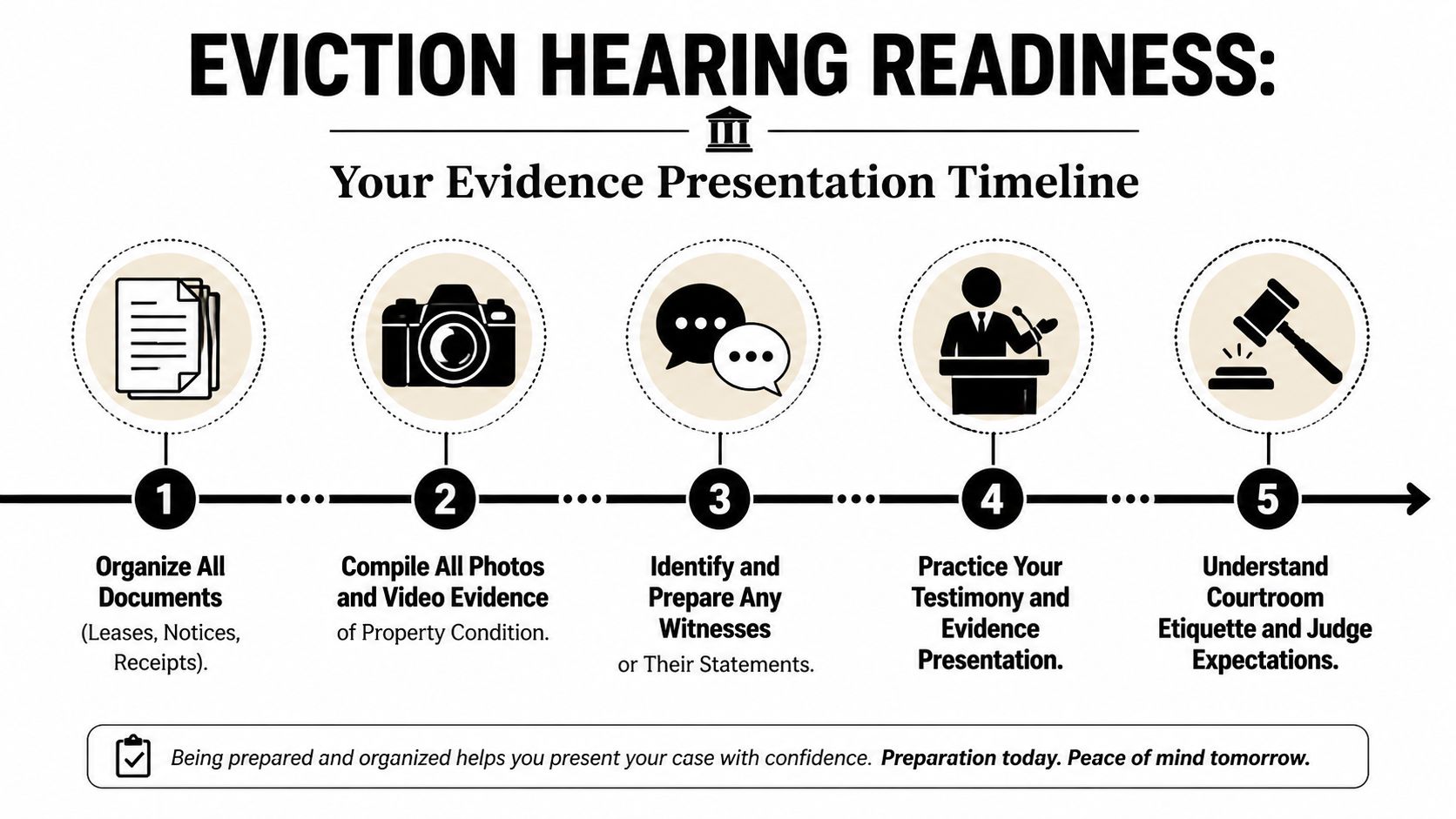
A visual checklist can help you organize before the hearing.
Build a hearing binder
Use a folder, binder, or clipped packet with tabs. Label the sections clearly.
A simple structure works well:
- Tab 1: Notice and court papers
- Tab 2: Lease and addenda
- Tab 3: Payment history
- Tab 4: Photos and repair records
- Tab 5: Texts and emails
- Tab 6: Timeline
- Tab 7: Witness statements or contact details
Bring your original set plus extra copies if possible. For more practical help, review this guide to tenant documentation for court in a Texas eviction defense.
Make a one-page timeline
Your timeline is often the most useful page in the room. It should list only the most important events in order.
For example:
| Date | Event |
|---|---|
| August 1 | Rent due |
| August 2 | Payment sent |
| August 3 | Landlord texted about balance |
| August 5 | Notice to vacate posted |
| August 6 | Repair request submitted |
| August 9 | Eviction filed |
That page helps the judge grasp your case quickly. It also keeps you from rambling when you're nervous.
This video may help you think through hearing-day preparation and how to stay organized in court.
Practice how you'll speak
You don't need courtroom polish. You do need focus.
Try this format when it's your turn:
- State your name and that you are the tenant.
- State the main reason you dispute the eviction.
- Hand up the most important document first.
- Walk the judge through dates, not emotions.
- Answer questions directly.
A good opening can be simple: “Your Honor, I'm disputing possession because the notice did not comply with the lease,” or “Your Honor, I have proof the rent was paid and communications confirming it.”
Speak slowly. Stop when the judge interrupts. Listen carefully, then answer only the question asked.
Witnesses and courtroom habits
If you have a witness, prepare them to testify to facts they personally saw or heard. A neighbor who saw water pouring through the ceiling is better than someone who only knows you were upset. A friend who watched you hand over a money order may be useful. Someone offering broad character praise usually isn't.
On hearing day:
- Arrive early so you can find the courtroom and review your papers.
- Dress neatly to show respect for the court.
- Silence your phone and keep documents in order.
- Don't argue with the landlord directly. Speak to the judge.
- Ask for clarification if you don't understand a question.
Thus, the phrase what evidence helps tenants win eviction cases in Texas becomes practical. It's not just about having proof. It's about having proof that is dated, labeled, copied, and easy to hand to the court in the right moment.
When to Hire a Texas Eviction Attorney
Some eviction cases are manageable with careful preparation. Others carry too much risk to handle alone.
You should strongly consider calling an eviction attorney or Texas landlord tenant lawyer if the landlord already has counsel, the case involves a claimed lease violation instead of straightforward rent issues, or your defense depends on retaliation, repair disputes, discrimination concerns, or another issue that may require separate legal action beyond the eviction hearing.
You should also get help if the timeline is confusing, service seems defective but you're not sure how to prove it, or the judge entered a judgment and you need advice about next steps. Appeals, writ issues, and overlapping claims under the Texas Property Code can become technical quickly.
Legal help also matters when your documents are incomplete. A lawyer can spot what's missing, identify the strongest defense, and keep the hearing focused on points that matter in Justice Court. That can be the difference between presenting a stack of papers and presenting a case.
If you're trying to protect your home, there's no shame in getting backup. Tenant rights are easier to enforce when your evidence is organized and your legal theory is clear.
If you need help with an eviction, lease issue, or rental dispute, contact The Law Office of Bryan Fagan, PLLC for a free consultation today. The firm helps Texans understand their tenant rights, evaluate defenses under the Texas Property Code, and prepare for fast-moving hearings with practical, strategic guidance.