Dealing with an eviction notice in Texas can make everything feel urgent at once. You're trying to keep housing, understand court papers, and decide what matters before the hearing date arrives.
The good news is that eviction cases are often won or lost on paperwork, not on who sounds more upset in court. If you're building tenant documentation for court Texas eviction defense, your job is to gather the records that show what happened, when it happened, and how those facts line up with your rights under the Texas Property Code and the court rules that govern evictions.
Texas law treats residential evictions as formal legal cases. Chapter 24 of the Texas Property Code governs the eviction process, and Sections 91 and 92 of the Texas Property Code often matter because they shape the lease relationship, repairs, notices, and landlord duties. If you're facing an eviction, think like you're preparing a case file, not just telling your side of the story. That approach helps tenants, and it also helps a Texas landlord tenant lawyer or eviction attorney step in quickly if legal help becomes necessary.
Why Your Eviction Case Depends on Strong Documentation
When tenants walk into court with only a verbal explanation, they usually put themselves at a disadvantage. Texas eviction defense is document-driven because the landlord's petition must state the lease terms, how and when pre-suit notice was given, and the rent amount due. If the tenant doesn't appear or can't produce counter-evidence, those pleaded facts are often taken as true under the Texas Evictions Deskbook.
Start with the four records that matter most
If you've been accused of nonpayment, gather these first:
- Your lease. Bring the signed lease and any renewal, addendum, or payment-plan agreement.
- Official notices. Keep every notice to vacate and any notice that says pay or move.
- Payment proof. Pull receipts, bank statements, money order stubs, and screenshots of payment confirmations.
- Communication history. Save texts, emails, portal messages, and letters with the landlord or management office.
A judge in Justice Court usually doesn't have much time. That means your documents need to do the work quickly. If the landlord says, “Rent for June and July was unpaid,” your answer shouldn't be a long speech. It should be a dated receipt, a bank record, and a text confirming payment.
Practical rule: If a document helps prove a date, a payment, a notice problem, or a repair issue, keep it.
A simple nonpayment example
Say your landlord claims you missed rent and gave proper notice. You need to test each part of that claim against your records.
Look at the lease first. Does it show the exact rent amount, due date, grace period, and method of payment? Then compare that with your payment records. If you paid by money order, find the stub and any photo or message showing delivery. If you paid electronically, print the confirmation page and the bank entry.
Next, check the notice. Was it a notice to vacate or something else? Did it match what the landlord later claimed in court papers? A mismatch doesn't automatically win the case, but it can matter. Judges notice dates, wording, and whether the landlord followed the lease and the statute.
Why organized proof beats a long story
Many tenants think the hearing is mainly about telling the judge what happened. It isn't. It's about showing the judge what happened.
That's why tenant rights in practice often depend on records you can hand up to the bench. A calm, short explanation tied to a paper exhibit is far more effective than a broad complaint that can't be verified. If you're preparing for court, your focus should be simple: match each landlord allegation with a document, photo, receipt, or message that answers it.
The Essential Evidence Your Defense Cannot Be Without
The strongest tenant packet is a timeline plus proof bundle. Texas Law Help advises tenants to bring documents, receipts, photos, and other evidence, and practical Texas eviction work shows the best packet usually includes the written lease, rent ledger, notices, screenshots of communications, repair requests, photos or videos, and proof of delivery, all lined up in the same order as the landlord's claims in the case papers, as explained in the Texas Law Help eviction guide.
Here is the checklist most tenants should build from.
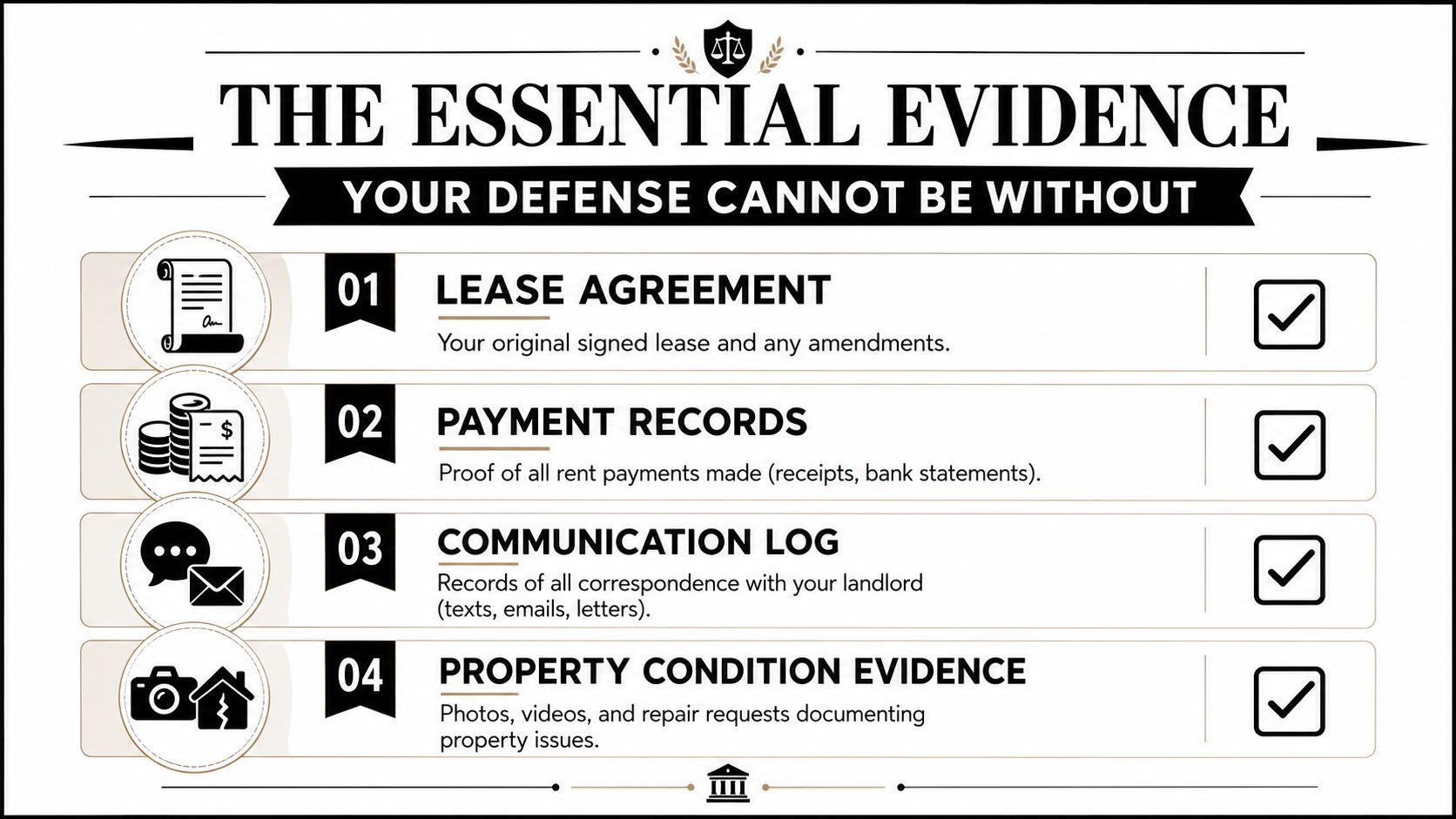
Your core packet
| Category | What to include | Why it matters |
|---|---|---|
| Lease file | Signed lease, renewals, addenda, house rules, payment agreements | Shows the actual contract terms |
| Notice file | Every notice to vacate, envelope, posting photo, email notice, text notice | Lets you compare what was sent and when |
| Payment file | Rent ledger, receipts, bank records, money order proof, portal screenshots | Rebuts nonpayment claims |
| Communication file | Texts, emails, maintenance portal messages, letters | Shows what each side said and when |
| Condition file | Photos, videos, repair requests, inspection notes | Supports habitability or misconduct defenses |
A short explanation helps here. Chapter 24 is about possession of the property, but many defenses turn on facts shaped by the lease and Texas Property Code Chapter 92, especially when the dispute involves repairs, notice, or retaliation.
A repair-based example that changes the evidence you need
Some tenants make the mistake of bringing only rent receipts when the actual issue is the landlord's conduct. If your defense involves serious repair problems, poor conditions, or retaliation after requesting repairs, your file needs to look different.
For example, if a landlord failed to address a major plumbing leak and then moved to evict after you kept complaining, gather:
- Time-stamped photos or video showing the condition over time
- Written repair requests sent by text, email, certified mail, or the tenant portal
- Proof the landlord received the request, such as delivery receipts or reply messages
- Any city or code complaint records
- Messages linking the dispute to your complaints, such as “If you don't like it, move out”
Bring media only if you can present it clearly. Printed photo sheets with dates are usually easier for court than trying to operate your phone and scroll in real time.
To help visualize how your packet should fit together, review this short explainer before you print anything:
What works and what usually doesn't
What works in Justice Court:
- Documents arranged by date so the judge can follow the story fast
- Complete message chains instead of one screenshot taken out of context
- Proof of delivery for notices and repair requests
- Marked exhibits that match the issue you're discussing
What usually doesn't work well:
- A pile of unsorted papers
- Photos with no date or explanation
- A handwritten narrative created the night before court
- General complaints that aren't tied to any lease term, message, receipt, or image
Bring records that prove events at the time they happened. Judges trust contemporaneous documents far more than recreated memory.
Documenting Defenses Beyond Nonpayment of Rent
Not every eviction is really about rent. Some cases start after the tenant asks for repairs, complains to code enforcement, objects to illegal entry, or pushes back against treatment that violates basic housing rules. Those cases require a different kind of evidence.
For defenses like poor habitability or retaliation, the proof must be specific. Tenants should gather time-stamped photos, repair requests, witness statements, and proof of reporting code violations. Contemporaneous documentation is often more persuasive than a later summary, as noted in the Texas Law Help Eviction Answer and Defense Guide.
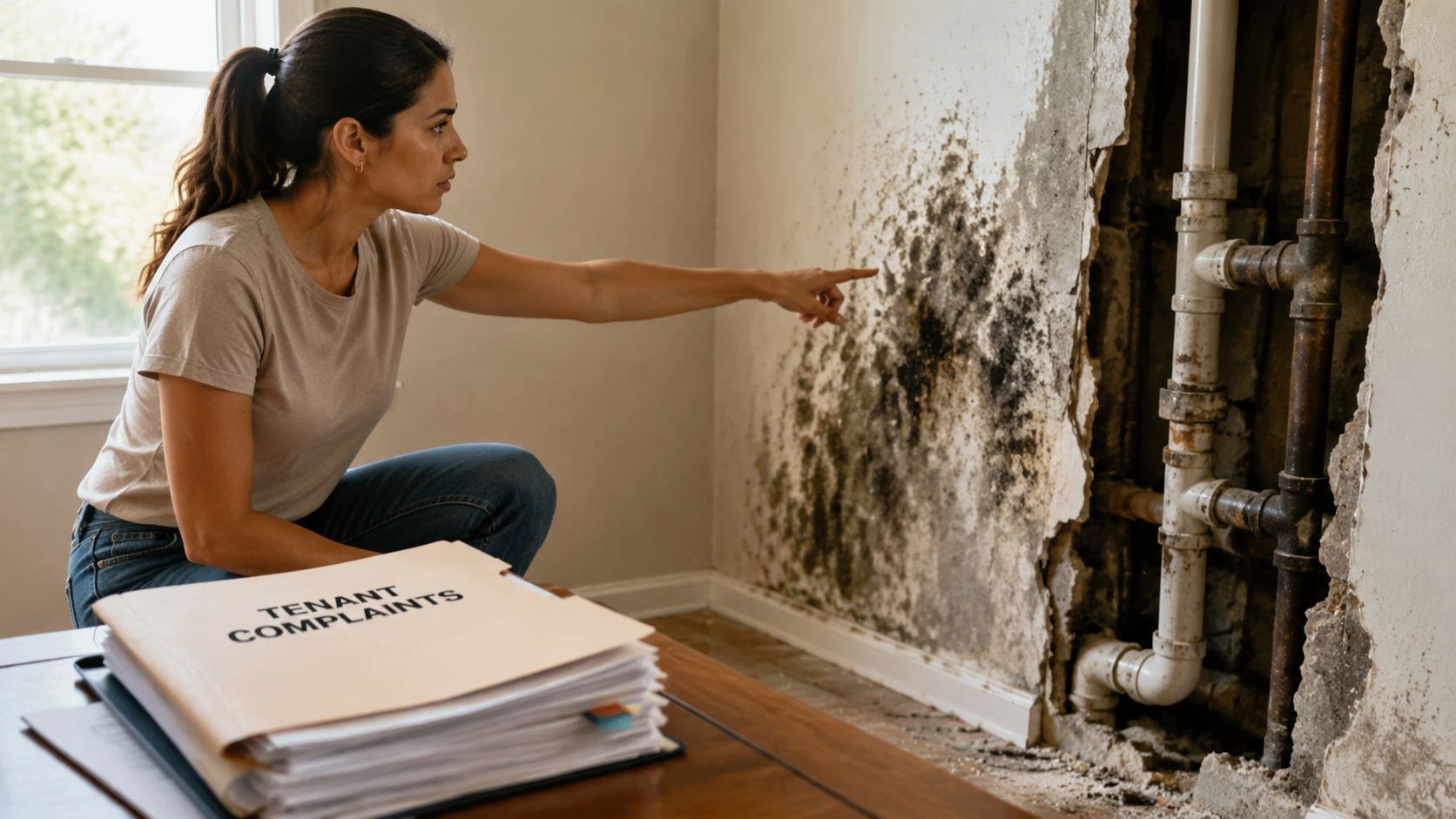
Habitability claims need a paper trail
Under Texas Property Code Chapter 92, repair issues can matter, but tenants often weaken those claims by relying on memory instead of records. If mold, plumbing failure, exposed wiring, leaks, or broken locks are part of your defense, your file should show a sequence:
- The condition existed.
- You notified the landlord.
- The landlord had time and a chance to respond.
- The problem continued or got worse.
- The eviction followed that dispute.
That sequence matters more than emotional language. A dated photo plus a repair email is stronger than saying, “The apartment was terrible.”
Retaliation and misconduct need matching exhibits
Retaliation claims often rise or fall on timing. If you reported code issues, requested repairs, or asserted your tenant rights, keep the documents that show those acts came before the eviction notice.
Helpful proof may include:
- Complaint records from a city department or housing authority
- Texts or emails showing the landlord's reaction
- Witness statements from roommates, neighbors, or visitors who saw conditions or interactions
- Logs of illegal entry or harassment, with dates and a brief factual description
If repairs are central to your case, this guide on what to do if a landlord ignores repair requests in Texas can help you compare your records against common legal requirements.
A judge can work with facts. A judge can't work with a binder full of conclusions.
Build an eviction defense binder
For these more complex defenses, I recommend a binder with a clean structure. It keeps the hearing focused and helps if you later need to consult a Texas landlord tenant lawyer or prepare for an appeal.
Use this format:
- Cover page with your name, cause number, property address, and hearing date
- One-page timeline listing the key events in order
- Tabbed sections for lease, notices, payments, repairs, communications, and photos
- Exhibit labels on every page or group of pages
- Three complete sets if possible: one for you, one for the judge, and one for the landlord or the landlord's attorney
If your defense is about black mold, for example, don't bury that proof under rent receipts. Put the timeline first, then the repair notices, then the photos, then the follow-up messages. The packet should tell a factual story without forcing the judge to hunt for it.
How to Organize and Prepare Your Documents for Court
Strong records can still fall flat if they're hard to follow. Organization matters because eviction cases move quickly, and an eviction filing can remain on a tenant's record for up to 7 years, while the process may begin after only 3 days following a notice to vacate, as discussed by Texas Housers on eviction hearing preparation.
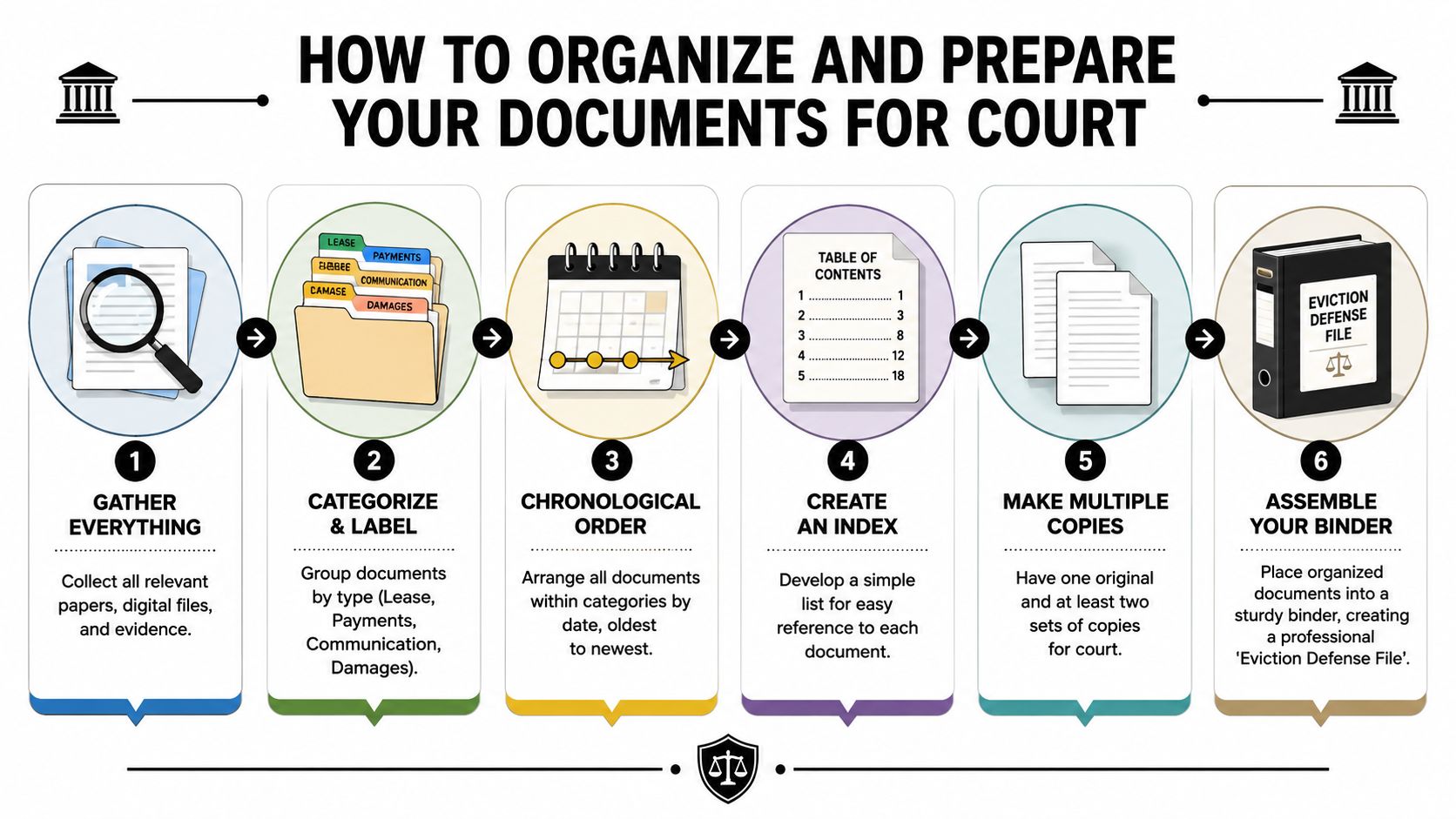
Put your file in courtroom order
The best setup is simple. Start with the document the judge needs first, not the one you found first.
Use this order:
- Case summary page with the reason you dispute the eviction
- Timeline with dates only, one line per event
- Lease documents
- Notices
- Payment records
- Repair and condition evidence
- Communications
- Any witness statements or supporting papers
A move-in checklist can also help explain condition disputes and missing-damage allegations. If you don't already use one, this tenant move-in checklist template shows the kind of details that become useful later in court.
Label exhibits so you can talk through them calmly
Don't hand the judge loose pages and start explaining at the same time. Mark your papers in advance.
A practical format is:
- Exhibit A for the lease
- Exhibit B for the notice to vacate
- Exhibit C for your payment proof
- Exhibit D for repair requests
- Exhibit E for photos
- Exhibit F for message screenshots
When the landlord says something inaccurate, you want to respond with precision. “Your Honor, Exhibit C is my payment confirmation for that month,” is far more effective than “I know I paid.”
Courtroom presentation starts before you speak
The way your packet looks affects how easy it is for the judge to trust and follow it. A neat binder, numbered pages, and readable copies show that you're serious and prepared.
Courtroom habit: Keep your explanation shorter than your evidence. Let the document carry the point.
If you have digital evidence, print it if possible. Phones die, screens crack, and courtrooms move faster than people expect. Printed screenshots with visible dates, sender names, and message context are usually the safer choice.
Presenting Your Documentation in the Courtroom
The hearing itself is usually shorter than tenants expect. That's one reason preparation matters more than performance.
When your case is called, stand when appropriate, speak clearly, and answer the judge's questions directly. If you interrupt the landlord, argue with the clerk, or jump between topics, you make your own documents harder to follow. A judge doesn't need a speech. A judge needs a clean record.
Use your exhibits instead of arguing in the abstract
If the landlord says rent wasn't paid, direct the court to your payment exhibit. If the landlord says proper notice was given, direct the court to the notice and compare it to the lease or your message history. If the landlord says conditions were never reported, point to the dated repair request and the response.
Useful courtroom phrases include:
- “Your Honor, I'd like to refer to Exhibit B.”
- “This document shows the date I gave notice.”
- “This screenshot is part of the full text chain, and the next page shows the reply.”
- “My timeline on page one matches the exhibits behind Tabs C through F.”
That approach keeps you grounded in proof, not emotion.
Think about appeal before the judge rules
Many tenants treat the first hearing as if it's the only stage that matters. Strategically, that's a mistake. If the outcome goes against you, your organization at the first hearing becomes the foundation for what comes next.
In Texas eviction cases, a county court appeal is a de novo proceeding, which means the case is heard again rather than reviewed for minor error. If your exhibits are already labeled, dated, and easy to reassemble, you're in a much better position than a tenant who leaves court with papers stuffed into a backpack.
That's also where an eviction attorney can evaluate the file more efficiently. A lawyer can only work with the record you preserved. If your strongest texts, photos, and notices are scattered, missing dates, or impossible to identify, you've created avoidable problems for yourself.
Keep your tone steady
You don't have to sound polished. You do need to sound reliable.
If the landlord says something false, don't say, “That's a lie.” Say, “I disagree, and Exhibit D shows why.” If the judge asks a yes-or-no question, answer it first, then explain if needed. Respectful, focused answers often do more for your case than forceful ones.
Thinking Ahead Preserving Your Record for an Appeal
A lot of eviction advice stops at the first hearing. That leaves tenants unprepared for one of the most important practical issues in Texas eviction defense: what happens if the Justice Court rules against you.
Tenants appealing a Justice Court eviction judgment must file required papers with the court and, in some cases, continue paying rent into the court registry on a strict schedule. Guidance for nonpayment appeals also notes that preserving, labeling, and re-filing your evidence in a de novo county court case is a common point of confusion, as explained in the Lone Star Legal Aid eviction appeals packet.
Why your first binder should be built for a second hearing
An appeal isn't the time to rebuild your file from scratch. If you lose in Justice Court, you may have very little time to make decisions and file what's required. That means your original evidence packet should already be ready to survive the next step.
Keep these habits from day one:
- Don't mark up your only copy during the hearing
- Keep exhibit labels consistent after court
- Save digital backups of photos, messages, and PDFs
- Retain the same timeline unless you need to correct an error
- Keep all filing receipts and stamped copies from the clerk
If you had a repair-based or retaliation-based defense, this matters even more. Those cases often depend on a sequence of events that has to be shown clearly and repeatedly.
Understand the appeal logistics early
Appeals in eviction cases are procedural. That means tenants sometimes lose not because their facts are weak, but because they missed a filing step, failed to keep proof of payment, or didn't preserve the evidence packet in usable form.
Under Texas court guidance discussed in appeal materials, tenants may need to file paperwork through the Justice Court, and those trying to remain in possession in certain cases may have registry-payment obligations that continue on a schedule. There can also be only a short window to cure missed payments in some situations. Those are not details to figure out after papers are lost.
If you think an appeal may become necessary, keep a separate folder for:
- Court-stamped pleadings
- Registry payment receipts
- Appeal-related notices
- The exact exhibit set used at the first hearing
For a broader look at the process, this guide on appealing an eviction in Texas is a useful starting point.
Practical trade-offs tenants should understand
There's a real trade-off between speed and completeness. When the hearing is close, tenants often rush to gather “everything.” That can backfire if the file becomes cluttered and the key documents disappear inside it.
A better approach is to divide your records into two groups:
| Group | Purpose |
|---|---|
| Hearing exhibits | The documents you'll likely rely on in court |
| Backup file | Extra records you may need if an issue comes up or an appeal follows |
That method keeps your presentation lean while still preserving the larger record.
Another trade-off is whether to attach every screenshot or only the strongest ones. For court, less is often better if the selected pages clearly prove the point. For appeal preparation, keep the full set archived. You may not need it at the first hearing, but you don't want to discover later that the omitted screenshot was the one showing the landlord's admission or the exact date of notice.
If you want structured help with forms and evidence organization, one option is reviewing materials from The Law Office of Bryan Fagan, PLLC, including tenant-focused guidance on eviction disputes and related rental issues. Whether you use a private attorney, legal aid, or self-help resources, the same principle applies: preserve the record as if someone else may need to understand your case quickly.
Your documents are not just for one court date. They are the record of your defense.
If you need help with an eviction, lease issue, or rental dispute, contact The Law Office of Bryan Fagan, PLLC for a free consultation today.