Dealing with a landlord dispute or eviction notice can be stressful, but understanding your rights under Texas law can make all the difference.
A lot of renters ask the same question in a panic: Can an apartment evict you for complaints in Texas? The short answer is sometimes yes, sometimes no. The answer depends on what kind of complaint is involved.
If you complained about repairs, unsafe conditions, utilities, or another legal issue, Texas law may protect you from retaliation. If other people complained about your conduct, and that conduct seriously violated the lease or safety rules, a landlord may have grounds to start an eviction case. Those are two very different situations, and mixing them up causes a lot of confusion.
The Critical Difference Between Complaints You Make and Complaints About You
Say you asked your landlord to fix a plumbing leak. A week later, you receive a notice saying neighbors complained that you were disruptive. You may immediately wonder whether the landlord is just trying to get rid of you because you spoke up.
That reaction is understandable. But the legal question in Texas is narrower. A landlord can't lawfully retaliate against you for making a good-faith complaint about repairs, code issues, utilities, or for exercising a statutory right. At the same time, a landlord can try to evict if there is a complaint tied to conduct that materially breaches the lease or safety rules, such as disturbing other tenants, damaging property, or creating a health or safety risk, as explained by the Texas State Law Library guide on retaliation and landlord-tenant problems.
Two complaint types that get confused
Here is the simplest way to separate them:
| Type of complaint | What it usually means |
|---|---|
| Complaint you make | You reported a problem, such as needed repairs, code violations, utility shutoffs, or another protected issue |
| Complaint about you | Someone says you violated the lease, disturbed neighbors, damaged the unit, or created a safety issue |
The first category often raises a retaliation issue. The second category often raises a lease enforcement issue.
A practical example
If you tell the landlord, “The bathroom ceiling is leaking and mold is forming,” that is different from a neighbor telling the landlord, “This tenant keeps blasting music late at night.”
One complaint is about the landlord's duty to address conditions. The other is about whether you followed the lease.
Practical rule: Texas law usually protects good-faith tenant complaints about conditions, but it doesn't shield a tenant from eviction if the landlord can prove a serious lease violation unrelated to that complaint.
What “materially breaches the lease” usually looks like
Not every annoyance leads to a valid case. Landlords generally need more than vague frustration. They need a complaint tied to conduct that matters under the lease or safety rules.
Common examples include:
- Repeated excessive noise that disrupts other tenants
- Property damage caused by the tenant or guests
- Dangerous behavior affecting health and safety
- Unauthorized occupants or animals if the lease clearly forbids them
- Conduct that violates community rules in a serious way
If you're trying to answer the search question can apartment evict you for complaints Texas, start here: identify whether the issue is your protected complaint or someone else's allegation that you broke the lease. That distinction controls almost everything that follows.
Understanding Your Anti-Retaliation Rights Under the Texas Property Code
Texas law gives tenants important protection against landlord retaliation. In plain English, a landlord generally can't punish you just because you asserted a legal right in good faith.
That protection is tied to the Texas Property Code, especially the retaliation rules commonly discussed under Section 92.331. If you want a broader map of where these rules fit, Texas Landlord-Tenant Law: An Overview explains how Texas Property Code Chapters 91-94 and Chapter 24 govern the rental relationship.
Protected actions
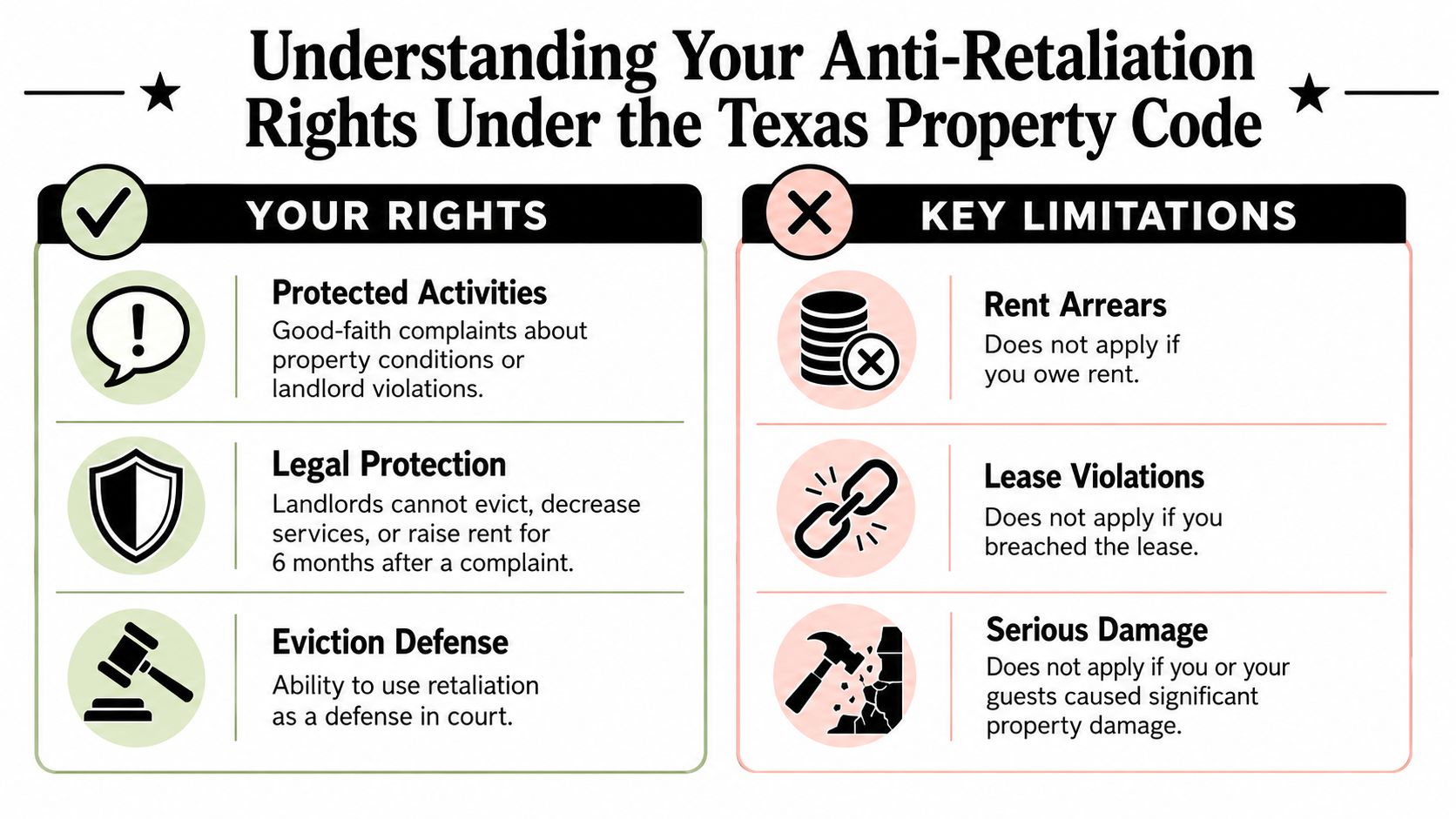
Texas anti-retaliation rules usually come into play when you took a lawful step such as:
- Requesting repairs in good faith when the landlord has a legal duty to address the condition
- Reporting code or safety problems to a government authority
- Complaining about utility issues or other landlord violations
- Exercising a statutory right given to tenants under Texas law
The key ideas are good faith and legal rights. The law is meant to protect tenants who raise real concerns, not to block all enforcement forever.
What retaliation can look like
When landlords cross the line, retaliation may take forms such as:
- Filing or threatening eviction because you made a protected complaint
- Raising rent to punish you
- Cutting services that were previously provided
- Pressuring or harassing you after you asserted a legal right
A more detailed discussion appears in this guide on Texas landlord retaliation and tenant rights.
If the timeline looks suspicious, pay attention. A legal repair request followed closely by an eviction threat can be an important warning sign, even though the landlord may still claim another reason.
Important limits tenants should know
Anti-retaliation protection isn't a free pass. It doesn't mean a landlord must ignore unpaid rent, major property damage, or a real lease breach.
A court will often look closely at whether:
- You were current on rent
- You acted in good faith
- The landlord had an independent, legitimate reason for enforcement
- The alleged lease violation occurred
That's where many tenants get tripped up. They know they made a protected complaint, but they don't realize the landlord may still argue there was a separate basis for eviction. The court then has to sort out whether the case is genuine enforcement or disguised retaliation.
For tenants and landlords alike, this is why knowing the Texas Property Code matters. It helps separate real violations from unlawful pressure.
When Complaints About You Can Lead to a Valid Eviction
A landlord doesn't need to tolerate conduct that seriously violates the lease. If neighbors, staff, or management report behavior that materially breaks lease terms or threatens safety, those complaints can support an eviction case.
That usually happens when the complaint is specific and connected to something the lease prohibits. General dislike, personality conflicts, or one vague accusation often won't carry much weight by themselves. But documented conduct can.
Common complaint-based lease violations
These issues often lead to formal action:
- Repeated noise problems after quiet hours
- Unauthorized pets or long-term guests
- Damage to the apartment or common areas
- Threatening or dangerous conduct
- Illegal activity on the property
- Unsanitary conditions that affect health or safety
For example, a tenant who leaves trash and food out in a way that contributes to infestations may face complaints tied to lease compliance and habitability concerns. In that kind of dispute, practical property-maintenance issues matter too, and resources on rodent control techniques for rental property can help landlords and tenants understand how neglect can turn into a larger lease problem.
Documentation usually matters more than volume
Five weak complaints aren't necessarily better than one strong one. A judge will care about whether the landlord can show facts such as dates, witness statements, photographs, prior warnings, or lease language.
Here's the difference:
| Weak complaint case | Stronger complaint case |
|---|---|
| “People say this tenant is a problem” | “Management documented repeated late-night noise and issued written warnings under the lease” |
| “The unit smells bad” | “Photos, maintenance notes, and witness statements show conditions affecting health and safety” |
| “Neighbors don't like them” | “Specific conduct violated written lease rules” |
A valid eviction case usually rests on proof of conduct, not just proof that someone complained.
The landlord still has to follow the legal process
Even when the complaint is legitimate, a landlord can't skip steps. The process usually begins with a written notice telling the tenant to leave if the problem isn't resolved or if the lease permits termination. If you're trying to understand what that first formal step looks like, this resource on notice issues and early eviction procedure can help clarify what tenants and landlords should expect.
So, can apartment evict you for complaints Texas? Yes, if the complaint is really evidence of a serious lease violation. No, if the landlord is using the word “complaint” to hide retaliation for a protected action. The hard part is proving which one is true.
The Texas Eviction Process Explained Step by Step
Many tenants worry that one complaint means they'll be locked out the next day. Texas law doesn't work that way. Eviction is a court process, not an instant removal.
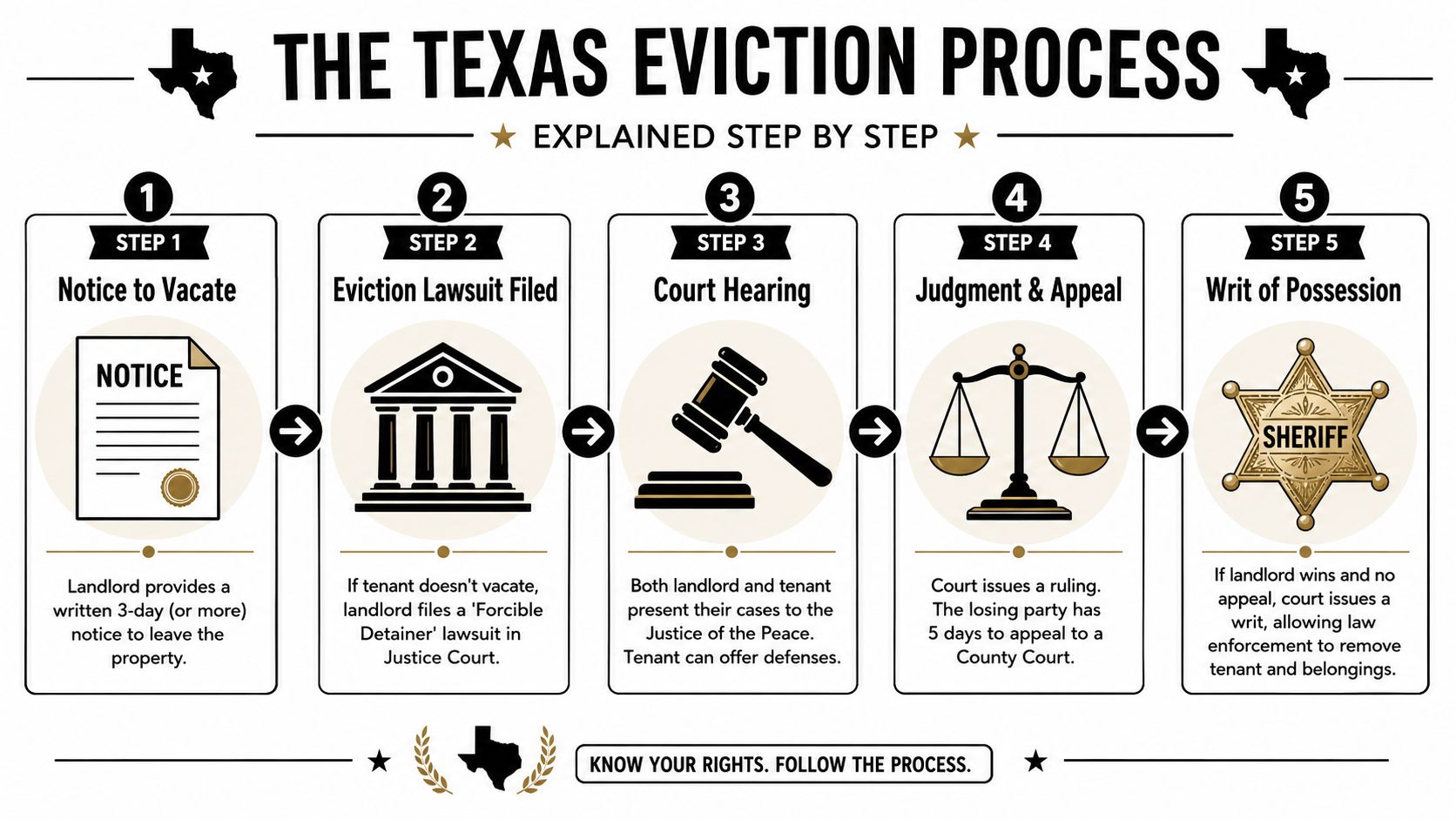
Under Texas law, a landlord must file a forcible detainer case in Justice Court, most eviction hearings take place within 10 to 21 days after the petition is filed, the notice period is usually three days unless the lease says otherwise, and the landlord must obtain a writ of possession before the constable or sheriff can remove a tenant, as explained by Texas Law Help's eviction guide.
Step one through step three
Notice to vacate
The landlord usually starts by giving written notice. In many cases, that notice is three days unless the lease provides a different period.Filing in Justice Court
If you don't move out by the deadline, the landlord may file a forcible detainer case.Service of court papers
You should receive notice of the lawsuit and the hearing date.
If you want a fuller procedural breakdown, this guide on the eviction process in Texas is a useful next read.
A short video can also help make the sequence easier to follow.
Step four and step five
Court hearing
Both sides can present evidence. Retaliation defenses, lease arguments, notices, payment records, and witness testimony become important at this stage.Judgment and writ of possession
If the landlord wins and the process continues, the court can issue a writ of possession. Law enforcement, not the landlord personally, carries it out.
What tenants often misunderstand
Tenants often assume a notice to vacate means they've already lost. It doesn't. A notice is the beginning of the formal process, not the end.
Another common mistake is ignoring court papers because the accusations seem unfair. That's dangerous. Once a case is filed, your defense has to be presented in court, not just in texts or leasing-office conversations.
How to Build Your Defense Against a Retaliatory Eviction
When tenants lose retaliation cases, it's often because they rely on memory instead of evidence. In eviction court, proof beats indignation.
That matters even more in Texas because eviction cases move quickly and many tenants appear without counsel. In Harris County alone, 81,510 eviction cases were filed last year, yet only 2.1% of tenants had legal representation. A Dallas County study found judges ruled for landlords 69% of the time when tenants had no representation, compared with 7% when tenants did have representation, according to The Texas Tribune's reporting on Texas evictions and tenant representation.
Build a timeline first
Before you argue with the landlord, organize the dates.
Create a simple timeline showing:
- When you made the protected complaint
- How you made it by text, email, portal, or letter
- When the landlord responded
- When warnings or notices appeared
- When the eviction notice arrived
If the timing shows that trouble started right after your repair request or code complaint, that can support a retaliation defense.
Courtroom focus: Judges often want a clean, chronological story. A dated timeline can make your defense easier to understand in a fast hearing.
Gather the documents that matter most
Start with the basics and keep them in one folder, printed and digital if possible.
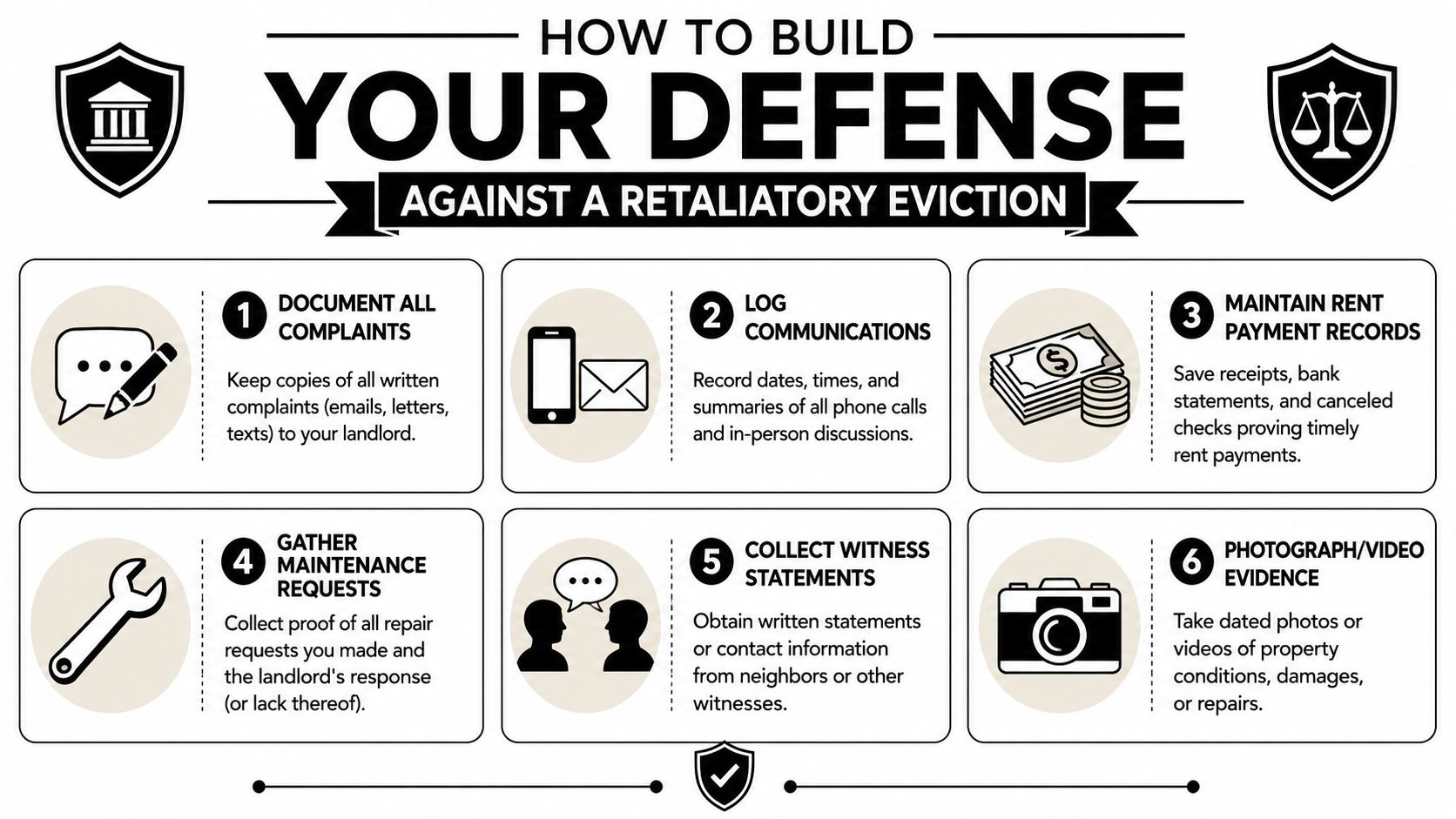
- Your lease so you can compare the accusation to the actual rules
- Repair requests and photos of the condition you reported
- Texts, emails, and portal messages with management
- Rent payment records showing you were current, if true
- Notices from the landlord including warnings and the notice to vacate
- Witness information from neighbors, guests, or maintenance workers
- Photos or videos related to the alleged complaint against you
If you need a practical list of arguments tenants raise in court, this overview of eviction court defenses in Texas can help you spot issues you might otherwise miss.
Don't overlook disability-related defenses
Some complaint-based cases involve behavior linked to a disability. That changes the analysis.
Disability Rights Texas explains that a landlord can't evict a tenant for disability alone, and that in some cases a reasonable accommodation request may help the tenant avoid eviction if the accommodation would allow compliance with the lease. The same source also notes that courts can be skeptical and may require evidence connecting the disability, the conduct, and the requested accommodation, as discussed in this Disability Rights Texas handout on eviction and reasonable accommodations.
A common example is a tenant whose conduct complaint is tied to a medical or mental health condition. In that situation, the issue may not be whether the behavior happened, but whether an accommodation could address it and allow future compliance.
Treat your defense like a case file
Don't walk into court with screenshots scattered across your phone. Label your evidence. Print it. Put it in order.
If you're dealing with a retaliatory eviction, discrimination issue, or a complaint-based case involving disability, a Texas landlord tenant lawyer or eviction attorney can help you frame the facts in a way the court can utilize. One option is The Law Office of Bryan Fagan, PLLC, which handles Texas landlord-tenant disputes for both tenants and landlords.
Next Steps Gathering Evidence and Seeking Legal Counsel
Once you receive a warning, notice to vacate, or court papers, stop relying on informal conversations. Start building a record. That means saving every message, taking photos, printing notices, and writing down dates while they're still fresh.
If your landlord claims there were complaints about you, compare those accusations to your lease line by line. Look for whether the alleged conduct is prohibited, whether management gave prior warnings, and whether the timing suggests retaliation after you exercised your tenant rights.
What to do today
Use a short action plan:
Save every document
Keep your lease, notices, payment records, emails, texts, and portal screenshots.Write a clear timeline
Include your complaint, the landlord's responses, and every notice or accusation that followed.Preserve physical evidence
Photograph repair issues, alleged damage, and any conditions related to the dispute.Identify witnesses
Neighbors, guests, maintenance staff, or family members may help confirm what happened.

When it's time to get legal help
You should strongly consider speaking with a lawyer if:
- You were served with an eviction lawsuit
- The landlord refused to accept rent
- You believe the eviction is retaliatory
- The dispute may involve discrimination or disability accommodation
- You're unsure how to present your evidence in court
A good eviction attorney or Texas landlord tenant lawyer can help you sort out whether the case is really about lease enforcement, retaliation, or both. They can also help landlords make sure they follow the Texas Property Code correctly and avoid costly mistakes.
Concerning apartment evictions in Texas related to complaints, the safest answer is this: a landlord can't legally evict you just because you asserted protected rights, but they may pursue eviction if they can prove a real lease violation and follow the legal process. Your evidence is what separates those two stories.
If you need help with an eviction, lease issue, or rental dispute, contact The Law Office of Bryan Fagan, PLLC for a free consultation today.