Signing a commercial lease in Houston is a massive step. For business owners, it’s the key to your future. For landlords, it’s the cornerstone of your investment. Dealing with a complex lease agreement can be stressful—but understanding your rights under Texas law can make all the difference. But the stakes are incredibly high, and one misunderstood clause in a dense lease agreement can create financial headaches that last for years.
This isn't just about finding a space—it's about protecting your bottom line. At The Law Office of Bryan Fagan, PLLC, we’ve seen firsthand how a poorly handled lease can derail a business. We're here to give you the clear, practical guidance you need to get it right.
Navigating The Houston Commercial Lease Market
Trying to make sense of a complex lease agreement is stressful, but understanding your rights under Texas law and the dynamics of the Houston market can change everything. A solid lease is the foundation of a stable, profitable business—whether you’re a first-time tenant or a seasoned landlord.
And the Houston market is always moving. In the first half of 2026, for instance, office leasing activity hit an impressive 8.8 million square feet. While that's a small dip from the year before, it’s still well above pre-2020 averages. Demand is strong. This means you need to be prepared.
Here's what you absolutely have to understand:
- Different Types of Commercial Leases: From Triple Net (NNN) to Gross Leases, we'll break down how each type impacts what you actually pay.
- Critical Contract Clauses: We’ll point out the make-or-break clauses that protect your interests, from rent and maintenance to what happens if someone defaults.
- Negotiation Strategies: You’ll learn how to negotiate terms grounded in Texas law to get the deal you want.
A well-negotiated lease isn't just a document; it's a strategic tool. It creates clarity, prevents disputes, and secures your financial future. Approaching it with knowledge and expert guidance is the smartest investment you can make.
As you get ready for your new space, it’s also smart to think about the practical details. Knowing your local options for things like cubicle installations in Houston Tx can help you create a realistic budget from the start.
Ultimately, both commercial and residential leases are built on specific legal foundations. Commercial agreements allow for more negotiation, but a strong grasp of the core principles of Texas lease agreement laws gives you a much-needed advantage. Our goal is to empower you with the knowledge to make confident decisions and lock down your next commercial property.
Decoding The Different Types Of Commercial Leases
When you get a commercial lease proposal, don't just skip to the rental rate. That number is only part of the story. The type of lease you sign is the real financial blueprint, determining exactly who pays for what—and how much risk you’re taking on as a tenant.
It all comes down to who covers the building’s major operating costs, often called “the three nets”: property taxes, property insurance, and common area maintenance (CAM). Getting this wrong can lead to thousands in unexpected expenses. Let's break down what you'll see in the Houston market.
Gross Lease or Full-Service Lease
The Gross Lease (or Full-Service Lease) is the most straightforward of them all. Think of it like a fixed-price contract. You pay one consistent amount each month, and the landlord handles all the property’s operating expenses—taxes, insurance, maintenance, you name it.
For a new business, this predictability is a huge win. You know exactly what your rent will be, making budgeting much simpler. But there's a catch. The landlord isn't giving you a free ride; they've estimated these costs and baked them into your rent, almost always with a cushion to protect themselves from rising expenses. So, while it’s simple, it might not be the most cost-effective deal on the table.
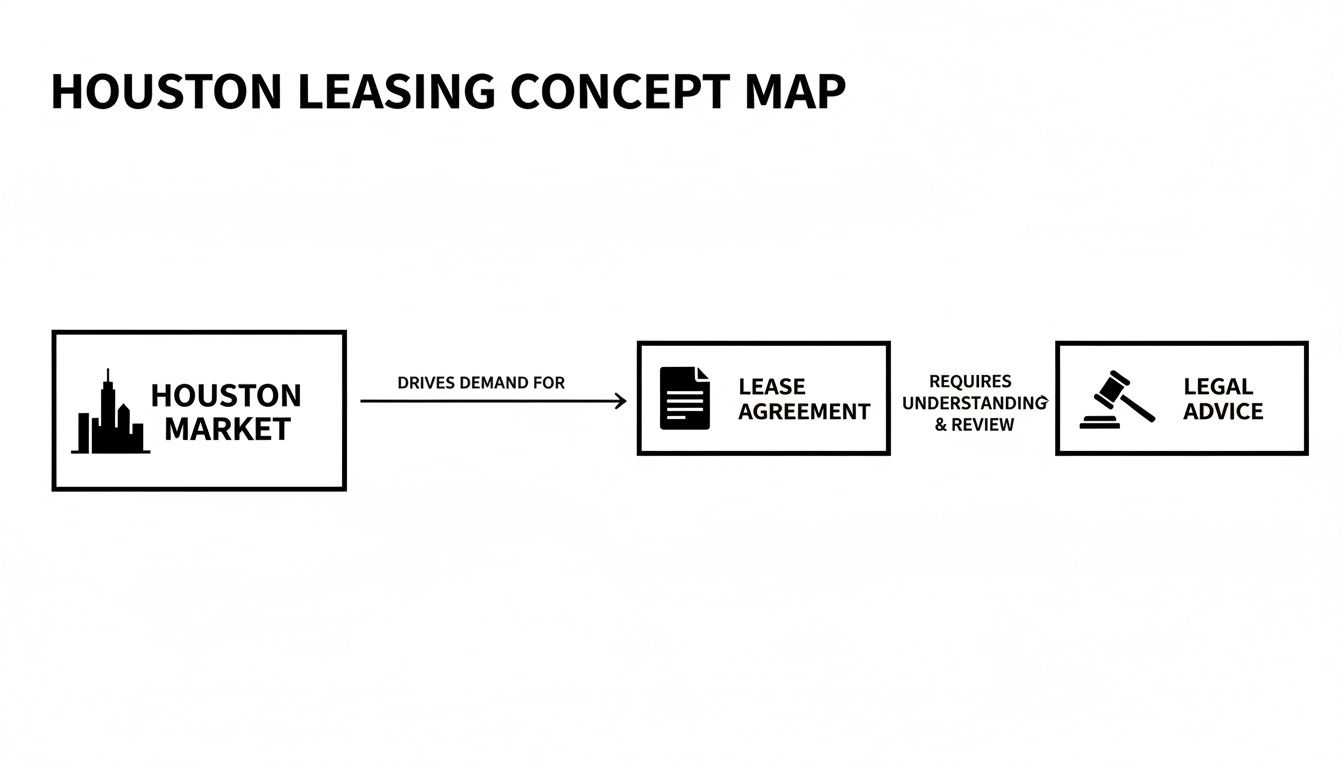
As you can see, understanding the market and the lease agreement itself is a critical step that comes long before you should ever sign on the dotted line.
Net Leases
This is where things get more complex. Unlike the all-in-one Gross Lease, a Net Lease separates your base rent from the property's other costs. You pay a lower base rent, but you also take on responsibility for one, two, or all three of the “nets.”
You’ll see this structure all over commercial leasing in Houston, especially in retail and industrial spaces. Here’s how they break down:
- Single Net Lease (N): You pay base rent plus your share of property taxes. The landlord covers insurance and maintenance. These are not very common.
- Double Net Lease (NN): You’re on the hook for base rent plus property taxes and property insurance. The landlord typically still handles structural repairs and common area maintenance.
- Triple Net Lease (NNN): This is the one you’ll see most often. You pay for everything: base rent, property taxes, insurance, and all common area maintenance. It puts the most financial burden on the tenant, but it usually comes with a significantly lower base rent.
A Triple Net (NNN) lease gives you more control, but it also means you absorb all the risk. If the property taxes spike or the parking lot needs a major repair, that cost is passed directly to you. Never, ever sign an NNN lease without demanding to see the property’s expense history for the last few years. Otherwise, you’re flying blind.
Other Common Lease Structures
Of course, landlords and tenants can agree to almost any variation. You’ll often find hybrid models that try to find a middle ground.
Modified Gross Lease
This is a compromise between a Gross and Net lease. The agreement spells out a custom arrangement—maybe you pay for CAM and utilities, but the landlord covers taxes and insurance. The key here is that there's no standard formula. You have to read every single line to understand what costs fall on your shoulders.
Percentage Lease
This is standard practice in retail, especially in malls and shopping centers. You pay a lower base rent, plus a percentage of your gross sales above a certain amount. This turns the landlord-tenant relationship into a partnership. The landlord has a direct incentive to keep the center clean, marketed, and full of shoppers, which in turn helps you succeed. It can lower your fixed costs, but it also means you share a piece of your success.
To make this a bit clearer, here’s a quick look at who pays for what under each main lease type.
Commercial Lease Types At A Glance
| Lease Type | Base Rent | Property Taxes | Property Insurance | Common Area Maintenance (CAM) |
|---|---|---|---|---|
| Gross Lease | Tenant Pays | Landlord Pays | Landlord Pays | Landlord Pays |
| Single Net (N) | Tenant Pays | Tenant Pays | Landlord Pays | Landlord Pays |
| Double Net (NN) | Tenant Pays | Tenant Pays | Tenant Pays | Landlord Pays |
| Triple Net (NNN) | Tenant Pays | Tenant Pays | Tenant Pays | Tenant Pays |
As the table shows, the responsibility shifts dramatically from the landlord to the tenant as you move from a Gross to a Triple Net lease.
Understanding these lease types is the first step, but it’s not the last. Each structure carries different financial risks and rewards. Choosing the right one for your business isn’t just a financial decision—it’s a strategic one. An experienced Texas landlord-tenant lawyer can help you analyze which lease structure truly protects your interests before you commit.
The Devil's in the Details: Essential Clauses in Your Houston Commercial Lease

That thick document your prospective landlord just handed you? It’s not just a formality. The fine print in your Houston commercial lease is where your rights are won or lost, where your budget is made or broken, and where your future business success is secured.
Skimming these pages is a recipe for disaster. One overlooked clause can lead to thousands in unexpected costs or cripple your ability to operate. In a tight market like Houston's—where asking rents are hovering around $20.78 per square foot and the vacancy rate is a slim 5.3%—landlords have the upper hand. You can’t afford to just sign and hope for the best.
Let’s walk through the critical clauses you absolutely must understand before you commit.
What the Texas Property Code Says About the Premises Clause
This sounds simple, but it's foundational. The Premises Clause defines the exact physical space you are renting. "The suite at 123 Main Street" isn't enough. It needs to be precise, because ambiguity here costs money.
A rock-solid Premises Clause will specify:
- Exact square footage: This number is the basis for your rent and your share of operating costs. Make sure it's accurate.
- A floor plan or site map: A visual exhibit leaves no doubt about your boundaries.
- Guaranteed parking: If you need dedicated spots for customers or staff, they must be specified in the lease. Don't rely on a verbal promise.
- Access to common areas: Your rights to use lobbies, restrooms, and elevators should be clearly spelled out.
Real-world scenario: A restaurant signs a lease for a space with a patio. The Premises Clause just says "Suite 101." Six months later, the landlord leases the patio to a new pop-up vendor. Because the patio wasn't explicitly included in the lease, the restaurant has no legal recourse.
Lease Term and Rent
This is the heart of the deal: how long you’re staying and what you’re paying. Your lease must have a clear commencement date (start) and expiration date (end).
But don’t just focus on the starting rent. Look closely for rent escalation clauses. These allow the landlord to increase your rent over the term, often tied to a fixed percentage or the Consumer Price Index (CPI). Knowing this is coming prevents a massive sticker shock in year two or three of your lease.
The Use Clause
The Use Clause defines exactly what you’re allowed to do in your space. Landlords use it to control the tenant mix and ensure your business operations are legal, safe, and don't disturb others. Think of a landlord who wants to prevent a noisy bar from opening next to a quiet accounting firm.
As a tenant, you need this clause to be broad enough to let your business evolve. A clause that’s too restrictive—like "for the sale of coffee only"—could stop you from adding profitable new products later. The goal is to negotiate language that protects your current business model while leaving room for future growth.
Maintenance, Repairs, and Security
This is where many landlord-tenant disputes begin. Who pays to fix the air conditioner when it dies in the middle of a Houston August? The answer is buried in your lease.
Unlike residential agreements, Texas law lets commercial landlords and tenants decide who is responsible for what. A common setup is for the tenant to handle everything within their suite while the landlord takes care of the roof, foundation, and common areas. Vague wording here is a ticking time bomb.
Your lease also needs to be clear about how security is handled. If your business has specific safety needs, clarifying responsibilities and understanding the requirements for hiring security guards in Texas is a crucial step that should be addressed in the agreement. If you’re getting started, reviewing a commercial lease agreement Texas template can give you a baseline of what to expect.
Advanced Lease Clauses And Negotiation Strategies
You’ve settled on the rent and the term. That’s the easy part. Now comes the fine print—the clauses that can either protect your business down the road or lock you into a financial nightmare. These are the terms that separate a good lease from a great one, and they’re where a landlord’s leverage can truly be felt.
Ignoring these sections is a rookie mistake. A few well-negotiated sentences here can give you the flexibility to grow, adapt, or even exit gracefully if things don’t go as planned. This is where you fight for your future security.
Assignment And Subletting Rights
What happens if your business takes off and you outgrow your space overnight? Or what if you get an offer to sell your company? This is where the assignment and subletting clause comes into play, and it dictates who gets to control your next move.
Think of it this way: assignment is like handing over the keys for good. You transfer the entire lease to a new tenant, and ideally, you walk away free and clear. Subletting is more like getting a roommate for your business. You rent out some or all of your space but remain on the hook for the full rent payment to the landlord.
Landlords, naturally, want total control over who occupies their property. They’ll often try to restrict these rights entirely. Your goal as a tenant is to negotiate for language stating the landlord cannot "unreasonably withhold, delay, or condition" their approval. Without that flexibility, you're stuck.
Default And Remedies
This section is the commercial lease equivalent of a prenuptial agreement. It spells out exactly what happens when someone doesn’t hold up their end of the bargain. Most people think of default as a tenant failing to pay rent, but it cuts both ways. A landlord can default, too—by failing to make promised repairs or not maintaining the common areas.
A strong remedies clause isn't a weapon; it's a roadmap. For a tenant, the most important piece is a "notice and cure" period. This gives you a set amount of time to fix a problem before the landlord can take drastic action like changing the locks or starting eviction proceedings. For landlords, this clause outlines their right to recover costs if you break the lease.
A critical point of negotiation in Houston is the landlord’s "lien for rent." Under Texas Property Code Chapter 54, commercial landlords have an automatic legal claim on your business property—equipment, inventory, everything—for unpaid rent. A smart tenant will negotiate to have this lien waived or limited to protect their assets.
Options To Renew Or Expand
An option to renew is one of the most valuable clauses for a tenant. It gives you the legal right to extend your lease, preventing the landlord from kicking you out or doubling the rent after you’ve spent years building a customer base at that location. A good renewal option clearly defines how the new rent will be calculated, whether it’s a fixed increase or based on fair market value.
Similarly, an option to expand or a Right of First Refusal gives you dibs on any adjacent space that becomes available. For a growing business, this is everything. It offers a clear path for expansion without the risk and expense of moving.
These options provide predictability when you need it most. They let you plan for the future with confidence. This is a complex area of lease law, and our firm provides in-depth guidance on lease review and negotiation to ensure your rights are locked in from day one.
How to Resolve Common Commercial Lease Disputes
No one signs a commercial lease expecting a fight. But when huge sums of money and your business’s future are on the line, even small disagreements can blow up into costly legal battles. A well-written lease is your first line of defense, but knowing how to handle conflict when it arises is just as critical.
Whether you’re a landlord trying to protect your asset or a tenant trying to run your business, the first step is always the same: go back to the lease. Most disputes are born from vague language or a simple misunderstanding of who is responsible for what.
The Never-Ending Battle Over CAM Charges
Common Area Maintenance (CAM) charges are easily one of the most disputed items in a Houston commercial lease. It usually starts when the tenant gets the annual reconciliation bill and the number is shockingly high. Suddenly, you're questioning every line item.
Are massive capital improvements like a new roof really "maintenance"? Do the landlord's marketing fees count as a shared expense? If you're questioning a CAM charge, you have to be strategic:
- Go to the Source: Pull up the CAM clause in your lease. What does it actually say the landlord can include? The definitions are everything.
- Ask for the Receipts: Your lease should give you the right to audit the landlord's books. Don't be afraid to use it. Request to see the detailed records for the expenses you're questioning.
- Put it in Writing: Send a formal, written notice to your landlord clearly outlining your specific objections. This creates a paper trail and shows you’re serious.
Who Fixes the Broken HVAC in August?
This is the classic Houston commercial property dispute. Unlike residential leases where landlord duties are spelled out by law, commercial leases are a different beast. The contract—and only the contract—dictates who pays for repairs.
If your landlord is supposed to fix the leaky roof but won't, or if the tenant has neglected their maintenance duties, the process starts with a formal written notice. This officially starts the clock on their time to "cure" the default. If they ignore it, you may have grounds for legal action, but you have to follow the specific steps laid out in your lease's default clause first.
Texas Property Code Chapter 93, which covers commercial leases, gives almost total authority to the lease agreement itself. If the contract you signed says you're responsible for all repairs inside your suite, that's what the courts will enforce. It's a brutal lesson in the importance of negotiating these terms before signing.
Early Termination and Fights Over the Security Deposit
A tenant needing to break a lease or a landlord trying to evict for non-payment can ignite a serious conflict. These situations are often driven by market shifts. For instance, while Houston's office market has shown signs of life in 2026, the overall instability makes some tenants desperate to get out and landlords just as desperate to hold them to the full term. Learn more about Houston's office market trends and what they mean for leases.
Disputes over the security deposit are just as common. Under Texas Property Code § 93.005, a landlord has 60 days after a tenant moves out to refund the deposit. But they can—and will—deduct for damages and other charges the tenant is liable for. Protect yourself with detailed move-in and move-out photos and records. It's your best proof.
When you’ve tried to negotiate and gotten nowhere, it's time to call a Texas landlord-tenant lawyer. An eviction attorney can mediate the issue, send a powerful demand letter, or, if it comes to that, fight for your interests in court to make sure your rights are protected.
Your Houston Commercial Lease Checklist
You’ve found the perfect space. You’ve shaken hands on the big-picture terms. Now comes the hard part—the part that can make or break your business before you even open your doors.
This is the due diligence phase. It's your last chance to spot hidden costs, deal-breaking restrictions, and legal traps before that lease becomes a legally binding anchor on your company’s future.
Think of it like the final inspection before buying a house. You loved the open house, but now you need a professional to check the foundation. This checklist is your guide to looking under the hood and making sure the property—and the contract—are exactly what you think they are.
Step-by-Step Due Diligence Before You Sign
Don't take anyone’s word for it. Before your signature hits that paper, you need to verify everything. This isn’t about negotiation anymore; it’s about confirmation. Each step is designed to save you from expensive surprises and future legal battles.
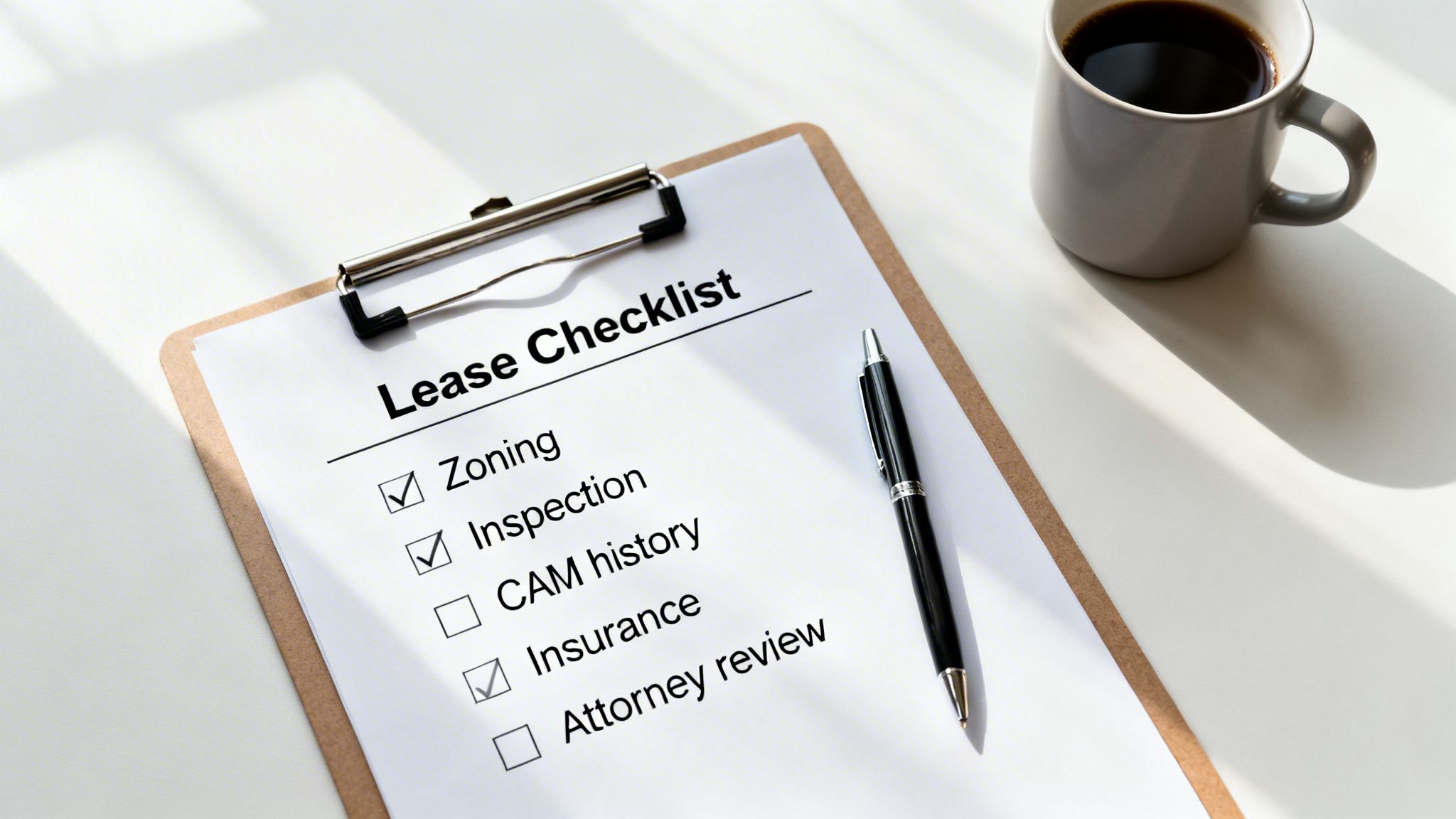
Your pre-signing checklist must include:
- Zoning and Permitted Use Verification: Go straight to the City of Houston and confirm the property's zoning allows your exact business activities. A simple mismatch here can get your business shut down.
- Professional Property Inspection: Hire a licensed inspector. You need a full report on the building’s structure, electrical, plumbing, and especially the HVAC system. In Texas, a broken AC isn't just an inconvenience; it's a business killer. Know who pays for that fix before it breaks.
- Review Historical CAM Charges: If it’s a net lease, you must demand at least three years of detailed Common Area Maintenance (CAM) records. This is the only way to budget accurately and identify if you're about to inherit out-of-control costs.
- Confirm Insurance Requirements: Don’t just read the insurance clause—send it directly to your business insurance agent. They'll tell you if your policy is enough or if you’ll need to buy more coverage, adding another expense to your bottom line.
The Final Legal Review
This is the most important step on the list. Don't skip it.
Having a Texas landlord-tenant lawyer review the final lease isn't an expense; it's an investment in your company's survival. An attorney who specializes in commercial leasing in Houston will spot dangerous language and hidden liabilities an untrained eye will always miss.
In Texas, commercial leases are almost entirely a matter of contract law. Unlike residential tenants, commercial tenants get very few automatic protections from the Texas Property Code. The document you sign is the law. A final legal review is the only way to protect yourself.
An attorney makes sure the legalese in the final document actually matches the terms you agreed to. They will check that the default clauses are fair, your renewal options are solid, and every single financial obligation is spelled out clearly. It's the final layer of protection your business deserves.
If you need help reviewing a commercial lease or find yourself in a rental dispute, contact The Law Office of Bryan Fagan, PLLC for a free consultation today.
Your Commercial Lease Questions, Answered
Signing a commercial lease can feel overwhelming, especially when you realize it’s nothing like renting an apartment. To give you some clarity, we’ve put together straight answers to the questions our Houston commercial real estate attorneys hear most often.
What Is The Biggest Mistake Tenants Make In Commercial Leases?
Overlooking the fine print, hands down. Two clauses cause the most financial pain.
First is the “Use Clause.” If it’s too restrictive, it can completely strangle your business’s ability to pivot or grow. You could be blocked from adding a new service or product line simply because the lease didn't allow for it.
The second is underestimating Common Area Maintenance (CAM) charges. Business owners get laser-focused on the base rent and gloss over the CAM section. But vague or poorly-defined CAM clauses can lead to massive, unpredictable bills that destroy your budget year after year.
Can A Landlord Refuse To Make Major Repairs?
Yes, and they often can. This is a huge shock to tenants used to residential leases. Unlike renting a home, when it comes to commercial property, Texas law gives almost total authority to the written contract.
If your lease doesn't explicitly state the landlord is responsible for the roof, the foundation, or the HVAC system, that massive expense will almost certainly fall on you. This is why getting repair obligations clearly defined before you sign isn't just a good idea—it's critical to protecting your business.
How Is A Commercial Security Deposit Handled Under Texas Law?
Very differently than in residential leases. The Texas Property Code offers almost no built-in protections for commercial tenants when it comes to security deposits.
This means the lease itself is your only protection. The contract must spell out the deposit amount, the specific reasons the landlord can make deductions, and a firm deadline for its return. Without that language in writing, you have very little power to get your money back if a dispute happens.
Do I Really Need A Lawyer To Review My Commercial Lease?
Absolutely. A commercial lease is a dense, complex legal instrument drafted by the landlord's attorney for one purpose: to protect the landlord. It is not written to be fair.
An experienced Houston lease lawyer isn't just another expense; they are a strategic investment in your business's future. They can spot hidden risks, negotiate more favorable terms, and save you from financial traps that could cost you tens of thousands of dollars down the line. It's about getting the peace of mind that comes from knowing your business is starting on a rock-solid legal foundation.
If you need help with an eviction, lease issue, or rental dispute, contact The Law Office of Bryan Fagan, PLLC for a free consultation today.