Dealing with a landlord dispute or eviction can be stressful—but understanding your rights under Texas law can make all the difference. When you’re facing a tenant who won't pay rent, a lease violation, or significant property damage, the financial and emotional drain can feel overwhelming. Typing "property dispute attorneys near me" into a search bar is the first step, but what you really need is a clear plan and an experienced advocate to protect your rights. This guide is built to give you exactly that.
Your Guide to Finding Texas Property Dispute Attorneys
Navigating a conflict with a tenant can make you feel completely alone. You’re watching your investment get chipped away, your time get wasted, and your frustration build. But understanding your rights as a landlord under Texas law is the key to taking back control. Whether it’s unpaid rent piling up, blatant lease violations, or destruction of your property, a knowledgeable Texas landlord tenant lawyer gives you the confidence to stop worrying and start acting.
At The Law Office of Bryan Fagan, PLLC, our focus is on helping landlords and tenants like you protect their assets and enforce their rights. This guide will walk you through common disputes, when you need to call an attorney, and how to find the right legal partner to resolve your issue.

What the Texas Property Code Says About Common Disputes
Texas property law is full of specific rules and procedures. One small mistake in paperwork or timing can cause massive delays, get your case thrown out, or cost you a fortune. An experienced attorney ensures every move you make is by the book and built for results.
Here are some of the most common issues both tenants and landlords bring to us:
- Evictions for Non-Payment: This isn't just about telling someone to leave. We handle the entire rigid legal process, starting with the ironclad "Notice to Vacate" required by the Texas Property Code and see it through to the end.
- Lease Violations: Unauthorized pets, secret roommates, or unapproved alterations—whatever the breach, we help you enforce the terms of the lease you both signed.
- Security Deposit Disputes: Knowing the difference between "damage" and "normal wear and tear" is critical. We guide you through the strict rules in Section 92.109 of the Texas Property Code to make sure you can legally withhold funds and avoid being sued. For tenants, we ensure your deposit is returned fairly and lawfully.
- Repairs and Habitability: A tenant has a right to a safe and habitable home. If a landlord fails to make necessary repairs, we help tenants enforce their rights. For landlords, we clarify your legal obligations to prevent false claims.
A property dispute is more than just a headache; it's a direct threat to your financial future or your housing stability. Acting fast with the right legal muscle is the only way to protect your rights and cut your losses.
The table below gives you a quick snapshot of common problems and the legal tools we use to solve them. It's a good starting point to help you figure out if it's time to stop worrying and start getting real legal help.
Common Texas Landlord-Tenant Disputes and Legal Solutions
This table summarizes frequent conflicts in Texas and the typical legal actions an attorney can help you take.
| Your Problem | Governing Law (Texas Property Code) | Potential Legal Action |
|---|---|---|
| Tenant has not paid rent | Section 24.005 | Landlord can file a Forcible Detainer (eviction) suit. |
| Tenant refuses to leave after lease ends | Section 91.001 | Landlord can file an eviction suit. |
| Landlord wrongfully withholds security deposit | Sections 92.104 & 92.109 | Tenant can sue for damages, potentially 3x the deposit amount. |
| Landlord fails to make necessary repairs | Section 92.056 | Tenant may have options like lease termination or repair-and-deduct. |
Knowing these basics helps you understand the process, but executing them correctly is where having an experienced lawyer in your corner makes all the difference.
What a Property Dispute Attorney Does for You
Most people only start searching for "property dispute attorneys near me" after a small problem has snowballed into a full-blown crisis. But a sharp attorney does more than just put out fires. They're a strategic partner who protects your rights from the ground up.
Think of them as both your shield and your sword. They defend you against baseless accusations and costly lawsuits, but they also give you the legal muscle to enforce your rights when the other party breaks their end of the deal. Their job is to safeguard your property, your rental income, or your rights as a tenant.

Proactive Protection for Your Rights
The easiest way to win a dispute is to stop it from happening in the first place. A property dispute attorney helps you build a rock-solid legal foundation from day one.
Here’s how they can help landlords and tenants:
- For Landlords: Drafting Ironclad Lease Agreements: A shocking number of disputes come from vague or legally flimsy leases. An attorney will craft a Texas-specific agreement that leaves no room for confusion, clearly outlining rules for rent payments, property use, and maintenance.
- For Tenants: Reviewing Your Lease Before You Sign: Before you commit to a year-long contract, an attorney can review the lease to spot unfair clauses, clarify your responsibilities, and ensure your rights are protected.
- Ensuring Legal Compliance: The Texas Property Code is a minefield of strict rules. An attorney makes sure your procedures—for everything from entering the property to handling security deposits—are 100% compliant. This is your single best defense against lawsuits.
Step-by-Step Guidance During a Dispute
When a conflict does flare up, an attorney takes decisive action on your behalf. Their goal is to resolve the situation as quickly and cost-effectively as possible while protecting your bottom line and your rights.
This is what they do when things go south:
- Navigating the Eviction Process: Evicting a tenant in Texas isn’t just asking them to leave; it's a rigid, step-by-step legal process. One mistake can get your case thrown out, forcing you to start over. An eviction attorney ensures every step, from the initial Notice to Vacate to the court hearing, is executed perfectly.
- How to Handle Security Deposit Disputes: When you move out, your landlord can’t just decide to keep your deposit. Section 92.109 of the Texas Property Code has strict rules for withholding funds and providing an itemized list of deductions. Your lawyer will guide you through this process to fight for the return of your money or, for landlords, to shut down any claims of wrongful withholding.
- Recovering Costs for Property Damage: What happens if repair costs are more than the security deposit? Your attorney can take the tenant to court to recover the remaining balance. You might also find it useful to learn how a formal demand letter in Texas can be a powerful first step in this process.
- How to Resolve Repair Issues: If your landlord isn't making needed repairs, you have rights. An attorney can help you provide proper legal notice, and if the landlord still doesn't act, can guide you on options like terminating the lease or suing the landlord.
A property dispute attorney translates your rights into concrete actions. They step in to handle difficult conversations, file the correct legal documents, and represent you in court, allowing you to focus on your life instead of the conflict.
Navigating Common Landlord and Tenant Disputes in Texas
Every landlord and tenant knows that sinking feeling. It’s the late-night call about a flooded bathroom or the deafening silence after a rent reminder. If you’re searching for "property dispute attorneys near me," it’s probably because a disagreement has gone from frustrating to critical.
Knowing the most common conflicts in Texas—and the laws that control them—is your first line of defense.
How to Legally Handle Evictions in Texas
Eviction is the most frequent and high-stakes dispute. Whether it’s for unpaid rent or a serious lease violation, you can't just change the locks. The Texas Property Code lays out a very specific, non-negotiable process.
It almost always starts with a formal “Notice to Vacate.” According to Texas Property Code Section 24.005, if a tenant hasn't paid rent, the landlord is required to give them a written notice to move out at least three days before they can file an eviction lawsuit.
- Real-World Scenario: Your tenant is two weeks behind on rent and has gone silent. You can’t legally barge in and start moving their belongings. Your only move is to correctly deliver a 3-Day Notice to Vacate. If they still refuse to leave, your next step is filing an eviction suit (a forcible detainer) in the local Justice of the Peace court. An eviction attorney ensures every notice and filing is done by the book, so your case doesn't get thrown out on a technicality.
What the Texas Property Code Says About Security Deposits
The security deposit is another major battleground. A landlord can deduct for damages beyond "normal wear and tear," but the law is extremely clear about how you can use that deposit.
Texas Property Code Section 92.109 comes down hard on landlords who wrongfully keep a security deposit. If a landlord fails to provide a refund or an itemized list of deductions within 30 days and is found to have acted in bad faith, they could be on the hook for three times the deposit amount, plus the tenant’s attorney fees.
Documenting everything is non-negotiable. An experienced landlord-tenant lawyer can give you a straight answer on what qualifies as "damage" versus "normal wear and tear," helping you avoid a very expensive lawsuit.
Step-by-Step Information for Resolving Repair Issues
What happens when your landlord won't fix a serious problem, like a broken heater in winter? Your lease should outline your right to a safe living space. You must provide your landlord with proper written notice of the issue.
If the landlord fails to make the repair in a reasonable time, the Texas Property Code gives you options. Often, a formal letter from an attorney is all it takes to resolve the standoff. If not, you may have grounds to terminate your lease or take other legal action. This allows you to protect your rights and ensure your home is safe.
Today's volatile real estate market only makes these conflicts more intense. In recent years, commercial property disputes have skyrocketed, with billions in loans heading toward foreclosure. This pressure trickles down, affecting both commercial and residential landlords and tenants across Texas. In this climate, it's more important than ever to handle disputes with firm, legally sound action. You can learn more about how these commercial dispute trends impact the market. An attorney helps you stay on the right side of the law, turning a stressful conflict into a managed process.
When Should You Hire a Property Dispute Attorney?
It’s a common reaction. You get a notice from your landlord or face a growing conflict with a tenant, and the first instinct is to try and handle it yourself. But when it comes to property disputes, waiting almost always makes things worse.
Knowing that exact moment to stop arguing and start seeking legal counsel can save you an incredible amount of time, money, and stress. Early guidance from a Texas landlord tenant lawyer can de-escalate a situation and give you a clear, confident action plan, turning legal uncertainty into decisive action before the financial stakes get out of control.
Clear Triggers to Call an Attorney Immediately
Some situations are simply too high-risk to handle on your own. If you’re facing any of these scenarios, it’s time to stop guessing and get a professional in your corner. These are the moments you should immediately search for "property dispute attorneys near me" and schedule a consultation.
- You are facing eviction. Whether you believe it's justified or not, an eviction notice is a legal action that can damage your rental history. An attorney can help you defend your rights.
- Your tenant is refusing to pay rent and won't leave. Once a tenant stops paying, every single day costs you money. An attorney can make sure the eviction process starts immediately and is handled flawlessly.
- Your landlord is refusing to make essential repairs. If your health and safety are at risk due to your landlord's negligence, you need legal help to enforce your rights.
- You receive a formal complaint, lawsuit, or notice from an attorney. This is a bright red flag. The dispute has officially become a legal battle, and responding without your own lawyer is a major risk.
Waiting to hire an attorney is like waiting to call the fire department until the whole house is engulfed in flames. Early intervention contains the damage and gives you the best chance of a quick, cost-effective resolution.
This process flow illustrates the main pathways for Texas property disputes, including eviction, deposit, and repair issues.
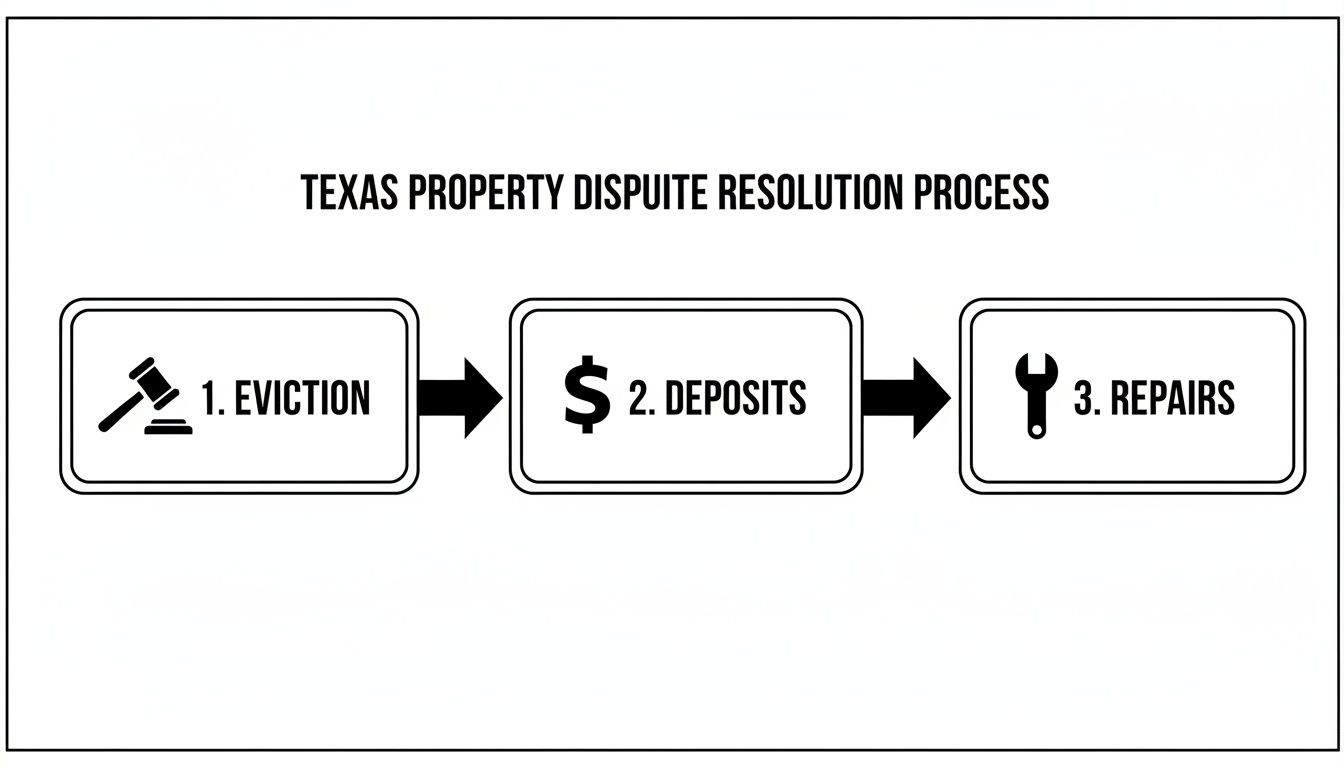
As you can see, whether the issue is eviction, deposits, or repairs, each has a distinct legal path. One wrong turn can jeopardize your entire case and your rights as a property owner or tenant.
The Financial Cost of Delay
Putting off legal action doesn't just prolong your stress—it actively puts your finances at risk. Minor disagreements can quickly spiral into major financial battles without prompt, expert intervention.
A free consultation with an attorney can clarify your rights and provide an immediate action plan. In some cases, a full-blown court battle isn't even necessary. Exploring alternative resolutions can be incredibly effective; you can learn more about how real estate mediation can resolve conflicts without the time and expense of a lengthy court fight.
How to Choose the Right Attorney for Your Needs

Okay, you’ve decided it’s time to call in a professional. But a quick search for "property dispute attorneys near me" can feel overwhelming. You’ll see a long list of law firms, but how do you know which one is right for your specific problem?
Choosing the right lawyer is like hiring the right specialist for a critical issue. You need a legal partner who lives and breathes Texas landlord-tenant law, not someone who just dabbles in it. This is about finding your lawyer—someone who understands what's at stake and has a proven history of protecting the rights of people just like you.
Key Questions to Ask During Your Consultation
That initial consultation isn't just a sales pitch; it's your chance to interview the attorney. Think of it as a two-way street. You get to see if their expertise, strategy, and communication style are a good fit for you.
Come prepared with these crucial questions:
- How much of your practice is dedicated to Texas landlord-tenant law? You're looking for a specialist. Ask them about their direct experience with cases just like yours, whether it's an eviction, a security deposit dispute, or a failure to repair.
- Based on what I’ve shared, what’s your initial strategy? A seasoned attorney should be able to walk you through a clear, initial game plan. They should explain the first few steps they'd take, why those steps are necessary, and how they connect to the Texas Property Code.
- What are the possible outcomes—both good and bad? An honest lawyer won't just promise you a win. They will give you a realistic picture, preparing you for the best-case scenario, the worst-case scenario, and everything in between.
- How will we communicate, and how often can I expect updates? Nothing is more frustrating than being left in the dark. Find out who your main point of contact will be and what their process is for keeping you informed.
You also need to get a firm handle on the firm's billing practices. Ask about the different law firm pricing models they use. Is it an hourly rate for unpredictable litigation? Or a flat fee for a standard procedure like an uncontested eviction? This transparency is non-negotiable for budgeting effectively.
Choosing an attorney is a business decision. The right one will feel like a strategic partner who is just as invested in protecting your rights as you are.
Preparing for a Productive First Meeting
To get the most out of your free consultation, you need to show up prepared. The more information you can provide right from the start, the better the attorney can size up your situation and give you concrete, actionable advice.
Think of it like going to a doctor's appointment. You wouldn't just say "I don't feel well"; you'd bring your medical history and list your symptoms. The details matter.
Here's a simple checklist of what to bring:
- The Lease Agreement: This is the contract that defines your entire legal relationship. It’s the starting point for everything.
- All Written Communication: Every email, text message, and formal notice you've sent or received. Print them out.
- Photos or Videos: If the dispute is over property damage or a repair issue, visual evidence is incredibly powerful.
- A Timeline of Events: Before the meeting, jot down a clear, chronological summary of what happened and when. This helps the attorney quickly grasp the history of the dispute.
At The Law Office of Bryan Fagan, PLLC, our team's dedicated focus on Texas property law ensures we are always ready to protect your interests.
Your Next Move with The Law Office of Bryan Fagan
Trying to handle Texas landlord-tenant law on your own can be frustrating and lonely. We've talked about your rights, the critical moments when you need legal help, and why choosing the right attorney is the key to protecting your investment or your home. Your search for "property dispute attorneys near me" can end here, with a team that's genuinely committed to your success.
At The Law Office of Bryan Fagan, PLLC, our approach is built on providing calm, confident, and clear guidance for Texas landlords and tenants. We believe in turning worry into a strategic plan of action. We’ll demystify the legal process and give you a straightforward path to resolving whatever dispute you're facing.
Your Advocate in Texas Property Law
Whether you're a landlord dealing with a tenant who refuses to pay or a tenant facing an unjust eviction, you don't have to figure it out alone. Our deep experience in Texas landlord-tenant matters means we’ve seen just about everything—and we know exactly how to respond to protect your rights. We're here to stand up for you with precision and purpose.
The right legal partner doesn't just put out fires. They provide the strategic counsel you need to prevent future conflicts and strengthen your position for the long haul.
Following the correct legal procedures isn't just a good idea; it's non-negotiable. An eviction, for instance, demands flawless execution, or a landlord risks having the case thrown out. To get a better handle on this critical process, you can learn more about finding the right eviction attorney near you and what they can do to help. Our goal is to take the legal burdens off your shoulders so you can get back to focusing on your life.
If you need help with an eviction, lease issue, or rental dispute, contact The Law Office of Bryan Fagan, PLLC for a free consultation today.
Your Top Questions About Property Disputes, Answered
When you're dealing with a property dispute, it's natural to have a dozen questions about your rights, the potential costs, and what happens next. Think of this section as your cheat sheet—clear, direct answers to the questions we hear most often from Texas landlords and tenants.
Our goal here isn't to bury you in legal jargon. It's to give you the straightforward information you need to make smart, confident decisions.
How Much Will a Property Dispute Attorney Cost Me in Texas?
This is usually the first thing people want to know, and the honest answer is: it depends entirely on your specific situation. A simple, uncontested eviction is a world away from a drawn-out lawsuit over thousands of dollars in property damage, and the costs will reflect that.
At The Law Office of Bryan Fagan, PLLC, we start every potential client with a free consultation. It’s our chance to hear what you’re up against and give you a transparent breakdown of the potential fees. Typically, we work with a few common fee structures:
- Flat Fees: We charge a single, set price for straightforward services, like handling an uncontested eviction from start to finish. This gives you absolute cost certainty.
- Hourly Rates: For more complex or unpredictable cases involving litigation or heavy negotiation, we use an hourly rate. We are always upfront and crystal clear about our rates.
- Retainers: This is an upfront payment that we hold in trust for you. As we work on your case, we bill our time against that retainer.
We believe in total transparency. You will always have a firm grasp of the potential costs before you ever agree to move forward.
Can't I Just Handle an Eviction on My Own?
Technically, a landlord can file an eviction without a lawyer. But it's an incredibly risky gamble. The Texas Property Code is a minefield of unforgiving rules that demand perfection.
One tiny mistake can torpedo a landlord's entire case. Using the wrong wording in the "Notice to Vacate," serving it incorrectly, or missing a single court deadline can get an eviction thrown out. That means you’re forced to start the whole process over, losing more rent, more time, and piling on the frustration.
An experienced eviction attorney is your insurance policy against these costly errors. We ensure every step is handled flawlessly, protecting you from avoidable delays and giving you the fastest, most effective path to regaining possession of your property.
What Are My Responsibilities as a Landlord for Making Repairs?
Under Texas law, landlords are generally required to fix conditions that materially affect the physical health or safety of a normal tenant. This is a critical distinction. It doesn’t mean you have to address cosmetic complaints or minor annoyances.
But your duty to repair isn't automatic. For a landlord's obligation to kick in, the tenant has to do their part first:
- They must be current on their rent.
- They must have given you proper written notice of the problem.
- The damage can't be their fault (or the fault of their family or guests).
An attorney can be invaluable here, helping determine whether a repair request is a legitimate health and safety issue you must address or an unreasonable demand. This guidance protects both landlords and tenants from false claims.
How Long Does an Eviction Actually Take in Texas?
While every case is different, a standard, uncontested eviction typically takes about three to four weeks from the day you start to the day you regain your property.
Here’s what that timeline usually looks like:
- Notice to Vacate: The clock starts with a 3-day written notice to the tenant.
- Filing the Lawsuit: If the tenant stays put, an eviction suit (known as a "forcible detainer") is filed in the local Justice Court.
- Court Hearing: A court date is usually set within 10 to 21 days of filing the suit.
- Appeal Period: If the judge rules in the landlord's favor, the tenant legally has five days to appeal that decision.
- Writ of Possession: If they don't appeal, a "Writ of Possession" is requested. This is the final court order authorizing a constable to physically remove the tenant from the property, which usually happens a few days later.
Of course, any hiccup—like the tenant filing an appeal—can add significant time to this process. Having a Texas landlord tenant lawyer in your corner is the best way to keep things moving forward as smoothly and quickly as possible.
If you need help with an eviction, lease issue, or rental dispute, contact The Law Office of Bryan Fagan, PLLC for a free consultation today.