If you own rental property in Texas, estate planning usually gets pushed behind lease renewals, repairs, late rent, and insurance questions. That’s understandable. But the legal mess tends to show up at the worst possible time, when a landlord becomes ill, loses capacity, or passes away and no one knows who can collect rent, renew a lease, return a security deposit, or make decisions about the property.
That uncertainty hurts families and tenants at the same time. A good estate plan doesn’t just say who gets your assets. It creates instructions for your home, your rentals, your bank accounts, and the people who may need legal authority to act quickly under the Texas Property Code and related estate laws. If you’re a landlord, investor, or property owner, estate planning texas is partly about family protection and partly about business continuity.
Your Essential Texas Estate Planning Documents
The hardest part for many people is getting started. Legal terms sound technical, and it’s easy to assume you need a giant estate to justify a plan. You don’t. You need a clear set of instructions and the right people named in the right roles.
In 2026, only 32% of Americans have a will, leaving nearly 175.6 million estates vulnerable to intestacy laws, which can be especially tricky in Texas because community property rules often affect property acquired during marriage, as noted in this CBS Austin report on declining estate planning rates.
The documents that do the heavy lifting
Think of a will as your written rulebook. It says who should receive your property, who should handle your estate, and, if needed, who should care for minor children. For a landlord, a will can also name the person who should step in to deal with leases, rent collections, and ongoing property obligations until the estate is settled.
A durable power of attorney works during your lifetime. It lets a trusted person act as your financial co-pilot if you can’t manage things yourself. That can matter fast if a roof claim needs handling, a property tax payment is due, or a tenant issue turns urgent while you’re in the hospital.
A medical power of attorney and an advance directive handle health decisions. These documents don’t transfer property, but they spare your family from guessing. They become your voice when you can’t speak clearly for yourself.
If you want a broader overview of the essential estate planning documents, that resource is a useful plain-English companion to what you discuss with your lawyer.
Practical rule: Your documents should work together. A will handles death. Powers of attorney help during incapacity. If one piece is missing, your family may need court involvement at exactly the wrong time.
Why landlords need more than a simple will
Rental owners often assume the deed tells the whole story. It doesn’t. The deed shows title, but your estate plan answers who has authority to manage the property if you can’t.
For example, suppose you own a duplex, one checking account for rent deposits, and a separate reserve account for repairs. If you become incapacitated without a durable power of attorney, your family may struggle to access accounts or sign documents. If you die with only partial instructions, your heirs may spend months sorting out who controls the property.
Ownership changes also matter. If you’ve recently transferred property interests or are considering doing so, it helps to understand how title affects inheritance and control. This guide on adding someone to a deed in Texas is relevant because title decisions and estate planning need to match.
A simple way to think about it
Most Texas estate plans start with these questions:
- Who makes decisions if you can’t? Choose agents for finances and healthcare.
- Who handles your estate after death? Name an executor you trust.
- Who receives what property? Be specific, especially with real estate and rental income.
- How will your family access information? Keep deeds, insurance, leases, and account details organized.
That’s the foundation. Once those basics are in place, Texas law starts to matter a lot.
How Texas Law Uniquely Shapes Your Estate Plan
Texas doesn’t let you use a one-size-fits-all estate plan copied from another state. Property ownership, probate rules, and creditor protections work differently here. If you own rentals, those details aren’t abstract. They affect who owns what, who can act, and how long your family may be tied up in court.

Texas also gives you one major tax advantage. Texas has no state estate or inheritance tax, but poor planning can still become expensive because probate can cost 3-7% of the estate’s value, and 68% of Americans risk that outcome by not having a will, according to this Texas estate planning guide from Edelman Financial Engines.
Community property changes the conversation
Texas is a community property state. In plain English, most assets acquired during marriage are generally treated as belonging to both spouses. That sounds simple until you own a rental house, refinance a property, inherit money, mix accounts, or improve separate property with marital funds.
A common confusion goes like this. One spouse says, “The rental is mine because I found it and manage it.” Texas law may see that differently depending on when it was acquired, how it was titled, and where the money came from.
For landlords, this matters because the plan has to classify property correctly. If you don’t identify separate property and community property carefully, your heirs may inherit conflict instead of clarity.
Homestead rights and why your residence follows different rules
Your primary residence is not treated exactly like your rental portfolio. Texas homestead protections can shield a home from certain creditors and can create special inheritance and occupancy issues for surviving family members.
That distinction matters when someone says, “I want everything split evenly among the kids.” If one asset is the homestead and another is an income-producing rental, the legal and practical path may not be equal at all. One child may want to live in the home. Another may want immediate cash. A surviving spouse may have rights that affect what happens next.
A clean estate plan doesn’t just name beneficiaries. It matches the legal character of each property to the family’s real-life needs.
Probate is a process, not just paperwork
Probate is the court-supervised process for validating a will, paying debts, and transferring property. Some estates move through probate with manageable effort. Others don’t, especially when real estate is involved, family members disagree, or nobody has authority lined up in advance.
For a rental owner, probate can interrupt ordinary operations. Tenants still need notices. Repairs still happen. Security deposits still have to be tracked. Insurance and taxes don’t pause because a family is grieving.
Here’s where people often get stuck:
- They think a will avoids probate. Usually, a will guides probate. It doesn’t automatically skip court.
- They assume family can “just handle it.” Banks, title companies, and other parties often require legal authority.
- They overlook multi-property complications. Each parcel can create its own title and transfer issues.
Long-term care planning also overlaps with estate planning
Some Texas families are not just planning for death. They’re planning for incapacity, nursing care, or Medicaid eligibility. If that’s part of your picture, timing matters. Asset transfers can affect benefits planning, and families often benefit from learning the basics of the Medicaid look-back period before making gifts or retitling property.
For many landlords, the right takeaway is simple. Your estate plan must fit Texas law, your family structure, and the way your properties are owned and managed.
Key Strategies to Bypass the Texas Probate Process
A Texas landlord dies owning four rentals in his own name. The leases are active, one unit has a plumbing leak, property taxes are coming due, and the family assumes the will is enough to let someone step in. Then they learn a hard truth. The will may explain who should receive the properties, but it does not by itself give anyone immediate control to collect rent, sign repair approvals, or transfer title without court involvement.
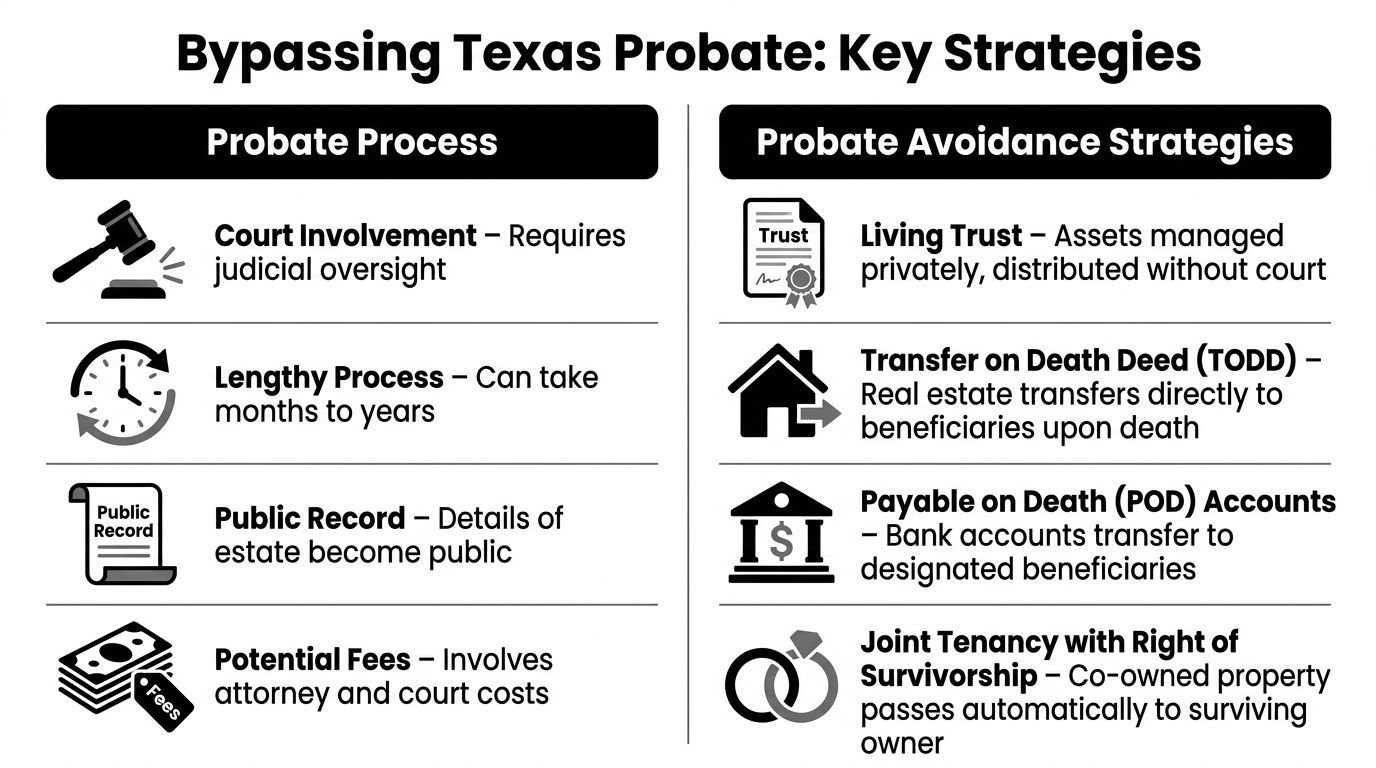
That gap is why probate-avoidance planning matters so much for rental owners. The right tool depends on what you own, how each property is titled, and whether your larger goal is privacy, speed, control, or business continuity.
One strong option is the revocable living trust. A trust works like a management wrapper around property you transfer into it. During your lifetime, you usually stay in control as trustee. If you become incapacitated or die, the successor trustee you named can step in under the trust terms, which often allows management to continue without waiting for probate authority. As explained in this Texas trust and probate overview, many Texans use trusts to reduce delay and keep transfers more private.
When a living trust makes the most sense
A revocable living trust often fits well if you own multiple rentals, expect ongoing management issues, or want one person to step in quickly and keep the business running. For a landlord, that can mean someone has clear authority to deal with tenants, approve repairs, coordinate with insurance, and keep records organized while the family handles everything else.
That continuity matters. A rental portfolio is not a savings account that can sit untouched for months. It is closer to a small business with keys, deposits, vendor relationships, and legal obligations.
A trust is often a strong fit if:
- You own several properties and want a cleaner transfer process across the portfolio.
- You want privacy because trust administration is usually less public than probate.
- You want a backup manager during incapacity so someone can act without asking a court for authority.
- You expect uneven family dynamics and want written instructions for how properties should be managed or distributed.
Simpler tools for specific assets
A trust is not the answer for every asset. Sometimes a narrower tool does the job with less cost and less paperwork.
A Transfer on Death Deed can pass Texas real estate to a named beneficiary outside probate if it is prepared, signed, recorded, and coordinated correctly with the rest of the estate plan. Some owners also compare that option with an enhanced life estate deed. If you are weighing those approaches for a rental house or other Texas real estate, this guide to the Lady Bird deed in Texas explains how owners often use deed-based planning for probate avoidance.
Bank accounts may allow Payable on Death designations. Investment accounts may allow Transfer on Death registrations. These tools can be effective, but they are asset-specific. They do not solve management problems for a rental portfolio, and they do not replace the need to coordinate titles, leases, LLC documents, and beneficiary forms.
The better question is not “Which document avoids probate?”
It is “Which document gives the right person the right authority over this specific asset at the right time?”
Probate avoidance methods in Texas
| Method | Assets Covered | Best For | Probate Avoidance? | Privacy Level |
|---|---|---|---|---|
| Revocable Living Trust | Real estate, accounts, business interests, personal property moved into the trust | Owners with multiple assets or rentals needing continuity | Yes, for properly funded trust assets | High |
| Transfer on Death Deed | Texas real estate named in the deed | Owners wanting a direct transfer of a specific property | Yes, if valid and coordinated with the rest of the plan | Moderate |
| Payable on Death account | Bank accounts with a beneficiary designation | Cash accounts that should transfer quickly | Yes | Moderate |
| Transfer on Death registration | Eligible investment accounts | Investors wanting named beneficiary transfers | Yes | Moderate |
| Joint ownership with survivorship features | Certain co-owned assets | Limited situations where automatic transfer fits the ownership plan | Often, depending on setup | Lower to moderate |
Where people make mistakes
People often get stuck in several ways:
A trust that never receives title to the property is just paper. If your rentals are still owned in your individual name, the trust may not control them when it matters.
A deed can also create trouble if it points one way and the rest of the plan points another. For example, a landlord might sign a Transfer on Death Deed for one property, leave a will dividing everything equally among three children, and forget that one child is already handling repairs and tenant issues. The legal transfer may be simple, but the family conflict can be expensive.
Beneficiary designations create their own problems. An old POD form on a bank account can send cash to one person while the rental properties pass another way, leaving the person managing the buildings without funds for taxes, insurance, or emergency repairs.
The cheapest tool can become the costliest one if your family structure is complicated. Prior marriages, blended families, co-owned rentals, or active leases usually call for closer coordination.
A practical way to decide
Start with the properties, not the paperwork.
- List each asset separately. Include rentals, your homestead, LLC interests, bank accounts, vehicles, and digital records.
- Note the practical problem if you were gone tomorrow. Who would collect rent, approve repairs, access operating funds, or sign closing documents?
- Match the tool to that problem. A trust may suit a rental portfolio. A POD designation may be enough for a reserve account.
- Confirm the setup is complete. Titles, deeds, beneficiary forms, and entity documents all need to agree.
If you want formal drafting or review, The Law Office of Bryan Fagan, PLLC is one Texas firm that handles legal matters involving property rights and related planning issues.
Estate Planning for Texas Landlords and Rental Properties
A landlord’s estate plan has to do more than transfer title. It has to keep a rental business functioning while family members are stressed, tenants need answers, and legal deadlines keep running.
That need is widely overlooked. 40% of Texas households rent, and 60% of probated estates under $50,000 involve unresolved rental disputes, often because no one made clear plans for lease succession or security deposits, according to this discussion of estate planning for low-income earners and renters in Texas.
If you become incapacitated tomorrow
Suppose you own three single-family rentals. One tenant pays by app, one mails checks, and one is already late. You’re suddenly unable to manage anything. Who can sign a repair authorization, answer a notice issue, or communicate with the bank?
If your plan includes a durable power of attorney or a trust with a successor trustee, someone you chose can step in. If it doesn’t, your family may spend precious time trying to prove authority while the properties keep generating problems.
That’s why landlord planning often includes:
- A decision-maker for finances who can access rent-related accounts.
- A property management roadmap with vendor contacts, lease files, and insurance information.
- Clear authority to handle tenant issues under the lease and applicable sections of the Texas Property Code.
If you pass away while leases are still active
Tenants don’t disappear because the owner died. The lease usually still matters. Rent is still owed. Repair requests still exist. Security deposits still have to be accounted for properly.
Texas landlords already know that deposit handling can become a flashpoint under the Texas Property Code, especially Chapter 92 issues tied to move-out, deductions, and notice practices. If your heirs inherit a file cabinet full of unsigned renewals, scattered receipts, and no list of deposits held, they can walk straight into a dispute.
Keep one master file for each property with the lease, amendments, deposit records, repair history, insurance, mortgage information, and utility details. Your estate plan is stronger when your records are usable.
Rental property is part asset and part operation
Many guides discuss real estate as if it were passive. Rental property isn’t. It’s a business function that continues after death or incapacity unless someone has authority and instructions.
For that reason, landlords often consider whether to hold property individually, in an entity, or in trust-based structures. If you’re exploring liability and management issues, this guide on transferring property to an LLC in Texas is a useful starting point. In some situations, the LLC interest itself is then addressed in the estate plan rather than relying only on the deed to the property.
A few real-world landlord scenarios
A parent leaves rentals to two children
One child wants to keep the properties. The other wants cash. Without a clear plan, they may become accidental business partners. That can trigger conflict over repairs, rent increases, and sale timing.
A trust can provide instructions. It can allow one child to buy out the other, require a sale, or appoint a neutral trustee to manage the transition.
An unmarried couple co-owns a rental
This comes up more than many people expect. If the legal paperwork is thin, one partner may assume the survivor automatically takes over. Texas law doesn’t always work that way for unmarried partners. The right deed language, entity planning, and beneficiary structure matter.
A landlord dies with tenant deposits in a separate account
The money is still owed according to the law and the lease terms. If nobody knows where the account is or who can access it, the estate may face claims from tenants and pressure from heirs at the same time.
Here’s a helpful video if you’re trying to think through property transfer and planning issues in practical terms:
The Property Code still matters after the owner is gone
Landlord obligations don’t vanish at death. Notices, repairs, habitability concerns, and deposit issues still have to be handled according to law. That’s why a landlord estate plan should leave behind more than legal documents. It should leave an operating manual.
A strong landlord packet usually includes names of tenants, rent amounts, due dates, vendor contacts, utility details, insurance information, account locations, and a summary of any ongoing disputes. That kind of preparation protects both your family and your tenants.
Your Texas Estate Planning Action Checklist
Finishing a long article on estate planning in Texas often leaves readers with one of two feelings. Either they’re relieved they finally understand it, or they’re overwhelmed because they now see how many moving parts exist. A checklist fixes that.
Gather your information
Start by collecting what you own and what you owe. Include your home, rental properties, bank accounts, loans, insurance policies, business interests, and digital accounts. For landlords, add leases, security deposit records, and property manager or contractor contact lists.
Then sort your assets by how they’re owned. Some may be in your individual name. Some may be jointly owned. Some may already have beneficiary designations.
Decide who does what
Pick the people who will fill the key jobs:
- Executor to handle your estate after death.
- Trustee or successor trustee if you use a trust.
- Agent under durable power of attorney for financial matters.
- Medical agent for healthcare decisions.
Choose people who are organized and willing to serve. The right choice isn’t always the oldest child or the closest relative. It’s the person who can stay calm, keep records, and follow instructions.
Write down why you chose each person. You don’t have to put every reason in the legal document, but your family may benefit from understanding your thinking.
Draft, sign, and coordinate
Once you know your goals and your decision-makers, work with a Texas attorney to prepare the needed documents. For many families, that means a will, powers of attorney, healthcare documents, and sometimes a trust.
After signing, check the non-document items that control transfers. Review deeds, account titles, and beneficiary forms. If those don’t match the plan, your paperwork may point in one direction while ownership records point in another.
Fund and maintain the plan
Many plans often fail. You can create a trust and still leave assets outside it. You can sign a power of attorney and never tell your family where it is.
Use this short maintenance list:
- Move assets where needed. Retitle trust assets correctly.
- Store documents safely. Keep originals in a known, accessible place.
- Create a landlord summary sheet. List rents, deposits, vendors, insurance, and account details.
- Review after life changes. Marriage, divorce, death, major purchases, and business changes should trigger a review.
A plan is not a one-time task. It’s a system you revisit as your family and property holdings change.
Common Estate Planning Mistakes Texans Make
A Texas landlord dies on a Friday. Rent is due on the first. A pipe bursts in one unit over the weekend. The family has a will somewhere, but no one knows who can talk to tenants, collect rent, approve repairs, or access the lease files. That kind of mess usually does not start with a dramatic legal mistake. It starts with ordinary gaps that were easy to ignore while the owner was alive.
Texans often assume estate planning is mainly about dividing property after death. For rental owners, it is also about keeping a small business running during a crisis. A house can sit still. A rental rarely does. Tenants need answers, deposits must be tracked, and someone has to make decisions with legal authority.
One problem shows up often in blended families. General estate plans can leave a current spouse, children from a prior relationship, and the person managing the rentals with different expectations about who gets income, who controls the property, and who decides whether to sell. A discussion of estate planning for complex and nontraditional families in Texas helps illustrate why generic language can create conflict instead of preventing it.
Mistake one, thinking you don’t own enough
Many Texans put this off because they do not feel wealthy. But ownership is only part of the problem. Authority is the true issue.
If you own one rental house, a bank account that receives rent, and a security deposit account, someone will need legal power to step in if you die or become incapacitated. Even a modest portfolio can stall fast if no one can sign a lease renewal, hire a plumber, or respond to a city notice. For landlords, the question is often less about net worth and more about operational control.
Mistake two, signing a trust and never funding it
This mistake creates false comfort. The documents are signed, the binder goes on the shelf, and the owner assumes the plan is finished. Meanwhile, the deed is still in the individual’s name, the LLC interests were never assigned, or the bank accounts still point in a different direction.
A trust only controls what it owns or is designed to receive. If a rental property was supposed to be part of the trust, the title and related records need to match that plan. For a landlord, that also means checking the practical details. Which name appears on leases? Which account receives rent? Which entity shows up on insurance? If those pieces pull in different directions, your family may spend months sorting out a problem that could have been cleaned up in an afternoon.
Mistake three, treating a blended family like a simple one
This is one of the most common sources of litigation and resentment. “I want everyone treated fairly” sounds reasonable, but it leaves too much unsaid.
Fair may mean one thing to a surviving spouse who depends on rental income to pay bills. It may mean something else to children who expect to inherit the property itself. A trust can help spell that out. It can give one person income for life, preserve the underlying property for children later, or set rules for sale, maintenance, and management. Without that level of detail, your family may end up arguing over who gets the monthly rent, who pays for repairs, and whether one heir can force a sale.
Mistake four, forgetting digital and operating details
Landlords often focus on the will, deed, and trust but skip the tools that keep the rentals running day to day. That is like handing someone the keys to a truck without telling them where the fuel card, route sheet, or service records are.
Online rent portals, bookkeeping software, tenant screening accounts, email inboxes, maintenance apps, and cloud-stored leases matter just as much in the first few weeks after a death or incapacity. If your executor or trustee cannot get into those systems, the legal documents may be perfectly drafted and still fail in practice.
A useful approach is to keep a landlord instruction file that covers:
- Rent collection systems and where payments land
- Tenant communication methods such as email, portal, text platform, or phone number
- Vendor contacts for repairs, lawn care, pest control, and turnovers
- Lease and deposit records and where they are stored
- Access procedures that let your fiduciary step in lawfully and quickly
Estate planning works best when your legal documents and your property management habits support each other.
Mistake five, never updating the plan
Rental ownership changes shape over time. You may buy a second property, refinance the first one, move a house into an LLC, remarry, fire a property manager, or decide one child should receive a different role than another. Any of those changes can make an older plan incomplete.
An outdated plan can create very specific problems. The wrong person may have authority. A former spouse may still appear in a document. A newly purchased rental may sit outside the structure you intended. Review your plan after family changes, ownership changes, and management changes. For Texas landlords, those updates are not housekeeping. They are part of keeping the business stable for the people you leave behind.
If you need help creating an estate plan that fits your rental properties, your family structure, and your rights under Texas law, contact The Law Office of Bryan Fagan, PLLC for a free consultation today. Whether you're dealing with ownership questions, lease-related planning concerns, or broader property and probate issues, a Texas landlord tenant lawyer can help you understand your options and build a practical strategy before a dispute starts.