Dealing with an eviction notice can be stressful — but understanding your rights under Texas law can make all the difference. While getting a notice to vacate can make your stomach drop, it's crucial to remember that this is just the start of a legal process. Knowing your rights is your first and most important step in figuring out how to stop eviction in Texas.
A simple mistake on that notice from your landlord can sometimes get the whole eviction case thrown out before it even gets to a judge.
Decoding a Texas Eviction Notice
When you're dealing with a landlord dispute, the stress can be overwhelming. But understanding your rights under Texas law is your best defense. An eviction notice, officially called a "Notice to Vacate," is not a court order. Think of it as a formal warning from your landlord, letting you know they plan to file an eviction lawsuit if you don't comply with its terms.
This notice is the foundation of their entire case. If it's shaky, their case could collapse, buying you precious time to build a defense or negotiate a solution.
This infographic lays out the key pieces of a Texas eviction notice.
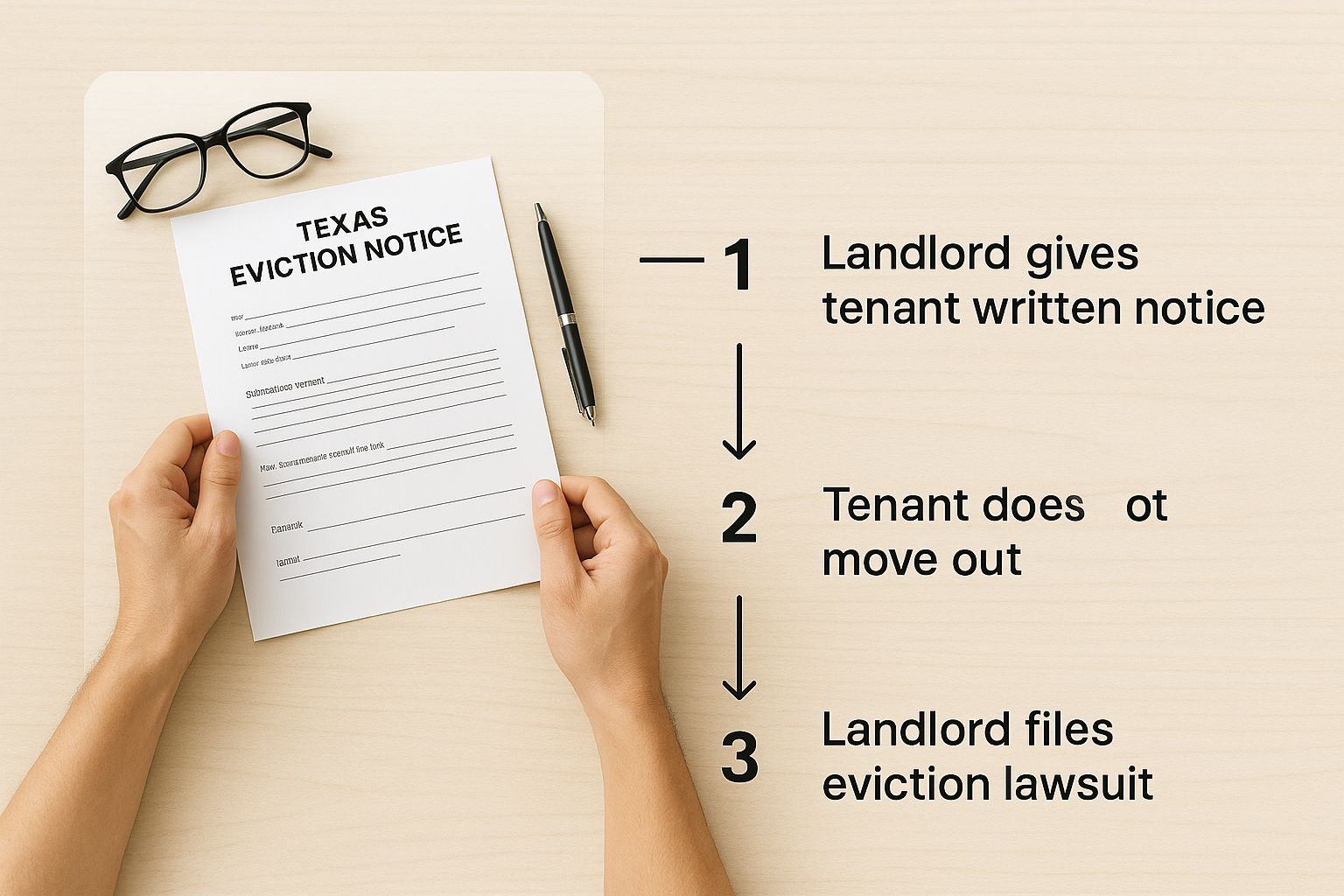
As you can see, every single detail counts—from the stated reason for eviction to the exact deadline they give you to act.
Understanding the Types of Notices
Landlords in Texas use different notices for different problems. The most common is the 3-Day Notice to Vacate for Non-Payment of Rent. This gives you three full days to either pay the rent owed or move out before the landlord can file a lawsuit.
However, your lease can change this timeframe, so always pull it out and read it carefully.
Other common notices include:
- Notice for Lease Violations: This is for breaking a rule in the lease, like having an unauthorized pet or making excessive noise. The notice period for these violations often depends on what your lease says.
- Notice for Holding Over: If you stay past your lease's end date without signing a new one, your landlord can give you a notice to vacate, starting the eviction process.
What the Texas Property Code Says About Eviction Notices
A notice isn't legally binding just because your landlord wrote it. For it to be valid, Texas Property Code Section 24.005 says it has to meet some very specific requirements.
First, it absolutely must be in writing. A verbal warning or a text message telling you to leave doesn't count as legal notice.
Second, it has to be delivered correctly. The law allows for:
- Handing it directly to you or someone over 16 at the property.
- Posting it on the inside of your main entry door.
- Sending it by certified or registered mail.
If your landlord just tapes it to the outside of your door or shoves it in your mailbox, that notice is invalid. Any eviction lawsuit they file based on it could be challenged and dismissed. Knowing the ins and outs of the full legal process is critical. You can get a more detailed breakdown in our guide on the eviction process in Texas.
A landlord can't just hand you a piece of paper and expect it to hold up in court. The table below breaks down exactly what the law requires for a Notice to Vacate to be considered valid in Texas.
What Makes a Texas Notice to Vacate Valid
| Required Element | What It Means for You | Why It's Important |
|---|---|---|
| Must be in writing | A verbal warning or text message isn't a legal notice. | This creates a clear paper trail and prevents disputes over what was said. |
| Clear demand to vacate | The notice must state that you need to move out. | Ambiguous language can make the notice invalid. |
| Reason for eviction | It must specify why you're being evicted (e.g., non-payment of rent, lease violation). | You have a right to know the specific accusation against you so you can defend yourself. |
| Specific timeframe | It must state the deadline to move out (e.g., 3 days). | This gives you a clear timeline to either fix the issue, move, or prepare for court. |
| Proper delivery | It must be delivered according to legal methods (in-person, posted inside, certified mail). | Improper delivery is a common and effective defense that can get an eviction case dismissed. |
Scrutinizing the notice for these details is your first line of defense. A single mistake by the landlord could be the key to stopping the eviction in its tracks.
A common mistake we see landlords make is miscalculating the notice period. A 3-day notice means three full 24-hour periods after the notice is delivered. If a landlord gets impatient and files the lawsuit even an hour too early, their case can be thrown out.
With eviction filings on the rise, knowing your rights is more important than ever. For example, Travis County saw a record 13,210 eviction filings in 2024, and the numbers for 2025 are expected to be even higher. This trend highlights just how landlord-friendly the Texas eviction system can be and why tenants absolutely must be on their guard.
Your First 72 Hours: Responding to the Notice
The moment that notice to vacate is in your hands, a clock starts ticking. That initial three-day window (or whatever timeframe is in your lease) is the most critical period you have. How you handle these first 72 hours will set the tone for your entire defense and is the first step in learning how to stop eviction in Texas.
Feeling a wave of panic is completely normal, but you have to replace it with a strategy. This isn't just about reading a notice; it's about immediately building the foundation of your legal case. Your landlord is getting ready to file a lawsuit, and you need to prepare to defend your home with that same level of seriousness.

Step 1: Document Everything—Right Now
From this point on, consider every single interaction with your landlord a piece of potential evidence. Don't ever rely on your memory or a verbal promise. A solid, organized paper trail is often the most powerful tool a tenant rights lawyer has in court.
Get a dedicated folder—either physical or digital—and make it your eviction file. Here's what needs to go in it immediately:
- The Notice Itself: Write down the exact date and time you got it. How did it arrive? Was it handed to you, taped to your door, or mailed? Those details are more important than you think.
- All Written Communication: Save every single email and text message. If you have a phone call or face-to-face talk, send a short, polite follow-up email confirming what you discussed. "Hi [Landlord], just wanted to confirm our call today where we discussed…"
- Proof of Rent Payments: Dig up bank statements, copies of canceled checks, or any rent receipts. This is non-negotiable if the eviction is over non-payment.
- Maintenance Requests: Find every repair or maintenance request you've ever submitted. This can build a timeline of unresolved problems that might be a key part of your defense.
This isn't just busywork. Meticulous records can punch holes in the landlord's story and give you the leverage you need.
Step 2: Can You "Cure" the Violation?
Many eviction notices give you a chance to "cure," or fix, the issue. If it's about unpaid rent, paying the full amount within that notice period can often stop the eviction process in its tracks, long before a lawsuit is filed.
Under Texas Property Code Section 24.005, you have this right unless your lease has a clause that specifically waives it. Some do, so pull out your lease and read that section carefully.
Let’s look at a real-world scenario: Say you get a 3-day notice for a noise complaint you feel is unfair. Instead of ignoring it, you draft a written response right away. You might explain that you had family over for a one-time birthday celebration and even get a brief note from a neighbor saying it was a rare occurrence. This kind of proactive communication shows you're a responsible tenant and can de-escalate the situation entirely.
If you do cure the violation by paying rent, always get a receipt. More importantly, get something in writing from your landlord confirming that your payment is accepted and that they are dropping the eviction. Never assume paying is enough—a landlord could take your money and still file. An experienced eviction attorney can make sure your payment is properly documented to truly protect you.
Step 3: Don't Ignore the Deadlines
The biggest mistake a tenant can make is to ignore the notice. That deadline isn't a suggestion; it's a legal countdown. As soon as it expires, your landlord is legally free to walk into the local Justice of the Peace court and file an eviction lawsuit against you.
Letting those first few days slip by puts you on the back foot and dramatically limits your options. Use this time wisely. Get your documents in order, figure out exactly why you're being evicted, and get legal advice. The fastest way to protect your home is to know your rights and act on them immediately.
Navigating the Justice Court Eviction Lawsuit
https://www.youtube.com/embed/J2DxbKzoTc4
If the notice period has run out and you're still in your home, your landlord can file an eviction lawsuit, which in Texas is formally called a Forcible Detainer suit.
This moves the fight from a piece of paper on your door to the formal court system. Specifically, it goes to the Justice of the Peace (JP) court in your precinct. Receiving a court summons—called a citation—is a serious step, but it’s a structured process with rules you can use to defend yourself.
The citation lays it all out: who is suing you, why, and the date and location of your hearing. The absolute worst thing you can do right now is ignore it. If you don't show up, the judge will almost certainly issue a default judgment, which is an automatic win for your landlord.
The Importance of Filing a Written Answer
Once you've been served with the citation, your first move is to file a written Answer with the court. An Answer is a straightforward document telling the court you intend to fight the eviction and show up to defend yourself.
You don't need to outline your entire legal strategy here; you just need to get it filed before your court date.
Filing an Answer is critical. It officially signals to the court that the eviction is contested. It slams the brakes on your landlord’s attempt to get a quick, easy default judgment and guarantees you a chance to stand before the judge and tell your side of the story. Most JP courts have simple, fill-in-the-blank Answer forms you can grab at the courthouse or find on their website.
Responding to the lawsuit is your first active step in the legal battle. Think of it like raising your hand in a classroom to say, "I'm here, and I have something to say." Without it, the judge may assume you agree with everything the landlord has alleged.
Preparing for Your Hearing in Justice Court
Justice Courts are meant to be a bit less formal than higher courts, but don't mistake that for being casual. You absolutely need to come prepared. The judge's decision hinges entirely on the evidence presented at the hearing. Your mission is to organize your facts, evidence, and arguments so you can present them clearly.
Here’s a practical checklist for getting ready:
- Gather Your Evidence: Round up every document you have. This means your lease, every rent receipt, any photos or videos showing the property's condition, and all your communications (texts, emails) with your landlord.
- Organize Your Arguments: Don't just walk in and wing it. Write down the key points you need to make. Stick to the facts. Did the landlord serve the notice to vacate correctly? Can you prove you paid rent? Do you have evidence they ignored your repair requests?
- Observe the Courtroom: If you can, get to the court early. You’ll probably see other eviction cases on the docket. Watching how the judge manages the courtroom gives you a feel for the process. When it's your turn, both you and your landlord (or their lawyer) will get a chance to present your cases.
What to Expect From the Judge and Landlord
The judge isn't there to pick sides; their role is to apply the Texas Property Code to the facts of your case. They'll listen to the landlord first, who will explain why they have the right to evict you. After that, it's your turn to respond and lay out your defense.
This is where having a Texas landlord tenant lawyer in your corner can be a game-changer. A seasoned attorney knows the local JP judges and what arguments resonate with them. They can navigate procedural rules and make objections that someone representing themselves might miss entirely.
The legal landscape is always in motion. Tenant advocates are constantly fighting new bills designed to make evictions faster—and not in a good way for tenants. For instance, recent legislative efforts were made to push through bills that could have harmed renters across a state where over 164,000 evictions were filed in recent years. You can read more about these efforts to protect Texas renters on nlihc.org. A good eviction attorney is on top of these changes and uses that knowledge to build the strongest defense possible for you.
Building Your Legal Defense Against Eviction
Once you’re in the Justice Court system, the game changes. It’s no longer just about paperwork and deadlines; it's about the substance of your case. This is your chance to stand before a judge and explain exactly why the eviction isn't legally justified.
Knowing how to stop eviction in Texas often boils down to one thing: raising a valid legal defense. The Texas Property Code isn't just a rulebook for landlords—it gives tenants powerful defenses that can completely shut down an eviction attempt.
These aren't loopholes. They are your legal rights, designed to keep the landlord-tenant relationship fair. Let's dig into some of the most effective defenses used to protect tenant rights.

Improper Notice to Vacate
We can't stress this enough: the notice to vacate is the foundation of the entire eviction lawsuit. If the landlord gets this step wrong, their case crumbles. They can't just fix it—they have to start the whole process over from square one.
This defense hones in on technical, but absolutely critical, mistakes. Common issues include:
- Jumping the Gun: The landlord filed the lawsuit before the 3-day notice period was actually over.
- Wrong Delivery Method: They just slapped the notice on the outside of the door or sent it in a way the law doesn't allow.
- Vague or Missing Details: The notice didn't clearly say why you were being evicted or state the exact amount of rent they claimed you owed.
A judge won't just brush these procedural requirements aside. If you can prove the notice was flawed, it's often the fastest path to winning an eviction suit.
Retaliation by the Landlord
Texas law has your back if a landlord tries to evict you as payback for exercising your legal rights. It's called retaliation, and it’s illegal.
Under Texas Property Code Section 92.331, a landlord is forbidden from retaliating against you for taking legally protected actions. This includes things like formally requesting essential repairs, calling code enforcement on a violation, or organizing with other tenants to address a building-wide issue.
Here’s the powerful part: if your landlord hits you with an eviction notice shortly after you’ve taken one of these actions, the law automatically presumes their motive is retaliation. The burden of proof then flips to them. They have to convince the judge they had a legitimate, non-retaliatory reason for the eviction.
Here’s a real-world example: Imagine you sent a certified letter to your landlord demanding they fix a faulty heater in the middle of winter. A week later, you get a notice to vacate, claiming you violated a minor lease rule they’ve never cared about before. That timing is no coincidence, and a judge will see it that way.
Breach of the Implied Warranty of Habitability
In every residential lease in Texas, there's an unspoken guarantee from your landlord: the property is safe, secure, and fit for human habitation. This is called the implied warranty of habitability.
If your rental has a condition that seriously threatens your physical health and safety, your landlord has broken that promise. This covers serious problems, such as:
- No hot water or a non-working HVAC system
- Serious mold growth
- A leaking roof or other major structural defects
- Uncontrolled pest infestations (roaches, rodents, etc.)
To use this as a defense, you must show the court you gave the landlord proper written notice of the problem and a reasonable amount of time to fix it. If they ignored you or failed to make the repairs, you have a strong argument that their failure to provide a habitable home excuses your obligation to pay rent. This is a complex defense, and knowing the full scope of your tenant rights in Texas for eviction is critical. You can learn more in our detailed guide on tenant rights during an eviction in Texas.
Discrimination
It is flat-out illegal for a landlord to evict you based on your race, religion, sex, national origin, disability, or because you have children (familial status). These protections are guaranteed by both the federal Fair Housing Act and the Texas Fair Housing Act.
Proving discrimination can be tricky because landlords rarely admit their illegal motives. But a strong case can be built on a pattern of behavior. For instance, if you can show the landlord consistently evicts tenants of a certain race for minor issues while letting other tenants slide for the same behavior, that's powerful evidence. An experienced eviction attorney knows how to uncover this evidence and build a compelling discrimination defense to protect your rights.
Finding Alternatives to a Court Battle
Sometimes, the best way to figure out how to stop eviction in Texas is to avoid the courtroom entirely.
A formal eviction lawsuit creates a public record that can haunt you for years, making it incredibly difficult to find a decent place to rent down the road. Finding a solution before it gets to that point is always the smarter play for your housing stability and your rental history.
An eviction battle is a costly, stressful nightmare for everyone involved—including your landlord. Because of this, many landlords are surprisingly open to practical alternatives that save them the headache and legal fees. If you approach it the right way, you can find a win-win outcome where you get the time you need and your landlord avoids a drawn-out court process.
Negotiation and Mediation
Never underestimate the power of direct communication. Reaching out to your landlord to negotiate a solution should be your first move. The goal here isn't to win an argument; it's to find a middle ground that you can both live with.
This could mean proposing a payment plan to get caught up on rent. But you have to be realistic and specific. Don't just promise you'll pay—offer a clear, written schedule of payments you know you can make. And whatever you agree on, get it in writing and signed by both of you. A verbal agreement is almost worthless if things go south later.
If talking directly isn't getting you anywhere, mediation is an excellent next step. A neutral third party helps guide the conversation between you and your landlord, focusing on finding a practical compromise instead of declaring a winner and a loser. It's far less formal than court, and many Texas Justice Courts can refer you to low-cost or even free mediation services.
Exploring a "Cash for Keys" Agreement
In some situations, moving out is the most realistic path forward. If that's your reality, a "cash for keys" agreement can be a lifesaver.
Here's how it works: you agree to voluntarily pack up and leave by a specific date, and in exchange, your landlord gives you a cash payment.
Why would they do this? Because it saves them the time and expense of a formal eviction. For you, it provides some much-needed cash for moving expenses and—most importantly—keeps an eviction judgment off your permanent record.
Key Takeaway: A "cash for keys" deal is a formal contract, not a handshake agreement. It needs to clearly state the move-out date, the exact payment amount, and that the landlord agrees not to file an eviction lawsuit as long as you hold up your end of the bargain. An experienced eviction attorney can help you draft or review the agreement to make sure you're protected.
Accessing Texas Eviction Prevention and Rental Assistance Programs
You are not in this fight alone. Dozens of state and local programs across Texas are set up specifically to help tenants who are on the brink of eviction. These programs can provide the critical financial lifeline you need to get back on your feet.
Here’s where to start looking for help:
- Texas Rent Relief Program: While the big federal program has wound down, many city and county-level programs still have funds for rental and utility assistance. Check the official websites for your local city and county for the most up-to-date information.
- Non-Profit Organizations: Groups like the Salvation Army, Catholic Charities, and local community action agencies often have emergency funds set aside to help tenants stay in their homes.
- Legal Aid Societies: Organizations like Legal Aid of NorthWest Texas or Texas RioGrande Legal Aid offer free legal services to eligible low-income tenants. This kind of expert help can be invaluable.
To help you weigh your options, here’s a quick comparison of the alternatives to a full-blown court fight.
Comparing Your Eviction Alternatives
| Alternative | Best For… | Potential Outcome |
|---|---|---|
| Negotiation | You have a good relationship with your landlord and a clear plan to catch up on rent. | A new payment agreement is signed, and the eviction is stopped. |
| Mediation | Direct communication has failed, but both sides are willing to find a compromise. | A neutral third party helps you reach a legally binding settlement. |
| Cash for Keys | You've decided moving out is the best option but need financial help to do it. | You move out on an agreed date, receive cash, and avoid an eviction record. |
| Rental Assistance | You need temporary financial help to cover rent and stabilize your situation. | A program pays some or all of your back rent, resolving the issue. |
Each path has its own pros and cons, but they all share one critical benefit: keeping an eviction off your record.
These resources can make all the difference, but you have to act fast—the funds are almost always limited. If you feel your landlord is treating you unfairly or violating your rights during this process, you may need to escalate the matter. You can learn more by reading our guide on how to file a complaint against your landlord.
The state is also starting to recognize the importance of these proactive measures. Texas is now incentivizing Eviction Prevention Plans within its Housing Tax Credit program, which connect at-risk families with case managers to create six-month payment agreements. You can learn more about these eviction prevention plans on texashousers.org.
What Happens After the Court's Decision
The judge’s ruling is a huge moment, but it’s rarely the end of the story.
Whether you won or lost, what you do in the hours and days after the judgment is critical. The clock starts ticking immediately, and understanding the timelines and legal steps involved can make all the difference.
If the judge rules in your favor, it's a massive relief. It means the landlord failed to prove their case, and you have the legal right to stay. But don't just take a verbal win and walk away.
You need to get a copy of the judge's written order—the judgment. This document is your proof that the eviction was stopped. It’s your shield against any future claims from the landlord about the same issue.
If the Landlord Wins the Case
Hearing the judge rule for your landlord can feel devastating. But you still have rights, and more importantly, you still have a little time.
The landlord can't just change the locks or throw your stuff on the curb. That's illegal.
Instead, the judgment kicks off a new, very strict timeline. Under the Texas Property Code, you have exactly five days to either move out or file an appeal. This five-day window is non-negotiable and includes weekends and holidays.
If you believe the judge got the law or the facts wrong, appealing is your only option to fight the decision. An appeal moves your case from the Justice Court up to the County Court for a completely new trial. It’s a complex legal maneuver that requires filing specific documents and often posting a bond to cover rent. This isn't a DIY project—you absolutely need an experienced eviction attorney to navigate this process correctly.
Understanding the Writ of Possession
What happens if you don't move and you don't appeal within those five days?
The landlord can take the final legal step to have you physically removed. They’ll go back to the court and request a Writ of Possession.
A Writ of Possession isn't just another notice. It’s a direct order from the court to a law enforcement officer—a constable or sheriff—to remove you and your belongings from the property. It is the final enforcement tool in an eviction case.
Once the writ is issued, the constable will post a 24-hour warning notice on your door. This notice tells you the exact date and time they will be back to execute the writ.
That 24-hour period is your last chance to move out on your own terms. If you're still on the property when the officer returns, they have the full legal authority to physically remove you and everything you own.
The entire process is designed to move fast. Knowing these timelines is crucial for figuring out how much time you truly have to find a new place and organize a move. Losing in court is tough, but being prepared for what comes next gives you back a small measure of control during a very difficult time.
Your Top Questions About Texas Eviction Law, Answered
When you’re facing an eviction, you don't have time for dense legal jargon. You have urgent, practical questions, and you need straight answers—fast.
We understand. We hear these same concerns from Texas tenants every single day. Below, we’ve tackled the most common questions to give you the clarity you need to protect your rights.
Can My Landlord Just Kick Me Out or Change the Locks?
Absolutely not. This is one of the most critical things to understand.
A landlord cannot legally lock you out, shut off your utilities, or throw your belongings on the curb to get rid of you. In Texas, this is called an illegal "self-help" eviction, and it’s a direct violation of the Texas Property Code.
The only legal way a landlord can force you to leave is by filing an eviction lawsuit, winning in court, and getting a formal judgment signed by a judge. If your landlord tries to take matters into their own hands, you have the right to sue them for damages.
How Fast Does the Eviction Process Actually Happen in Texas?
It moves quicker than most people realize. While every case has its own timeline, a standard, uncontested eviction in Texas usually wraps up in about three to four weeks.
Here’s a rough breakdown of how that time flies by:
- Notice to Vacate: Your landlord must give you at least a 3-day written notice before they can even file in court.
- Court Hearing: Once filed, the hearing is usually scheduled for just 8 to 10 days later.
- Appeal Window: If the judge rules against you, you only have 5 days to file an appeal or move out.
- Writ of Possession: If you don't appeal or leave, the landlord gets a "Writ of Possession." This gives the constable the authority to post a final 24-hour warning on your door before physically removing you.
This process is designed to be fast, which is why you can't afford to wait. Every single day counts.
If I Pay the Rent, Does the Eviction Stop?
This is a tricky one, and the answer is: not always.
Once an eviction lawsuit is officially filed with the Justice Court, simply paying the rent you owe doesn't automatically stop the process. It's often up to the judge and, more importantly, whether your landlord is willing to accept the money and drop the case.
A landlord can legally refuse your rent payment after filing the lawsuit and still move forward with the eviction.
This is a common trap. A landlord might take your money and proceed with the case anyway, arguing the payment only covered back rent and not their court costs or attorney fees.
If you do pay, never do it without getting a signed, written agreement from the landlord. The document must state that they accept your payment as full settlement and that they will formally dismiss the eviction lawsuit. Without that piece of paper, you have almost no protection. An experienced eviction attorney can make sure any payment you make actually ends the case for good.
If you need help with an eviction, lease issue, or rental dispute, contact The Law Office of Bryan Fagan, PLLC for a free consultation today.