
Getting a notice to vacate in Texas can feel like the ground just shifted under you. One day you're trying to figure out rent, work, kids, or a move. The next day you're staring at a deadline and wondering how fast a landlord can force you out.
The first thing to know is this: an eviction in Texas is a legal process, not a same-day removal. That matters because the process creates windows of opportunity. If you use those windows well, you may be able to buy time, raise defenses, negotiate a better outcome, or stay in the property while a court reviews the case.
For how to delay an eviction in Texas legally, the answer usually isn't one magic move. It's a series of choices made at the right time. Some choices help. Some waste time. Some can make things worse if you rely on outdated advice.
Facing an Eviction Notice in Texas
A common situation looks like this. A tenant misses rent, gets a written notice on the door, and immediately starts hearing conflicting advice from friends, online forums, and older articles. One person says paying something should stop the case. Another says the landlord can have the sheriff there in a day or two. Neither answer gives you a usable plan.
Texas law gives landlords a path to remove a tenant, but it also requires steps and timing. Those rules matter to both sides. A landlord has to follow them. A tenant can use them.
The first goal is time with purpose
Legal delay only helps if you use it to do something concrete. That usually means one or more of these:
- Fix the immediate problem by seeking rental help or proposing a payment plan
- Review the paperwork for notice, service, and timing problems
- Prepare a defense if the landlord didn't follow the lease or the Texas Property Code
- Protect your record by negotiating a move-out agreement instead of taking an eviction judgment
- File an appeal on time if the court rules against you
Older internet advice can hurt you. A strategy that worked during pandemic-era programs may not exist now.
That's especially important because many people still rely on references to the Texas Eviction Diversion Program. Current Texas court guidance says that the Texas Eviction Diversion Program is no longer accepting applications, so tenants need current, narrower strategies instead of assuming a broad automatic delay is still available, as explained by Texas court eviction information.
What tenants and landlords both need to hear
For tenants, the key point is that panic leads to bad decisions. For landlords, the key point is that rushing around the rules can create delay too. A flawed notice, bad service, or a poorly documented claim can slow down a case that might otherwise have moved cleanly.
The Texas Property Code and related court rules don't turn every eviction into a long fight. But they do create structure. That structure is where a Texas landlord tenant lawyer or eviction attorney can often identify opportunities.
The Legal Clock Understanding the Eviction Timeline
If you want to slow an eviction legally, you need to understand where the clock starts and what each stage allows. Texas doesn't treat eviction like a single event. It happens in stages.
A clear timeline helps you separate rumor from reality.
The standard timeline
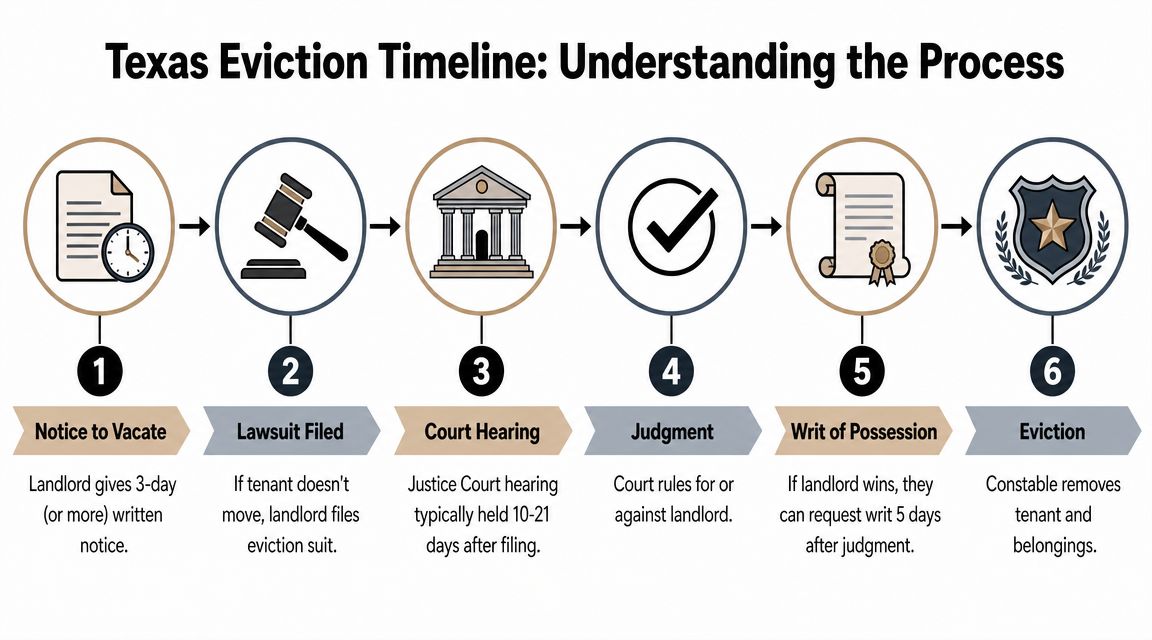
Under Texas law, a landlord generally must give at least a 3-day notice to vacate before filing an eviction suit unless the lease provides a different period, the hearing must be set no sooner than 10 days and no later than 21 days after filing, and if the landlord wins, a writ of possession generally becomes available 6 days after final judgment, followed by at least 24 hours' notice before execution, according to the Texas State Law Library eviction process guide.
That timeline creates several windows where action matters.
| Stage | What it means for you |
|---|---|
| Notice to vacate | Time to review the notice, gather your lease, and try to resolve the issue before suit is filed |
| Filing period | Time to watch for service and prepare for court |
| Hearing setting | Time to organize documents, witnesses, photos, payment records, and defenses |
| Post-judgment gap | Time to decide whether to appeal or negotiate an agreed move-out |
| Writ notice period | Final emergency window to act before physical removal |
Why the timeline matters strategically
A lot of tenants assume the worst part is the notice. Often, the most important part is what happens after the case gets filed. That's when people either start acting deliberately or fall behind.
If you need a deeper look at the pace of these cases, this guide on how long the eviction process lasts in Texas is a useful companion.
The video below gives a practical visual overview of the process.
What the legal clock does and does not do
The process gives you time. It does not give you unlimited time.
- It does help if you're using the gap to negotiate, apply for help, or prepare your case.
- It doesn't help if you ignore court papers and assume the case will somehow disappear.
- It can help both sides because a structured timeline often leads to settlement before a forced lockout.
Practical rule: Treat every date in an eviction like a real deadline, not an estimate.
That mindset alone changes outcomes. A tenant who starts acting on day one has more options than a tenant who waits until the constable is posting a writ.
Your Initial Response Reviewing Notices and Opening Communication
The initial hours after receiving a notice are more critical than generally recognized. Many avoidable mistakes happen during this time. Tenants either throw the notice in a drawer, or they send angry messages that make settlement harder.
A better response is calm and methodical.

Review the notice like a lawyer would
Start with the basics. Look at the names, address, date, lease terms, and how the notice was delivered. Then compare the notice to your lease and your payment history.
Focus on questions like these:
- Was the notice period correct under the lease or default Texas rules?
- Was the property identified correctly so there's no confusion about the unit?
- Was the reason for the notice clear enough for you to understand the claim?
- Was delivery handled properly based on the lease and the facts?
A defect doesn't automatically win the case, but it can offer grounds for negotiation. In practice, many legal delays come from forcing the landlord to start over with correct paperwork.
Should you pay after getting the notice
Tenants often receive bad advice on this matter. Paying past-due rent after receiving a notice to vacate does not automatically stop an eviction in Texas, and the landlord can still proceed with the case, as explained in this discussion of the Texas eviction process and payment issues.
That doesn't mean payment never helps. It means payment is a negotiation tool, not a guaranteed legal cure.
Consider the difference:
| Situation | Likely effect |
|---|---|
| You send partial payment without a written agreement | The landlord may keep pursuing eviction |
| You offer a full catch-up plan in writing | The landlord may agree to delay or dismiss |
| You document proof of payment disputes | You may strengthen your court position |
Open communication carefully
A smart message to a landlord or manager is short, factual, and solution-focused. Ask whether they'll accept a written payment plan, a delayed move-out, or dismissal if funds are paid by a specific date. Don't promise money you don't have. Don't admit facts you're not sure about.
Try this approach:
- Keep it written: Email or text creates a record.
- Ask for clear terms: If they agree, get the amount, date, and dismissal terms in writing.
- Stay professional: Judges often see the messages later.
If you can turn a confrontation into a written agreement, you've often created more protection than a rushed verbal promise ever will.
This early stage is also where tenant rights under the Texas Property Code start to matter in practical ways. If the landlord has ignored serious repair issues, retaliated, or misapplied payments, save every document now. Those issues may become defenses later.
Asserting Your Rights in Court With Tenant Defenses
When the case reaches court, many tenants think their only options are to pay, move, or show up and hope for sympathy. That's not how good defense work happens. A tenant needs to identify legal issues, organize proof, and present a coherent story that fits the law.
In Justice Court, judges often move quickly. Clarity matters.
What to bring and how to think about your defense
Bring your lease, payment records, text messages, emails, repair requests, photos, notices, and any witness who directly knows the facts. Organize them in the order the story happened. If you have screenshots, print them if possible.
Also think in terms of legal theories, not just frustration. "My landlord has been unfair" is not as strong as "the notice was defective" or "the eviction is retaliatory after written repair complaints."
This overview of Texas tenant defenses to eviction is a useful starting point for the most common arguments.
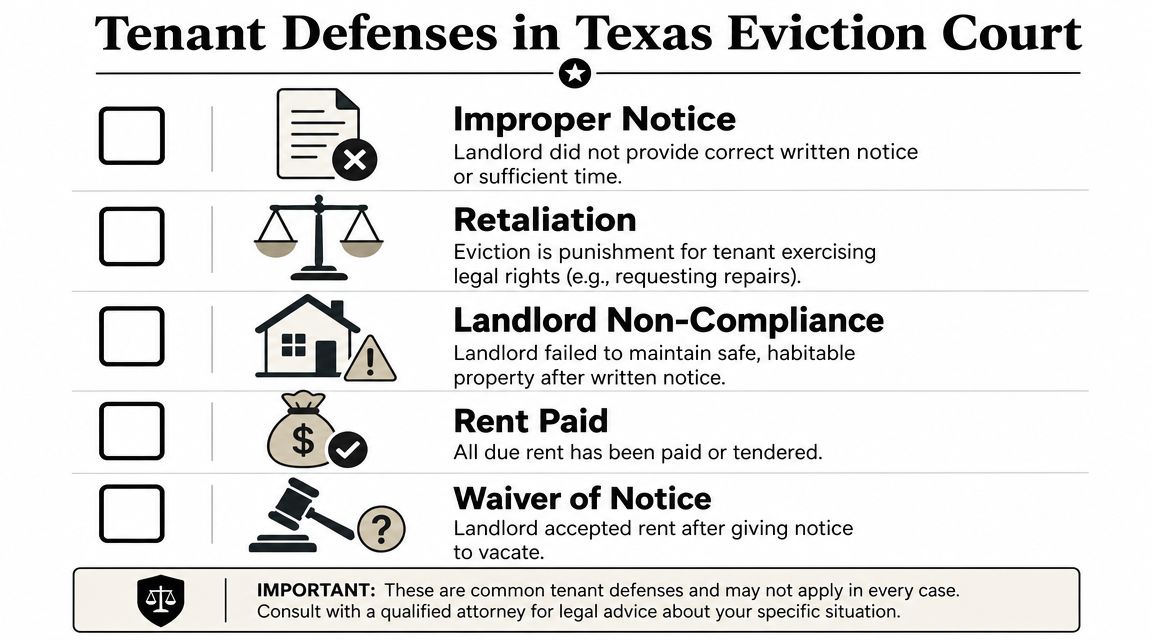
Defenses that can delay or defeat the case
Some defenses attack the landlord's procedure. Others attack the reason for the eviction itself.
Improper notice
If the landlord didn't give the required notice or served a flawed notice, the court may deny the eviction or force the landlord to start again.Service problems
If court papers were not served correctly, that can affect how the case proceeds and whether a continuance is appropriate.Retaliation
A tenant who requested repairs or exercised protected rights may have a defense if the eviction is punishment for doing so.Habitability and landlord noncompliance
In some cases, severe repair failures and documented written complaints matter. These arguments work best when tied to records, dates, and photographs.Payment and waiver issues
If the landlord accepted rent in a way that changed the situation, that may affect the case depending on the facts and lease language.
A courtroom example
Suppose a tenant reported a serious plumbing issue in writing, followed up repeatedly, and then received an eviction notice soon after escalating the complaint. That doesn't automatically prove retaliation. But if the timing, messages, and landlord conduct line up, it can become a serious defense.
Another example is simpler. A landlord serves a notice that doesn't match the lease requirements, files immediately, and expects a fast default. A tenant who shows up with the lease, the notice, and a clear timeline may be able to stop that hearing from turning into a quick judgment.
Judges don't need a dramatic speech. They need documents, dates, and a defense that fits the rules.
Filing an answer and asking for time
Procedurally, tenants should take the case seriously from the moment they're served. In many cases, filing a written answer helps preserve issues and shows the court you're participating rather than ignoring the case. If you need more time for a witness, records, or language access, a request for continuance may be appropriate, but you need a real reason.
The strongest in-court delay is never "I need more time" by itself. The stronger position is "I need more time because I was just served, I have repair records to obtain, or the landlord's notice is disputed and I need a fair chance to present that evidence."
That approach is practical, credible, and far more likely to get traction with an eviction attorney or the court.
Filing Motions and Appeals to Extend Time
If the judgment goes against you, the case may still not be over. In Texas, the most powerful legal delay usually comes after judgment, but only if you move fast and follow the rules exactly.
Many tenants lose time they could have preserved. Not because they had no rights, but because they missed a deadline or misunderstood what an appeal requires.
Motions can help before or after hearing
A motion for continuance asks the court to postpone a hearing. Sometimes that's the right move if service was late, a witness is unavailable, or key records aren't ready. It isn't automatic, and weak requests often fail.
Other motions may be available depending on the posture of the case. The basic point is that motions work best when they are tied to a concrete legal or factual reason, not just fear of losing.
The appeal window is short
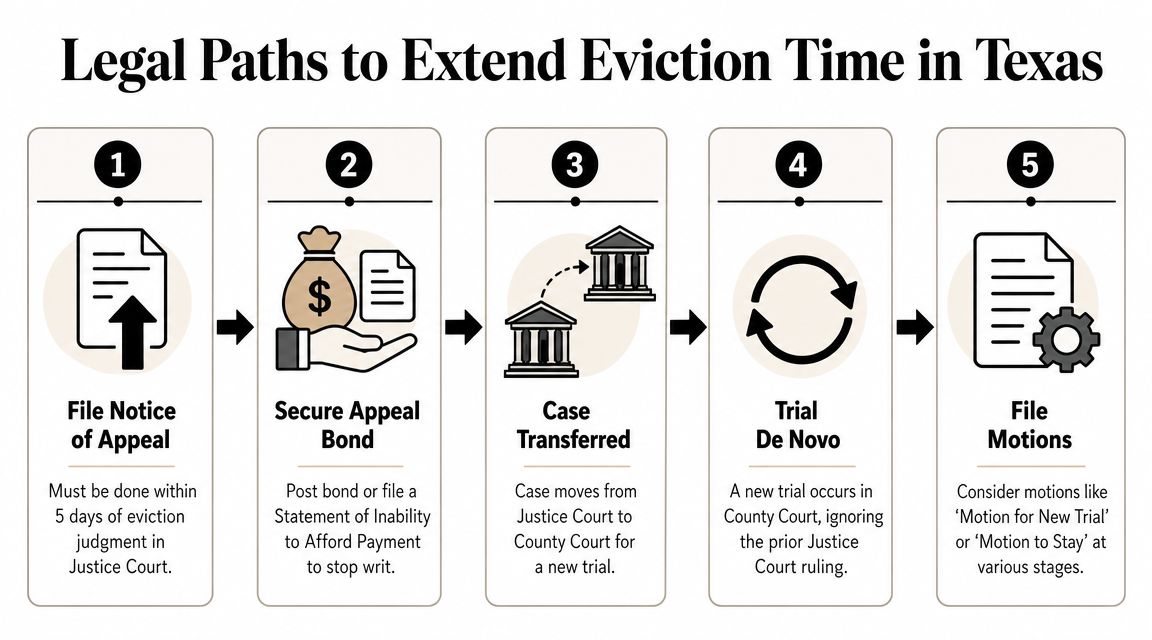
Texas tenants typically have only 5 calendar days to appeal an eviction judgment. To remain in the home during the appeal of a nonpayment case, the tenant must usually pay one month's rent into the court registry within 5 days of filing the appeal and continue making payments each month. Missing a payment can allow the landlord to get a writ of possession, according to Texas Law Help's eviction appeal guidance.
That is the point many people miss. Filing the appeal is only part of the job. Staying in possession usually requires ongoing compliance.
For a fuller discussion, see this guide on how to appeal an eviction in Texas.
What an appeal actually does
An appeal isn't just a request for mercy. It moves the case forward for a new review under the applicable procedures. Used correctly, it can create meaningful time. Used carelessly, it can collapse almost immediately.
Here is the practical workflow:
File within the deadline
Count carefully. Waiting to "see what happens" is usually fatal.Serve the other side properly
Don't assume filing alone solves the problem.Calendar every rent-registry deadline
Missing a registry payment can undo the protection you were trying to secure.Keep proof of every filing and payment
Save stamped copies, receipts, screenshots, and confirmations.
A hard truth about appeals
Appeals are powerful, but they aren't casual paperwork. They are rule-bound. If you're trying to learn how to delay an eviction in Texas legally, this is one of the clearest examples of a strategy that works only when done precisely.
An appeal can buy time. A late appeal buys nothing.
In some nonpayment appeals, current guidance also notes that an indigent appeal still may require ongoing rent payments into the registry, and in certain situations the minimum can be significant unless subsidized housing rules change the analysis. That's why tenants should treat the financial side of an appeal as seriously as the legal side.
Considering Settlement Bankruptcy or Emergency Relief
Not every case should be fought to the bitter end. Sometimes the strongest strategy is to change the goal. Instead of trying to "win" the eviction outright, you try to protect your record, control the move-out date, or create enough breathing room to stabilize your finances.
That is where settlement, bankruptcy, and emergency court relief come into the conversation.
Settlement can create real delay without more court
Even though the old Texas Eviction Diversion Program is no longer active, its central idea still matters. The program allowed for a 60-day delay when both sides participated, which showed the power of mutual agreement. Today, tenants can still use that same concept to negotiate a delayed move-out or dismissal in exchange for rental assistance or a payment plan, as explained by Texas Tenant Advisor's eviction guidance.
A negotiated agreement can do things a judge may not do on the fly:
- Set a move-out date that gives you time to secure housing
- Avoid a final eviction judgment in some cases
- Convert conflict into clear terms with payment dates and dismissal language
- Reduce surprises for both landlord and tenant
A landlord may agree because certainty has value. A tenant may agree because control has value.
Bankruptcy and emergency relief
Bankruptcy is not an all-purpose eviction cure, but in the right case it can interrupt collection pressure and create short-term protection through the automatic stay. Because bankruptcy law is federal and highly technical, it usually belongs in a coordinated plan with both a bankruptcy lawyer and a Texas landlord tenant lawyer.
If you want a plain-language comparison from another jurisdiction, this article on bankruptcy and Georgia evictions helps illustrate how bankruptcy can affect possession cases and why timing matters.
Emergency relief in state court, such as a request for a temporary restraining order, is different. That tool is usually reserved for urgent, unlawful conduct, such as a lockout or other action that violates legal process. Courts don't grant that kind of relief lightly. You need facts, evidence, and a legal basis that justifies immediate intervention.
Settlement is often the most underrated legal delay tool because both sides keep more control than they would at a rushed hearing.
The Texas Property Code gives both landlords and tenants rights, but rights are only useful when matched with a realistic strategy. Sometimes that strategy is a defense. Sometimes it's an appeal. Sometimes it's a negotiated exit that prevents a worse outcome.
If you need help with an eviction, lease issue, or rental dispute, contact The Law Office of Bryan Fagan, PLLC for a free consultation today. A Texas eviction attorney can review your notice, explain your tenant rights under the Texas Property Code, and help you choose the best legal strategy before valuable time is lost.