
Dealing with a landlord dispute or eviction can be stressful — but understanding your rights under Texas law can make all the difference. Whether you’re a landlord navigating a difficult situation or a tenant facing uncertainty, knowing the eviction timeline is the first step toward regaining control.
So, how long is the eviction process in Texas? In a straightforward, uncontested case, you’re typically looking at three to four weeks from the day the first notice is delivered to the final lockout.
While that sounds fast, the path is loaded with legal requirements. One misstep by either party can derail the entire process. Knowing the timeline gives you power—the power to protect your rights, your home, or your property. This guide will provide clear, practical guidance on what to expect.
The Texas Eviction Timeline Explained
For tenants, an eviction notice can feel like your world is being pulled out from under you. For landlords, it’s a frustrating but sometimes necessary step to regain control of your property. No matter which side you’re on, understanding the process is crucial for protecting your rights.
This timeline gives you a bird's-eye view of the three main stages of a Texas eviction, from the initial notice all the way to a potential lockout.
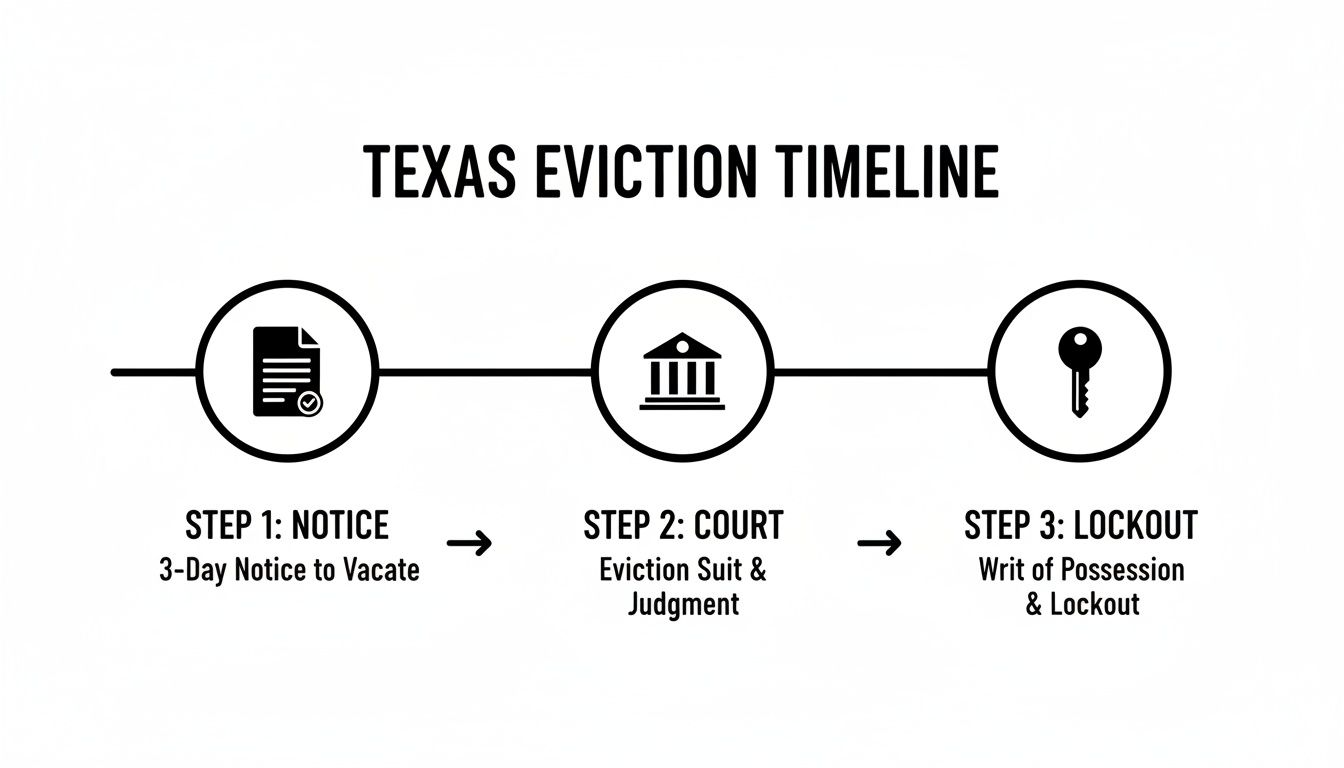
As you can see, the process moves from a formal warning to a courtroom and, if necessary, a final order to vacate. Each step is governed by strict deadlines set by the Texas Property Code.
What the Texas Property Code Says About Eviction Steps
The entire eviction process is dictated by the Texas Property Code. These aren't suggestions; they are firm rules designed to ensure the process is handled legally and fairly for both tenants and landlords.
Let's walk through a common scenario: a tenant has not paid their rent.
- The "Notice to Vacate": The process begins when the landlord delivers a formal legal document, typically giving the tenant 3 days to either pay the rent they owe or move out.
- Filing an Eviction Lawsuit: If the tenant does neither, the landlord’s next step is to file an eviction lawsuit, also known as a forcible detainer suit, in the local Justice of the Peace court.
- Court and Final Removal: A hearing is scheduled, a judge makes a ruling, and if the tenant still doesn't leave, a final court order called a Writ of Possession is executed by law enforcement.
The process is much faster than it used to be. Cases that once dragged on for months now often conclude in under a month. You can learn more about the Texas eviction process and what each step means for your rights.
Here’s a step-by-step breakdown of the major milestones:
- Notice to Vacate: This is the official starting point. The landlord delivers a written notice giving the tenant a specific timeframe (usually 3 days for non-payment) to fix the problem or leave the property.
- Filing the Lawsuit: If the tenant doesn't move out after the notice period expires, the landlord can file a formal eviction suit. A court date is usually set within 10 to 21 days of this filing.
- The Court’s Judgment: At the hearing, a judge listens to both sides and makes a decision. If the judge rules for the landlord, the tenant has 5 days to appeal.
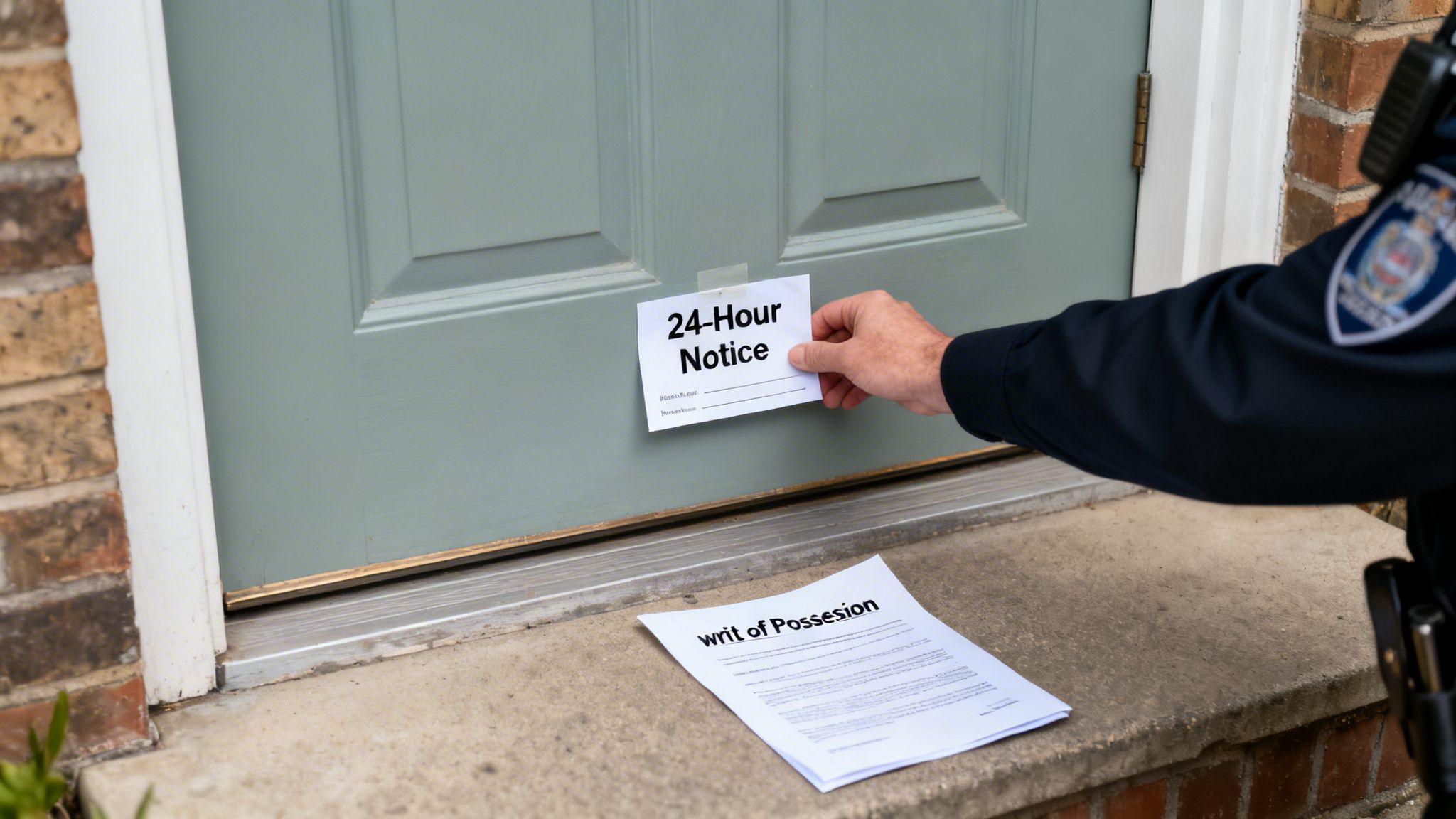
- The Writ of Possession: If there’s no appeal and the tenant still hasn't moved, the landlord can request this final court order. A constable will then post a 24-hour warning on the tenant's door before returning to physically remove them.
To help you visualize how these pieces fit together, we’ve created a table outlining the typical timeline for an uncontested eviction.
Estimated Timeline for an Uncontested Texas Eviction
| Eviction Step | Governing Law (Texas Property Code) | Typical Timeframe | Key Action |
|---|---|---|---|
| Notice to Vacate | Sec. 24.005 | 3 days (can be more or less if the lease specifies) | Landlord delivers a written notice demanding the tenant pay rent or move out. |
| File Eviction Suit | Sec. 24.0051 | Day 4 or later | Landlord files a "Forcible Detainer" petition with the Justice of the Peace Court. |
| Court Hearing | Rule 510.6 | 10 to 21 days after filing suit | Both landlord and tenant appear in court to present their case to the judge. |
| Judgment Appeal Window | Rule 510.9 | 5 days after judgment | The losing party has 5 days to file an appeal if they disagree with the judge's decision. |
| Writ of Possession | Sec. 24.0061 | At least 24 hours after posting | If no appeal is filed and the tenant remains, the landlord gets this final order for removal. |
| Tenant Removal | Sec. 24.0061 | 24+ hours after writ is posted | A constable or sheriff physically removes the tenant and their belongings. |
Remember, this timeline represents a best-case scenario. If a tenant contests the eviction, files an appeal, or if there are procedural errors, the process can take significantly longer.
The First Step: Your Notice to Vacate
Every legal eviction in Texas starts with one critical piece of paper: the Notice to Vacate.
A landlord can't just change the locks or file a lawsuit because they feel like it. They must give you a formal, written warning first. Think of it as the legal starting gun. If a landlord gets this first step wrong, their entire case can fall apart, and your rights as a tenant are protected.

Under Texas Property Code Section 24.005, this notice officially tells you there’s a problem and gives you a deadline to either fix it or move out. Any mistake here can invalidate the eviction, forcing the landlord to start over from scratch and causing massive delays.
Understanding the Notice Period
The most common reason for eviction is failing to pay rent. When that happens, Texas law gives a default notice period of 3 days. This means you have three full days from the moment you receive the notice to either pay what you owe or leave.
However, the lease you signed can specify a different timeframe, and the reason for the eviction is a huge factor.
- Real-World Scenario (Unpaid Rent): You are late on rent. Your landlord hands you a 3-day Notice to Vacate, giving you exactly 72 hours to pay up. If you pay in full within that time, the eviction process stops.
- Real-World Scenario (Lease Violation): Let's say your lease has a strict no-pets rule, but you adopted a dog. The landlord might give you a notice to "cure" the violation, often with a longer deadline like 30 days (if the lease specifies it), to rehome the pet or move out.
Key Takeaway: That notice period isn't a friendly suggestion—it's a hard legal deadline. A landlord must wait for the entire notice period to expire before they can file an eviction lawsuit.
How the Notice Must Be Delivered
A text message or a casual "you need to get out" from your landlord doesn't count. The Texas Property Code is extremely specific about how a Notice to Vacate must be delivered to be legally valid.
Here are the only acceptable delivery methods:
- In-Person Delivery: Handing the notice directly to you or anyone at the property who is 16 years or older.
- Mailing: Sending it via regular, registered, or certified mail, which creates a paper trail.
- Posting on the Door: Taping or otherwise securing the notice to the inside of your main entry door.
If you’ve received a notice, knowing what to do next is your first line of defense. Our guide on how to respond to an eviction notice walks you through the immediate steps you should take. If you are a landlord, you must follow these rules to the letter. Any slip-up is a potential defense a tenant can use in court, which could get your entire case thrown out.
Filing the Eviction Lawsuit in Court
The Notice to Vacate has expired, but the tenant is still there. Now what?
Many landlords are tempted to take matters into their own hands by changing the locks or shutting off utilities. Do not do this. Such "self-help" evictions are illegal in Texas. The next step isn’t at the front door—it’s at the courthouse. To move forward legally, you must file a lawsuit known as a Forcible Detainer.
This is the formal legal action you take in the local Justice of the Peace (JP) court for the precinct where your property is located. By filing, you are officially asking a judge to order the tenant to leave.

Submitting the Petition and Serving the Tenant
Kicking off the lawsuit requires filing a sworn petition with the court. This document is your formal complaint and must clearly lay out the reasons for the eviction. But just filing the paperwork isn't enough; the law demands that your tenant be officially notified.
This formal notification is called a citation. It must be properly delivered, or "served," by a sheriff or constable. Proper service ensures the tenant knows they’re being sued and have the right to show up and defend themselves. Any mistake here can give the tenant grounds to fight the eviction and cause major delays.
A crucial note for landlords: Your petition must include the tenant's name and address, a clear reason for the eviction, and a copy of the original Notice to Vacate. Missing any one of these can get your case dismissed.
How Long Until the Court Date
In the past, the waiting game for a court date was a major frustration. Landlords and tenants could be stuck in limbo for weeks. Fortunately, Texas law now provides much-needed clarity.
Under current Texas rules, once the suit is filed, the court must schedule a hearing date between 10 and 21 days later. This single change has dramatically streamlined the timeline and provides a real answer to the question, "how long is the eviction process in Texas?"
This predictable timeframe helps everyone involved.
- For landlords: You get a clear schedule for when you might regain possession of your property.
- For tenants: You have a firm date to either prepare a defense or make arrangements to find a new home.
Whether you’re the landlord filing the petition or the tenant responding to it, understanding these deadlines is critical. An experienced Texas landlord tenant lawyer can make sure your rights are protected every step of the way.
What to Expect at Your Eviction Hearing
This is the day you stand before a judge and tell your side of the story. The idea of court might sound intimidating, but eviction hearings in a Texas Justice of the Peace (JP) court are usually less formal than what you see on TV. This is your chance to make your case, and walking in prepared can change everything.
For both landlords and tenants, this hearing comes down to proof. The judge’s ruling will be based on the evidence and testimony presented right then and there.
Presenting Your Case to the Judge
When your case is called, you and the other party will approach the bench. You'll each get a chance to speak, present your documents, and answer the judge's questions. You cannot walk into that courtroom empty-handed. A winning case is built on organized, undeniable proof.
- For Landlords: You’ll need the signed lease, a copy of the Notice to Vacate you delivered, proof of that delivery (like a certified mail receipt), and a clear payment ledger showing exactly what is owed.
- For Tenants: You must bring your copy of the lease, any rent receipts or bank statements that prove you paid, photos of the property's condition (if repairs are the issue), and copies of every email or text with your landlord.
Think of it this way: the judge wasn't there. Your evidence has to tell the story for you. A tenant with receipts proving rent was paid on time is in a powerful position. So is a landlord with a perfect paper trail. An experienced eviction attorney knows exactly how to organize this evidence to make your case as strong as possible.
Possible Hearing Outcomes
What happens in the hearing depends on who shows up and what they bring.
Scenario 1: The Tenant is a No-Show
If the landlord appears but the tenant does not, the judge will almost always issue a default judgment. This means the landlord automatically wins possession of the property because the tenant didn't show up to contest the eviction.
Scenario 2: Both Parties Argue Their Case
If both you and the other party are present, the judge will hear both sides. The landlord states their case for eviction, and the tenant presents their defense. The outcome will be one of two things:
- Judgment for the Landlord: The judge agrees the eviction is justified and grants the landlord a judgment for possession of the property.
- Judgment for the Tenant: The judge finds the eviction was improper. Perhaps the notice was flawed, or the tenant proved they didn't violate the lease. The tenant wins the right to stay in the home.
The Final Step: The Writ of Possession
So you won your eviction case in court. You might feel the urge to head straight to the property and change the locks, but hold on. Winning the lawsuit only grants you the right to possession. To legally remove a tenant who won’t leave, you need one more official step: obtaining a Writ of Possession.
Think of the writ as the final, enforceable command from the court. It’s a legal document that directs a constable or sheriff to physically remove the tenant and their belongings from your property. It’s the last word in the eviction process, but it doesn't happen instantly.
The Five-Day Appeal Window
The moment the judge rules in your favor, a five-day clock starts ticking. This waiting period gives the tenant a chance to appeal the court's decision.
If the tenant files an appeal within those five days, the process is put on hold and the case moves up to a County Court for a new trial.
But if those five days pass without an appeal—and the tenant is still occupying your property—you can finally ask the court to issue the Writ of Possession.
Executing the Writ
Once you request the writ, the court issues it to the local constable’s office. A constable will visit the property and post a written warning in an obvious spot, usually the front door.
This isn't just a friendly reminder. Under Texas Property Code Section 24.0061, the warning must give the tenant a minimum of 24 hours’ notice before an officer will return to physically remove them. This is their last chance to leave voluntarily.
After that 24-hour notice period is up, the constable returns to oversee the final lockout. The tenant and their possessions are removed from the premises under the supervision of law enforcement.
It is crucial that you let the officers handle this step. Any attempt to remove a tenant yourself can expose you to a lawsuit for wrongful eviction. You can learn more about the specifics of a Writ of Possession and the protections it offers. By following the legal process from start to finish, you ensure the eviction is handled lawfully and your rights as a property owner are fully protected.
Why an Eviction Can Take Longer
While many Texas evictions wrap up in that standard 3-to-4-week window, that timeline isn’t guaranteed. The process can hit unexpected speed bumps, and what seemed like a straightforward case can suddenly drag on for much longer.
Understanding these delays is critical. For landlords, it’s about managing expectations. For tenants, it’s about knowing your rights and identifying opportunities to challenge an eviction you believe is wrong. Most delays come down to two things: procedural mistakes by the landlord or a valid defense raised by the tenant.
Tenant Defenses That Can Stall an Eviction
A tenant facing eviction is not without options. The Texas Property Code gives you several powerful, legitimate defenses that can protect your tenant rights. If you can prove your case, you might stop the eviction completely.
An experienced eviction attorney can help you determine if your situation gives you grounds to fight back. Here are some of the most common defenses:
- Improper Notice: The landlord delivered the Notice to Vacate the wrong way or the notice itself was legally flawed. A judge will likely dismiss the case, and the landlord has to start the entire process over.
- Retaliation: Your landlord cannot legally evict you for exercising your rights. Did you request a critical repair, like a broken AC, only to get an eviction notice? That looks like illegal retaliation and is a strong defense.
- Breach of Warranty of Habitability: Landlords are legally required to provide a safe, livable home. If your rental has a serious health or safety hazard—like severe mold or no hot water—and the landlord has refused to fix it, you may be able to fight the eviction.
One of the biggest mistakes a landlord can make is accepting a partial rent payment after sending a Notice to Vacate. Some courts see this as canceling the notice, forcing the landlord to restart the clock and adding weeks to the process.
The Game-Changer: Filing an Appeal
The single biggest delay in any eviction lawsuit is an appeal. If either the landlord or the tenant disagrees with the Justice Court’s final decision, they have five days to file an appeal. This is where the timeline really gets thrown out the window.
An appeal kicks the case up to the County Court for a completely new trial, known as a "trial de novo." This means the case starts over, as if the first hearing never happened. Suddenly, you’re looking at weeks, or even months, of additional time. An appeal makes the question "how long is the eviction process in Texas" almost impossible to answer with certainty.
Answering Your Most Pressing Texas Eviction Questions
Knowing the eviction timeline is one thing, but you probably have many other questions. What does this look like in the real world? Let’s provide clear answers to the questions we hear most often from both landlords and tenants.
Can a Landlord Evict a Tenant Immediately in Texas?
Absolutely not. A landlord cannot just change the locks, throw your things out, or force you to leave on the spot. These "self-help" evictions are illegal.
The process must start with a formal, written "Notice to Vacate." This document officially tells you that you need to move out, and in most cases, it must give you at least three days to do so before the landlord can file an eviction lawsuit.
How Much Does It Cost to File an Eviction in Texas?
The costs can add up and vary by county. At a minimum, you're looking at a court filing fee, which usually runs between $50 and $100.
Then, you have to pay a constable or sheriff to legally deliver the lawsuit papers to the tenant. That service fee is typically another $75 to $150. Hiring an experienced eviction attorney to ensure every step is done right is an additional—and highly recommended—cost.
What Happens to My Belongings If I Am Evicted?
This is a difficult reality many tenants face. If the court issues a Writ of Possession and you haven't moved out, a constable will come to the property to supervise your removal.
Your belongings will be moved outside, usually to the curb or the edge of the property. Once they are there, the landlord has no further responsibility for them. They are vulnerable to weather, damage, or theft.
As you navigate the legal side of things, it's wise to plan for the practical side, too. Having a checklist for moving out of a rental property can bring some order to a chaotic time. You can also dig deeper into the specific protections you have by reading about tenant rights in a Texas eviction.
If you need help with an eviction, lease issue, or rental dispute, contact The Law Office of Bryan Fagan, PLLC for a free consultation today.