Yes, paying rent can often stop an eviction in Texas, but it usually works only if you act within a very short window. In many nonpayment cases, that window starts with a notice period of at least 3 days unless your lease says otherwise, and the rules change sharply once the landlord files in court.
Getting that notice can feel like the floor just dropped out from under you. A lot of tenants read a notice to vacate and assume one of two things: either paying now automatically fixes everything, or it's already too late. Neither assumption is always right.
The answer to can you stop eviction by paying rent in Texas is about timing, paperwork, and procedure. Before a lawsuit is filed, payment may solve the problem if the landlord accepts it and the amount is complete. After a lawsuit is filed, payment often becomes a settlement issue instead of an automatic right. After judgment, the path gets narrower and more technical.
Facing Eviction in Texas? Here's What You Need to Know
A common situation looks like this. You fall behind, your landlord posts a notice on the door, and by that evening you're searching for answers while trying to borrow money, review your lease, and figure out whether you still have time. That stress is real, and Texas eviction timelines don't leave much room for delay.
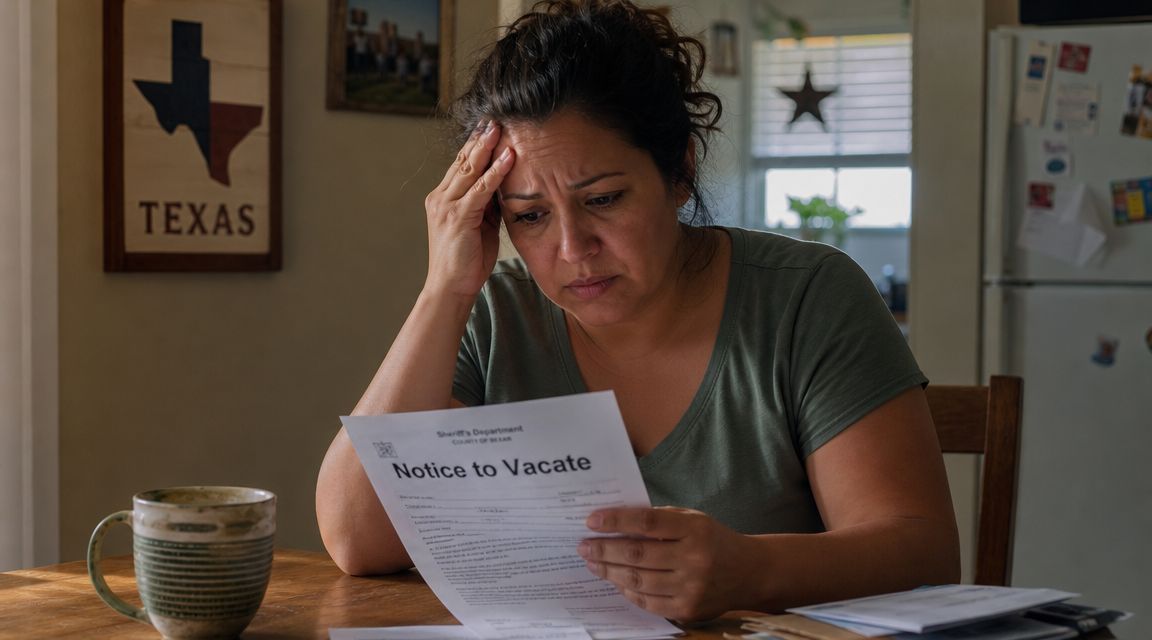
If you're in that position, start by treating the notice as a legal deadline, not a warning you can sort out later. A notice to vacate is often the first formal step in the Texas eviction process under the Texas Property Code, and your next move depends on whether you are still in the notice stage, already in Justice Court, or dealing with a judgment.
The question isn't just can you pay
The more useful question is this: At what stage does payment still stop the eviction, and when does it only help if the landlord agrees?
That distinction matters because tenants often use the same strategy at the wrong time. Paying during the notice period can be very different from paying after a forcible detainer case has been filed. If you're trying to decide what to do the day you receive a notice, this guide on how to respond to an eviction notice in Texas can help you organize your first steps.
Practical rule: In a nonpayment case, every day counts. The earlier you act, the more options you usually have.
What actually works
The strongest approach is usually simple:
- Read the lease first. Your lease may change the notice timeline or set rules about fees and payment methods.
- Confirm the full amount due. Partial payment often creates more confusion than protection.
- Use a traceable payment method. You want proof that can be shown to a landlord, a judge, or both.
- Get the agreement in writing. A spoken promise to “hold off” is much weaker than a signed document.
- Keep every record. Notices, receipts, screenshots, money order stubs, and emails all matter.
This isn't just about staying current on rent. It's about protecting possession of your home, preserving your tenant rights, and avoiding procedural mistakes that make an already hard situation worse.
The Notice to Vacate Your First Chance to Act
At the notice stage, timing favors the tenant more than it will later. Under guidance collected by the Texas State Law Library, a landlord generally must give at least 3 days' notice to vacate unless the lease says otherwise before filing an eviction suit, and in nonpayment cases the tenant may receive a notice to pay rent or vacate instead. That means your chance to stop the case by paying is often measured in days, not weeks, as explained in the State Law Library's overview of the Texas eviction process.

That short deadline is why Section 24.005 of the Texas Property Code matters so much in practice. It governs the notice to vacate process. For many tenants, this is the only stage where catching up quickly can stop the dispute before it becomes a court case.
What to do as soon as the notice arrives
Take these steps in order:
- Check the deadline on the notice. Compare it to your lease. If the lease changes the timeline, that may control.
- Read the reason stated. This article focuses on nonpayment cases. Payment doesn't work the same way for other lease violations.
- Ask for a ledger if the amount is unclear. You need to know the exact balance being demanded.
- Prepare full payment if you can. In this stage, full payment is usually more useful than partial payment.
- Request written confirmation that payment resolves the notice. That protects you if the landlord later claims the default wasn't cured.
Later in the process, tenants may need delay tactics or court strategy. During the notice stage, the better move is usually immediate cure. If you need a broader view of your options, including procedural ways to slow the process, review how to delay an eviction in Texas legally.
A short explainer may help if you're trying to understand the timeline quickly:
A realistic example
Suppose a tenant receives a notice for unpaid rent on Monday. The tenant checks the lease, confirms the amount due, buys a cashier's check, and delivers it before the notice deadline expires. The tenant also gets a signed receipt showing the payment covered the past-due rent and listed fees. In that situation, the landlord may have little reason to continue with a nonpayment eviction.
If you can cure the default during the notice period, do it in a way that leaves no argument about amount, timing, or receipt.
The hold off agreement matters
TexasLawHelp also notes that tenants can negotiate a hold off agreement, which is a written payment plan or cure agreement in which the landlord agrees not to evict if the tenant fixes the problem. That can be useful when full payment isn't available immediately but the landlord is willing to work out a short plan.
A good hold off agreement should cover:
- The full balance. Include rent, late fees, and any other charges the landlord insists must be paid.
- Exact payment dates. Avoid vague language like “soon” or “next week.”
- A promise not to proceed with eviction if you comply.
- Signatures from both sides.
- Copies of each payment made under the agreement.
At this stage, payment can still function as a direct solution. Once the case is filed, it usually becomes a negotiation tool instead.
Making Payment the Right Way to Protect Yourself
Knowing when to pay isn't enough. You also need to pay in a way that protects you if the landlord later says the amount was short, late, or never received.
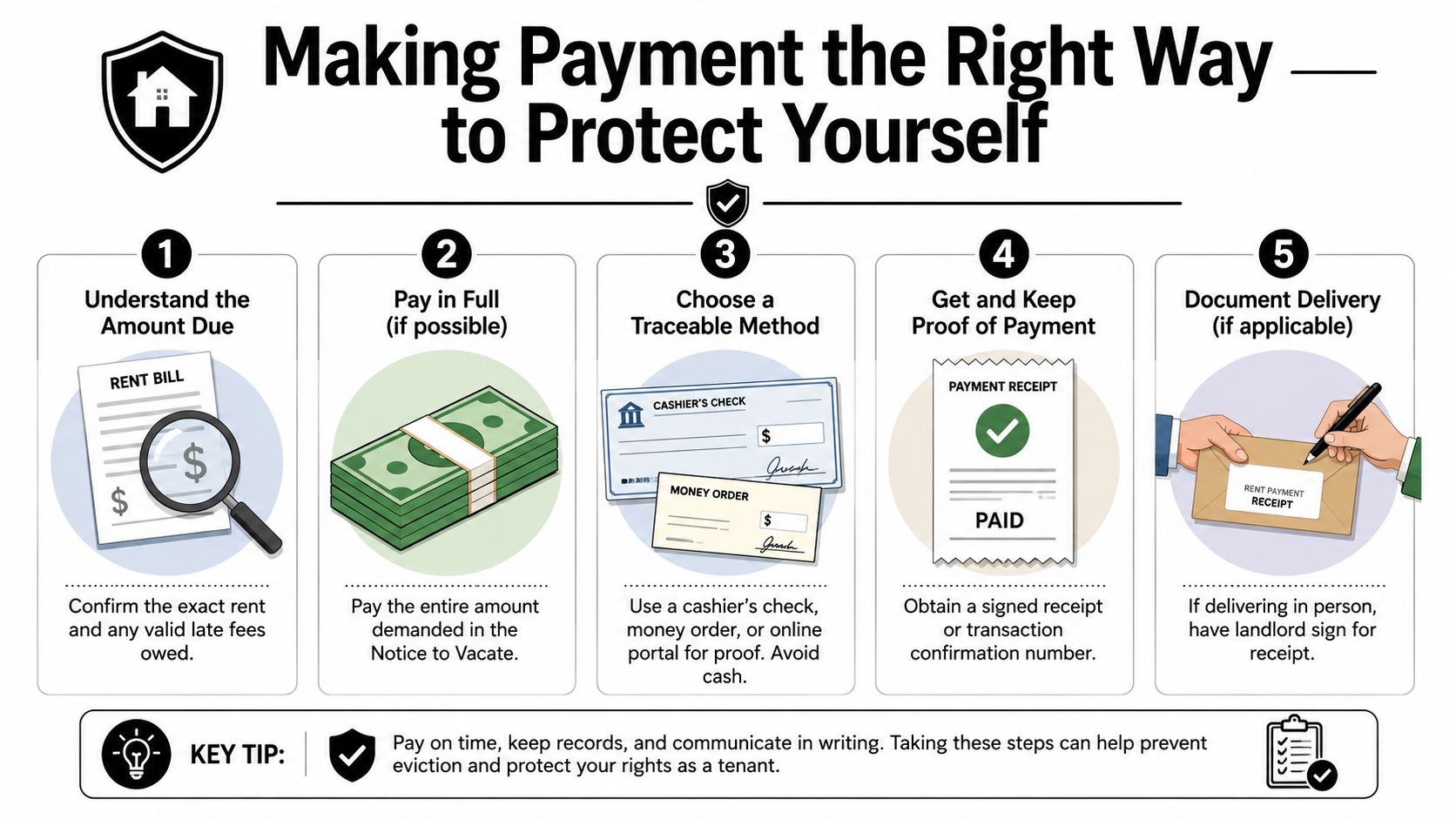
A lot of eviction problems get worse because the tenant has no clean paper trail. They paid cash. They handed over part of the money without a receipt. They relied on a phone call. In court, those details can hurt.
Use payment methods that leave proof
The safest options are usually the ones that generate a record on their own.
| Method | Why it helps | Main caution |
|---|---|---|
| Cashier's check | Creates bank record and physical proof | Keep copy and receipt |
| Money order | Easy to track with stub and receipt | Photograph before delivery |
| Online portal | Timestamped confirmation | Save screenshots immediately |
| Personal check | Memo line can identify rent period | Only useful if account has funds |
| Cash | Fast, but risky | Never use without a signed receipt |
What your receipt should say
A receipt is more than proof of payment. It is proof of what the payment was for.
Try to get a dated receipt that states:
- The amount received
- The date and time
- The rent period covered
- Whether late fees are included
- Whether the payment resolves the notice or default
- Who accepted the payment
If the landlord or manager won't write that much, send your own written confirmation right away.
Keep the evidence as if a judge will read it later, because one might.
A simple message you can send
You don't need legal jargon. You need clarity. A text or email like this helps:
I delivered payment today for the full amount you requested for past-due rent and fees. Please confirm in writing that you received it and that this payment cures the notice to vacate dated [insert date]. I am keeping copies of the payment record and this message.
That kind of message does two things. It creates a timestamp, and it shows that you understood the payment as a cure, not just a partial good-faith gesture.
Avoid the most common payment mistakes
Some mistakes show up over and over in nonpayment cases:
- Paying only part of the balance. Landlords may accept partial money without giving up the eviction.
- Ignoring added charges. If the landlord claims fees are part of the default, dispute them in writing if needed, but don't assume they're irrelevant.
- Using cash without documentation. Cash can disappear into a factual dispute fast.
- Failing to confirm delivery. A money order in your hand doesn't help if no one can prove it was tendered.
- Relying on verbal assurances. “You're fine” is not as useful as a signed note or written message.
Written agreements are stronger than hopeful conversations
If the landlord says, “Pay me by Friday and I'll stop the eviction,” ask for that in writing. A short written agreement is often better than a long friendly conversation.
TexasLawHelp advises tenants who negotiate these arrangements to include the full amount owed, including fees, and to keep copies of every payment. In practice, that written record is what often separates a fixable problem from a hearing with conflicting stories.
If you're weighing outside help, options can include local legal aid, tenant counseling resources, or a Texas landlord tenant lawyer. The Law Office of Bryan Fagan, PLLC also handles landlord-tenant disputes involving notices, negotiations, and eviction defense for Texas clients.
After the Lawsuit Is Filed Your Options in Court
Once the landlord files a forcible detainer case in Justice Court, the question changes. At that point, paying rent no longer works the same way it did during the notice period. You may still be able to resolve the case by paying, but usually only through agreement, dismissal, or a court-recognized settlement.

Many tenants are often surprised. They bring the rent to court and assume the case must go away. Sometimes it does. Sometimes the landlord wants court costs, fees, or a signed move-out agreement. Sometimes the landlord wants possession even if the rent is now available.
What payment means after filing
After filing, payment is usually one of these things:
- A settlement tool. You offer full payment in exchange for dismissal.
- A defense issue. You show the landlord refused timely cure or misstated the amount.
- A bargaining chip. You negotiate more time to move or remain under a written agreement.
- Part of a dismissal package. The landlord agrees to nonsuit the case once funds clear.
That is why court-stage payment needs precision. You need to know what the landlord is demanding now, not what was listed on the original notice.
A short comparison of the stages
| Stage | Does payment usually stop the case by itself | Main issue |
|---|---|---|
| Before filing | Often, if timely and accepted | Cure within notice period |
| After filing | Not automatically | Settlement or dismissal terms |
| After judgment | Much harder | Appeal rules and possession risk |
Court resolutions do happen
Texas courts previously ran the Texas Eviction Diversion Program, which allowed eligible landlords and tenants in nonpayment cases to resolve matters outside a normal eviction judgment. If the requirements were met, past-due rent obligations and utility delinquencies could be covered in full and the eviction case dismissed, as described on the Texas courts' eviction information page. The program is no longer accepting applications, but it remains a useful example of a larger legal point: payment can still be decisive even after filing, if the case is resolved through the proper court process or agreement.
Court filing doesn't always end your chances. It does mean informal fixes are less reliable.
What to ask for in court
If you're trying to resolve a filed case, focus on written terms. Ask for one of these outcomes if the landlord is willing:
- Dismissal of the case after payment
- A reset or hold so payment can clear
- A written settlement filed with the court
- Confirmation about court costs and fees
- A clear statement on whether possession is preserved
If the landlord agrees in the hallway but the court record says something else, the written court record usually matters more.
An eviction attorney can make a practical difference. Court-stage negotiations move fast, and small wording changes can determine whether you're genuinely protected or just hoping the other side follows through.
What If the Landlord Won't Accept Your Payment?
A landlord's refusal doesn't automatically mean you're out of options. In some nonpayment cases, a tenant who can show a timely attempt to make full payment may have a useful defense or at least a stronger position for settlement. The key is proving exactly what you tried to do.
Build the record immediately
If the landlord won't take the money, document the refusal the same day.
Use a checklist like this:
- Photograph the payment instrument. Take a picture of the money order or cashier's check before and after the attempted delivery.
- Send written confirmation. Email or text the landlord that you attempted full payment and it was refused.
- Preserve witnesses. If someone was with you, ask them to write down what they saw while it's fresh.
- Keep the original funds intact. Don't cash out or destroy the money order stub.
- Save delivery proof. If you mail anything, keep tracking and copies.
A tenant in this position should also avoid angry messages or vague accusations. Stick to facts. State the amount, the date, the place, the person who refused it, and that the funds remain available.
A refusal can matter in court
Suppose you appeared at the leasing office with a money order for the full amount demanded before the deadline expired, and management refused to accept it. If you later appear in court with the money order copy, your written message, and proof of the timing, that can change the conversation. It may not guarantee dismissal, but it can support your side of the story.
TexasLawHelp notes that if the landlord has already filed suit, the tenant may still resolve the case by paying the arrears. It also notes that after judgment the process becomes much harder, though an appeal can sometimes preserve possession if the tenant pays court-ordered rent into the registry on time, as discussed in this guide on appealing an eviction in Texas.
Judges often care less about what each side says now than what each side can prove happened then.
Don't confuse refusal with illegal self-help
If a landlord refuses payment and then tries to remove you without following the court process, that raises a different problem. Lockouts, utility shutoffs, and property removal can involve separate tenant-rights issues from the rent dispute itself.
If you're dealing with that kind of conduct, read about illegal eviction in Texas and what tenants should do. A nonpayment case doesn't give a landlord permission to skip legal procedure.
Protecting Your Rights Is Not a DIY Project
Texas eviction law looks simple from a distance. Pay what you owe, keep your home, move on. In real life, it turns on narrow deadlines, lease wording, proof of tender, court costs, dismissal language, and whether the case is still curable or already in a judgment posture.
Small errors can have big consequences
The hardest part for tenants is that many mistakes feel minor when they happen:
- You paid, but not the full amount demanded.
- You paid on time, but can't prove it.
- You settled, but never got the agreement signed.
- You appeared in court, but didn't understand what the judgment required next.
Those are the kinds of details that can decide whether you keep possession, buy time, or lose your advantage. They also explain why tenant rights are strongest when paired with a clean factual record and a strategy that fits the exact stage of the case.
Legal guidance is often most useful early
A Texas landlord tenant lawyer or eviction attorney can help review the notice, compare it to the lease, calculate what must be paid, communicate with the landlord, and put any settlement into language that protects you. In some cases, the right move is immediate payment. In others, it's negotiation. In others, it's preparing a defense or preserving rights after judgment.
The Texas Property Code gives structure to the process, but it doesn't remove the practical pressure tenants face when the deadline is close and housing is on the line. If you're asking whether paying rent will stop your eviction, the better reason to get legal help is that the answer may be yes today, maybe tomorrow, and much harder after that.
If you need help with an eviction, lease issue, or rental dispute, contact The Law Office of Bryan Fagan, PLLC for a free consultation today.