Dealing with a property transaction can be stressful—but understanding your rights under Texas law can make all the difference. When you're buying property, you're signing a mountain of paperwork. But one document matters more than almost any other—the Texas warranty deed. This isn't just a receipt; it’s the legal instrument that transfers ownership and gives you the highest level of protection available. It’s the seller's binding promise that the property is truly theirs to sell and that they will defend your ownership against any future claims.
Your Guide to Secure Property Ownership in Texas
Whether you're a landlord adding to your portfolio or a family buying your first home, the closing process can be a blur of legal jargon. But getting the right deed is the bedrock of a secure investment. Without it, you’re left vulnerable.
This guide is focused on the gold standard for transferring Texas real estate: the warranty deed. Think of it as your best defense against the hidden problems that can turn a dream property into a financial nightmare.
Why Understanding Your Deed Matters
A deed is the foundation of your property rights. If it's weak or improperly handled, you could be walking into a minefield of future problems.
- Title Disputes: Imagine finding out an heir or an ex-spouse of a previous owner has a claim to your property.
- Financial Loss: You could be on the hook for old liens or debts you knew nothing about.
- Legal Battles: Clearing up title defects often means expensive, time-consuming court fights.
Here’s a real-world scenario: A landlord buys a new rental, but the deed has weak protections. Months later, a creditor from the seller slaps a lien on the property for an old, unpaid business debt. Without the guarantees of a strong warranty deed, that new owner might have to pay off someone else's debt just to keep their property.
The type of deed you get at closing defines your rights. Some deeds offer almost no protection, leaving you to fend for yourself. A Texas warranty deed forces the seller to stand by the sale and defend your title against claims.
This guide will show you exactly what a warranty deed does, how it shields you from risk, and how it stacks up against other, weaker deeds. The protections you establish from day one, much like your rights under Texas homestead laws, are what ensure your peace of mind for years to come.
If you’re caught in a title dispute, facing a complicated property deal, or just want to make sure your rights are locked down, our team is here to help. An experienced Texas landlord tenant lawyer can provide clear, straightforward guidance for property owners across Texas.
What Is a Warranty Deed and How Does It Protect You?
When you buy a property, one piece of paper matters more than almost any other: the deed. This is the document that proves you own your investment. At the top of the food chain is the warranty deed. Think of it as the seller's ironclad, legally binding promise that they have clean title to the property and the undisputed right to sell it to you. For any savvy property owner in Texas, this is the gold standard of protection.
A warranty deed isn’t just a fancy receipt for a real estate transaction. It’s a series of powerful guarantees—called covenants—from the seller (the grantor) to you, the buyer (the grantee). If someone comes out of the woodwork later with a claim against your title, the seller is on the hook to make it right. It’s this rock-solid protection that provides peace of mind and makes a warranty deed a non-negotiable for anyone serious about real estate.
The Two Main Types of Warranty Deeds
Here in Texas, warranty deeds aren't all created equal. They generally come in two flavors, and the difference between them is massive. One offers wall-to-wall protection for your asset, while the other leaves you exposed to serious risks. Knowing exactly which one you’re getting is crucial.
General Warranty Deed: This is the best protection money can buy—the "bumper-to-bumper lifetime warranty" for your property's title. The seller guarantees the title is clean and promises to defend your ownership against any and all claims that have ever existed against the property, even from decades before they owned it.
Special Warranty Deed: This is a much weaker guarantee, more like a "limited 90-day warranty." The seller only promises the title is clear for the specific time they owned the property. They make zero promises about what happened before they came along.
Let's say you buy a rental property with a Special Warranty Deed. A year later, a contractor shows up with a mechanic’s lien filed five years ago against a previous owner. Because your seller only warranted the title during their period of ownership, they have no legal obligation to help you. You're on your own. But if you had a General Warranty Deed? That seller would be legally required to step in and clear that lien.
For any buyer—especially an investor whose business relies on unclouded ownership—a General Warranty Deed is the only way to go. It rightly shifts the risk of old, hidden title problems back onto the seller.
The Power of Recording Your Deed
Once you have that signed and notarized warranty deed in hand, there’s one final, critical step: you must record it with the county clerk in the county where the property sits. This simple act makes your ownership part of the official public record, effectively shouting to the world that you are the new, rightful owner.
The historical significance of recording deeds is huge. The public archives in Taylor County, for example, show how deed recordings have grown from a handful in the 1870s to over 4 million digitized images today, creating an unbroken chain of ownership for the entire region. You can see these historical property records for yourself on the official Taylor County, Texas, website.
This public record is your ultimate shield. Failing to record your deed invites chaos, creating an opening for old liens, forgotten heirs, or fraudulent sellers to contest your ownership. An experienced Texas landlord tenant lawyer will tell you this isn't just a suggestion; it's a fundamental step in securing your asset.
Comparing a Warranty Deed and a Quitclaim Deed
In Texas real estate, the type of deed you use to transfer property isn't just a technicality—it's everything. While both a warranty deed and a quitclaim deed will move a property from one person to another, the protection they offer the buyer couldn't be more different.
Getting this wrong is one of the costliest mistakes an investor or homebuyer can make. You need to know exactly what you’re signing.
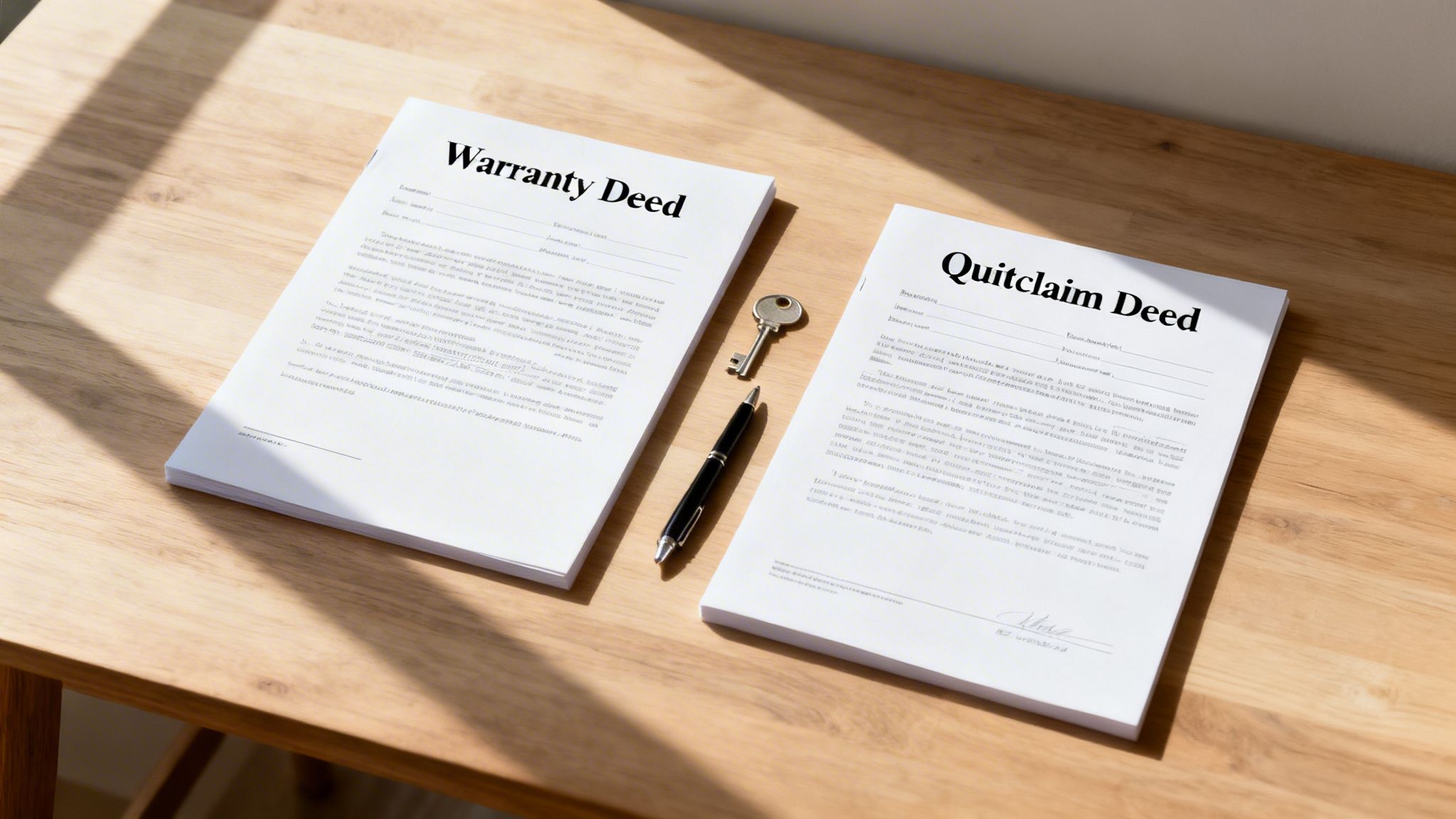
Think of a warranty deed as a seller’s ironclad promise. When they sign it, they are legally guaranteeing they own the property free and clear and will defend your title against anyone who comes along later with a claim.
A quitclaim deed, however, is the complete opposite. It comes with zero promises. The person signing it is simply transferring whatever interest they might have in the property—which could be full ownership, a partial share, or absolutely nothing.
Key Differences in Protection and Use
The real difference comes down to one thing: risk.
With a warranty deed, the seller takes on all the risk of title problems. With a quitclaim deed, that risk is dumped squarely on the buyer’s shoulders.
Let’s say you’re a landlord buying another rental property. You’d demand a General Warranty Deed. This forces the seller to guarantee the title is clean, with no old mechanics' liens, surprise claims from a previous owner’s long-lost heir, or nasty boundary disputes. It protects your investment.
On the other hand, you might see a quitclaim deed used between family members to clean up a messy title. If one sibling wants to give their share of an inherited house to another, they can “quit” their claim. It's a quick way to hand over a potential interest, but it’s not a secure way to buy property from an outside party.
A quitclaim deed essentially says, "I'm giving you whatever I might own of this property, but I'm not promising I own anything at all." In a standard sale, that’s a gamble no buyer should ever take.
To put it in black and white, here’s a straightforward comparison of what each document means for a property owner in Texas.
Warranty Deed vs Quitclaim Deed at a Glance
This table breaks down the fundamental differences in legal protection and common uses for these two very different deeds.
| Feature | Warranty Deed | Quitclaim Deed |
|---|---|---|
| Legal Guarantee | Provides strong legal promises (covenants of title) from the seller that the title is clear. | Provides no guarantees or promises about the title. The seller makes no claims about ownership. |
| Protection Level | High. Protects the buyer against title defects, liens, and other claims. | None. The buyer receives the property "as-is" and assumes all risk of title problems. |
| Common Use Cases | Standard for most real estate sales (e.g., buying a home, commercial property, or investment rental). | Used to clear title defects, transfer property between family members, or in divorce settlements. |
| Seller's Liability | The seller is legally liable and must defend the buyer's title against valid claims. | The seller has no liability after the deed is signed, even if a major title defect is discovered. |
The bottom line is simple: a warranty deed offers powerful protection backed by the seller's legal promises. A quitclaim deed offers nothing but a transfer of whatever interest the grantor happens to have, if any.
What the Texas Property Code Says About Covenants of Title
A Texas warranty deed is more than just a piece of paper that transfers property. The real value is in the six legal promises baked into it.
These promises, called covenants of title, are the seller's sworn guarantee that you're getting a clean, problem-free title. They are your legal firepower if a past issue suddenly threatens your ownership.
These covenants fall into two groups: present and future. Present covenants are promises about the state of the title the moment you close, while future covenants are the seller's ongoing commitment to protect you down the road.
The Three Present Covenants
These promises are all about the “right now.” If they’re going to be broken, it happens at the closing table. Think of them as a snapshot of the title’s health the second you become the owner.
Covenant of Seisin: This is the big one. The seller swears they actually own the property and have the legal right to it. It’s a direct, fundamental promise of ownership.
Covenant of Right to Convey: This goes a step further. The seller not only owns the property but also has the absolute legal authority to sell it to you. For example, a trustee might technically own a property but be blocked from selling it by a trust agreement. This covenant guarantees no such restrictions exist.
Covenant Against Encumbrances: This is your shield against financial surprises. The seller guarantees the property is free from any hidden liens, mortgages, or other claims, except for what's already been disclosed in the deed.
Imagine buying a rental property, only to find out six months later that a contractor put a mechanic’s lien on it before you bought it—and the old owner never paid. That’s a clear breach of this covenant, giving you the right to make the seller fix the problem.
This promise is what keeps you from inheriting the seller’s old debts. If a creditor from the past tries to make a claim, you may need to know how to handle a Texas abstract of judgment and use your deed’s covenants as protection.
The Three Future Covenants
Future covenants are promises that stick with you long after the sale. They force the seller to step up and defend your title if any old issues pop up later on.
Covenant of Quiet Enjoyment: This isn’t about noisy neighbors. It’s the seller's promise that no one with a better claim will come along and try to kick you out. If they do, the seller has a duty to defend your right to be there.
Covenant of Warranty: This is the ultimate promise. The seller agrees to defend your title against any and all claims and to pay you back for any financial losses if someone else's claim turns out to be valid. This is the heart of a general warranty deed—it obligates the seller to fight your legal battles for you.
Covenant of Further Assurances: Lastly, the seller promises to sign any extra paperwork or take any necessary steps to correct a title defect. If a typo on a previous deed clouds your ownership, for instance, the seller has to help you fix it.
These six covenants are what turn a simple property deed into a protected investment. They make sure you get exactly what you paid for: undisputed ownership. Without them, you’re left exposed to massive financial and legal headaches. If a seller is refusing to honor these promises, an experienced property lawyer can help you enforce your rights.
How to Meet the Legal Requirements for a Texas Warranty Deed
For a warranty deed to actually protect your ownership rights in Texas, it has to follow a strict set of rules laid out in the Texas Property Code. Think of it as a legal checklist. If you miss even one box, the entire property transfer could be invalidated, putting your investment at serious risk. A properly drafted and recorded deed isn't just paperwork—it's the foundation of your ownership.
The law is incredibly specific about what makes a deed valid. This isn't a simple handshake agreement; it's a formal legal instrument. Getting every detail right is non-negotiable if you want to protect your rights as the new property owner.
Essential Elements of a Valid Texas Deed
To hold up in court, a Texas warranty deed needs several key components. Each piece plays a critical role in making the transfer official, clear, and legally binding.
A valid deed must:
- Be in writing: You can’t enforce a verbal promise to transfer real estate in Texas.
- Identify the seller (grantor) and buyer (grantee): Full, correctly spelled names are required. No ambiguity.
- Show the grantor's intent to convey the property: This is done with specific legal phrasing, called a granting clause, like "grant, sell, and convey."
- Contain an adequate legal description of the property: A street address isn’t enough. You need the precise description found in a survey or a prior deed.
The grantor also has to sign the deed in front of a notary public. This formal step, known as acknowledgment, confirms the grantor’s identity and proves they signed the document willingly. Without that notary stamp, the deed can't be legally recorded.
A common and costly mistake is using a vague property description. An error here can create a “cloud” on the title, forcing you into expensive legal battles just to prove where your property lines are. Precision is your best defense.
The history of Texas property records shows just how important these formalities are. For instance, you can look at records from the post-World War I boom in Travis County and see how meticulously deeds were documented to manage the flood of land transactions. You can explore how these historical deeds were handled by checking out the Travis County Deed Records from 1927.
Step-by-Step: Recording Your Deed
Once the deed is signed and notarized, you have one last critical job: filing it with the county clerk in the county where the property sits. This is what we call recording the deed.
This diagram helps visualize how a deed's promises (covenants) are split between guarantees about the present and shields for the future.
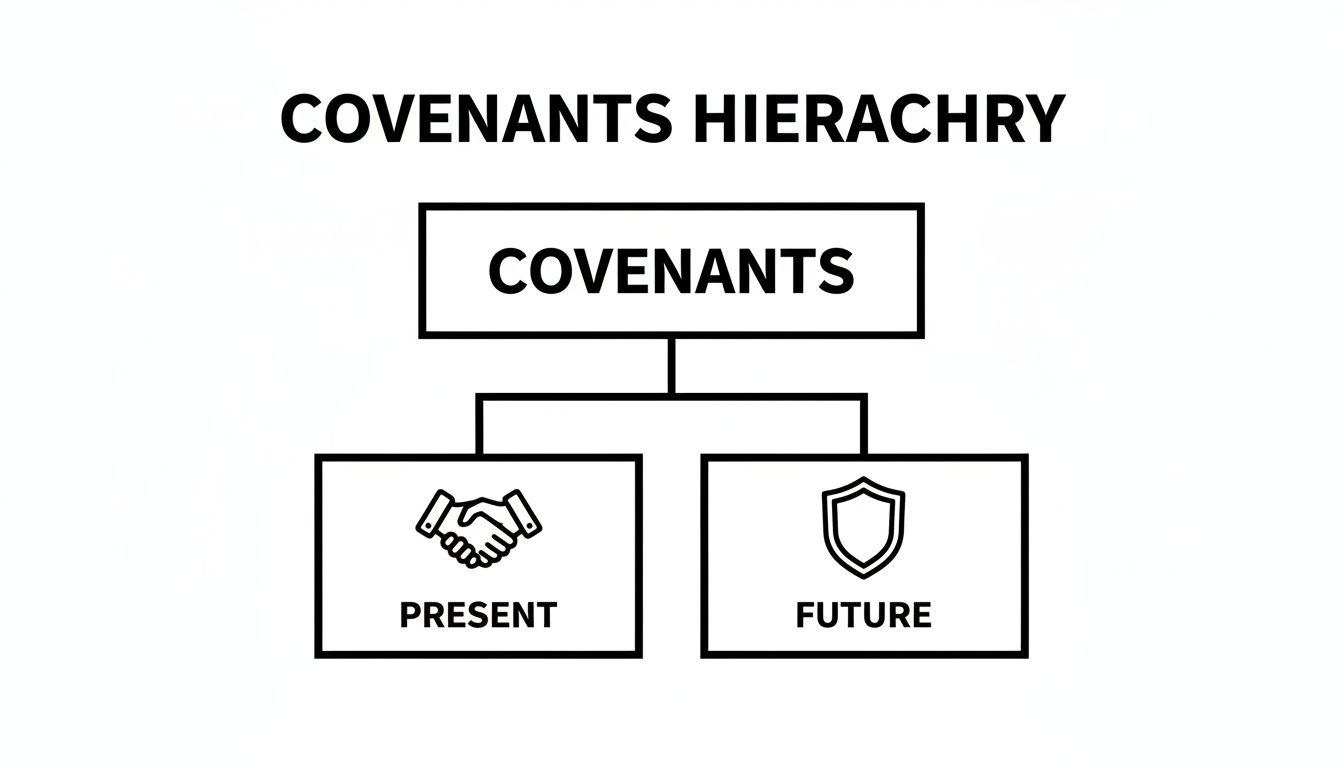
As you can see, present covenants are all about the state of the title right now, at the moment of the sale. Future covenants act as an ongoing shield, protecting you from claims that pop up later. Recording your deed makes all these promises part of the public record. It’s your ultimate proof of ownership, putting the entire world on notice that you are the rightful owner. If you have any doubts about this process, a Texas landlord tenant lawyer can ensure your deed is drafted, signed, and filed correctly.
Common Issues and When to Consult a Property Lawyer
A warranty deed is supposed to give you peace of mind, but it’s not a magic shield. Even with what looks like a rock-solid deed, you can inherit a legal mess that threatens your entire investment. The problem is, a deed is only as good as the seller’s promises—and sometimes, those promises are broken or were never good to begin with.
You might close on your property, thinking everything is settled, only to discover a ticking time bomb of a legal issue left behind by a previous owner. These surprises can turn your dream property into a nightmare.
Surprise Liens and Encumbrances
One of the most common headaches for new property owners is finding an undisclosed lien. This is a legal claim a creditor has on your property to cover someone else's old debt. Even with a general warranty deed in hand, these can crawl out of the woodwork.
Some of the most frequent culprits are:
- Mechanic's Liens: A contractor who wasn’t paid for work done for the previous owner can slap a lien on your property.
- Unpaid Property Taxes: The county doesn’t care who owns the property now; if past taxes are due, they can place a lien on it.
- HOA Liens: Homeowners' associations are notorious for filing liens over unpaid dues and fines, which can balloon with interest and fees.
Imagine you buy a rental home, and six months later, you get a notice that the HOA is foreclosing over two years of unpaid dues from the seller. Your warranty deed should protect you, but getting the seller to actually pay up often requires a lawyer's intervention.
Confusing Deed Language and Exceptions
Not all warranty deeds are created equal. Sellers and their attorneys often slip in specific phrases to limit their own liability. These are called exceptions or reservations, and they can gut the protections you thought you had.
A common exception will state the property is sold "subject to all easements and restrictions of record." This sounds innocent, but it could conceal a major utility easement that kills your plan to build a pool or a restrictive covenant that dictates how you can use your own land.
These clauses are designed to let the seller off the hook. If a problem arises from an issue mentioned in the "exceptions," you likely have no legal recourse against them. An experienced property lawyer spots this kind of tricky language before you sign, saving you from a costly and frustrating trap. And when it comes time to sign, ensuring the electronic signature legal requirements are met is critical to making sure your deed is legally enforceable.
When You Absolutely Need a Lawyer
Trying to handle complex property disputes on your own is a huge gamble. You're putting your most valuable asset on the line. Certain situations are simply too high-stakes to navigate without an eviction attorney or property law expert in your corner.
You need to call an experienced Texas property lawyer immediately if you run into any of these red flags:
- A Suspected Title Defect: The title search uncovers a potential lien, a boundary dispute, or another person’s claim to the property.
- Complex or Vague Deed Language: The deed is loaded with exceptions, reservations, or language you don't fully understand.
- A Seller Breaching a Covenant: An old lien pops up, and the seller who promised to clear it is now ignoring your calls.
- Suspected Fraud or Forgery: You have any reason to believe the deed itself—or any document in the chain of title—is fake.
- Disputes Over Ownership: You and a co-owner can’t agree on what to do with the property. A lawyer can explain your options, including a partition action in Texas, which can force the sale of the property.
Think of a lawyer as your best line of defense. They can dig into the title history, decode the fine print in your deed, and take the necessary legal action to protect your ownership rights.
Frequently Asked Questions About Texas Warranty Deeds
Real estate law is full of terms that sound similar but mean very different things. When you're buying or selling property, one wrong assumption can put your entire investment at risk. Here are the straight answers to the questions we hear most often about warranty deeds in Texas.
What Is the Difference Between a Deed and a Title?
This trips up a lot of people. It's actually simple when you think about it this way: the deed is the physical piece of paper—the legal document you sign that officially moves ownership from the seller to you.
A title, on the other hand, isn't something you can hold. It’s the concept of your legal right to own the property, free and clear. A strong warranty deed is the tool used to transfer a clean title, but the two are not the same thing.
Can a Warranty Deed Be Reversed?
No. Once a warranty deed is signed, notarized, and delivered, it's final. The seller can't just change their mind and take the property back. The transfer is legally complete, and the buyer (the grantee) is the new owner.
The only way to undo it is for the new owner to willingly sign a new deed transferring the property back. The rare exceptions involve proving the deed was signed under fraud or extreme pressure, which means going to court and winning a judge's order to void the sale.
We often see this come up in messy divorces. A spouse might sign a warranty deed giving their partner the house, then later argue it wasn't a true gift. Texas courts are very clear: unless you have powerful evidence to prove otherwise, a signed deed is presumed to be exactly what it looks like—a final transfer of ownership.
What Is a Transfer on Death Deed?
A Transfer on Death Deed (TODD) is an entirely different instrument used for estate planning, not for sales. It lets a property owner name someone to inherit their property automatically when they die, skipping the long and expensive probate process.
Here’s where it differs from a warranty deed:
- When it works: A warranty deed transfers ownership right now. A TODD only transfers it after the owner’s death.
- Can it be changed? An owner can cancel or update a TODD anytime they want. A delivered warranty deed is irreversible.
A TODD is a smart estate planning tool, but it's not what you use to buy or sell a home. For that transaction, a warranty deed is the standard.
If you need help with a deed dispute, lease issue, or rental dispute, contact The Law Office of Bryan Fagan, PLLC for a free consultation today. Our experienced attorneys are here to secure your investment and protect your tenant rights and property rights. You can schedule your consultation here: https://texastenantlawyers.com.