Planning for what happens to your property after you’re gone can be stressful—but understanding your rights under Texas law can make all the difference. You want your home to pass to your loved ones smoothly, without getting stuck in a long, expensive court battle. For many Texans, a Lady Bird Deed is one of the most effective ways to achieve that peace of mind.
Think of it as setting up a direct, automatic transfer of your property that only happens the moment you pass away. Until then, it’s 100% your property. You call all the shots. You can sell it, lease it, refinance it, or even change your mind about who inherits it—all without needing anyone else's permission.

What the Texas Property Code Allows: Bypassing Probate
For most families, the biggest hurdle in settling an estate is probate. This is the court-supervised process of validating a will, paying off debts, and distributing assets. In busy Texas counties, probate can drag on for 6-12 months and cost 3% to 7% of your estate’s total value in legal and court fees. A Lady Bird Deed (also called an "enhanced life estate deed") is a legal tool designed to cut right through that red tape.
Here’s a simple explanation of how it works: the deed splits the ownership into two distinct parts.
- Your Life Estate: This gives you complete, present-day ownership. You can live in the house, collect rent, and make all the decisions for as long as you live. As the "life tenant," you keep full control.
- The Remainder Interest: This is the future interest you give to your chosen heir, known as the "remainderman." They have no rights or say in the property while you are alive. Their ownership only kicks in automatically upon your death.
Because the property transfers immediately, it never becomes part of your probate estate. There’s no court, no lengthy delays, and no public record of the transfer in a probate file. It’s a private, efficient, and cost-effective way to pass on real estate.
What “Enhanced” Means for Your Rights
You may have heard of a traditional life estate deed, but a Lady Bird Deed is different—and that difference is crucial. The key is the word "enhanced."
With a standard life estate, your hands are tied. If you wanted to sell the property or take out a mortgage, you would need your beneficiary’s signature. This can cause huge problems if your financial situation changes, you have a falling out with your heir, or they simply refuse.
A Lady Bird Deed completely removes that roadblock. It specifically reserves your right to sell, mortgage, gift, or otherwise deal with your property however you see fit, without ever needing to consult your beneficiary. That flexibility is everything.
This isn’t a legal loophole; it's a well-established estate planning tool recognized under Texas law. If you’re looking for a way to keep full control of your real estate now while ensuring it gets to your family without the cost and hassle of probate, a Lady Bird Deed is one of the most powerful tools available.
Lady Bird Deed vs. Traditional Will: A Quick Comparison
This table provides a simple breakdown of how a Lady Bird Deed and a Traditional Will handle key aspects of property transfer in Texas.
| Feature | Lady Bird Deed | Traditional Will |
|---|---|---|
| Probate Required? | No. The property transfers automatically at death. | Yes. The will must be submitted to a probate court. |
| Control During Your Life | Full Control. You can sell, lease, or mortgage without permission. | Full Control. The will has no effect until after you die. |
| Time to Transfer | Immediate. Occurs instantly upon filing the death certificate. | Months or Years. Depends on the complexity of the probate process. |
| Privacy | Private. The transfer happens outside of public court records. | Public Record. The will and asset inventory become public documents. |
| Cost to Transfer | Minimal. Typically just the cost of filing the deed and death certificate. | Expensive. Involves court fees, attorney fees, and administrative costs. |
| Protection from MERP | Yes. Protects the property from most Medicaid Estate Recovery claims. | No. The property is part of the probate estate and subject to recovery. |
While a will is a cornerstone of any good estate plan, a Lady Bird Deed offers specific advantages for real estate that a will simply can't match. It’s a targeted solution for a very common goal.
Understanding Your Powers as the Property Owner
The real power of a Texas Lady Bird Deed comes from one simple word: “enhanced.” Unlike other estate planning tools that can tie your hands, an enhanced life estate deed leaves you with complete and total control over your property while you’re alive.
You aren’t just a guest in your own home. You’re the owner, plain and simple. Your beneficiary has zero legal say in what you do. This absolute control is what makes the Lady Bird Deed such a go-to tool for Texas property owners who want to plan for the future without giving up their freedom today.
Let’s break down exactly what your rights look like.
The Five Powers You Keep
With a Lady Bird Deed, you are not a "life tenant" in the old-fashioned sense. You are the full owner, with a powerful set of rights that keep you in the driver's seat. Your property remains your asset to use, manage, and benefit from however you see fit.
These retained powers include:
- The Absolute Right to Sell or Gift: If a great offer comes in, you can take it. If you decide to give the property to someone else during your lifetime, you can. You have the right to sell the property and keep 100% of the money—no need to ask your beneficiary for permission.
- The Freedom to Mortgage or Refinance: Need cash for a home renovation or want to refinance for a better rate? No problem. You can take out a home equity loan or a new mortgage using the property as collateral, just like you always could.
- The Power to Lease and Collect Rent: If you use your property to generate income, nothing changes. A Lady Bird Deed lets you continue to sign leases, collect rent, and run your rental business without any interference.
- The Ability to Change Your Mind: Relationships and circumstances change. If you fall out with a beneficiary or simply want to name someone else, you can. You have the sole power to revoke the deed or file a new one naming a different person.
- The Right to Live in and Use the Property: You keep the exclusive right to live on the property for the rest of your life. This also protects your ability to maintain crucial tax benefits, which you can learn more about in our guide to Texas homestead laws.
Think of it this way: a Lady Bird Deed essentially works like a beneficiary designation on a bank account, but for your real estate. Your heir has an expectation of inheriting the property, but they have no enforceable legal rights until the moment you pass away.
Real-World Scenario: A San Antonio Landlord
Consider Maria, a 65-year-old landlord in San Antonio with two rental homes. She wants her kids to get the properties without going through the headache and expense of probate court. But she also knows she might need to sell one of them in the next decade to help fund her retirement.
A traditional life estate deed would be a huge mistake. It would require her children’s signatures to sell, and if one of them said no or couldn't be reached, her plans would be dead in the water.
Instead, Maria works with a Texas property lawyer to draft two separate Lady Bird Deeds. Each deed names one of her children as the beneficiary for one of the properties.
For the next ten years, she operates the rentals just as she always has—managing tenants, collecting income, and making repairs. When she’s ready to retire, she decides to sell one of the properties. She signs all the closing paperwork herself, and the entire sale proceeds are wired directly to her bank account. Her children aren't involved in the sale at all. The sale simply cancels out the Lady Bird Deed on that property.
The second rental home remains under its own Lady Bird Deed. When Maria passes away years later, her other child simply files her death certificate in the county records, and ownership transfers automatically. This is the exact kind of control and flexibility a lady bird deed texas is designed to provide.
How a Lady Bird Deed Compares to Other Legal Tools
Choosing the right way to pass on your property can feel like navigating a maze of legal documents. You have a clear goal—transfer your real estate without the headaches—but the path isn't always obvious. To really understand why a Lady Bird Deed is so popular in Texas, it helps to see how it stacks up against other common tools, like those you might read about in a guide on the difference between a will and trust.
Each option comes with its own rules, benefits, and drawbacks. Let's break down the key differences so you can see where the Lady Bird Deed really shines.
Lady Bird Deed vs. a Traditional Will
The single biggest difference comes down to one word: probate. When you use a will to transfer property, it must go through the Texas probate court system. This process is public record, can drag on for months or even years, and racks up attorney and court fees that chip away at the value of your estate.
A Lady Bird Deed, on the other hand, is specifically designed to bypass probate entirely for real estate. The moment you pass away, the property transfer happens automatically and privately. It saves your family a tremendous amount of time, money, and stress. While a will is still vital for your other assets, a Lady Bird Deed is a far more direct and efficient tool for your home or land.
Lady Bird Deed vs. a Revocable Living Trust
A Revocable Living Trust is another well-known tool for avoiding probate. With a trust, you retitle your property into the trust’s name and then manage it as the trustee. While trusts are powerful and effective, they are also more complex and expensive to create and maintain.
A Lady Bird Deed offers a simpler, more affordable alternative if your main goal is to transfer a single piece of real estate. You don't have to go through the hassle of retitling your property; you just file one document that acts as a future instruction. For most homeowners, it's a much more streamlined choice.
But if you own multiple properties or have a very complex financial life, a trust might offer the comprehensive control you need. Keep in mind that when joint ownership gets complicated, it can sometimes lead to disputes that require a court to step in. You can learn more about how courts handle these situations in our guide on what is a partition action.
Lady Bird Deed vs. a Traditional Life Estate Deed
This is where you really see the "enhanced" part of the Enhanced Life Estate Deed. With a traditional life estate deed, you give away some of your ownership rights the day you sign it. Your beneficiary (the "remainderman") gets an immediate legal interest in the property, which means you cannot sell, mortgage, or otherwise dispose of the property without their consent.
That lack of flexibility can become a huge problem if your financial or personal circumstances change down the road. The Lady Bird Deed fixes this. It allows you to keep 100% control. You can sell your house, take out a mortgage, or lease it to someone else at any time, for any reason, without needing anyone's permission.
This infographic lays out the straightforward power you keep.
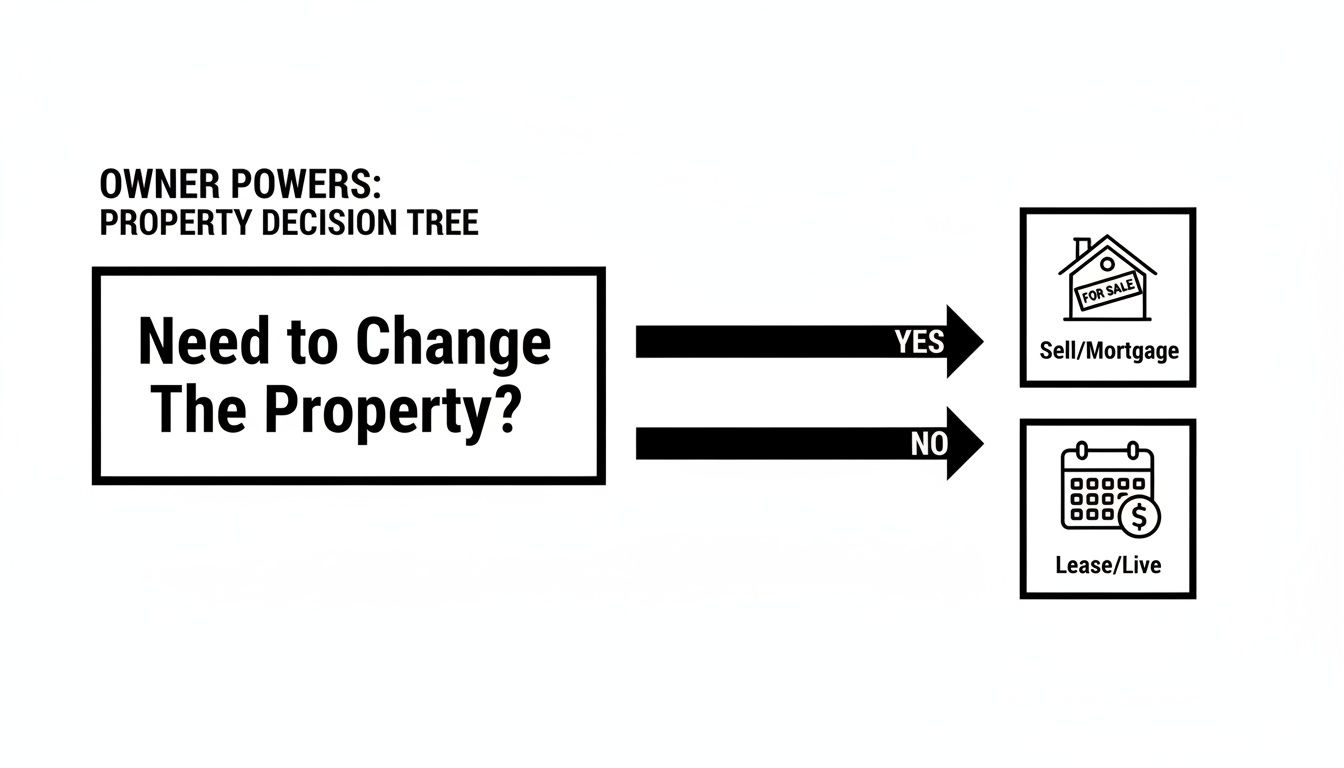
As you can see, whether you need to access the equity in your home or just want to continue living in it, the decision remains entirely yours.
Lady Bird Deed vs. a Texas Transfer on Death Deed (TODD)
The Texas legislature created another probate-avoidance tool, the Transfer on Death Deed (TODD), under Chapter 114 of the Texas Estates Code. It functions very similarly to a Lady Bird Deed, but a few crucial distinctions often make one a better fit than the other.
- Power of Attorney: This is a major one. An agent acting under a durable power of attorney can sign a Lady Bird Deed on your behalf. They cannot sign a TODD—it must be signed by the property owner. This makes the Lady Bird Deed a much more flexible tool for incapacity planning.
- Warranty of Title: A Lady Bird Deed can be drafted to include a warranty of title, which protects the chain of title and can be important for your beneficiary's future title insurance. A TODD offers no such warranty.
- Creditor Claims: Both deeds subject the property to post-death creditor claims, but the legal frameworks are slightly different. How those claims are handled can vary, and the common-law foundation of the Lady Bird Deed is often preferred by experienced practitioners.
While the TODD is a statutory creation, the Lady Bird Deed is built on a longer history of Texas common law. It generally offers more flexibility, especially when you’re planning for a future where you might not be able to manage your own affairs.
How to Create and File a Lady Bird Deed in Texas
Putting a Lady Bird Deed in place seems simple enough on the surface. But this is one area of Texas law where a small mistake can have huge consequences. A simple error—a wrong word, a missed signature—can invalidate the entire document, forcing your home straight into the expensive and time-consuming probate process you were trying to avoid.
This isn't a DIY project you can afford to get wrong. Let's walk through the steps, but pay close attention to the details. Getting this right is everything.

Here's how a lady bird deed in Texas is properly prepared and filed, step by step.
Step 1: Gather the Necessary Information
Before a single word is written, you need to collect the core facts. Accuracy here is non-negotiable. Any mistake can create a "cloud on the title," a legal headache that can take a lot of time and money for your family to fix later.
You'll need:
- The Grantor's Full Legal Name: That’s you, the current owner. It needs to match exactly what's on your current deed.
- The Grantee's Full Legal Name: This is the person (or people) you want to inherit the property. Be specific and clear, like "my daughter, Jane Doe."
- The Full Legal Property Description: This is not the street address. You must use the official description from your existing deed, which usually includes lot, block, and subdivision details.
Step 2: Draft the Deed with the Correct Legal Language
This is the most critical step—and where most DIY attempts go wrong. A Lady Bird Deed is a precise legal instrument, not just a fill-in-the-blank form. It needs very specific language to work.
The deed has to explicitly state that you are reserving a life estate for yourself, but with enhanced powers to sell, mortgage, or otherwise control the property without needing your beneficiary's permission. This language is the "magic" that makes it a Lady Bird Deed.
A Critical Warning: Grabbing a generic form online or trying to draft this yourself is a huge gamble. One poorly worded clause could accidentally give away your rights, create an invalid transfer, or trigger a costly legal fight for your loved ones down the road. This is precisely why getting advice from an experienced Texas property lawyer is so important.
While legal counsel is the safest route, some people look into legal tech tools for help. For example, an AI Contract Generator can help produce drafts of legal documents. But remember, these tools are a starting point at best and can't replace the personalized advice of a lawyer who understands your specific situation.
Step 3: Sign the Deed Before a Notary
Once the deed is drafted perfectly, it has to be signed correctly. You must sign the document in the physical presence of a notary public.
The notary’s job is to verify your identity and witness your signature, then add their own signature and official seal. Don't sign it ahead of time. Under the Texas Property Code, a deed isn't valid without this formal, notarized signature.
Step 4: File the Deed with the County Clerk
Your signed and notarized deed does nothing until it's officially on the record. The final step is to file the original document in the real property records of the county where your home is located. If you live in Houston, for example, that would be the Harris County Clerk’s Office.
Filing gives public notice of the transfer and legally secures your beneficiary's future interest in the property. You'll need to pay a small filing fee, which varies from county to county. Once filed, the process is complete.
Common Pitfalls and How to Avoid Them
A Lady Bird Deed sounds like a perfect, simple solution to avoid probate. And for many Texas families, it is. But it's not a magic wand, and getting it wrong can create a bigger mess than the one you were trying to avoid.
This isn't a DIY project you can download from the internet. The success of a Lady Bird Deed depends entirely on getting the legal details exactly right. Let's walk through the most common traps you need to be aware of before you sign anything.

The Title Insurance Headache
Here's a problem that often pops up years later. When your beneficiary inherits the property and decides to sell it, the buyer will need title insurance. But some title companies get nervous when they see a Lady Bird Deed in the property's history.
They might worry about potential claims against your estate that were never settled in probate. This can cause frustrating delays or even an outright refusal to issue a policy. An experienced Texas property lawyer can usually sort this out with the title underwriters, but it's a headache your family shouldn't have to deal with.
Tripping the "Due-on-Sale" Clause in Your Mortgage
If you have a mortgage, your loan documents almost certainly have a "due-on-sale" clause. This gives your lender the right to call the entire loan due if you "transfer" the property without their permission.
Now, federal law provides exemptions that should protect a Lady Bird Deed from triggering this clause. But that doesn't mean your lender's automated system—or an inexperienced loan officer—won't mistakenly flag the deed as a sale. Straightening this out can cause a lot of unnecessary stress.
While a lady bird deed in Texas is a well-established legal tool, its success hinges on flawless execution. Even minor drafting errors can create a cloud on the title, making the property nearly impossible for your heirs to sell or refinance.
The Problem with Multiple Beneficiaries
Leaving your home to all your children equally seems fair, right? But when you name multiple beneficiaries on a Lady Bird Deed, you might be setting them up for a future fight. Once they inherit the property, they become co-owners.
What happens if one child wants to sell, but the others want to live there? What if one is having financial trouble and a creditor places a lien on their share of the house? You need to understand how an abstract of judgment in Texas could suddenly tie up your family home. These disagreements can sour family relationships and often end up in a costly, painful court battle.
The Deed Can Still Be Challenged
A Lady Bird Deed skips the probate process, but it doesn't make it immune to a lawsuit. A bitter or disinherited family member could still file a suit, claiming you were forced into signing it (undue influence) or that you weren't mentally competent when you did.
Fighting these claims is expensive and emotionally draining for the family you were trying to protect. While a properly prepared deed is your best defense, the risk is real. In fact, while these deeds help over 20,000 Texas families avoid probate each year, up to 10% are contested on grounds like fraud or duress. A well-drafted deed from a lawyer almost always stands up in court, but a flawed one can fail spectacularly.
Your Top Questions About Texas Lady Bird Deeds, Answered
When you’re thinking about something as important as a Lady Bird Deed, questions are going to come up. This is your home we're talking about—your single most valuable asset—and you need straight answers, not legal jargon.
Let’s walk through the questions we hear most often from our clients, so you can get the clarity you need to make the right decision.
Does a Lady Bird Deed Really Protect My Home From Medicaid?
For many Texans, the short answer is yes. This is one of the biggest reasons people choose this deed.
Here’s how it works: The Texas Medicaid Estate Recovery Program (MERP) has the right to go after a person's estate to recoup the costs of long-term care. But because a Lady Bird Deed passes your home to your heir the moment you pass away, the property never legally enters your probate estate.
This simple, automatic transfer keeps your home out of MERP's reach in most situations. It's a powerful way to protect your family's inheritance while still getting access to the care you might need.
What Happens If My Beneficiary Dies Before Me?
This is a scenario you absolutely have to plan for. If you don't, you could undo all the benefits of the deed.
If your primary beneficiary passes away before you do, and you haven't made any updates, the Lady Bird Deed could become void. Your property would then get tangled up in the probate court system—the very thing you were trying to avoid.
The solution is simple but crucial: always name at least one contingent beneficiary. Think of them as a backup. They only inherit if your first choice is no longer living, providing an essential safety net for your estate plan.
Can I Still Use a Lady Bird Deed If I Have a Mortgage?
Yes, you can. But it’s smart to know how this interacts with your loan.
Most mortgages include a "due-on-sale" clause, which gives the lender the right to demand full payment if you transfer an interest in the property. This is where people get nervous.
The good news is that a federal law generally stops lenders from calling your loan due just because you created a life estate like this. While a bank's automated system might mistakenly flag the deed, it's a known issue that can be cleared up. The mortgage is still your responsibility, and when your heir takes over the property, they take over the mortgage debt along with it.
Do My Heirs Still Get a “Step-Up” in Tax Basis?
They do, and this is a huge financial win for your family. A "step-up in basis" means that for tax purposes, the property’s value is reset to its fair market value on the date of your death.
Let's break down what that really means with an example:
- You bought your home years ago for $50,000.
- At the time of your passing, the home is now worth $350,000.
- Your beneficiary decides to sell it right away for that same $350,000.
Thanks to the step-up, their taxable capital gain is $0. Without a lady bird deed texas, they could have faced capital gains tax on the $300,000 increase in value—a tax bill that could easily run into the tens of thousands. This deed preserves that critical tax advantage.
Get a Clear Path Forward for Your Property
Navigating Texas estate law can feel like a maze, especially when your most valuable asset—your home—is on the line. A properly drafted Texas lady bird deed gives you a powerful combination of control and protection that most other tools simply can’t offer. It lets you keep complete ownership of your property for your entire life while ensuring it passes directly to your loved ones without the stress and expense of probate court.
The hard truth is that a Lady Bird Deed is not a DIY project. The difference between a secure transfer and a future legal nightmare often comes down to the details. The deed must be drafted with legal precision, signed exactly as required, and filed correctly with the county. Your home is too important to risk on a template form.
If you need help with a Lady Bird Deed, lease issue, or other property matter, contact The Law Office of Bryan Fagan, PLLC for a free consultation today. We’re here to provide the clear, practical guidance you need to protect your rights and your family's future. Schedule your free consultation today.