Dealing with a landlord dispute or eviction can be stressful—but understanding your rights under Texas law can make all the difference. Before any rent dispute, repair issue, or eviction notice, there's one document that sets the stage for everything: the property deed.
Think of it as the property's official birth certificate. It’s the single most important legal paper that proves who actually owns a piece of real estate, and it forms the foundation of the landlord-tenant relationship. Understanding your rights related to this document is crucial for protecting yourself, whether you are a landlord, tenant, or property manager.
What Is a Property Deed and Why Does It Matter?
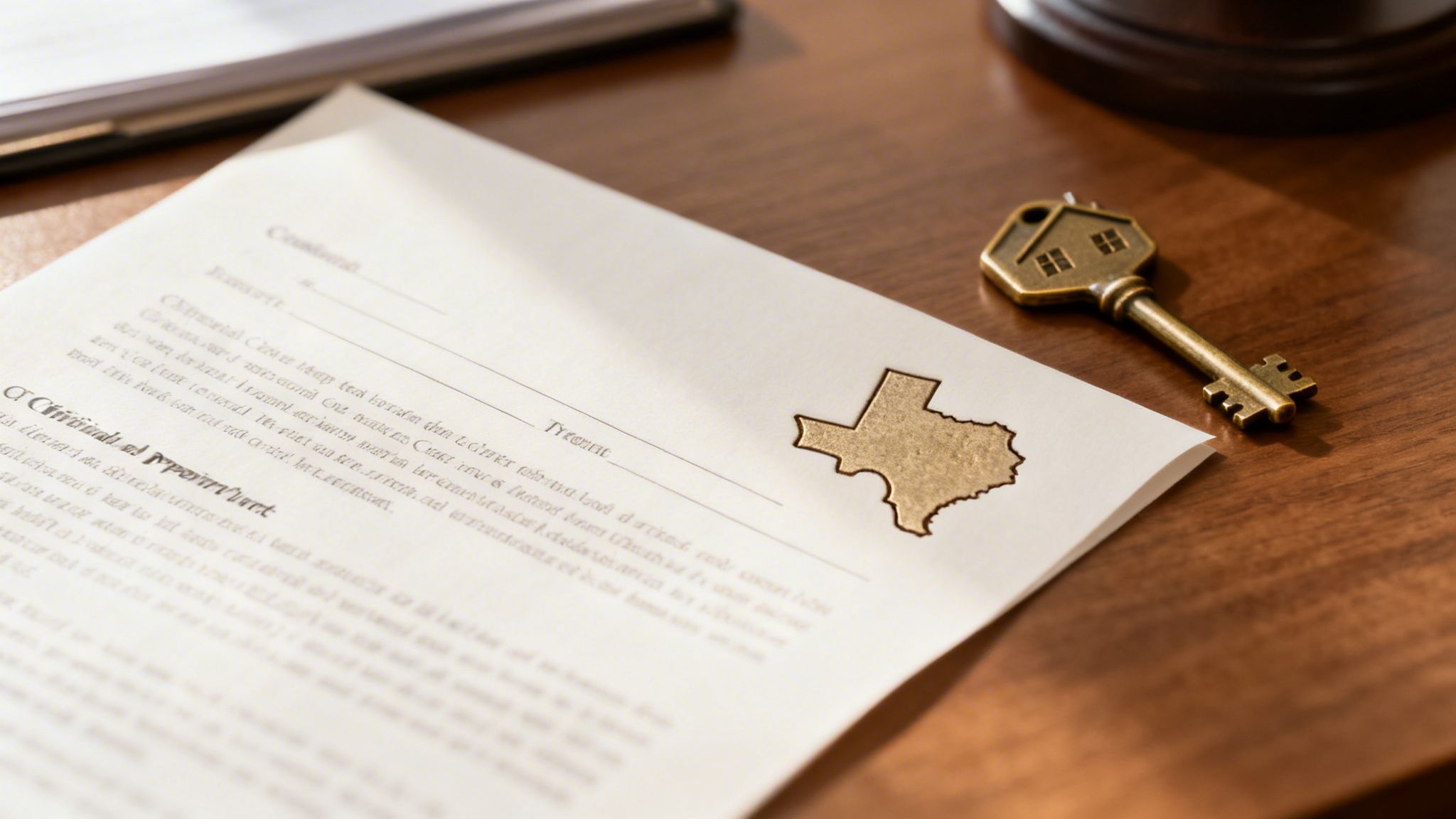
A property deed isn't just a formality. It’s the legal instrument that officially transfers ownership from one person (the grantor) to another (the grantee). Understanding this is critical because it directly defines who has rights and who has responsibilities.
For a landlord, a valid deed is your proof of authority. It’s what gives you the legal power to rent out a property, collect rent, and enforce a lease. Without a solid deed in your name, your authority can be challenged, leaving you vulnerable in a property dispute.
For a tenant, that same deed is your security. It confirms the person you’re paying every month is the legitimate owner with the right to lease the property to you. This simple check can protect you from rental scams and ensure your lease is valid under Texas law.
The Foundation of the Landlord-Tenant Relationship
Before a lease is ever signed, the deed establishes the ground rules for the entire landlord-tenant relationship. If the deed is fraudulent, flawed, or held by someone else, any lease you sign could be worthless.
This is because the deed grants the owner specific powers that are essential for a rental agreement to work:
- The Right to Occupy: The deed is what allows an owner to give a tenant legal permission to live on the property.
- Authority to Lease: It verifies the landlord’s power to enter into a binding rental contract in the first place.
- A Clear Chain of Title: A clean history of deeds shows an unbroken line of ownership, which is crucial for settling any disputes over who has rights to the property. You can learn more by checking out our guide on real estate contracts in Texas.
The role of the deed is so central that it impacts both sides of the rental equation, though in slightly different ways.
Why Property Deeds Matter for Landlords and Tenants
| Stakeholder | Primary Importance of the Deed | Real-World Scenario |
|---|---|---|
| Landlord | Establishes the legal right to lease the property and enforce the rental agreement. | A landlord uses the deed to prove their standing in court when needing to evict a non-paying tenant. This is a common step an eviction attorney will advise. |
| Tenant | Confirms the landlord is the legitimate owner and has the authority to rent out the unit. | A tenant verifies the owner's deed to avoid paying rent to a scammer who doesn't actually own the property, thus protecting their tenant rights. |
Ultimately, a deed is much more than a piece of paper filed away at the county courthouse.
A clear and properly recorded deed is the strongest protection against ownership disputes. It serves as public notice, telling the world who legally owns the property and preventing others from making fraudulent claims against it.
Whether you're a landlord trying to protect your investment or a tenant making sure your home is secure, understanding property deeds in Texas is your first line of defense. It gives you the power to ask the right questions, verify who's in charge, and move forward with confidence.
Exploring the Different Types of Texas Property Deeds
When you buy a piece of property in Texas, the deed you receive is more than just a piece of paper. It’s a legal promise from the seller. But not all promises are created equal.
Think of deeds like different levels of insurance for your property's title. Some give you comprehensive protection, while others offer very little—or none at all. Understanding the type of deed you have is critical, as it spells out exactly what guarantees the seller (grantor) is making to you, the buyer (grantee).
These guarantees, or warranties, directly define your rights. For a landlord, a strong deed is your shield—it solidifies your authority to lease the property without worrying about a surprise ownership claim. For a tenant, it confirms your landlord has the clear right to rent to you in the first place, securing your lease.
General Warranty Deed: The Gold Standard of Protection
The General Warranty Deed is what you’ll see in most Texas real estate deals, and for good reason. It offers the buyer the strongest protection possible because the seller makes two huge promises about the property's title.
When a seller gives you a General Warranty Deed, they are guaranteeing:
- The title is clean and free from any claims or liens—not just from when they owned it, but all the way back through the property's entire history.
- They will legally defend you against any title claims that pop up from the past, no matter how far back they originate.
Here’s a real-world scenario: A landlord buys a rental house with a General Warranty Deed. Five years later, an heir of a previous owner suddenly surfaces, claiming a right to the property. Because the landlord has a General Warranty Deed, the person who sold them the property is legally required to step in, handle the court battle, and pay the costs to protect the landlord’s title. That’s real peace of mind.
Special Warranty Deed: A More Limited Guarantee
A Special Warranty Deed dials back the protection. With this deed, the seller only guarantees the title against claims that came up while they owned the property. They make zero promises about what happened before they took ownership.
You'll often see this type of deed in commercial real estate transactions or when a bank or an estate is selling a property. The seller is only willing to vouch for their time of ownership, not for any hidden problems left behind by previous owners.
Key Distinction: A General Warranty Deed protects against claims from the property's entire history. A Special Warranty Deed only protects against claims from the seller's period of ownership.
For a landlord, this means you’re taking on more risk. If a title problem from a prior owner emerges, defending your title—and paying for it—is now your problem.
Quitclaim Deed: No Guarantees at All
The Quitclaim Deed is easily the most misunderstood deed, and it comes with a major warning: it offers zero warranties. The person signing it isn't even claiming to own the property. They are simply transferring whatever interest they might have over to you.
It's the legal equivalent of someone saying, "I’m not promising I own this, but if I do, all my rights are now yours."
Quitclaim deeds aren't used for typical home sales. Instead, they serve very specific purposes, like:
- Clearing up title clouds: Used to remove a potential claim from a distant relative or an ex-spouse.
- Gifting property: Transferring a house between family members who trust the ownership history.
- Fixing a typo: Correcting a spelling error on a previous deed.
Any landlord offered a property with only a Quitclaim Deed should see a massive red flag. It often signals that there are known—or suspected—problems with the title that the seller doesn’t want to be responsible for.
What the Texas Property Code Says About the Transfer on Death Deed
The Transfer on Death Deed (TODD) is a powerful and specific instrument for estate planning. It lets a property owner name a beneficiary who will automatically inherit the property when the owner dies, completely bypassing the slow and costly probate court process.
While the owner is alive, they keep total control. They can sell the property, take out a mortgage on it, or even revoke the TODD entirely. The beneficiary has absolutely no rights until the owner passes away. As laid out in Texas Estates Code, Chapter 114, for a TODD to be valid, it must be signed and recorded in the county land records before the owner's death.
This is an invaluable tool for any property owner, landlords included, who want to pass their assets to their heirs smoothly and without court intervention.
The Legal Requirements for a Valid Texas Deed
A property deed seems straightforward, right? A piece of paper that says who owns what. But in Texas, getting it wrong can be a disaster. Think of it less like a simple receipt and more like a legal landmine. One missed step or vague phrase, and a transfer of ownership can be invalidated, creating enormous problems for property owners and their tenants.
When a landlord offers you a lease, you're trusting they have the undisputed right to that property. A valid deed is the bedrock of that trust. That's why the Texas Property Code lays out non-negotiable rules—to prevent fraud, shut down disputes before they start, and make sure everyone knows who truly holds the title.
The Absolute Must-Haves for a Texas Deed
For a deed to hold up in court, it has to be perfect. Leaving out even one of these core elements can render the whole document worthless. That could void a sale entirely or leave a landlord scrambling to prove they even own the building.
A valid Texas deed must always:
- Be in writing: This is non-negotiable under the Statute of Frauds. In Texas real estate, verbal promises are worthless. This isn't just a suggestion; it's a hard rule to prevent "he said, she said" nightmares. You can read more about why this is so critical in our article on verbal contracts in Texas.
- Identify the grantor and grantee: The deed has to be crystal clear about who is selling the property (the grantor) and who is buying or receiving it (the grantee). No nicknames or ambiguity allowed.
- Show intent to convey: The document needs specific legal language making it obvious the grantor intends to transfer the property. Phrases like "grant and convey" are the legal keys that turn the lock.
- Have a proper legal description: A street address isn't good enough. A valid deed needs the kind of description you’d find on a survey—lot and block numbers or "metes and bounds." This ensures the specific piece of land is identified without any possible confusion.
The type of deed matters, too. A General Warranty Deed offers the strongest protection for a buyer, while a Quitclaim Deed offers almost none. It's typically just used to clean up title issues, not for a clean sale, highlighting why knowing what you're signing is so important.
The Final Steps to Make It Official
Getting the words on the page is only half the battle. Two final, critical actions must happen to make the transfer legally binding. Without them, the deed is just a piece of paper with no real power.
First, the grantor (the seller) must sign the deed in front of a notary public. The notary's seal is the official verification that the signature is legitimate.
Second, the signed deed must be delivered to and accepted by the grantee (the buyer). This is the moment of truth—the physical or symbolic handover that officially moves ownership from one person to another.
Crucial Takeaway: One of the most common and expensive mistakes we see is a bad legal description. If it’s vague, typo-ridden, or just plain wrong, the deed can be thrown out. This creates a "cloud on the title" that can take a lawsuit and thousands of dollars to fix.
This strict process isn't new. It’s a legacy stretching back to the very foundations of Texas. The thousands of contracts and land titles recorded then are still preserved by the Texas General Land Office (GLO) and can influence property disputes today. In fact, you can now access over 300 digitized volumes from Travis County, showing just how vital these historical records are for ensuring clear ownership under Texas law. You can explore these archives yourself at the Texas General Land Office's collection.
Why You Must Record Your Property Deed in Texas (And What Happens If You Don’t)
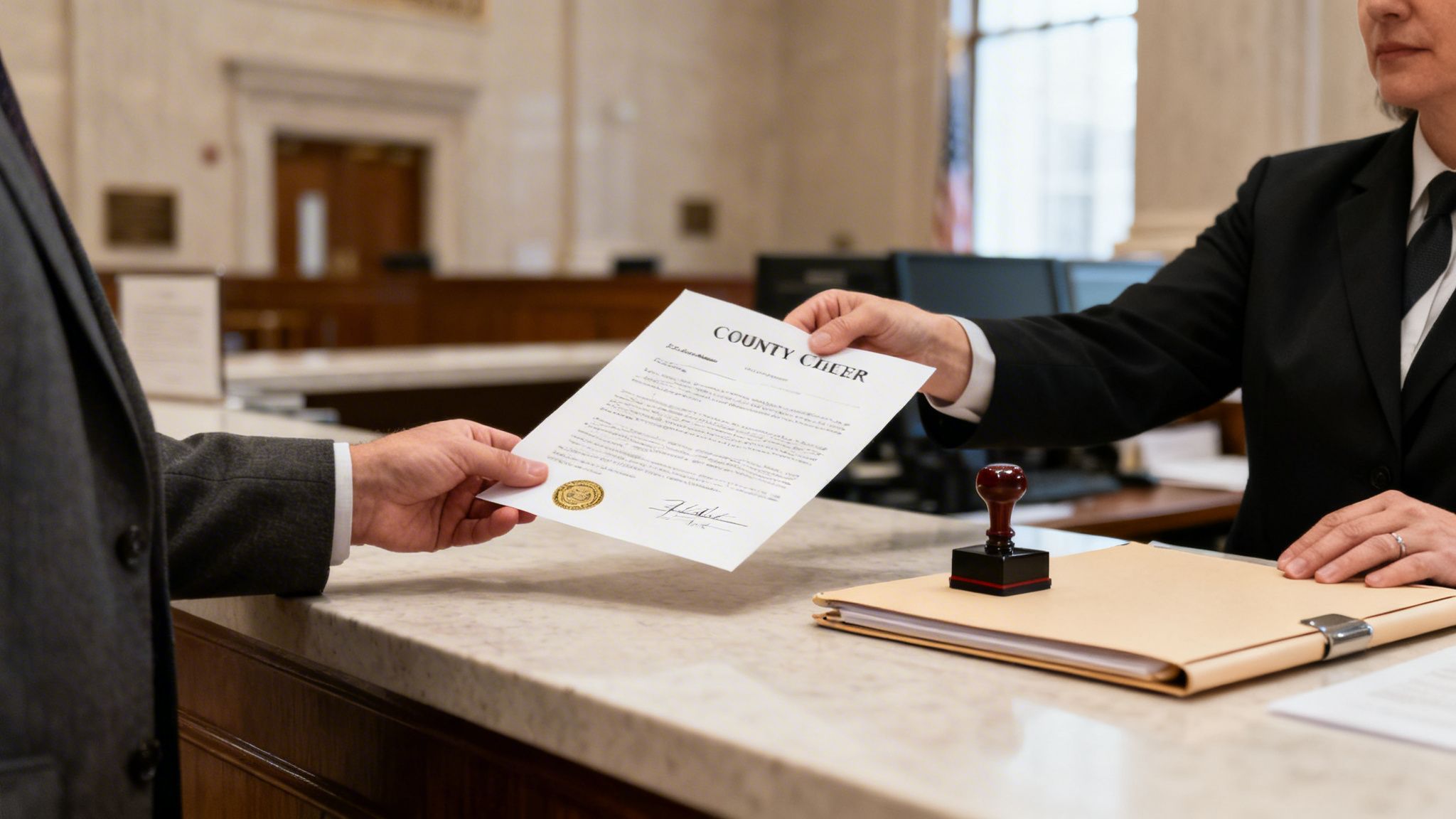
That signed deed in your hand feels like the finish line, but it’s not. It’s just a private agreement between you and the seller. To truly lock down your ownership rights in Texas, you have one more critical step: recording the deed.
This isn’t just a formality. You need to file that deed with the county clerk in the county where the property sits. This one action transforms your private transaction into an official, public record. It's your ultimate proof of ownership—the public announcement to the world that this property is yours.
Filing your deed protects you from a world of headaches. It prevents the previous owner from fraudulently trying to sell the property to someone else. It makes your ownership legally enforceable against everyone. It stakes your claim, loud and clear.
This matters for landlords and tenants, too. A landlord with a recorded deed has undeniable authority to collect rent, enforce a lease, or file for eviction. For a tenant, it’s how you verify you’re renting from the actual owner, not a scammer, ensuring your lease holds up in court.
The Chain of Title: Your Property’s Legal DNA
Once recorded, your deed becomes the newest link in the property’s chain of title. Think of it as the property's official biography. It’s a complete, chronological history of every single owner, from the original government grant all the way to you.
A clean, unbroken chain of title is non-negotiable. Any gap in the history, suspicious transfer, or lingering claim creates a "cloud" on the title. A clouded title throws ownership into question, and that uncertainty can kill a sale, block a loan, or completely invalidate a lease.
A landlord with a broken chain of title might not have the legal power to enforce their own lease. And if you’re a tenant, you could be paying rent to someone who has no legal right to collect it—a risk no one can afford.
This is why a title search is a standard part of any real estate deal. A title company or attorney pores over this history to make sure the person selling or leasing the property has the absolute right to do so. It’s all about providing security and peace of mind for everyone involved.
From Dusty Books to Digital Records
Not long ago, researching a deed meant spending days at the county clerk’s office, digging through massive, handwritten ledgers. It was a tedious, time-consuming process.
Thankfully, technology is changing the game. Many Texas counties are digitizing their historical records, making it easier than ever for landlords, tenants, and owners to find the information they need. This move toward accessibility is a game-changer for resolving disputes under the Texas Property Code.
Take Travis County, for example. They’ve digitized over 300 deed books dating from 1840 to 1919, plus indexes from 1842 to 1924, and made them all available online for free. This joint effort between the county clerk and local archives means you can research a property's history from your laptop. You can see how they manage deed research and explore these historical deed records for yourself.
How to Resolve Common Deed Problems
On paper, a property deed looks simple. It’s the official document that says who owns a piece of property. But when that document is flawed, fraudulent, or unclear, it can throw everything into chaos for both landlords and tenants.
For a tenant, it's the ultimate nightmare: finding out the person you’ve been paying rent to isn't the real owner. For a landlord, a hidden problem with your deed could mean you have no legal authority to rent your property out in the first place. These aren't just minor clerical issues; they're foundational cracks that can lead to stressful, expensive legal battles. Knowing the red flags is the first step to protecting your rights.
Deed Fraud and Defective Deeds
Deed fraud is an outright scam. A criminal forges a deed to make it look like they own a property they have no rights to, then tries to rent it out or even sell it. They often prey on vacant homes, properties tied up in probate, or houses facing foreclosure.
Real-world scenario: You find a perfect rental online at a great price. You meet the “landlord,” sign a lease, and hand over your deposit and first month's rent. A few weeks later, the actual owner shows up, completely unaware of your existence. Suddenly, you’re out thousands of dollars and facing an immediate move, with no legal right to be on the property.
A defective deed is a different beast. It isn't necessarily fraud, but it contains a critical mistake that renders it legally invalid. These errors create what’s called a “cloud on the title,” making it impossible to say who truly owns the property.
Common defects include:
- An incorrect legal description of the property lines.
- A forged or missing signature from a previous owner (the grantor).
- A notary seal that was improperly applied or is missing entirely.
If a landlord’s deed is defective, their ownership is in question. That means any lease they sign with a tenant is built on incredibly shaky ground.
Boundary Disputes and Their Impact
Another headache is the classic boundary dispute. This is when you and a neighbor disagree on where one property ends and the other begins. It might be a fence that was accidentally built a few feet over the line or confusion over who can use a shared driveway.
You might think this is just an owner-to-owner problem, but it directly impacts tenants. If that parking spot, storage shed, or slice of the backyard you were promised in your lease is actually on the neighbor’s property, you can lose access to it in a heartbeat. These disputes can get surprisingly specific—the Texas Supreme Court has even ruled on fights over who owns the empty space under a property.
Key Takeaway: Whether you're a landlord or a tenant, if you have even a small suspicion that something is wrong with the property's ownership, your first move should be to verify the deed. This isn't secret information; it's public record available at the county clerk's office. An unclear or contested title is a massive red flag.
Step-by-Step Guide for Resolving Deed Issues
Discovering a potential issue with a deed is unnerving, but there’s a logical path forward to protect your rights.
- Stay Calm and Organized. Your first instinct might be to panic, but emotional decisions rarely help. Take a breath and focus on the facts.
- Gather Your Paper Trail. Pull together every relevant document: your lease agreement, proof of rent payments, any emails or texts with the landlord, and a copy of the deed if you have one.
- Verify the Official Owner. Head to the county clerk’s office (or their website) for the county where the property is located. Look up the address and confirm who is listed on the official deed.
- Get a Legal Opinion. If the records don't match what you were told, or if you confirm fraud, it’s time to call an attorney. Deed and title issues are far too complex to handle on your own. Legal action is often required, and sometimes disputes between co-owners can even force a sale of the property, a process detailed in our article on what a partition action is.
A skilled Texas landlord-tenant lawyer can cut through the confusion and explain your legal options. Whether you’re a tenant caught in a scam or a landlord with a clouded title, getting expert legal help is the only way to protect your interests.
How to Get a Copy of a Property Deed in Texas

Whether you’re a landlord preparing for a dispute, a tenant trying to confirm who you're paying rent to, or a homeowner who just needs a copy, you’ll eventually need to get your hands on a property deed. Thankfully, these aren’t secret documents. In Texas, property deeds are public records, which means anyone can access them if they know where to look.
Every single property deed in the state is filed and kept on record with the county clerk in the county where the property sits. That’s your source of truth. And today, most counties have put their records online, making the search easier than ever.
Getting Ready to Search
Before you dive in, taking a few minutes to gather the right information will make your search a whole lot faster. You might think a street address is all you need, but it's often the least reliable way to search a county’s official records.
For the best results, you’ll want at least one of these:
- The full name of the current owner (grantee) or the person who sold it (grantor). This is usually the most reliable piece of information you can have.
- The property’s legal description. This isn’t the street address—it's the lot, block, and subdivision name. It's far more precise.
- The year the property was purchased. This is a huge help for narrowing down searches, especially for older properties where records might not be fully digitized.
Having this info ready will save you a headache, whether you’re searching from your couch or heading to the clerk's office.
Finding the Deed Online
The fastest way to get a copy of a deed is to use the online portals that most major Texas counties now provide.
Real-world scenario: Imagine a tenant in San Antonio gets a new landlord and something feels off. They can go straight to the Bexar County Clerk's online records search, type in the owner's name, and pull up the recorded deed. In minutes, they can confirm the person they're paying is the actual legal owner—a simple search that provides immediate peace of mind and protects their tenant rights.
The process is pretty much the same from county to county:
- Know the County: First, figure out which county the property is in. A quick online search of the city name will tell you.
- Find the County Clerk’s Website: Just search for "[County Name] County Clerk" to land on their official site.
- Look for Property Records: On the site, find the link for "Real Property," "Official Public Records," or "Deed Records."
- Start Your Search: Use the portal to enter the owner’s name or legal description you found earlier.
- Download the Deed: Once you find the right document, you can usually view or download an unofficial copy for free. If you need a certified copy for court, you can order one for a small fee.
In-Person Requests and Other Resources
What if you can't find it online, or you need an official, certified copy for a legal matter? Your best bet is to go directly to the county clerk’s office. The staff there can point you to public-access computers and help you track down exactly what you need.
Navigating Texas property records requires precision, and county clerks from Cameron County to Chambers and Bexar County have built robust systems to manage it all. These public search portals are the backbone for resolving landlord-tenant issues and have helped streamline millions of property transactions. If you want a deeper look at how a major county handles this incredible volume of data, you can read more about Cameron County's advanced recording system.
Common Questions About Texas Property Deeds
When you're dealing with something as important as real estate, confusion over paperwork can create a lot of stress. We get questions about Texas property deeds all the time from both landlords and tenants.
Here are some straight answers to the most common ones we hear.
What’s the Difference Between a Deed and a Title?
It's easy to get these two mixed up, but the distinction is crucial.
Think of it like this: title is the idea of ownership. It’s your abstract, legal right to own, use, and sell your property. The deed, on the other hand, is the physical, signed legal document that actually moves that ownership from one person to another.
You can't have a valid transfer without both—the deed is the tool used to convey the title.
Can Property Be Transferred in Texas Without a Deed?
Absolutely not. The Texas Property Code is crystal clear on this.
Any agreement to transfer real estate must be in writing and signed. This requirement, called the Statute of Frauds, exists to prevent handshake deals from turning into messy "he said, she said" legal battles. A verbal promise to give you property means nothing in a Texas court.
How Much Does It Cost to Record a Deed?
The good news is that recording a deed is usually affordable. The exact cost depends on the county, but you can typically expect a base fee of around $25 to $30 for the first page.
Each additional page will cost a bit more, usually about $4. It's always a good idea to check your specific county clerk’s website for the most current fee schedule before you go.
Do I Really Need a Lawyer to Handle a Deed?
Legally, no. Practically, yes. While you aren't required by law to hire an attorney, trying to draft or file a deed yourself is a huge gamble.
Simple mistakes—a wrong word, an incorrect legal description, or a missed step in the filing process—can create a "cloud on the title." That's a fancy term for a big, expensive legal mess that could jeopardize your ownership down the road. An experienced Texas landlord tenant lawyer ensures it’s done right the first time, protecting your investment and giving you peace of mind.
If you need help with an eviction, lease issue, or rental dispute, contact The Law Office of Bryan Fagan, PLLC for a free consultation today.