Yes. In Texas and in most manufactured home communities, mobile home owners typically do have to pay lot rent because they own the home itself but rent the land underneath it. If you're staring at a new lease, a rent notice, or a rule violation and wondering whether that monthly charge is really required, your concern is justified, and Texas law gives you more structure and protection than many people realize.
Owning a mobile home can feel like homeownership until the park sends a notice that reminds you it also works like a tenancy. That disconnect causes a lot of stress. A family may be current on the home loan, keep the place in good shape, and still face trouble because the lot rent, fee schedule, or community rules weren't fully understood.
That is where the Texas Property Code matters. For tenants, it sets guardrails around leases, notices, and evictions. For landlords and property managers, it creates rules that must be followed before rent increases, nonrenewals, or removal from the lot. If you're asking, Do mobile homes have to pay lot rent?, the short answer is yes. The more important question is what that rent includes, when it can change, and what rights you have if a dispute starts.
Understanding Your Rights as a Mobile Home Owner in Texas
A common situation looks like this. You bought a manufactured home because it gave you a path to ownership that felt more realistic than buying a traditional house and land together. Then a notice arrives about lot rent, new community rules, or a possible lease issue, and suddenly it feels like you own your home but still answer to a landlord.
That feeling is normal. In Texas, a person who owns a mobile home but rents the lot still has tenant rights tied to that land lease relationship. The law treats the lot differently from the home itself, and that difference controls what the park owner can require and what process they must follow if a dispute develops.
Why people get confused
Many people assume ownership of the home means full control over the property. It doesn't work that way in a manufactured home community. Your rights come from two places at once:
- Your ownership rights in the home: You own the structure and are usually responsible for maintaining it.
- Your tenancy rights in the lot: You rent the space where the home sits, so the lease and park rules still matter.
- Your statutory rights under Texas law: The park owner can't just make up the process as they go.
Practical rule: If you own the home but rent the ground, treat every lot-related issue like a landlord-tenant issue, not just a homeownership issue.
That distinction matters when the issue involves unpaid rent, utilities, pets, noise complaints, or nonrenewal. It also matters when a landlord threatens eviction without proper written notice.
What clients usually need to know first
Most readers aren't asking for a legal theory. They need to know whether the charge is legitimate, whether an increase was done correctly, and whether they can lose the place where their home sits.
The answer depends on the lease, the written rules, and the notice given. A Texas landlord tenant lawyer or eviction attorney will usually start with those documents because they show whether the park followed the required process and whether you still have time to respond before the situation gets worse.
Why Lot Rent Exists The Land-Lease Model Explained
If you own the home and still get a monthly bill from the park, the frustration is real. I hear the same question from Texas clients all the time. Why am I paying rent if the home is already mine?
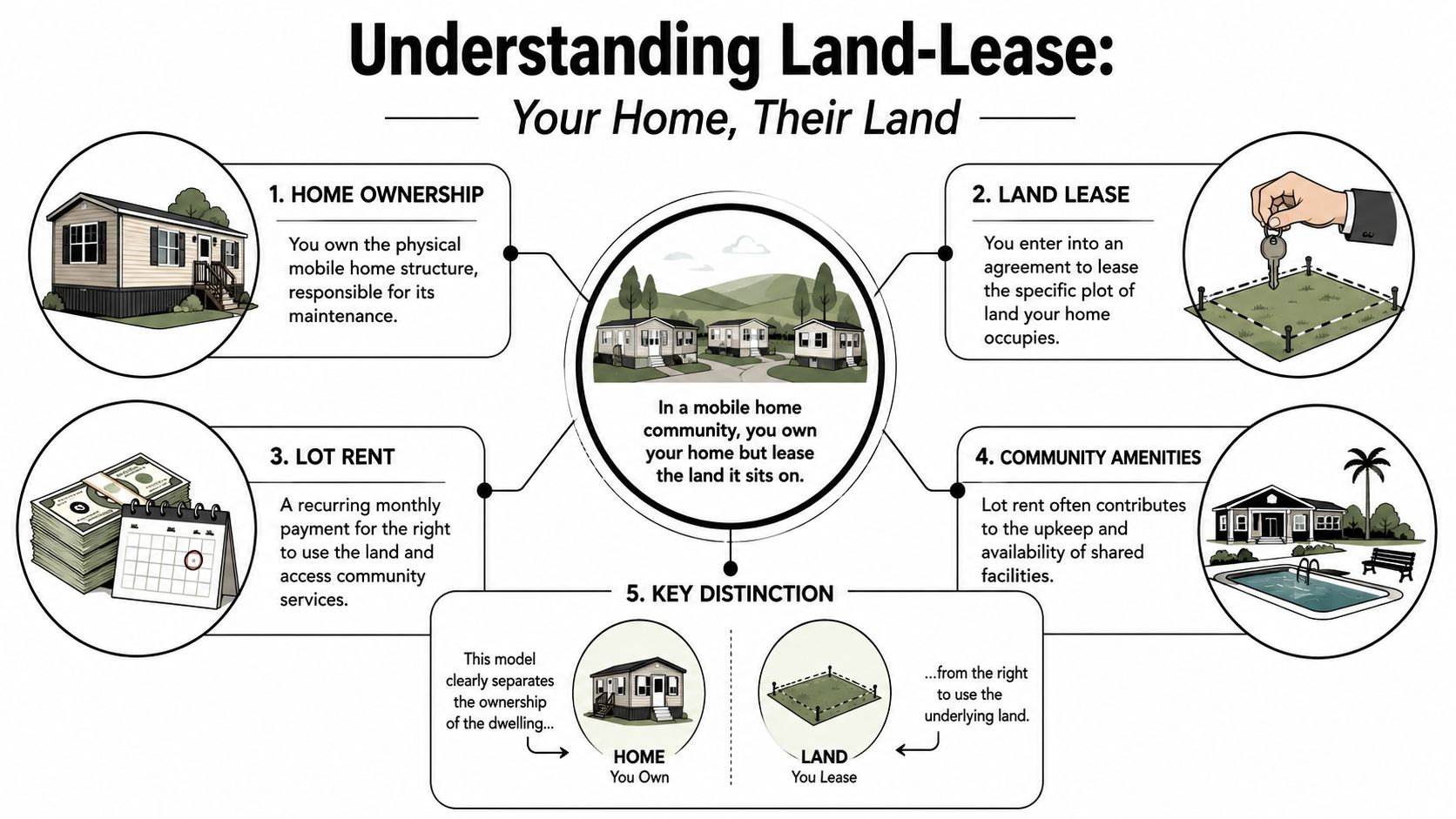
Because in many manufactured home communities, you bought the structure, not the dirt under it. Your right to keep that home in place comes from a land-lease agreement with the community owner. Under Texas Property Code Chapter 94, the leased lot is a defined part of the legal relationship, not an informal parking spot the owner can change on a whim.
What lot rent usually pays for
Lot rent pays for possession of the space itself. It may also cover shared infrastructure and services if the lease says so. That can include roads, common areas, trash, utility systems, or other community expenses. The exact mix matters.
Two communities can quote the same base rent and produce very different monthly bills. One may include water, trash, and maintenance of common areas. Another may charge those items separately through fees or pass-through billing. A plain-English guide on how trailer park rent works in Texas can help you spot those differences before a dispute starts.
That billing structure also explains why a rent dispute is not always just about the posted monthly amount.
Why ownership of the home does not eliminate lot rent
A manufactured home in a land-lease community works more like owning a building placed on leased ground than owning a traditional house on its own lot. The recurring charge is tied to continued use of the land. If the lease ends or the park claims a default, the problem is serious because moving a manufactured home is expensive, difficult, and sometimes not realistic at all.
That practical pressure is why lease terms matter so much in this part of Texas law. A park owner may have strong influence even when the resident owns the home outright.
| Question | General answer |
|---|---|
| Do you own the home? | Usually yes |
| Do you own the land under it? | Usually no |
| Why is lot rent charged? | For the right to keep the home on that leased lot |
| Can extra fees apply? | Yes, depending on the lease and written fee schedule |
Where owners get trapped
The first trap is focusing only on base rent. The second is assuming that if rent is current, the lot is secure. In this area of law, both assumptions can be costly.
A tenant can stay current on rent and still face removal efforts over rule violations, lease defaults, or notice issues. Texas manufactured housing disputes often turn on the paper trail. The lease, the rules, the fee schedule, and the notices usually decide who has the stronger position. That is also why the lesser-known double-notice problem for non-rent breaches catches so many residents off guard. A resident may correct the rule issue and still end up facing eviction if the notices and lease language line up against them.
What to review before you sign or renew
Ask for the full lease package, not just the monthly rate. Review the fee schedule, utility language, community rules, and renewal terms. What a Texas Lease Should Include is a useful checklist for that review.
Some readers also want broader context for why land access keeps producing recurring charges even when the structure is already paid for. This explanation of what is economic rent gives that background.
Decoding Your Lease Agreement Under Texas Property Code
If you're worried that a park manager can change the deal after you've moved your home onto the lot, that stress is understandable. In Texas, the lease usually decides the fight before anyone walks into court. For manufactured home communities, the controlling rules are often in Chapter 94, and small details in the lease package can decide whether a rent increase, rule enforcement action, or termination notice holds up.
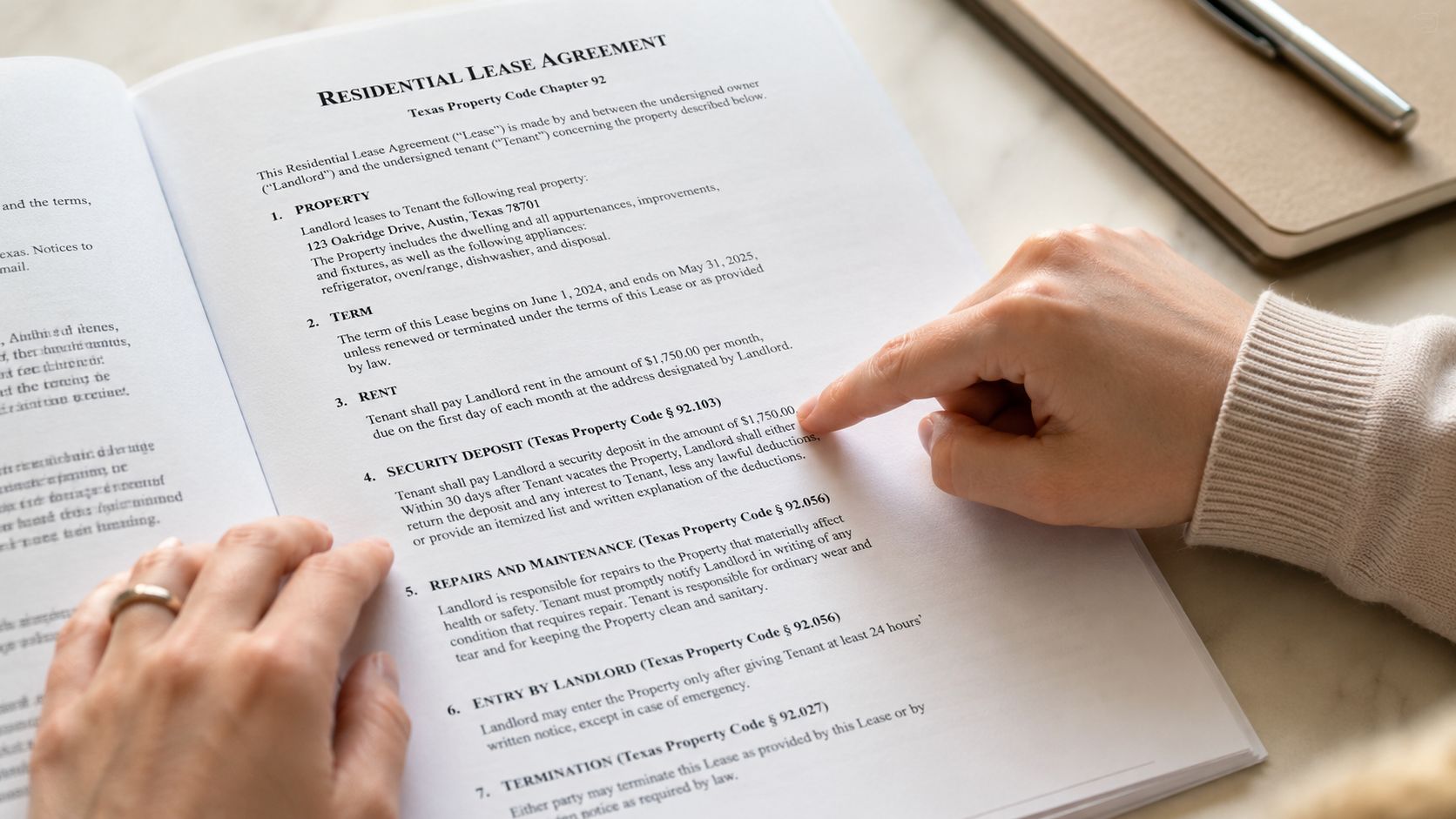
What your lease should actually tell you
A proper lease package should let you answer three practical questions without guessing. What do you owe each month? What rules can get you into default? How can the park change the terms?
Review the document set as a whole, not just the signature page. In these cases, I look for the written lease, the community rules, any separate fee sheet, utility billing terms, renewal language, and notice provisions. If one of those pieces is missing, the argument often becomes whether the resident ever got fair notice in the first place.
Pay close attention to these items:
- The lease term and renewal language. Month-to-month and fixed-term leases create different risks.
- All written rules. Pet limits, parking, guests, lawn care, storage, skirting, and exterior condition rules need to be in writing.
- Every charge beyond base rent. Water, sewer, trash, late fees, administrative fees, and pass-through charges should be stated clearly.
- The notice procedure. The lease should spell out how notices are delivered and when they take effect.
- Default language. Many residents often find themselves blindsided by these provisions. The lease may treat non-rent rule violations as separate defaults with their own cure process.
The safest lease is one that lets you calculate your real monthly cost and identify the acts that could trigger eviction.
Where lease review gets more technical
A manufactured home resident often focuses on the rent amount. I understand why. But from a legal standpoint, the more dangerous provisions are usually buried in the default and notice sections.
That matters because Texas manufactured housing disputes are not limited to missed payments. A rule violation, maintenance issue, unauthorized occupant claim, or other alleged breach can start the removal process. The double-notice trap often grows out of this part of the lease. A resident cures the first notice and assumes the problem is over. Then a later notice arrives based on another alleged violation within the period allowed by the lease or statute, and the case suddenly becomes much harder to defend. That is why the wording of the breach, cure, repeat-violation, and termination clauses deserves close review.
Readers who want a broader grounding in Texas landlord-tenant rules can review Texas Property Code Section 92 and related tenant protections. Chapter 94 governs many manufactured home community issues, but Section 92 still helps explain how Texas handles notice, deposits, repairs, and enforcement concepts more generally.
Problems that should make you stop and ask questions
Some lease terms are not automatically unlawful, but they raise risk and deserve a second look.
- Vague fee clauses that let the park add charges without a clear schedule
- Rule packets referenced but not attached
- Broad default language that gives the landlord wide discretion to label conduct a lease breach
- Notice clauses that conflict with what Texas law requires
- One-sided cure provisions that give the resident little time to fix a problem
- Terms that treat repeat non-rent violations harshly, which is often where the double-notice issue starts
A lease dispute does not always need a lawsuit first. In some cases, a negotiated solution keeps the tenancy intact and avoids the cost of moving a home. If the conflict is still at an early stage, some residents benefit from resolving conflicts with mediation before positions harden.
A practical file review before you sign or renew
Pull every document together in one folder. Then check them in this order.
- Signed lease. Confirm names, lot number, dates, and signatures.
- Community rules. Make sure you received the version the park says applies.
- Fee sheet and utility terms. Match every recurring charge to written language.
- Notice provisions. Check how the lease says notices must be given.
- Default and cure sections. Read these slowly. They often control rent disputes and non-rent disputes alike.
- Prior notices or warnings. If you are renewing after a prior dispute, keep those papers with the lease. They may matter later.
Clients often want a simple answer: "Can the park do this?" The honest answer is that it depends on the lease language, the notices, and whether the park followed Texas procedure. That is exactly why careful lease review at the front end saves so much money and trouble later.
Navigating Lot Rent Disputes and Eviction Risks
If you are holding a late notice and wondering whether the park can force you out before you can catch up, take a breath. In many Texas lot-rent cases, there is still a short window to act, but the value of that window depends on what the notice says, when you received it, and whether the amount claimed is correct.
National rent comparisons do not decide a Texas eviction case. What matters in my office is more practical. Is the charge authorized by the lease? Does the notice match the default? Did the park give the cure period required for nonpayment? Those questions usually matter more than whether another community charges less.
A visual overview helps if you're trying to understand the usual path from missed payment to court action.
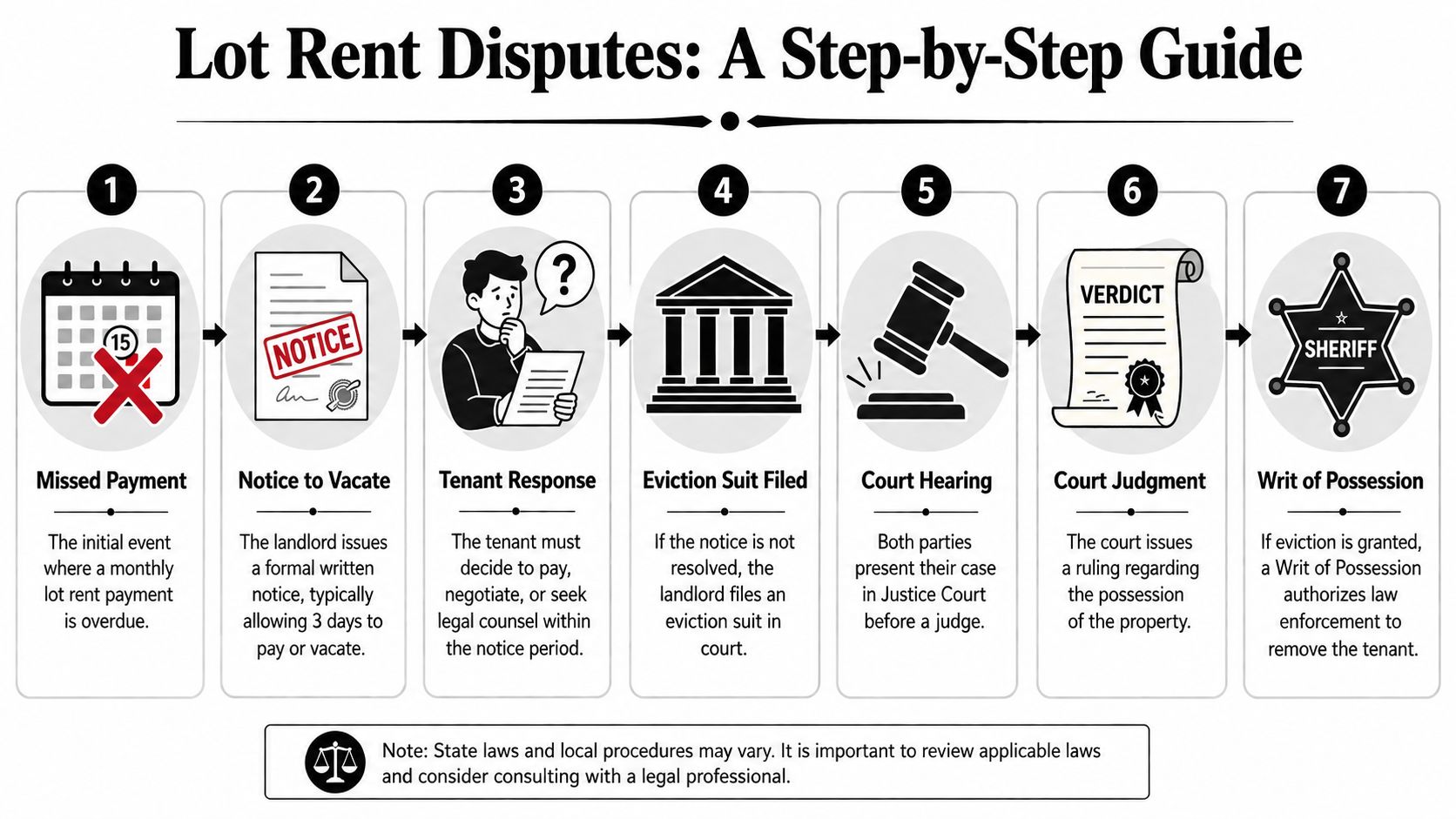
What happens after a missed payment
A typical rent dispute in a manufactured home community follows a predictable path, and small mistakes early can cost you the chance to stop it.
- The payment is missed. That usually puts the tenant in default under the lease.
- The park sends written notice. The paper notice controls. Verbal warnings and front-office conversations do not replace it.
- Texas law gives a cure period for nonpayment. As noted earlier, manufactured home tenants generally have a 10-day period after the required written notice to pay the full amount due or vacate.
- If the default is not cured, the park can file an eviction case. That case is usually filed in Justice Court.
- Removal still requires a court order. A park cannot lock you out, tow the home, or remove you from the lot without going through the legal process.
If you are still inside the cure period, speed matters.
Ask for a ledger. Compare it to your lease. Confirm whether late fees, utilities, or other charges were added correctly. Then respond in writing and keep proof of delivery. Clients who move quickly often have more room to resolve the problem than clients who wait for the court papers.
What landlords can do and what they cannot do
Park owners can enforce the lease, send default notices, refuse partial payments unless they agree otherwise, and file an eviction case if the rent default is not cured on time.
They still have limits. They cannot skip court. They cannot remove the home themselves. They cannot treat pressure, threats, or repeated phone calls as a substitute for the notice and filing steps Texas law requires.
That distinction matters in complaint-driven disputes too. If the park claims the problem is repeated disturbances, rule violations, or tenant conduct rather than unpaid rent, the process can become more complicated. This guide on Texas eviction based on tenant complaints explains how non-rent allegations can build toward removal even when the tenant does not think the issue is serious.
Some cases should be fought. Some should be settled quickly to protect the tenancy and avoid the cost of moving a manufactured home. If the relationship has not completely broken down, resolving conflicts with mediation can sometimes narrow the dispute before filing fees, court dates, and missed work start piling up.
A short video can also help you understand the practical flow of an eviction matter before you respond.
A real-world example
A tenant owns the home, misses lot rent after losing work hours, and receives a written default notice. If the tenant pays the full amount within the cure period and keeps proof of payment, a nonpayment eviction usually should not proceed on that rent default.
The mistakes I see are predictable. Partial payment with no written agreement. Reliance on a phone call with the manager. Waiting because the tenant assumes the park will "work with them." In court, assumptions carry very little weight. Receipts, notices, account ledgers, and written responses carry much more.
Rent cases are often fixable. The harder cases are the ones where the paperwork starts as a rent problem and later turns into a rule-violation problem with different notice rules. That is where many residents get blindsided, especially in manufactured home communities.
The Hidden Risk Eviction for Non-Rent Violations
Many tenants think rent is the only thing that can put their home at risk. It isn't. Some of the hardest cases involve non-rent violations such as pets, repeated noise complaints, yard condition issues, or breaking a community rule that the tenant thought had already been fixed.
That assumption causes trouble because rent cases and non-rent cases don't move the same way.
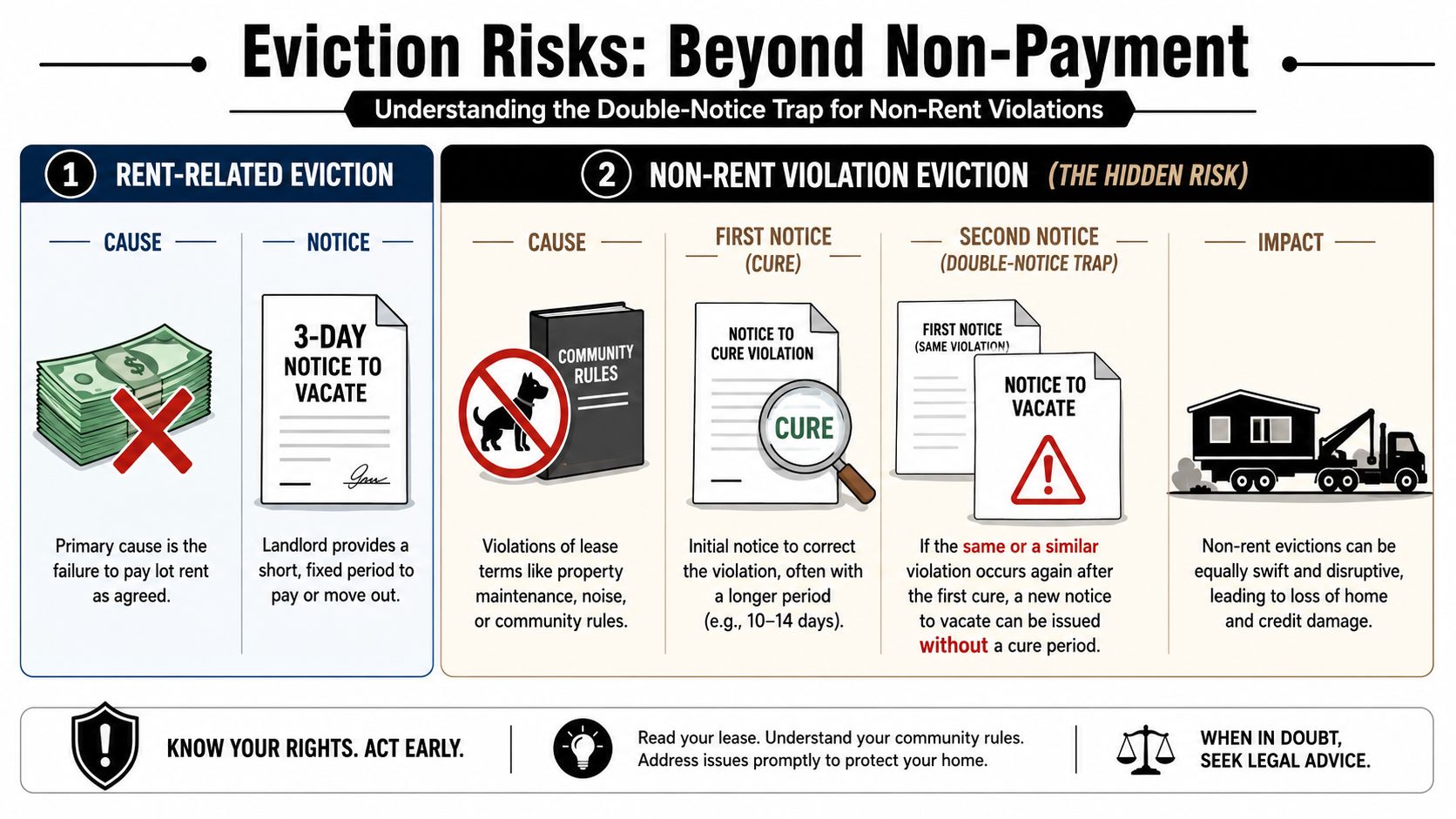
The double-notice trap
For rent delinquency, Texas law gives a familiar kind of relief. The tenant can stop the eviction by paying within the required cure window.
For certain non-rent breaches in manufactured home communities, the law is less forgiving. As explained by Texas Tenant Advisor's guide to mobile and manufactured homes, unlike standard lot rent delinquency where a 10-day notice allows payment to stop eviction, non-rent breaches require a mandatory 60-day notice of intent not to renew before termination can occur. That creates a serious vulnerability because a tenant may correct the problem and still face lease termination.
Why fixing the problem may not be enough
Take a simple example. A tenant gets in trouble for violating a pet rule or for repeated complaints about noise. The tenant removes the pet or quiets the activity and assumes the problem is over.
It may not be over.
The park owner may still proceed through the nonrenewal route after giving the required notice. That surprises people because they expect a rule violation to work like a late rent case. It doesn't always.
A tenant can cure a payment default with money. A non-rent breach may still cost the tenant the lease term itself.
How to respond if you get a non-rent notice
If the notice involves rules rather than unpaid rent, don't treat it casually. The first step is to read the exact wording and identify whether the park is claiming a lease breach, issuing a notice tied to nonrenewal, or both.
Use this checklist:
- Preserve the notice: Keep the envelope, date, and full document.
- Compare it to the rules: Match the accusation against the written community rules you received.
- Fix the issue anyway: Correction still helps, even if it doesn't guarantee renewal.
- Document the correction: Take photos, receipts, witness statements, or written confirmation.
- Get legal review quickly: An eviction attorney can identify whether the notice complies with the statute and lease.
Readers dealing with complaint-based notices sometimes also benefit from seeing how Texas law treats housing disputes over reported behavior. This discussion of whether an apartment can evict you for complaints in Texas provides useful context on complaint-driven enforcement.
Protecting Your Home and Rights with a Texas Tenant Lawyer
If you are sitting at your kitchen table with a notice from the park and a home you cannot easily move, the pressure is real. In Texas, one missed deadline or one badly handled response can turn a fixable dispute into a case about possession of the lot and, in practice, the future of your home.
This part of the case is rarely about broad legal theory. It is about documents, dates, and whether the park followed Chapter 94 and the lease exactly. I regularly see tenants hurt by two avoidable mistakes. They trust a verbal assurance from management, or they assume curing a problem ends the dispute. In mobile home parks, especially with non-rent violations, that assumption can be costly because of the double-notice trap discussed above.
A lawyer adds value by testing the paper trail against the law. That means reviewing the lease, the community rules, the notices, the notice dates, and any proof that the alleged violation was corrected. It also means identifying the park owner's true theory. Is this a nonpayment case, a claimed rule breach, a nonrenewal, or a combination designed to preserve more than one path to removal?
That distinction matters.
A rent case can often be resolved one way. A non-rent case may keep going even after the tenant fixes the problem, depending on the notice history and lease posture. That is the kind of issue tenants miss when they try to handle the matter through informal conversations with park staff. Landlords make mistakes too. A defective notice, the wrong timing, or inconsistent rule enforcement can weaken the case and change settlement posture quickly.
The Law Office of Bryan Fagan, PLLC handles Texas landlord-tenant matters involving leases, notices, disputes, and evictions. The practical work usually starts before the hearing. Counsel can preserve evidence, respond in writing, press for documents, assess whether the park complied with statutory requirements, and negotiate from a position tied to the record rather than assumptions.
Some cases also involve property damage. If a storm loss or repair dispute is affecting your ability to keep the home compliant with park rules, outside information on legal assistance for insurance claims may help you address that separate problem while your tenancy position is being protected.
The short answer to the lot rent question is usually yes. The better question is whether the park has handled the lease, notices, fees, and enforcement process the way Texas law requires. Careful legal review can protect your strong position, your timeline, and in some cases your right to stay put.