Dealing with a landlord dispute or eviction can be stressful, especially when your housing and your mental health support are tied together. A common Texas scenario goes like this. You sign a lease, notice a strict no-pets clause, and then panic because your emotional support animal helps you function day to day.
That fear is real for tenants. It also creates confusion for landlords and property managers who are trying to follow lease rules without violating fair housing law. The question is simple, but the answer has important limits. Can a landlord deny an ESA in Texas? Sometimes yes. Often no. It depends on the property, the documentation, and the specific animal.
This guide explains the rules in plain English for both sides. It also touches on the Texas Property Code, practical communication steps, and what works when an ESA request lands in the middle of a lease dispute or possible eviction.
Your Right to an ESA in a Texas Rental
A tenant in Texas might find the right apartment, pay the deposit, sign the lease, and then freeze when they reread the no-pets policy. If that tenant has anxiety, depression, PTSD, or another qualifying condition, the emotional support animal may not be optional in any practical sense. It may be part of how that person safely lives in the home.

That is where federal fair housing law matters. The Fair Housing Act serves as the foundational federal statute prohibiting landlords in Texas from denying Emotional Support Animals when a tenant provides valid documentation. This federal mandate covers approximately 95% of rental properties in the United States, including the vast majority of Texas housing markets, effectively nullifying no-pet policies and breed restrictions for ESAs, according to HUD's assistance animal guidance.
What this means in everyday leasing disputes
For most rentals, a no-pets clause doesn't end the conversation. It means the tenant must request a reasonable accommodation. If the request is supported by valid documentation and the property is covered by the FHA, the landlord usually has to consider the animal as an accommodation rather than a pet.
That distinction matters under Texas practice. A pet policy controls pets. It doesn't automatically control disability-related accommodations.
Practical rule: If you are asking to keep an ESA in Texas housing, frame it as a fair housing accommodation request, not as a request for a pet exception.
Texas landlords still have property rights, and tenants still have duties to prevent damage and follow the lease in other respects. But in covered housing, the legal starting point is not "the lease says no pets." The legal starting point is whether the law requires an accommodation.
A useful starting point for tenants and landlords
If you're trying to understand the parts many people miss, Refresh Psychiatry's ESA housing guidance is a helpful practical read. For the Texas-side framework on rental obligations generally, it also helps to review Texas Property Code Section 92 basics, because ESA disputes often happen alongside repair issues, lease enforcement, entry disputes, or threatened eviction notices.
ESA vs Service Animal The Critical Legal Distinction
The biggest mistake I see in ESA disputes is that the tenant, the landlord, or both use ESA and service animal as if they mean the same thing. They don't. The legal rights overlap in some ways, but they come from different rules and apply in different settings.
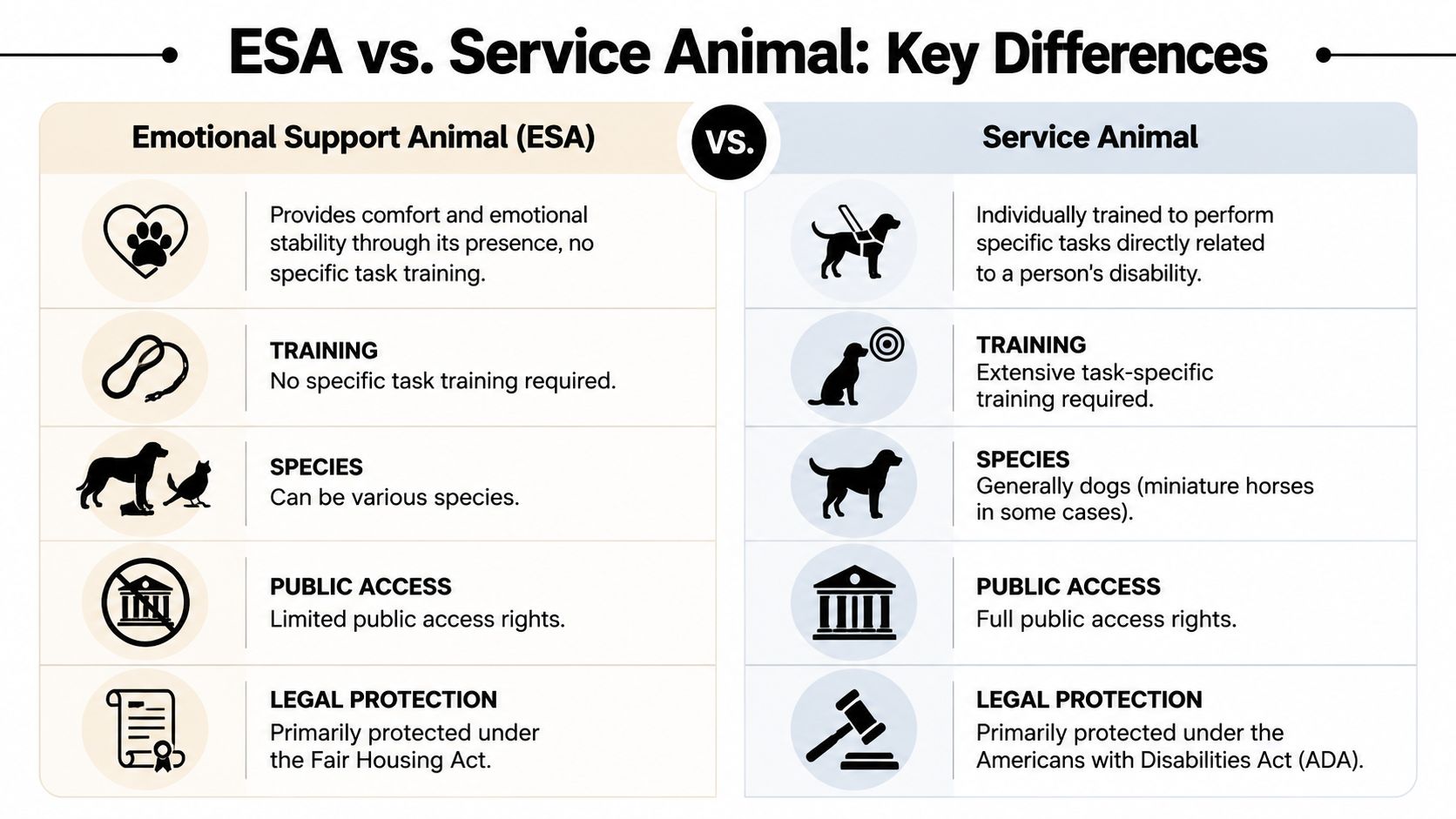
The short version
A service animal is generally a dog trained to perform specific tasks directly related to a disability. Think of a dog trained to guide a visually impaired person or perform another concrete disability-related task.
An emotional support animal provides comfort or emotional stability through its presence. It doesn't need task-specific training to qualify for housing protection.
Here is the practical comparison:
| Issue | Emotional Support Animal | Service Animal |
|---|---|---|
| Main legal setting | Housing | Public access and housing |
| Training required | No specific task training required | Specific disability-related task training |
| Species | Can be various species | Generally dogs |
| Public access rights | Limited | Broader rights in many public places |
| Main legal framework | Fair Housing Act | Americans with Disabilities Act |
Why landlords get tripped up
Landlords often hear "support animal" and assume the tenant must show a vest, certificate, or training record. That isn't how ESA housing law works. In housing, the key question is whether the tenant has a valid disability-related need supported by proper documentation.
Under the FHA, a landlord cannot deny an Emotional Support Animal solely based on a no-pets policy, breed restrictions for regular pets, or the requirement of a pet deposit or fee. Those are invalid reasons for denial, and an ESA is legally not considered a pet when requested as a reasonable accommodation, as explained in this Texas ESA housing discussion.
A visual overview helps if you're sorting out these categories:
Why tenants get tripped up
Tenants sometimes assume ESA status gives them public access rights everywhere. It doesn't. Housing law is the main protection at issue here. That means a tenant may have a valid ESA for an apartment and still not have the same rights in stores, restaurants, or other non-housing settings.
A strong ESA request for housing can still fail in public access situations because the legal framework is different.
That distinction also keeps a tenant from oversharing. For an apartment, the issue is the housing accommodation request. It is not a debate about ADA task training, public entry, or whether the animal wears a special vest.
When a Texas Landlord Must Approve an ESA Request
Once the tenant makes a proper housing request, the legal question is whether the landlord must approve it. In many Texas rentals, the answer is yes if the request is supported and the animal does not create a legally recognized problem.
What makes the request valid
The tenant should submit a written request for reasonable accommodation and attach documentation from a licensed mental health professional. The purpose of that documentation is to confirm a disability-related need for the animal. It is not a license for bad behavior, and it is not a free pass from all lease rules.
The landlord doesn't get to treat the ESA as an ordinary pet. Texas law aligns with federal standards, making it illegal for landlords to charge additional rent, pet fees, or security deposits for ESAs. HUD enforcement records also show that housing discrimination complaints related to assistance animals in the United States increased by over 40% between 2018 and 2022, according to HUD's enforcement update.
What the landlord still can enforce
Approving an ESA doesn't mean the tenant can ignore the lease. A tenant still must:
- Control the animal: Excessive noise, aggression, or repeated disruption can create separate lease issues.
- Prevent damage: The tenant remains responsible for actual damage caused by the animal.
- Follow neutral rules: Waste disposal, leash rules in common areas, and basic sanitation rules may still apply if enforced fairly.
A practical example
Suppose a tenant in Houston signs a lease for a no-pets apartment, later receives treatment, and then submits an ESA letter requesting accommodation for a dog. If the housing is covered and the documentation is valid, the landlord usually must approve the request. The landlord can't add pet rent just because the lease bans pets.
By contrast, if the tenant refuses to clean up after the animal or allows repeated property damage, the landlord may still enforce lease terms based on conduct. That is a behavior issue, not a simple ESA-status issue.
What works: A prompt written request, limited but valid supporting documentation, and a tenant who keeps the animal under control.
What doesn't: A text message saying "my dog is an ESA now," with no supporting letter and no formal accommodation request.
Where the Texas Property Code fits
The Texas Property Code often enters the picture when an ESA dispute turns into a notice to vacate, a threat of lockout, or a broader lease violation claim. The ESA issue may arise under fair housing law, but the enforcement fight often lands in the same practical place as any other landlord-tenant dispute. That is why both tenants and landlords should document each step carefully and respond in writing.
Valid Reasons a Landlord Can Legally Deny an ESA
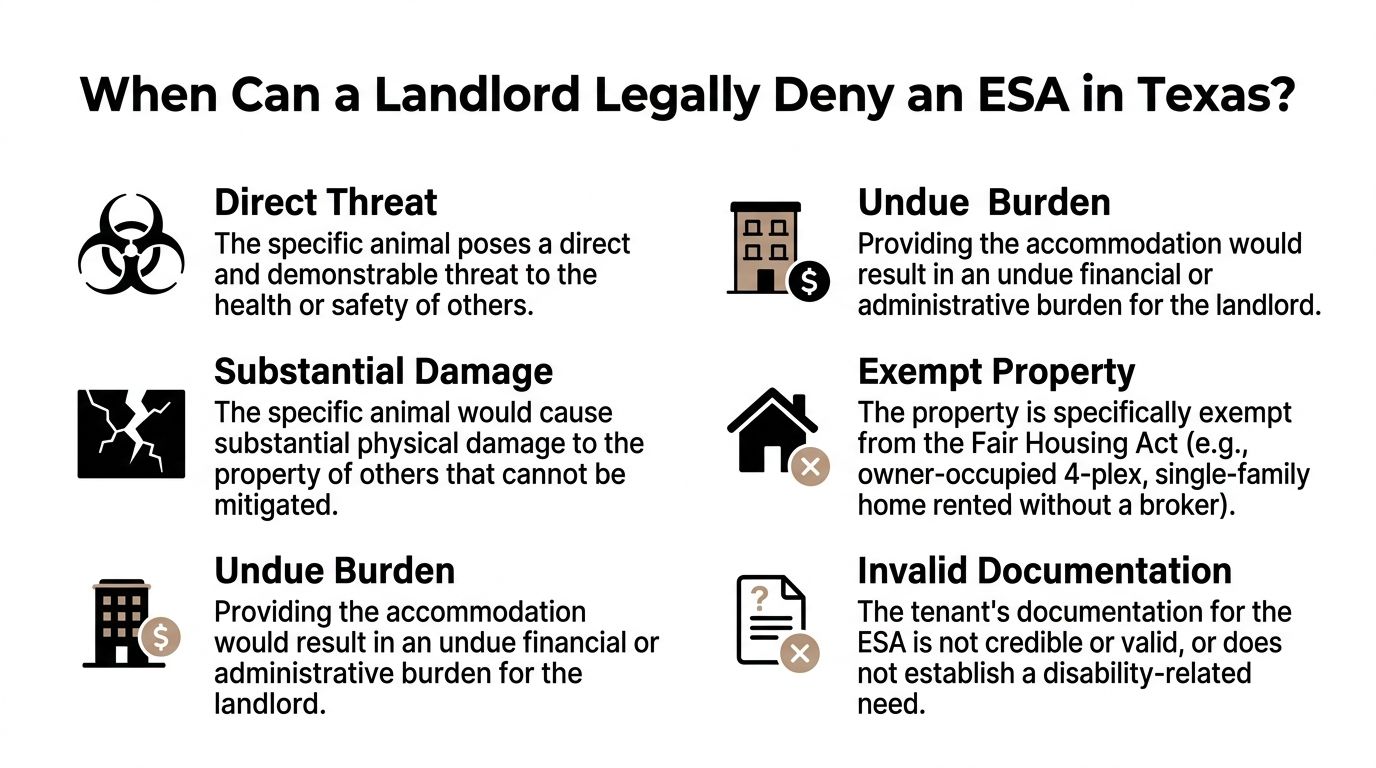
A landlord can deny an ESA in Texas, but the legal reasons are narrow. The law does not allow blanket refusals just because management dislikes animals or because the lease has a no-pets rule. The denial must fit a recognized exception and should be supported by facts.
Invalid or unreliable documentation
If the tenant doesn't provide credible documentation showing a disability-related need, the landlord may deny the request. A landlord may review whether the letter is verifiable and comes from a licensed professional.
This point matters more than many tenants realize. Benchmark data from HUD enforcement indicates that 85% of denied ESA claims in Texas are overturned when the tenant provides a proper letter from a licensed psychiatrist or psychologist, and the legal mechanism for denial under the FHA hinges on the undue financial or administrative burden and substantial property damage exceptions, both of which require documented evidence, according to HUD fair housing materials.
Direct threat based on the specific animal
A landlord may deny an ESA if the specific animal poses a direct, documented threat to health or safety that cannot be reduced by another reasonable step. The key phrase is specific animal. The analysis isn't supposed to rest on breed assumptions or generalized fear.
For example, a landlord shouldn't deny a dog merely because the breed appears on a restricted-pet list. But if the same dog has a documented history of aggression at the property, repeated attacks, or behavior that puts others at risk, that may support a lawful denial.
Substantial property damage
This is another fact-heavy exception. A landlord needs more than a suspicion that "dogs ruin floors." There should be evidence that the particular animal has caused serious damage before, or that there is a concrete reason substantial damage is likely and cannot be managed.
A common middle ground is to address the behavior first. If a young dog is still having accidents, practical containment and cleanup steps may solve the problem. In some cases, resources like Pet Magasin's dog diaper help may help a tenant reduce avoidable conflict while the accommodation request is pending or after approval.
Undue burden and exempt housing
The undue financial or administrative burden exception is real, but it is not easy to prove in ordinary residential leasing. A landlord needs a concrete operational reason, not inconvenience.
Some housing is also exempt from the FHA. Examples can include certain single-family homes rented without a broker and some owner-occupied buildings with four or fewer units. Those exemption questions can become technical quickly. If a landlord is trying to evaluate risk, or a tenant believes the exemption is being misused, it helps to review broader Texas landlord responsibilities alongside the fair housing issue.
A lawful denial is usually built on documentation, property status, or specific animal behavior. An unlawful denial is usually built on assumptions.
Quick decision guide
- No-pets lease only: Not enough by itself.
- Breed restriction only: Not enough by itself.
- Valid letter missing: May justify denial.
- Specific dangerous behavior documented: May justify denial.
- Substantial unmitigable damage risk: May justify denial.
- FHA-exempt property: May justify denial.
How to Request an ESA and How Landlords Should Respond
The smoothest ESA disputes are the ones that never become disputes at all. Procedure matters. A tenant who submits a clean written request gives the landlord something concrete to evaluate. A landlord who answers promptly and specifically reduces the chance of a discrimination complaint.

For tenants
A tenant doesn't need to disclose ESA status before signing the lease. But once the need exists, the tenant should make the request clearly and in writing. Under the FHA, a landlord cannot deny an ESA if the tenant provides a verifiable ESA letter from a licensed mental health professional. Tenants do not need to disclose their ESA status before signing a lease but must request accommodation upon diagnosis, and landlords must respond within a reasonable time, often interpreted as 10 to 30 days, as noted in the Department of Justice Fair Housing Act overview.
A simple tenant process
Write the request
Keep it short. You are asking for a reasonable accommodation for an assistance animal under fair housing law.
Attach supporting documentation
Include the ESA letter or similar supporting document from the licensed professional.
Send it in a trackable way
Email is usually fine if the landlord uses it for lease communication. Save the sent email and any attachments.
Ask for a written response
That keeps the timeline clear and reduces later disagreement.
Here is sample language a tenant can use:
I am requesting a reasonable accommodation to keep my emotional support animal in my rental home. The animal is necessary for me to have an equal opportunity to use and enjoy the dwelling. I have attached supporting documentation for your review. Please confirm in writing that you received this request.
For landlords
A landlord may verify the documentation, especially if the disability-related need is not obvious. But the landlord should stay in the lane of fair housing review, not demand broad medical disclosure.
What landlords should do
- Acknowledge receipt quickly: Silence creates risk.
- Review only what is necessary: Ask for clarification if the documentation is incomplete or not verifiable.
- Avoid medical fishing expeditions: Detailed records and diagnosis histories are usually not the right ask.
- Make an individualized decision: Focus on the specific request and the specific animal.
A landlord approval can be simple:
We have reviewed your request for a reasonable accommodation and approve your assistance animal in the property, subject to your ongoing responsibility for animal control, sanitation, and any actual damage caused.
A lawful denial should also be specific. It should identify the reason, such as invalid documentation or a documented safety concern, and preserve the paper trail.
What works and what escalates conflict
The best tenant requests are calm, complete, and documented. The worst are rushed phone calls made after a lease violation notice has already gone out.
The best landlord responses are prompt and fact-based. The worst are blanket statements like "we never allow dogs" or "company policy says no animals."
A common real-world pattern
In practice, many ESA conflicts aren't really about the law. They're about timing and communication. The tenant waits until after a complaint from a neighbor. The manager reacts as if the tenant is sneaking in a pet. Positions harden.
That is often the point where a neutral review helps. The Law Office of Bryan Fagan, PLLC handles Texas landlord-tenant disputes involving leases, notices, and property conflicts, which can include evaluating whether an ESA dispute is really a fair housing issue, a lease enforcement issue, or both.
Landlord-side advice: Treat every ESA request as a fair housing file, not a pet-policy exception.
What to Do If Your ESA Request Is Wrongfully Denied
If your ESA request was denied and the reason doesn't fit the law, don't assume the landlord's first answer is the final answer. Many disputes can still be corrected if you respond clearly and keep the record organized.
Start with a written follow-up. Restate that you are requesting a reasonable accommodation and explain why the stated reason for denial is not valid. Ask the landlord to reconsider in writing. If you need a procedural guide, this overview on how to file a complaint against a landlord in Texas is a useful next step.
A practical response path
- Preserve the paperwork: Save the lease, your request, the ESA letter, emails, texts, and any notices to vacate.
- Send one clean rebuttal: Avoid angry messages. Focus on the legal issue and missing facts.
- Consider an agency complaint: A tenant can file with the appropriate fair housing enforcement channel if the denial appears unlawful.
- Get a case evaluation if the facts are mixed: Exempt-property questions, alleged animal behavior issues, or overlapping eviction notices can change the analysis.
For both tenants and landlords, When to Consult a Texas Landlord-Tenant Attorney can help evaluate the strength of the position before the dispute turns into a formal claim or court case.
If the denial is tied to a notice to vacate, lockout threat, or active eviction filing, timing matters. That is when speaking with a Texas landlord tenant lawyer or eviction attorney can be especially important, because the ESA issue may become one part of a larger possession case under the Texas Property Code.
If you need help with an eviction, lease issue, or rental dispute, contact The Law Office of Bryan Fagan, PLLC for a free consultation today.