Dealing with an eviction notice can be incredibly stressful—but understanding your rights under Texas law can make all the difference. Fighting an eviction in Texas starts the moment you find that Notice to Vacate. It’s not just about showing up in court—it's about carefully reviewing the notice for mistakes, documenting everything, filing a proper "Answer" with the court, and building a case to defend your home.
What to Do Immediately After Getting an Eviction Notice

Seeing that official paper taped to your door can send anyone into a panic. But that "Notice to Vacate" isn't a final order—it's the starting pistol for the eviction process. It's a warning, not a command to leave immediately.
Ignoring it is the single biggest mistake you can make. The clock is officially ticking, and what you do in these first few days is absolutely critical for building your defense. Most of these notices give you a very short window, often just three days, to either fix the alleged problem (like paying late rent) or move out.
Your First Steps After Receiving the Notice
Your first job is to put that notice under a microscope. The Texas Property Code Section 24.005 lays out strict rules for what a valid notice must include, and landlords often make mistakes. Any error, big or small, could be enough to get the entire eviction case thrown out.
- Check for Errors: Read every single word. Is your name spelled right? Is the address correct? Does it clearly and accurately state the reason for the eviction? If it’s for non-payment, is the amount they’re demanding correct? A notice that’s vague, inaccurate, or sloppy might not hold up in court.
- Document Everything: This is non-negotiable. Write down the exact date and time you found the notice. How did it get to you? Was it taped to your front door, handed to you, or sent by mail? Snap a picture of the notice exactly where you found it. This isn't just paper; it's evidence.
- Do Not Move Out: Let’s be clear: this notice is not a court order. You have the absolute right to stay in your home until a judge says otherwise after a formal hearing. Packing up and leaving now is giving up before the fight even begins.
While you're taking these steps, it's also smart to look into financial aid. Even if you're not in Arizona, seeing how programs like emergency rent assistance in Maricopa County work can give you an idea of what kind of support might be available in your area.
A Real-World Scenario
Think about Maria, a tenant who gets a Notice to Vacate for unpaid rent. Her heart sinks, but she forces herself to look closer. The notice claims she owes rent for last month—a month she knows she paid.
Instead of panicking, she pulls up her bank statement, finds the cleared check transaction, and saves a screenshot. She then takes a timestamped photo of the notice on her door. Just like that, Maria has started building a rock-solid defense based on her landlord's mistake.
This first phase is all about staying calm and treating the notice like the legal document it is. For a deeper dive, read our guide on how to properly respond to an eviction notice. A Texas landlord-tenant lawyer can spot these critical errors from a mile away and help you use them to your advantage.
Know Your Legal Protections Under the Texas Property Code
The Texas Property Code isn't just a dense legal textbook—it's your most powerful shield in an eviction fight. Knowing the specific rules your landlord must follow can completely change the dynamic of your case, shifting the power back to you.
Too many tenants feel cornered when they get an eviction notice, assuming they have no choice but to pack their bags. But Texas law provides very specific protections that can stop an eviction cold if your landlord has dropped the ball on their legal duties.
The Landlord’s Duty to Repair
One of the strongest defenses a tenant has is the landlord's duty to repair. This isn't just a suggestion; it's the law. Under Texas Property Code Section 92.052, your landlord has to make a diligent effort to fix any problem that seriously threatens your physical health or safety.
This isn’t about minor annoyances like a squeaky door. We’re talking about major issues that make your home unlivable:
- A broken heater in the middle of a January freeze.
- A leaking roof that’s causing water damage and mold.
- Shoddy wiring that’s a clear fire hazard.
- No hot water for days on end.
If you’ve given your landlord proper written notice and they still haven’t made these critical repairs, you could have a solid defense against eviction—especially if you withheld rent because of it. But be careful, you have to follow the legal procedures to the letter for this to work.
Protections Against Landlord Retaliation
Ever asked your landlord to fix something major, only to get an eviction notice slapped on your door a week later? That’s not just unfair—it could be illegal retaliation.
Texas Property Code Section 92.331 explicitly protects you from this. A landlord cannot legally evict you for exercising your rights, like formally requesting repairs, joining a tenants' union, or reporting a code violation to the city.
If you can connect the dots and show that the eviction was a direct response to you standing up for your rights, a judge may see it as retaliation and rule in your favor. This law exists so you don’t have to choose between a safe home and a home at all.
Here's a real-world example: Your apartment has a serious mold issue from a pipe leak. You do everything right—you send a certified letter requesting repairs to create a paper trail. A week later, you get a "Notice to Vacate" for a flimsy, made-up lease violation. This is a classic retaliation scenario and can become the foundation of a very strong defense.
Your Right to Quiet Enjoyment
While it isn't a single statute number you can point to, the "covenant of quiet enjoyment" is a promise baked into every single Texas lease. It means your landlord has to provide a home where you can live in peace, free from unreasonable disruptions.
This covers everything from a neighbor's out-of-control parties to your landlord harassing you or showing up unannounced. If your landlord is making your life miserable to try and force you out, they're likely violating your right to quiet enjoyment, and that can be used as a defense in court.
To give you a better grasp of these critical rights, here’s a quick summary of what the Texas Property Code provides.
Key Tenant Rights in Texas Eviction Cases
| Tenant Right | Texas Property Code Section | How It Can Help You Fight Eviction |
|---|---|---|
| Right to Repair and Deduct | Sec. 92.0561 | Allows you to repair serious issues and deduct the cost from rent if the landlord fails to act, but you must follow strict rules. |
| Protection from Retaliation | Sec. 92.331 | If your landlord tries to evict you within 6 months of you requesting a repair or reporting a code violation, the law presumes it's retaliation. |
| Right to Terminate Lease | Sec. 92.056 | You may have the right to end your lease without penalty if a landlord fails to repair a condition that affects your health and safety. |
| Landlord Liability | Sec. 92.052 | Your landlord is legally required to repair conditions that affect your physical health and safety. Their failure can be a powerful defense. |
Understanding these fundamental protections is the first step toward building a successful defense.
The eviction crisis isn't just about tenants falling behind. National trends show affordability is a massive factor, but many cases actually turn on legal mistakes made by landlords. Cities across the country are seeing record eviction filings. For instance, the Atlanta metro area saw filings against nearly 25% of its rental households in a single year. The problem is hitting Texas hard, too—Austin saw a 32% increase in eviction filings last year, while Houston had over 76,698 filings.
When landlords are filing evictions at these rates, knowing your rights is more critical than ever. For a deeper dive into your legal protections, check out our guide on Texas tenant rights under the Property Code. Better yet, let an experienced Texas eviction attorney apply these laws to the specific facts of your case.
How to Build Your Defense and Gather Winning Evidence
In an eviction court, the story that wins is the one with the best proof. Your landlord will show up with their version of events, and a judge will expect you to do the same. This isn't about who tells the most compelling story—it's about who can back it up with cold, hard facts.
Building a strong case doesn't start the day you walk into the courtroom. It begins the moment you even suspect a dispute is coming. From that point on, your most important job is to become a meticulous record-keeper. Every text, every photo, every piece of paper can become a crucial part of your defense.
The Most Powerful Types of Evidence
Think of this as building a case file. You're looking for anything and everything that proves your side of the story or, just as importantly, pokes holes in your landlord's claims. Solid evidence is what turns a "he said, she said" argument into a clear-cut case.
Here’s what you need to start gathering right away:
- Your Lease Agreement: This is the rulebook. The judge will look at this first to understand everyone's rights and responsibilities. It’s the foundation of your entire case.
- All Written Communication: Every single text message, email, and formal letter between you and your landlord matters. This paper trail creates a timeline and proves who said what and when, especially if you notified them of issues.
- Photographs and Videos: A picture is undeniable. Get clear, date-stamped photos and videos of everything—unmade repairs, property damage, unsafe conditions. This is proof the judge can see with their own eyes.
- Rent Payment Records: Collect your bank statements, rent receipts, or canceled checks to show you've paid your rent on time. If you paid in cash and didn't get receipts, bank withdrawal slips from around the due date can help establish a pattern.
- Witnesses: Don't underestimate the power of a neutral third party. A neighbor who can testify about seeing the unrepaired leak, witnessing harassment, or confirming other parts of your story can be incredibly persuasive.
This documentation is your best defense. It moves the argument away from personal feelings and focuses the judge on the facts.
Real-World Scenario: Proving Your Case
Let's say you get an eviction notice for an "unauthorized pet." The landlord says your dog is a violation of the lease, but your dog is a registered emotional support animal (ESA).
Just telling the judge this is not enough. You have to prove it.
Your winning evidence would include:
- The formal letter from your doctor or therapist explaining your need for an ESA.
- Copies of the emails you sent to the landlord before the dog moved in, where you provided the doctor's letter and formally requested a reasonable accommodation under the Fair Housing Act.
- Any replies from the landlord acknowledging your request, whether they were texts or emails.
With this evidence, you've completely changed the narrative. You’re no longer a tenant breaking the rules—you’re a tenant who followed the law and is now facing what looks like an illegal, retaliatory eviction.
Create a Clear Timeline of Events
Once you have your proof, organize it. The best way to present your case is with a simple, chronological timeline. It helps you tell a clear story and helps the judge follow along without getting lost in the details.
Start at the beginning of the problem and list every key event with its date.
- May 1: Notified landlord via text about a water leak under the sink. (Include a screenshot of the text).
- May 8: Sent a follow-up certified letter after getting no response. (Include the certified mail receipt).
- May 15: Landlord sent an angry email refusing to make repairs. (Include a printout of the email).
- May 20: Received a Notice to Vacate for non-payment, even though rent was paid on the 1st. (Include the notice and your bank statement showing the payment).
This timeline becomes the backbone of your defense. It transforms a messy dispute into a straightforward narrative that a judge can easily understand. A well-prepared, evidence-backed defense is your absolute best shot at fighting an eviction in Texas.
Navigating the Texas Eviction Court Process with Confidence
Walking into a courtroom can feel overwhelming, but knowing what’s coming takes the fear out of it. The Texas eviction process kicks off in the Justice of the Peace (JP) court, a place with its own set of rules. Understanding them is your key to standing up for your rights.
The first move you have to make after your landlord sues you is filing an "Answer" with the court. This is just your formal, written response to their lawsuit. You must file this Answer by the deadline on your court papers. This is non-negotiable. If you miss it, the landlord almost always wins by default, and you never even get to tell your side of the story.
Filing Your Answer and Getting Ready for Court
Your Answer doesn't need to be filled with legal jargon. It can be a simple statement denying the landlord's claims and listing your defenses—things like improper notice, landlord retaliation, or their failure to make critical repairs.
Once your Answer is filed, it's time to prep for your day in court. This is all about turning your evidence into a clear, convincing story for the judge.
- Get Your Documents in Order: Line up your photos, emails, rent receipts, and your timeline chronologically. Make at least three copies of everything—one for you, one for the judge, and one for your landlord's side.
- Rehearse Your Story: You’ll get a chance to speak directly to the judge. Practice explaining your side clearly and concisely. Stick to the facts, reference your evidence, and leave the emotion out of it.
- Know the Courtroom Rules: The little things go a long way. Dress respectfully. Show up early. Always, always address the judge as "Your Honor." Stand when you speak, be polite, and never interrupt anyone.
The best defense is built long before you step inside the courtroom. It’s a methodical process.
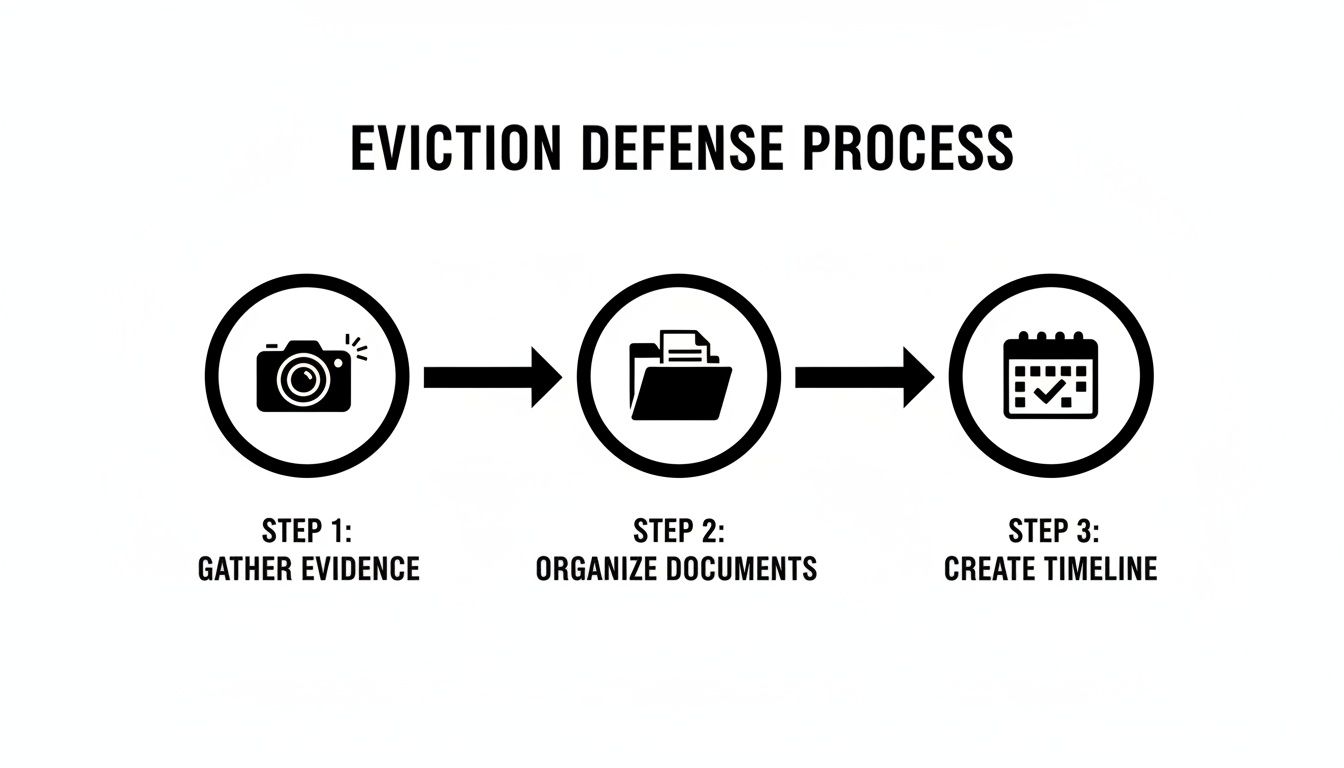
As you can see, it comes down to gathering your proof, organizing it logically, and building a timeline that makes your case impossible to ignore.
Presenting Your Case to the Judge
When it’s your turn to speak, all that preparation will pay off. Your job is to calmly walk the judge through what happened, using your organized documents to back up every point you make.
Here’s a real-world example: Let's say a tenant, Maria, is facing eviction for not paying rent. When her turn comes, she approaches the judge and says, "Your Honor, I have a timeline showing I legally notified my landlord about a broken HVAC system in the middle of August." She then presents photos of the unit, a copy of the certified mail receipt for her repair request, and temperature logs. She explains she withheld rent only after the landlord ignored her formal notice, which is a remedy available under the Texas Property Code. By presenting clear, organized proof, Maria shows the judge she acted within her legal rights.
This kind of fact-based presentation is far more powerful than simply saying, "My landlord is a bad person." It shows respect for the court and proves you have a legitimate defense. You also have the right to question your landlord. Prepare a few direct questions based on your evidence to poke holes in their claims.
This isn't just a local problem. The eviction crisis has hit the entire country hard. In North Carolina, for instance, 202,861 eviction cases were filed in the 2024-2025 fiscal year alone—the highest number ever recorded. This shows just how crucial it is for both tenants and landlords to get the process right. For landlords, a simple procedural mistake can get their case thrown out. For tenants, knowing the law is the only way to build a valid defense. These numbers reflect tough economic times, but a huge number of cases are won or lost simply based on who followed the law to the letter. You can read more about the national surge in eviction filings and its causes.
Understanding the Possible Outcomes
After hearing both sides, the judge will make a decision. There are a few ways it can go:
- You Win: The judge rules in your favor. The eviction is dismissed, and you get to stay in your home.
- You Lose: The judge rules for your landlord and grants them a "judgment for possession." You will then have five days to either move out or file an appeal.
- A Settlement is Reached: Sometimes, you and the landlord can agree to a solution. This might involve you agreeing to move out by a set date if the landlord drops the lawsuit, which keeps a formal eviction off your record.
If you lose in JP court, you have the right to appeal to the County Court. But an appeal is a complex legal battle with its own strict deadlines. At that point, getting help from an attorney who specializes in tenant rights isn't just a good idea—it's essential.
When You Should Hire a Texas Eviction Attorney
While you can represent yourself in a Texas eviction case, some fights are too high-stakes to go it alone. Knowing when to call in a professional isn't giving up—it's a smart, strategic move to level the playing field and protect your home.
Think about it: your landlord likely has experience with the eviction process, or they've hired an attorney who does. Walking into that courtroom by yourself is like stepping onto the field without a coach, while the other team has a full staff. An experienced Texas eviction lawyer is your advocate, your strategist, and your best defense.
Situations That Demand Legal Expertise
Some red flags are too big to ignore. If your eviction case involves any of the following, hiring an attorney is no longer just an option; it's a necessity for a fighting chance.
- Your Landlord Has a Lawyer: The moment your landlord brings in an attorney, you are at a serious disadvantage. They know the procedural rules, evidence standards, and legal arguments that win cases. Trying to counter that on your own is an uphill battle from the start.
- The Lease Is Complicated: That long, dense rental agreement can be a minefield of legal jargon. An attorney can dissect the contract and find defenses hidden in the fine print that you would never have known existed.
- You're Being Accused of Illegal Activity: An eviction based on allegations of criminal conduct carries consequences that go far beyond losing your housing. The stakes are just too high to handle without a legal professional who can protect your rights and your reputation.
- You're Facing Discrimination or Harassment: If you believe this eviction is retaliation for you requesting repairs or is based on your race, religion, family status, or another protected class, you need help. An attorney can build a powerful case for illegal landlord conduct.
A lawyer does more than just speak for you in court. They handle the complex paperwork, meet critical deadlines, and can often negotiate a settlement that keeps an eviction off your record entirely.
Using Data to Build a Stronger Case
The world of Texas evictions is always shifting, and a lot of that is driven by data. We know that roughly 7.8 out of every 100 renter households face an eviction filing each year, but what happens next varies wildly. This is where local knowledge becomes a powerful tool.
A skilled eviction attorney uses this kind of information to understand how judges in your specific court tend to rule and to build a defense strategy backed by real-world statistics. We follow these trends closely, using data from sources like Governing’s analysis of the housing crisis, to build evidence-based cases grounded in current Texas law.
The No-Risk First Step: A Free Consultation
Perhaps the best reason to consider a lawyer is that you can get an expert opinion without any financial risk. A free consultation is your chance to have a Texas landlord tenant lawyer look at the facts of your case and give you an honest, straightforward assessment.
You’ll walk away from that meeting knowing:
- Was the eviction notice you received even legally valid?
- What defenses do you have under the Texas Property Code?
- What are the most likely outcomes in your specific situation?
- How exactly could an attorney help you fight back?
This is your opportunity to get clarity and a concrete plan before you commit to anything. You'll understand your legal options, whether you decide to hire the firm or not. Don't think of legal help as a last resort—it's a powerful, proactive tool for protecting your rights.
If you're trying to figure out where to turn, you can learn more about how to find an eviction attorney near you in our detailed guide. An experienced lawyer ensures your side of the story is heard, your evidence is presented correctly, and your rights are aggressively defended.
Common Questions We Hear About Texas Evictions
When you're facing an eviction, a hundred questions are probably running through your mind. It's confusing and overwhelming. To give you some clarity right now, we’ve put together answers to the questions we get asked most often by Texas tenants.
How Fast Is the Eviction Process in Texas?
This is usually the first thing people want to know, and the answer is: incredibly fast. Texas eviction law is built for speed, which almost always benefits the landlord.
Once your landlord files the eviction lawsuit, you can expect a hearing in the Justice of the Peace (JP) court within 10 to 21 days. If the judge sides with your landlord, you have just five days to either move out or file an appeal. If you do neither, the landlord gets a "Writ of Possession," and a constable can show up to remove you and your belongings 24 hours after posting a final warning on your door.
Bottom line: a simple eviction can be over and done in as little as three weeks. This is why you cannot afford to wait.
Can a Landlord Just Lock Me Out Without Going to Court?
No. Absolutely not. This is one of the most serious violations a landlord can commit.
Landlords in Texas are forbidden from using "self-help" eviction tactics. That means they can't legally change the locks, remove your door, or shut off the water or electricity just to get you out. It is illegal.
The only legal way to remove you is to win an eviction lawsuit in court and have a constable execute the court-ordered Writ of Possession. If your landlord tries to lock you out on their own, they are breaking the Texas Property Code, and you have the right to sue them for it.
What Happens If I Lose in Court?
Losing in the JP court can feel devastating, but it’s not necessarily the end of the line. You have a right to a do-over.
You can appeal the judge's decision to the County Court, but the clock is ticking. You must file the appeal within five calendar days of the judgment. That deadline is non-negotiable. An appeal gives you a completely new trial, but be warned—the rules get much more formal. This is the stage where having an eviction attorney becomes critical.
If you lose and don’t appeal, that eviction judgment gets stamped on your public record. It acts like a giant red flag for future landlords, making it much harder to find a decent place to live.
Can I Stop Everything by Just Paying the Rent I Owe?
In many cases, yes. This is one of the most powerful tools a tenant has, but you have to know how to use it.
Under Texas Property Code Section 24.005(d), if the only reason for the eviction is unpaid rent, you have a "right to redeem" your tenancy. This means you can pay everything you owe—the rent, any late fees in your lease, and the landlord's court costs—and the eviction has to stop.
Key Takeaway: You can do this at any point before the judge issues a final ruling, even right there in the courtroom on the day of your hearing. As long as your lease doesn't specifically waive this right, the landlord is legally required to take the money and drop the case.
If you need help with an eviction, lease issue, or rental dispute, contact The Law Office of Bryan Fagan, PLLC for a free consultation today at https://texastenantlawyers.com.