Dealing with a landlord dispute or a deceptive business tactic can be stressful—but understanding your rights under Texas law can make all the difference. When a business uses misleading tactics to get your money, it's not just frustrating—it’s infuriating. You can feel powerless, tricked, and completely taken advantage of.
But you're not powerless. Consumer protection laws in Texas were specifically created to be your shield in these situations. They give you a clear legal path to hold businesses accountable for false, misleading, or downright unfair practices. The most powerful weapon in your arsenal is the Texas Deceptive Trade Practices-Consumer Protection Act (DTPA).
Your Shield Against Unfair Business Practices

When a company has wronged you—whether through bait-and-switch advertising, a defective product they refuse to fix, or surprise fees buried in the fine print—it's easy to feel like you're in a fight you can't win.
Fortunately, you don't have to go it alone. Texas law provides powerful tools designed to level the playing field between you and a dishonest business. This guide will walk you through your rights and introduce you to the primary legal shield you have in these exact situations.
Our focus will be squarely on the Texas Deceptive Trade Practices-Consumer Protection Act (DTPA). This law is the absolute cornerstone of consumer rights in our state, built to enforce fairness and honesty in the marketplace.
What This Guide Will Cover
We're going to break down how this powerful law actually works, what it covers, and the practical steps you can take to make a business answer for its actions. The goal here is to demystify the legal process so you can move forward with confidence and get the justice you deserve.
This guide will help you understand:
- The core mission of the DTPA and who it’s designed to protect.
- Real-world examples of deceptive practices that are illegal in Texas.
- The step-by-step process for filing a claim, starting with a formal demand letter.
- What kind of compensation you can get back, including the potential for triple damages.
For a wider view of how consumer protection acts are designed around the world, you can find useful context by reading about the salient features of consumer protection legislation. Seeing the bigger picture can help as we dive into the specifics of Texas law.
The DTPA was a game-changer. It fundamentally shifted the marketplace away from a "buyer beware" mindset and gave you, the consumer, a real voice and legal recourse when you've been treated unfairly.
Consider The Law Office of Bryan Fagan, PLLC your partner in this fight. We believe that an informed consumer is an empowered one. By understanding your rights under Texas consumer protection laws, you can spot when you have a legitimate complaint and know exactly what to do next. This guide is your first step toward taking back control.
Understanding the Texas Deceptive Trade Practices Act
Before 1973, Texas was a "buyer beware" state. If you got a raw deal, that was your problem. The seller held all the cards, and consumers had very little power to fight back against scams, shoddy work, or outright lies.
Then came the Texas Deceptive Trade Practices Act (DTPA). This law completely flipped the script.
Think of the DTPA as your legal shield against false, misleading, and deceptive business practices. It was designed to level the playing field and hold businesses accountable when they don’t play fair. Forget the dense legal jargon for a moment; what really matters is how this powerful law protects you in your everyday life.
The End of 'Buyer Beware'
The old rule of caveat emptor—Latin for "let the buyer beware"—put all the responsibility on you. It was up to you to spot the fine print, catch the lie, or recognize the bad deal before you paid up. If you didn't, too bad.
The DTPA, passed in 1973, changed everything. It gave regular people real legal muscle to stand up to businesses that tricked them. Suddenly, it was no longer acceptable for companies to make promises they couldn't keep or hide behind misleading language. You can read more about the history of the DTPA and its journey into law.
This shift was massive. Businesses now have a legal duty to be truthful and fair.
Who Is a 'Consumer' Under the DTPA?
To use the DTPA, you have to qualify as a "consumer." Luckily, the definition is much broader than you might think.
A consumer isn't just someone who buys something. It's any individual, partnership, or even a government entity that seeks or acquires goods or services by purchase or lease.
That word "seeks" is critical. You don’t have to actually complete the transaction to be protected. If you were lured in by a false promise or a deceptive ad, you may already have a claim.
Example Scenario: Imagine you see an ad for an apartment with "all utilities included" for a great price. You schedule a viewing, but during the tour, the landlord mentions that "all utilities" doesn't include electricity or internet. Even though you walked away without signing a lease, you sought to acquire goods and services based on a deceptive ad. The DTPA may still protect you.
What Counts as 'Goods and Services'?
The DTPA doesn't just cover you when you buy a lemon of a car or a faulty TV. Its reach is incredibly wide, applying to both goods and services.
- Goods: This means tangible things. We're talking about vehicles, furniture, electronics, and even your house or leased apartment.
- Services: This covers any work someone does for you. Think home repairs, insurance policies, legal advice, or property management services.
This broad scope means the DTPA is a safety net for most of the transactions you make. Whether you hired a roofer who did a terrible job or leased an apartment based on a landlord's false promises, the law gives you a path to hold them accountable. Understanding these basics is the first step to knowing when someone has crossed the line.
Recognizing Common DTPA Violations
You know you’ve been wronged. You feel it in your gut. But does the law agree?
This is where the Texas Deceptive Trade Practices Act (DTPA) gets specific. It’s not about vague feelings of unfairness. The law gives consumers a powerful tool called the "laundry list"—a detailed breakdown of actions that are automatically considered illegal. This takes the guesswork out of it.
Knowing how to spot these violations is the first step toward holding a dishonest business accountable.
The DTPA 'Laundry List' of Prohibited Acts
The DTPA spells out more than 25 specific actions that are illegal, period. You don't have to prove the business meant to trick you. All you have to show is that they did one of these things and it caused you harm.
While the full list is long, most violations fall into a few common-sense categories.
You've probably seen these in the real world:
- Misrepresenting Quality or Standard: A classic example is a mechanic charging you for premium, brand-name parts but secretly installing cheap, generic ones. Or a furniture store selling a "brand new" sofa that was actually a returned and damaged item.
- Passing Off Goods or Services as Another's: This is all about fake branding. Think counterfeit designer bags or a contractor who falsely claims they are certified by a major industry group to win your business.
- Bait-and-Switch Advertising: You see a TV advertised for a ridiculously low price. You rush to the store, only to be told, "Sorry, we're all sold out." Then, they aggressively push a much more expensive model on you. That's a bait-and-switch.
- Failing to Disclose Information: This is about hiding the truth. A used car dealer knows a car has serious flood damage but conveniently "forgets" to mention it. That silence is a deceptive act.
This powerful law didn't come out of nowhere. The DTPA has deep roots in Texas history, born from the public outrage following the Sharpstown Scandal in the early 1970s. That major political corruption scandal pushed lawmakers to create a law with real teeth to fight fraud at every level.
Let's look at a few more concrete scenarios. The table below shows just how broad the DTPA's protections are and how these violations can appear in everyday transactions.
Examples of Deceptive Practices Under Texas Law
| Type of Violation | Example Scenario |
|---|---|
| False Advertising | A landlord advertises a rental property with a 24/7 fitness center, but fails to disclose that it's only open during limited business hours. |
| Misrepresenting Guarantees | A roofer tells you their work is "guaranteed for life," but the written contract contains fine print limiting the warranty to only one year. |
| Unconscionable Acts | An emergency plumber takes advantage of a homeowner's burst pipe situation by charging $5,000 for a simple repair that should only cost a few hundred dollars. |
| Pyramid Schemes | A company promises you can "earn thousands from home" by recruiting others to buy into a program, with little focus on selling an actual product or service. |
As you can see, the law is designed to protect consumers in a wide range of situations where a business takes gross advantage of their lack of knowledge or bargaining power.
Breach of Warranty as a DTPA Violation
Beyond the laundry list, a broken promise—or a breach of warranty—is one of the most powerful grounds for a DTPA claim. A warranty is simply a seller's guarantee about their product. When that guarantee fails, you have a case.
There are two kinds of warranties you need to know:
- Express Warranty: This is a direct, specific promise from the seller. It can be in writing (like a "20-year warranty" on a roof) or even spoken. If a salesperson tells you, "This phone is waterproof up to 50 feet," they’ve just created an express warranty.
- Implied Warranty: These are unspoken guarantees that the law automatically bakes into a sale. The most common is the implied warranty of merchantability, which just means a product will do what it's supposed to do. For tenants, the law implies a warranty of habitability—that your rental unit is safe and livable.
Here's how an implied warranty works: You lease an apartment. No one has to tell you the plumbing will work—the Texas Property Code implies it. If your pipes constantly leak and the landlord fails to make repairs, they may have breached the implied warranty of habitability. That breach can be the foundation of your DTPA claim.
Violations in Landlord-Tenant Relationships
Don't forget, the DTPA protects renters, too. A landlord isn't just renting out space; they're providing goods (the apartment) and services (repairs, security, amenities). This means they absolutely have to play by the DTPA's rules.
For instance, a landlord could be committing a deceptive act if they:
- Advertise an apartment complex with a sparkling pool and a state-of-the-art gym, but after you move in, you find out both have been closed for months for "repairs."
- Claim the unit has "all new appliances" when they're actually ten years old and barely work.
- Fail to tell you about a known, chronic pest problem or a history of flooding in your ground-floor apartment.
These aren't just minor annoyances—they can be serious violations. These issues can also cross over into other illegal landlord behavior. Our guide on what constitutes landlord harassment in Texas digs deeper into how you can protect yourself.
The bottom line is simple: if you feel you’ve been lied to, misled, or cheated, there's a good chance the DTPA is on your side.
Your Step-by-Step Guide to Filing a DTPA Claim
It’s one thing to feel like you’ve been ripped off by a business or landlord. It’s another thing entirely to know what you can actually do about it.
Thankfully, the Texas Deceptive Trade Practices Act (DTPA) gives you a clear, step-by-step path to follow when seeking justice. The process is specifically designed to give the other party a fair shot at making things right before you ever have to set foot in a courtroom.
Taking that first step can feel like a big deal, but it's the most important move you can make to protect your rights. And it all starts with one formal document.
The First Step: The DTPA Demand Letter
Before you can file a lawsuit under the DTPA, Texas law requires you to send a written demand letter to the business or landlord that wronged you. This isn't just a friendly suggestion—it's a mandatory legal step.
The whole point of this letter is to put the other party on formal notice of your complaint. You're giving them a chance to settle the dispute without things escalating.
Your letter needs to clearly lay out three key things:
- What exactly happened. Describe the deceptive, misleading, or false act in plain English. What did they promise you? What did you actually get? Be specific.
- How much money you lost. You must list your "economic damages," which means the actual, out-of-pocket financial hit you took. This could be the cost of repairs, the difference in value between what you bought and what you got, or other direct financial losses.
- What you want to settle the claim. This is your bottom line—the total of your economic damages plus any reasonable attorney’s fees you’ve paid so far.
This visual flow chart breaks down some of the common violations that can trigger a DTPA claim, like misrepresentation, bait-and-switch scams, and failing to disclose important information.
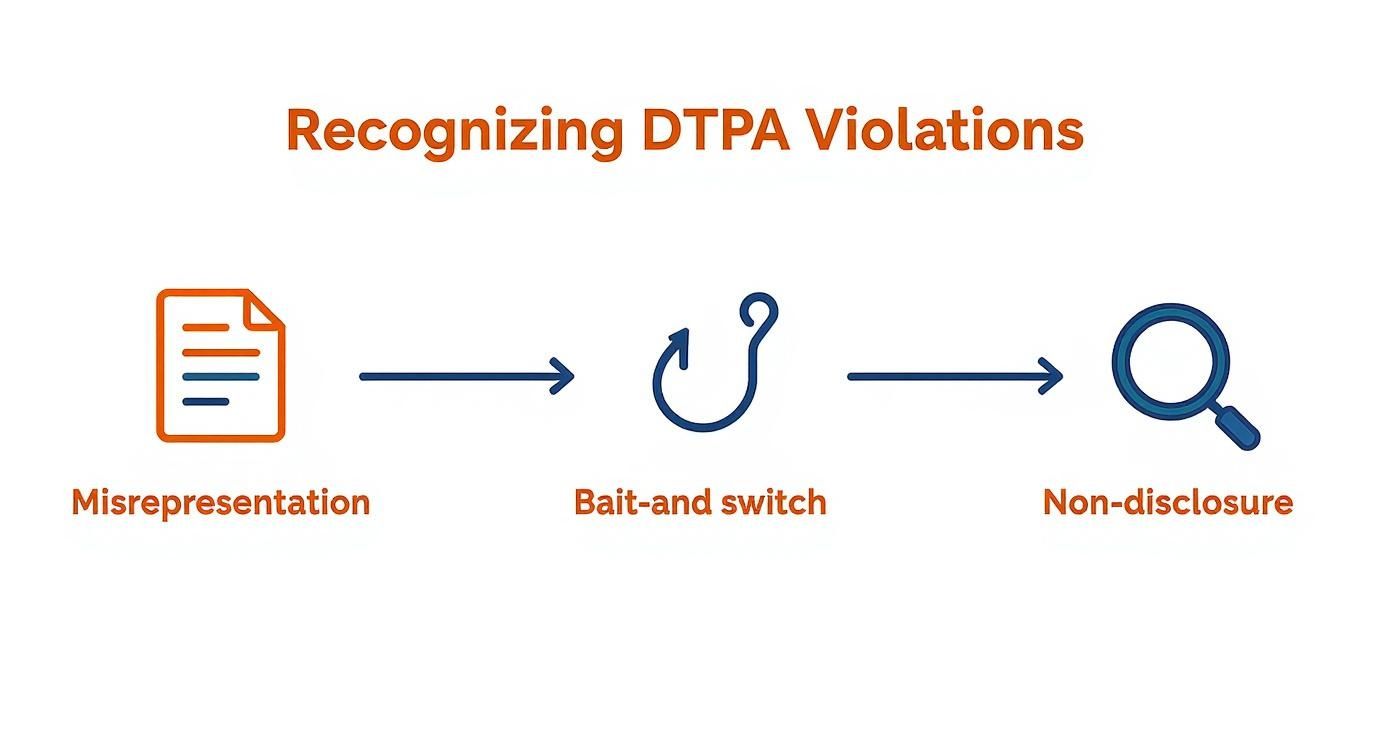
Spotting these patterns is the first step in building a solid case, even before you start writing your demand letter.
The 60-Day Waiting Period
Once the business gets your demand letter, a clock starts ticking. By law, they have 60 days to respond. During this time, they’re expected to look into your claim and decide if they want to make a settlement offer.
A well-drafted demand letter from a Texas landlord tenant lawyer often gets a much more serious and prompt response than one from an individual. It signals to the business that you understand your rights and are prepared to take legal action if necessary.
If the business comes back with a settlement offer inside that 60-day window, the ball is in your court. You can accept it or reject it. If the offer seems fair and covers your losses, accepting it can resolve the entire matter quickly.
But what if they ignore you? Or what if they lowball you with a ridiculous offer? If that happens, you’re free to file a lawsuit as soon as the 60-day period is up. You just have to respect that waiting period first.
Building Your Case
While you're waiting for that 60-day clock to run out, don't just sit on your hands. Use that time to get all your ducks in a row. A strong case is built on a foundation of solid proof. Your mission is to create a crystal-clear timeline of events that shows how the business's actions directly caused your financial harm.
Start gathering everything you can find, including:
- Contracts and Agreements: The original service agreement, purchase contract, or lease.
- Communications: Every single email, text message, and letter you exchanged with the business.
- Receipts and Invoices: Proof you paid, plus any receipts for money you had to spend on repairs.
- Photographs or Videos: Visual proof is powerful. Take pictures or videos of shoddy work or a defective product.
Having all this organized and ready to go will be a massive advantage, whether you're negotiating a settlement or eventually presenting your case in court. This principle holds true for other disputes, too; for example, our guide on how to file a complaint against a landlord stresses just how crucial a paper trail is. The stronger your evidence, the stronger your position.
What Can You Actually Get Back in a DTPA Case?

It’s one thing to know your rights have been violated, but it’s another to understand what you can actually win in court. This is where the Texas Deceptive Trade Practices Act (DTPA) really shows its strength.
The law isn't just about getting an apology. It’s built to make you whole again and to hit businesses where it hurts—their bottom line—so they think twice before deceiving another Texan.
Getting Your Actual Money Back: Economic Damages
The starting point for any DTPA claim is economic damages. This is the most direct and easy-to-understand remedy.
Think of it as the dollars and cents you lost because of the company's bad act. It’s all about getting you back to the financial position you were in before the problem started.
This covers the real, provable losses you suffered, such as:
- Repair or Replacement Costs: The amount it takes to fix the shoddy work or replace the defective product.
- Loss of Value: The gap between what you paid and what the item or service was actually worth.
- Related Expenses: Any other direct costs you racked up, like hiring an expert to inspect the damage or paying for temporary solutions.
Example Scenario: Let’s say you paid a contractor $10,000 for a new roof that leaks. To have a reputable company tear it off and do the job right costs $12,000. In that case, your economic damages are at least $12,000. These are the hard numbers you can prove with receipts, invoices, and estimates.
Hitting Them With Triple the Damages
Now, this is where the DTPA gets serious. If you can prove the business acted "knowingly" or "intentionally," a judge can award you up to three times your economic damages. We call this "treble damages," and it's a powerful tool.
So, what's the difference?
- Knowingly: This means the business knew what it was doing was false, deceptive, or unfair at the time. They weren't just incompetent; they were aware they were misleading you.
- Intentionally: This is even worse. It means they acted knowingly and did it on purpose, specifically intending for you to fall for their deception. They didn't just know it was wrong—they wanted to trick you.
Imagine a car dealer who rolls back the odometer on a used car. That’s a classic example of a "knowing" and "intentional" act. A court could force them to pay you up to three times what you lost, sending a clear message that fraud doesn't pay in Texas.
The threat of treble damages is a huge motivator for businesses to settle. It dramatically raises the stakes, often convincing them to negotiate a fair resolution long before a trial ever begins.
Can You Be Compensated for the Stress?
Sometimes, the damage isn't just financial. A long, drawn-out fight with a dishonest business can cause real emotional harm. The DTPA gets that.
If you can prove the business acted knowingly or intentionally, you might also recover damages for mental anguish. We're not talking about simple frustration or anger here. This is compensation for serious emotional distress, like debilitating anxiety, grief, or despair.
For example, a landlord who knowingly rents out an apartment with a dangerous carbon monoxide leak that makes your family sick could absolutely cause the level of distress that qualifies. You can learn more about a landlord’s legal duties in our guide to a breach of lease in Texas.
Making the Other Side Pay Your Legal Bills
This might be the most important part of the DTPA for the average person: the recovery of attorney's fees. If you win your case, the law forces the business you sued to pay your reasonable and necessary legal costs.
This is a game-changer. It levels the playing field, making it possible for everyday Texans to take on big companies without going broke in the process. This provision ensures that justice isn't just for those who can afford to write a massive check to a lawyer.
Texas's consumer protection laws are a cornerstone of its economy, which serves over 30 million people. The state has continuously refined these laws to tackle issues in trade, insurance, and other industries. Agencies like the Texas Department of Insurance are vital in this process, often helping resolve disputes before they ever land in court.
Partnering with a Consumer Protection Lawyer
While you have the legal right to file a DTPA claim yourself, the justice system isn't exactly a DIY project. It's a maze of deadlines, procedures, and legal jargon.
One simple mistake in a demand letter or a single missed deadline can derail your entire case. This is where bringing in an experienced Texas landlord tenant lawyer or eviction attorney changes the game completely.
When a lawyer gets involved, it sends a clear signal to the business: you're serious. An attorney makes sure your claim is built on a solid foundation from day one, maximizing your chances of a successful outcome.
Why You Need a Legal Advocate
A dedicated Texas attorney does a lot more than just fill out forms. They take the entire legal battle off your shoulders, letting you get back to your life while they fight for you.
Here’s what an experienced lawyer will handle:
- Drafting a Demand Letter That Gets Noticed: They know the precise legal language needed to grab a business's attention and force them to take your claim seriously.
- Gathering the Right Evidence: Attorneys are experts at digging up and organizing the proof needed to build an airtight case against a deceptive company.
- Negotiating from a Position of Strength: They can spot a lowball settlement offer from a mile away and counter with the full weight of the law behind them, including the powerful threat of treble damages and attorney's fees.
- Fighting for You in Court: If the business refuses to offer a fair settlement, your lawyer will be fully prepared to take the fight to a judge and jury.
Navigating the Legal Marketplace
As you start looking for legal help, you'll quickly realize you've entered another consumer marketplace. It's smart to have a basic idea of how different firms promote themselves. A little bit of understanding law firm marketing practices can help you become a more informed client and choose the right advocate to protect your interests.
You don't have to go up against a dishonest business by yourself. An attorney levels the playing field, making sure your voice is heard and your rights under Texas consumer protection laws are fully enforced.
Think of hiring a lawyer as an investment in getting the justice you deserve. The DTPA was designed with a key provision allowing you to recover your attorney's fees. This makes legal help accessible, so you can pursue your claim without worrying about being buried in legal bills. It ensures the business that broke the law is the one that ultimately pays for it.
Answering Your Questions About Texas Consumer Laws
When you're caught in a dispute with a business, it's natural to have a lot of questions. Things can get complicated fast. Below are some straightforward answers to the questions we hear most often from Texans trying to understand their rights.
How Long Do I Have to File a Consumer Protection Lawsuit in Texas?
You generally have two years to file a lawsuit under the Deceptive Trade Practices Act (DTPA). This deadline is what lawyers call the statute of limitations, and it’s a hard and fast rule.
That two-year clock usually starts ticking the moment the deceptive act happened. But what if you didn't know you were wronged right away? The law accounts for that. If you couldn't have reasonably discovered the problem, the clock starts on the date you found it—or should have found it. The key takeaway is to act fast, because if you wait too long, you could lose your right to sue for good.
Does the DTPA Cover Buying a House?
Yes, absolutely. The DTPA is a powerful tool for homebuyers in Texas. If a seller lied about the condition of the property, hid a known defect like a cracked foundation, or used any other deceptive tactic to close the deal, you could have a solid claim.
Real estate cases can get tricky, though. Licensed agents and brokers have their own set of professional and legal standards to follow. If you suspect you were duped during a home purchase, it’s a smart move to talk to an experienced attorney who can untangle the specific facts of your situation.
What If a Business Just Ignores My DTPA Demand Letter?
If you send a formal DTPA demand letter and the business doesn't respond within the 60-day period—or they come back with a ridiculously low settlement offer—you're clear to file a lawsuit.
Their failure to engage in good faith isn't just frustrating; it can be used against them in court. A judge might view their refusal to even negotiate as a sign of bad faith, which can bolster your case for winning additional damages and making them pay for your attorney's fees.
Can I Use the DTPA Against My Landlord?
You certainly can. A lease is considered a consumer transaction, putting the landlord-tenant relationship squarely under the DTPA's protection. As a tenant, your rights are protected when you are paying for goods (the apartment) and services (maintenance, security, amenities).
So, if your landlord lured you in with false promises—like advertising a sparkling pool that is never open or showing you a perfect model unit when yours is a wreck—you might have a DTPA claim. This right exists in addition to all the specific protections you have under the Texas Property Code, giving you one more way to fight back against a bad landlord.
If you need help with an eviction, lease issue, or rental dispute, contact The Law Office of Bryan Fagan, PLLC for a free consultation today. Our experienced attorneys can protect your rights and fight for the compensation you deserve. https://texastenantlawyers.com