Dealing with a landlord dispute can be stressful—but understanding your rights under Texas law can make all the difference. When your landlord fails to hold up their end of the deal, it’s more than just an inconvenience—it's a landlord breach of lease. This happens when a landlord doesn't meet their legal or contractual duties, effectively breaking the binding agreement you both signed.
We're not talking about minor annoyances here. A breach involves significant violations that can impact your health, safety, and your fundamental right to peacefully enjoy your home.

Understanding Landlord Obligations in Texas
Facing a dispute with your landlord is incredibly stressful. But knowing your rights under Texas law gives you the power to stand your ground. Your lease isn't just a piece of paper; it's a legal contract with specific responsibilities for both you and your landlord. When a landlord fails to meet those responsibilities, they’ve breached the contract, and that means you have legal options.
Your protections are spelled out in the Texas Property Code, a set of laws that every landlord in the state must follow. Think of it as the official rulebook for the landlord-tenant relationship. The first step to solving any problem is recognizing when your landlord has broken one of those rules.
What the Texas Property Code Says About Landlord Duties
While your lease has its own specific terms, Texas law sets certain minimum standards that landlords simply cannot ignore. These core duties are there to protect your rights from unfair practices and unsafe living conditions.
Here are a few key responsibilities every landlord has:
- Duty to Repair: If something breaks and it materially affects your physical health and safety, your landlord is required to fix it under the Texas Property Code.
- Right to Quiet Enjoyment: You have a legal right to live in your home without constant, unreasonable disturbances from your landlord.
- Security Devices: Landlords must provide and maintain specific security devices, like working door locks and window latches.
- Lawful Eviction: A landlord can't just kick you out or lock you out. They must follow the strict legal process for eviction. An experienced eviction attorney can help if you face an illegal lockout.
When a landlord drops the ball on these fundamental duties, it's a clear landlord breach of lease.
To get a more detailed look at your protections, you can learn more about the Texas Property Code and your tenant rights in our guide. Knowing these rules is what empowers you to identify a breach and take action with confidence.
Common Ways Landlords Breach a Lease in Texas
It’s one thing to have a minor disagreement with your landlord; it's another thing entirely when their actions—or inactions—cross a legal line. A landlord breach of lease isn't about small annoyances. It’s about a significant violation of your rights as a Texas tenant.
Figuring out if your landlord has actually broken the law can be tough. The economic pressures since 2020 haven't made things any easier, with rising costs causing some landlords to cut corners on maintenance or even try to illegally alter lease terms mid-stream. Knowing the most common violations is the first step toward protecting yourself.
Failure to Make Necessary Repairs
This is, without a doubt, one of the biggest issues we see. Your landlord has a legal "duty to repair" any problem that genuinely threatens your physical health and safety. This is baked right into Texas Property Code § 92.052.
We’re not talking about chipped paint or a scuffed floor. This law covers the serious stuff:
- Real-World Scenario: Imagine your air conditioner dies in the middle of a brutal Texas summer. You send a written notice to your landlord, but a week goes by with no action. The extreme heat makes your apartment unsafe. This inaction is a clear breach.
- Major plumbing disasters, like a burst pipe or persistent water damage that could lead to mold.
- Dangerous electrical problems or a heater that won’t work in a freeze.
- Serious pest infestations (like roaches, rats, or bedbugs) that make the property unlivable.
If you’ve given your landlord proper written notice about one of these issues and they drag their feet or ignore you, they are in breach of your lease. It's that simple.
Key Takeaway: The "duty to repair" is a cornerstone of your tenant rights in Texas. Ignoring a valid repair request for a condition that threatens your health or safety is a direct violation of the law and your lease agreement.
Illegal Entry or Harassment
Your home is your private space. The law recognizes this with the right to "quiet enjoyment," which means your landlord can't just show up unannounced whenever they feel like it.
Except for true emergencies, like a fire or major flood, your landlord must give you proper notice before entering. Most leases define this as 24 hours. Constant, unannounced pop-ins aren't just rude; they can be considered a form of harassment and a breach of your lease.
Worse, a landlord can never take matters into their own hands to force you out. Things like changing the locks, removing your doors or belongings, or shutting off your utilities are illegal "self-help" eviction tactics and are treated as extremely serious violations. To learn more about what your landlord can and cannot do, check out our guide on landlord responsibilities in Texas.
Wrongfully Withholding Your Security Deposit
Problems with security deposits are another all-too-common headache. Once you’ve moved out and provided a forwarding address, the clock starts ticking for your landlord.
Under Texas Property Code § 92.103, they have 30 days to return your security deposit.
They are allowed to make deductions, but only for damages that go beyond "normal wear and tear." If they do keep any of your money, they are legally required to give you a written, itemized list explaining every deduction. A landlord who keeps your deposit without a legitimate reason or fails to provide that itemized list is acting in "bad faith" and is in breach of their legal duties.
Common Landlord Breaches and Relevant Texas Property Code Sections
| Type of Breach | Brief Description | Relevant Texas Property Code Section(s) |
|---|---|---|
| Failure to Repair | Neglecting to fix conditions that affect a tenant's physical health and safety after proper notice. | § 92.052, § 92.056 |
| Wrongful Eviction | Attempting to remove a tenant without a proper court order or by using illegal "self-help" methods. | § 92.0081 |
| Illegal Lockout | Changing the locks to prevent a tenant from entering their home without following legal procedures. | § 92.0081 |
| Illegal Entry | Entering the rental unit without proper notice or for reasons not permitted by the lease. | § 92.0081 |
| Retaliation | Taking adverse action (like eviction) against a tenant for exercising a legal right, such as requesting repairs. | § 92.331 |
| Security Deposit Issues | Wrongfully withholding the security deposit or failing to provide an itemized list of deductions within 30 days. | § 92.103, § 92.109 |
| Utility Shutoff | Intentionally shutting off utilities (water, electricity, gas) that the landlord is responsible for providing. | § 92.008 |
Understanding these specific codes can empower you to identify when your landlord's actions are not just unfair, but unlawful. If any of these situations apply to you, it's a clear sign that you need to take action.
Your Legal Remedies for a Landlord's Breach
Discovering your landlord has violated your lease can make you feel cornered and powerless. But Texas law doesn't leave you without options. When a landlord is in breach, you have specific legal remedies—but you have to use them correctly.
Acting rashly, like stopping your rent payments out of frustration, is one of the worst mistakes you can make. It can land you in a much bigger legal mess. The key is to follow the exact legal procedures to protect your rights.
Step-by-Step Guide to Responding to a Breach
- Give Formal Written Notice: Send a letter via certified mail describing the problem and requesting a fix. This creates proof that your landlord was officially notified.
- Allow Reasonable Time: Give your landlord a reasonable chance to address the issue after they receive your notice.
- Take Legal Action: If they fail to act, you can then pursue your legal remedies.
Lease Termination for Severe Breaches
In the most serious cases—when the landlord's failure to act makes your home unsafe or uninhabitable—Texas law may give you the right to terminate your lease. This isn't a step you can take for minor inconveniences. It’s reserved for severe issues that directly threaten your physical health and safety, as laid out in the Texas Property Code.
- Example: A severe mold outbreak from a leaky roof that your landlord has ignored, despite your written complaints. If that mold is making you sick, it's a condition that materially affects your health. That could be your ticket to legally and properly terminate the lease without penalty after giving proper notice.
But before you pack your boxes, you must follow the steps precisely, starting with formal written notice. Consulting a Texas landlord tenant lawyer is highly recommended before taking this step.
Suing Your Landlord for Damages
Did your landlord's breach cost you money? You have the right to take them to court. You can file a lawsuit in Justice Court (what many people call small claims court) to get a court order forcing the landlord to make repairs and pay you back for your losses.
For instance, if your landlord illegally locked you out, you could sue for the cost of a hotel, spoiled groceries, and other related expenses. Or, if they never fixed a broken pipe and it flooded your apartment, you could sue for the value of your damaged property. To get started, you can learn more about how to file a complaint against your landlord.
A Word of Caution: Never, ever withhold rent to get back at your landlord. In Texas, your responsibility to pay rent is legally separate from your landlord's duty to make repairs. If you stop paying, you are the one breaching the lease, and your landlord will have clear grounds to evict you.
Using the Repair and Deduct Remedy
In certain situations, Texas law gives tenants a powerful tool: the right to "repair and deduct." Under Texas Property Code § 92.0561, you can pay for a critical repair yourself and subtract the cost from your next rent payment.
This remedy comes with a very strict set of rules, and you must follow every single one:
- The problem must materially affect your physical health and safety.
- You must have already given the landlord proper, formal written notice.
- The landlord must have failed to fix it in a reasonable time.
- The repair cost cannot be more than one month's rent or $500, whichever is greater.
Building Your Case with Proper Notice and Documentation
When you're in a dispute with your landlord, it often comes down to one simple thing: what you can prove. The actual breach of the lease is only half the story. Your landlord might remember things differently, which is why creating a rock-solid paper trail is the single most important thing you can do to protect yourself.
A quick text about the broken AC or an email about a leak might feel like you've done your part, but in the eyes of Texas law, it's often not enough to build a legal case. You have to be formal.
The Power of a Formal Demand Letter
This is your starting line. The first, most critical step is to send your landlord a formal demand letter. This isn't just a complaint—it's an official notice that puts them on the clock to fix the problem.
And you absolutely must send it via certified mail with a return receipt requested. This isn't negotiable. That little green card you get back in the mail is your undeniable proof that they received your notice.
Your demand letter needs to be professional and straight to the point. Make sure it includes:
- The date you're writing it.
- A detailed description of the issue and how it violates your lease or the Texas Property Code.
- A clear request for what you want them to do, like completing a specific repair by a reasonable date.
- A statement that you will pursue your legal remedies if they fail to act.
Think of this letter as Exhibit A. It proves you gave your landlord a fair and documented chance to do the right thing.
Creating an Evidence File
Beyond the letter, you need to think like a detective. Your job is to gather every piece of evidence you can to back up your claim. The more proof you have, the stronger your position becomes.
This simple process—Notice, Wait, Action—is the roadmap for holding your landlord accountable.
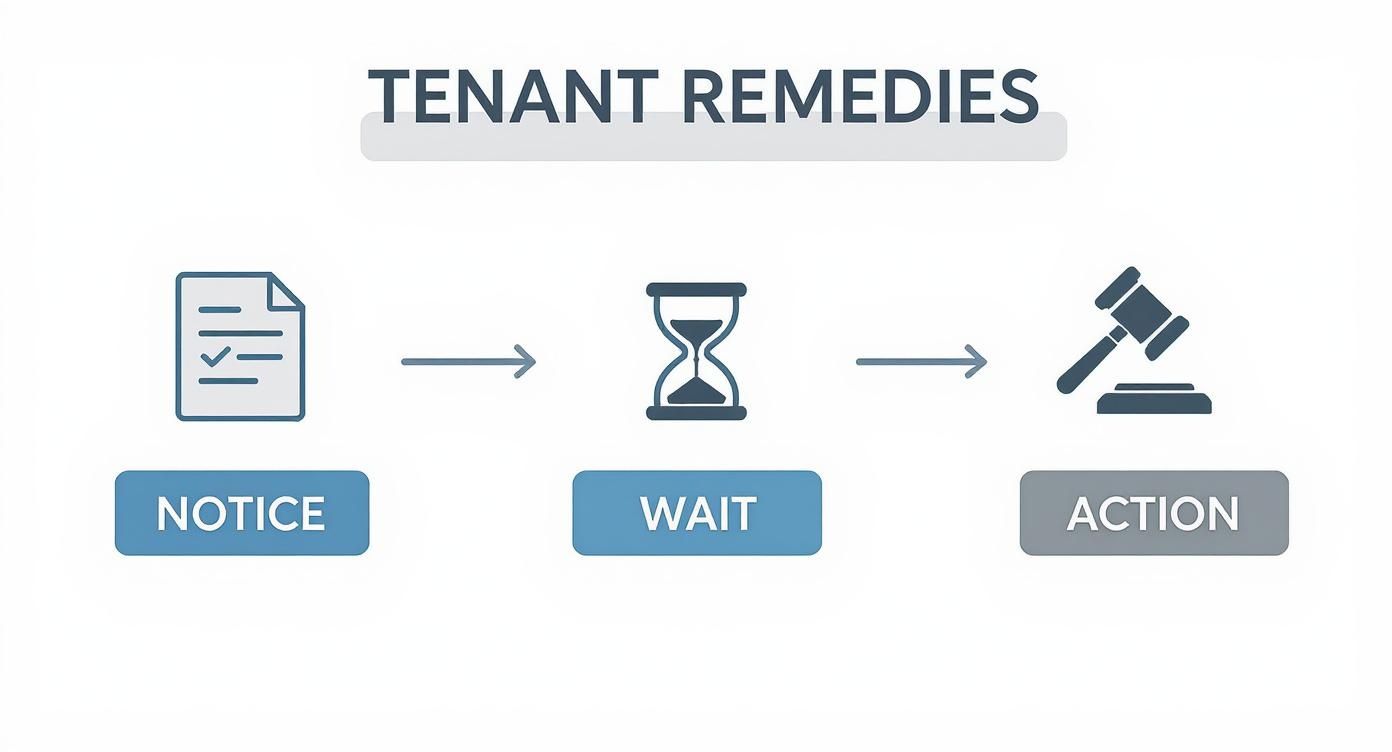
As you can see, taking legal action is the final step, and it only comes after you've given proper notice and your landlord has failed to respond.
Here's what your evidence file should contain:
- Dated Photos and Videos: A picture is worth a thousand words, especially in court. Take clear photos and videos of the problem, making sure they are dated.
- Copies of All Correspondence: Keep a copy of every single letter, email, or text message you've sent. Don't forget to save your certified mail receipts.
- Receipts for Expenses: Did the landlord's failure to fix the heat force you to buy space heaters? Did you have to eat out because the kitchen was unusable? Keep every single receipt.
- A Detailed Log: Get a notebook and write everything down. Log every phone call, conversation, and visit related to the issue, noting the date, time, and what was said.
This isn't just a pile of paperwork. This is what transforms your complaint from a "he said, she said" argument into a well-supported legal claim. It's the ammunition a Texas landlord-tenant lawyer needs to effectively fight for your rights.
Understanding a Landlord's Potential Defenses
To win a fight, you have to know your opponent’s moves. The same is true in a landlord-tenant dispute. Anticipating the arguments your landlord might use against a landlord breach of lease claim is a critical part of building a case that holds up under pressure.
Just because you have rights doesn’t mean your landlord will simply back down. They have legal defenses, too, and knowing what they are ahead of time lets you gather the right evidence to dismantle them. This isn't about playing legal games; it's about being prepared for the realities of a Texas courtroom.
Common Arguments Landlords May Use
When you claim your landlord breached the lease, don't expect them to just agree. They'll almost certainly come back with a reason why they aren't at fault. Here are a few of the most common arguments a Texas landlord might raise:
- You Caused the Damage: Landlords are not on the hook for fixing problems that you, your family, or your guests created—whether on purpose or by accident. If they can prove your actions are the real reason for the broken appliance or the hole in the wall, they can argue the responsibility to repair was never theirs.
- You Didn't Give Proper Notice: This is a big one. As we’ve discussed, Texas law is very specific about how you notify a landlord. A quick text or a phone call won't cut it. If you didn't send a formal, written notice (ideally by certified mail), your landlord has a powerful argument that they were never legally required to act.
- Forces Beyond Their Control: Sometimes, things happen that are completely out of the landlord's hands. Think of an "act of God," like a hurricane tearing up the roof, or a city-wide utility outage. In these cases, the landlord can argue that the repair delays weren't their fault but were caused by these outside events.
Key Insight: A landlord’s defense often comes down to procedure. Your best weapon against these arguments is keeping meticulous records and following the legal notification process in the Texas Property Code to the letter.
There are also complex situations where outside factors can create unusual breach scenarios. For instance, if a corporate tenant goes bankrupt, the business can legally walk away from its lease. In those cases, the law actually caps how much the landlord can recover in damages, showing that even landlords face limits. To learn more about this, you can discover more insights about the statutory cap on landlord claims.
Being ready for these defenses allows you and your eviction attorney to build a proactive strategy. It’s how you make sure your claim is rock-solid before you ever have to argue it in front of a judge.
Frequently Asked Questions About Texas Lease Violations
When you're in a dispute with your landlord, the questions can pile up fast. You need straightforward answers to protect your rights, especially when you think you're dealing with a landlord breach of lease.
This section tackles the most common questions we hear from Texas tenants caught in these tough situations. Our goal is to give you the practical guidance you need to make smart decisions.
Knowing the specific rules in the Texas Property Code is your best tool for holding a landlord accountable and getting things resolved.
Can I Stop Paying Rent if My Landlord Is Not Making Repairs?
No. This is a common mistake that can get you evicted. In Texas, you generally cannot stop paying rent, even if your landlord is failing to make critical repairs.
Withholding rent puts you in breach of the lease, and your landlord can start the eviction process immediately. That can do serious damage to your rental history, making it harder to find a place in the future.
The proper way forward is to keep paying your rent while you pursue your legal options. This includes sending a formal demand letter for repairs via certified mail, suing in Justice Court, or terminating your lease if the problem is severe enough to affect your health and safety.
Always talk to a Texas landlord tenant lawyer before you even consider messing with your rent payments.
How Long Does My Landlord Have to Make Repairs in Texas?
The Texas Property Code says landlords must make repairs within a "reasonable time" after you give them proper written notice. But the law doesn't define this with a specific number of days, like 24 or 72 hours.
So, what’s "reasonable"? It all depends on the problem.
A broken air conditioner in the middle of a Texas August demands a much quicker response than a cracked windowpane. If the issue directly threatens an ordinary tenant's physical health or safety—like a major water leak or a faulty heater in winter—the landlord's duty to act fast is much greater.
Important Note: The clock on that "reasonable" timeframe doesn't start until you've given them proper notice. Sending a letter via a trackable method, like certified mail, is the only way to create the proof you need to enforce your rights.
What Should I Do if My Landlord Enters My Home Without Notice?
Your lease gives you the right to "quiet enjoyment" of your home, which means your landlord can't just show up unannounced. They need to give you advance notice unless there's a true emergency, like a fire or major flood.
If your landlord walks in without permission, your first move is to send them a formal written notice by certified mail.
In that letter, you should:
- Clearly state the date and time the violation occurred.
- Politely remind them of their legal duty to provide notice under your lease and Texas law.
- Demand that they stop entering your home without proper notice immediately.
This letter isn't just a complaint; it's a critical piece of evidence. If the unannounced visits continue and turn into a pattern of harassment, it can become a serious landlord breach of lease. That could give you the legal grounds to terminate the lease or even sue for damages with help from an experienced eviction attorney.
If you need help with an eviction, lease issue, or rental dispute, contact The Law Office of Bryan Fagan, PLLC for a free consultation today.