In Texas, the 3 times rent rule usually means a landlord wants your gross monthly income to be at least 3 times the monthly rent, so a $1,500 apartment often calls for $4,500 per month in income. It's a common screening guideline, not a statewide Texas law.
That distinction matters more than most renters realize. A lot of people find a place they can handle month to month, submit an application, and then hit a wall when the leasing office says they don't meet “3x rent.” Others hear online that Texas banned the rule and assume a denial must be illegal. Neither view is quite right.
If you're applying for a rental, the immediate concern is simple. Can you qualify, and if not, what can you do next? If you're a landlord, the concern is different. Can you use an income standard without creating legal trouble?
The answer to both questions starts with understanding what this rule is, what the Texas Property Code does and does not regulate, and when an ordinary screening practice can turn into a tenant-rights problem.
The Stress of Renting and the 3x Income Rule
A common Texas rental scenario looks like this. You find an apartment in your price range, gather your documents, pay the application fee, and then learn the property wants proof that your income meets a specific multiple of the rent. Suddenly the issue isn't whether you can pay. It's whether you fit the landlord's formula.
That can feel arbitrary, especially for people with irregular income, recent job changes, savings, family support, or housing assistance. It can also feel unfair when one property seems flexible and another treats the standard like a hard cutoff.
Many disputes about the 3x rule aren't really about rent math. They're about how the rule gets applied, what counts as income, and whether the landlord is using the same standard for everyone.
For landlords and property managers, the pressure runs the other way. Screening has to be fast, consistent, and defensible. A vague process creates avoidable conflict. A rigid process can create fair housing risk.
Texas law gives landlords room to set screening standards, but the legal analysis usually doesn't stop there. Key questions include whether the policy was disclosed, whether it was applied consistently, and whether a denial points to a broader lease, discrimination, or application-fee issue under the Texas Property Code and related housing laws.
What the 3 Times Rent Rule Actually Means
The simplest answer to what is the 3 times rent rule in Texas is this. It's a screening guideline many landlords use to decide whether an applicant appears able to pay rent consistently.
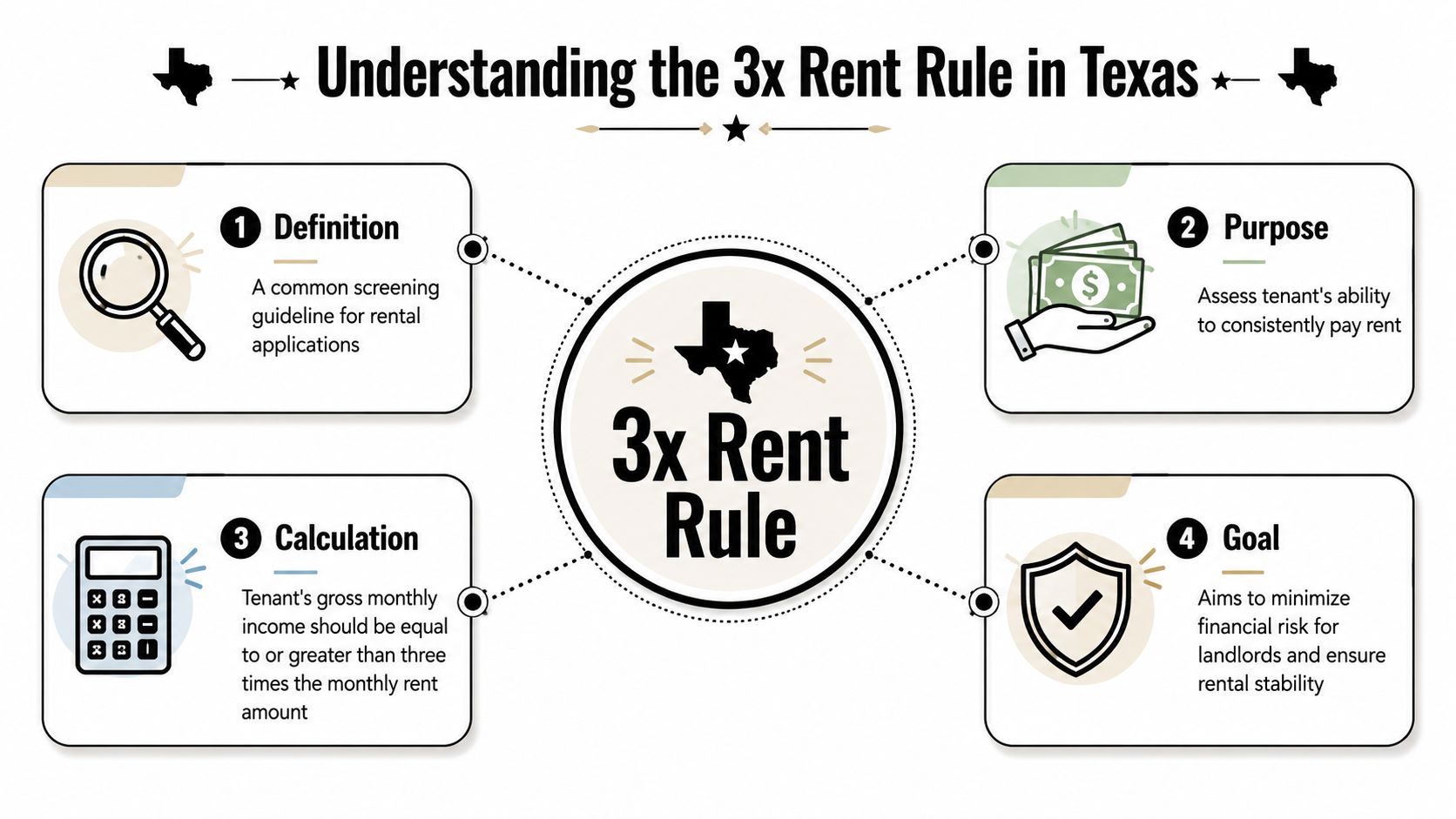
Under that approach, the landlord compares the monthly rent to the applicant's gross monthly income, meaning income before taxes and other deductions. For a $1,500 rental, the target is typically $4,500 per month. For a $2,000 rental, the target is $6,000 per month, as explained in this overview of how the 3x rent requirement works.
What landlords usually ask for
Most landlords don't just take an applicant's word for income. They usually verify it with documents such as:
- Recent pay stubs. Many properties ask for two to three recent pay stubs, based on the screening practices described in how the 3x rent requirement works.
- Bank records. Some ask for three to six months of bank statements when income is less traditional or harder to confirm, according to the same explanation of how the 3x rent requirement works.
- Tax return or offer letter. A tax return may help with self-employment income, and an offer letter can help if you've just started a new job, again as described in how the 3x rent requirement works.
What this rule is not
It is not a statewide statutory cap, and it is not a Texas Property Code rule that says every landlord must use the same formula. That's why screening disputes often turn on policy wording and application procedures. Readers looking for a broader discussion of what Texas law permits in screening applicants and handling application fees may also find Tenant Screening and Application Rules in Texas useful.
Practical rule: Treat the 3x standard as an underwriting policy. Don't treat it like a law written into every Texas lease.
Why Texas Landlords Use This Income Guideline
Landlords use this guideline for one reason. Risk.

The 3x rent benchmark became a common market norm because it matches the long-used affordability idea that rent should take up about one-third of gross income. Under that rule of thumb, a tenant earning $60,000 per year would generally be viewed as able to cover about $1,667 per month in rent, and someone applying for an $1,800 apartment would typically need about $64,800 annual gross income, as discussed in this explanation of the 3 times the rent standard. The same source notes that Texas law does not set a statewide income multiple for ordinary private-market leases.
The business side of the policy
A landlord isn't just looking at rent alone. They're also thinking about missed payments, turnover, repair costs, and the expense of enforcing a lease if things go wrong. For owners trying to understand the broader economics of operating rental property, issues like taxes on rental income also affect how tightly they manage screening risk.
That doesn't make every strict policy wise. It does explain why landlords often prefer a simple income standard they can apply quickly.
Here's the trade-off:
| Landlord goal | Possible downside |
|---|---|
| Consistent screening | Good applicants can get rejected if income is hard to document |
| Lower payment risk | Rigid policies can ignore savings, guarantors, or strong rental history |
| Faster approvals | Poorly explained standards create disputes over fairness |
A smart landlord pairs an income standard with clear written criteria, lawful handling of fees, and a basic understanding of related issues like Texas law on application fees for rentals. If the applicant becomes a tenant, separate rules also govern move-out money and What a Landlord Can and Cannot Deduct From a Deposit.
What to Do If Your Income Does Not Meet the 3x Rule
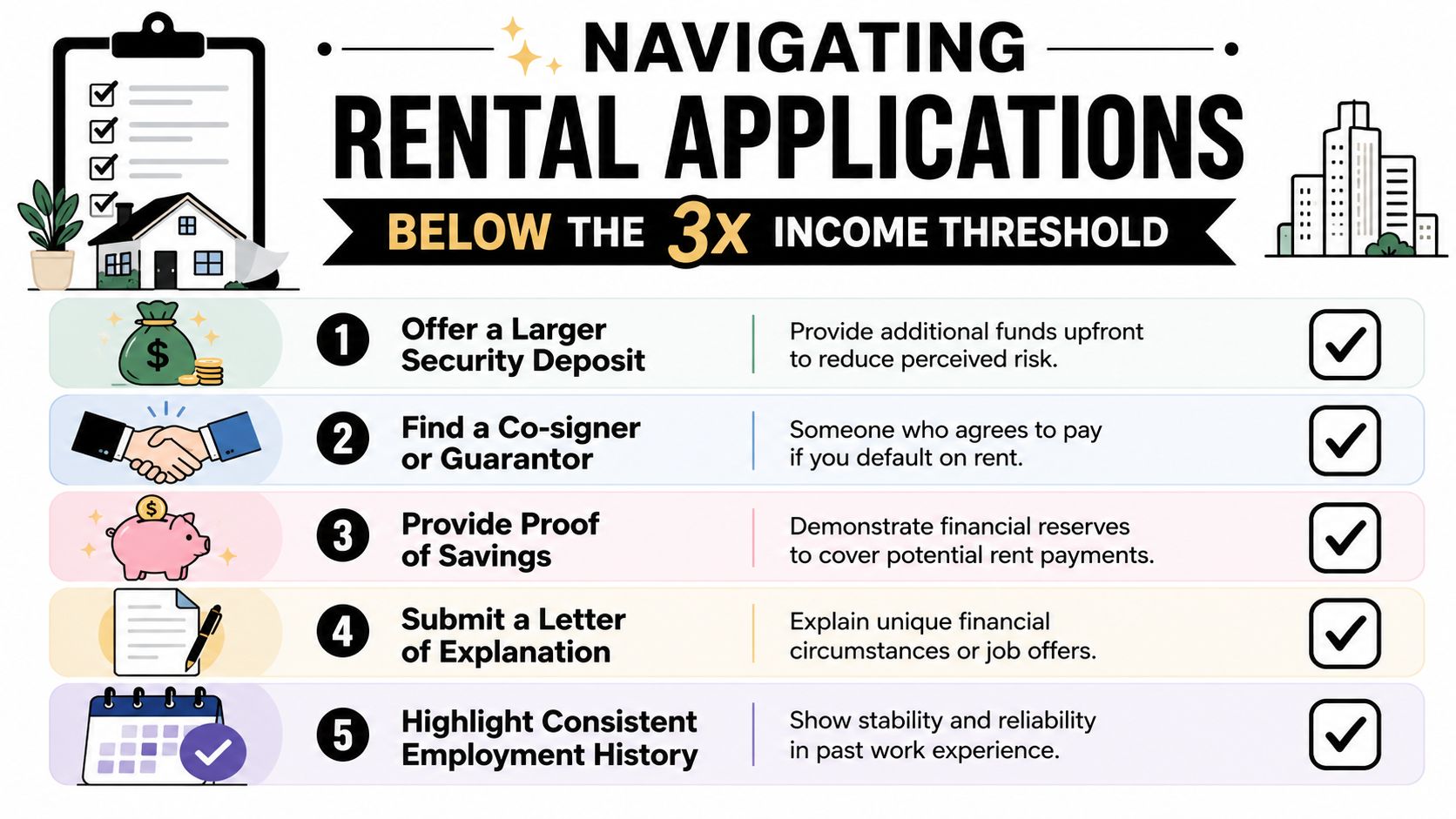
Missing the 3x standard doesn't always end the conversation. Some landlords won't budge. Others will consider a fuller picture if you make it easy for them to see why you're still a reliable applicant.
What tends to help
- A guarantor or co-signer. This works best when the landlord already has a written policy allowing one. It gives the landlord another financially responsible person to pursue if rent isn't paid.
- Documented savings. Savings don't replace income in every screening system, but they can help if your earnings fluctuate or you recently changed jobs.
- An offer letter. If your new job hasn't produced enough pay stubs yet, an offer letter can fill that gap when the property is willing to review it.
- Combined roommate income. In some shared rentals, the property may consider total household income rather than only one applicant's income. For disputes over who owes what under a shared lease, see roommate lease rights in Texas and who is responsible.
- A concise explanation letter. This can help when the numbers alone don't show the full story, such as seasonal work, commission income, or a recent promotion.
What often causes problems
Some applicants make the mistake of arguing with the leasing staff about whether the rule is “real.” That usually goes nowhere. The better move is to ask a direct question: What alternatives will this property accept if income is slightly below the standard?
Another weak approach is submitting disorganized documents. If your income is unusual, organize the file before you apply. Put the most persuasive records first. Make it easy for the reviewer to see the pattern.
If you're close to qualifying, presentation matters. A clean package with pay records, bank statements, and a short explanation often works better than sending scattered screenshots over several days.
Think beyond the lease approval
If qualifying for a rental also means furnishing a new place on a tight budget, some renters look at practical credit-based options such as Miller Waldrop financing solutions. That doesn't solve a lease denial, but it can help you plan total move-in costs more realistically.
One final caution. Be careful about offering terms the landlord can't legally accept or hasn't agreed to in writing. Verbal assurances during the application stage often create confusion later.
Your Legal Rights and Fair Housing Protections
A landlord can generally use income screening. The legal risk starts when that screening standard is applied in a way that treats protected groups unfairly or ignores lawful income sources without a valid, consistent reason.

Texas guidance makes the key point clearly. The 3x rule is common, but its application can raise fair housing concerns, especially when a landlord's screening criteria affect how different types of income, including vouchers or disability payments, are counted, as discussed by the Texas State Law Library rent guidance.
When a screening policy may cross the line
Here are the patterns that usually deserve closer attention:
- Refusing to count lawful income such as disability income or other valid sources while counting the same economic support differently for other applicants.
- Applying one standard to one applicant and a looser standard to another without a clear written policy.
- Using the 3x rule as a cover for denying families, people with disabilities, or applicants from a particular national origin or background.
- Failing to consider reasonable accommodations when a disability-related issue affects how paperwork is presented or reviewed.
What the Texas Property Code does and does not do here
The Texas Property Code regulates many landlord-tenant issues, including lease enforcement, late fees, and retaliation rules. It does not create a statewide command that all landlords use a 3x multiplier. That's why these disputes often sit at the intersection of contract terms, screening practice, and fair housing law. For a broader legal framework, review this overview of the Texas Property Code landlord-tenant rules.
A legal screening rule can still be used illegally if the landlord applies it selectively or rejects income only when it comes from certain people.
Landlords should also remember that investment strategy and screening culture vary by state and market. Investors comparing state-level policy climates sometimes read resources on best rental markets for investors, but local compliance still depends on how the actual policy is written and enforced in Texas.
Debunking Myths About Texas Rent Rules
One of the most common questions right now is whether Texas banned the 3 times rent rule. The answer is no.
A recent viral TikTok claim says that Texas landlords can no longer require three times the rent as of July 1, 2026, but that claim is misinformation. Texas does not have a statewide rent-control rule limiting rental pricing or income requirements, and landlords can continue using income screening guidelines like the 3x rule, as reflected in this discussion of the viral Texas 3x rent rumor.
Why this rumor spreads
People often blend together three different issues:
- Rent control
- Lease screening
- Discrimination law
Those aren't the same thing. A landlord can generally set screening standards. A landlord still has to comply with applicable housing laws. And Texas law still regulates many real parts of the rental relationship, including late fees, retaliation, security deposits, and lease enforcement.
If you want a broader legal overview instead of social media summaries, review Texas Landlord-Tenant Law An Overview.
A better question to ask
Don't ask only whether the 3x rule is “legal.” Ask these instead:
- Was the policy disclosed before I applied
- Was it applied the same way to everyone
- Did the landlord reject a valid source of income
- Is the dispute really about screening, or is it about fees, deposits, or a lease term
That framing gets you much closer to the actual legal issue.
When You Should Contact a Texas Landlord-Tenant Lawyer
Some disputes are simple application disappointments. Others are legal problems hiding behind an application denial.
You should speak with a Texas landlord tenant lawyer or eviction attorney when the facts suggest more than a routine underwriting decision.
Common warning signs
- Your income was rejected without a clear explanation. This matters most when the income came from a lawful source the landlord seemed willing to count for others.
- The property changed the standard mid-process. If the requirement shifts after the application fee is paid, that can point to a screening or disclosure problem.
- You suspect discrimination. If comments, exceptions, or paperwork requests were inconsistent, get legal advice before assuming it was just bad communication.
- You're a landlord creating screening criteria. A lawyer can help you write policies that are clear, consistent, and easier to defend if challenged.
The Law Office of Bryan Fagan, PLLC can review screening disputes, lease issues, and related tenant rights questions, including how Texas law and fair housing concerns may affect your options. If your situation needs individualized guidance, you can also schedule a consultation with a Texas landlord-tenant attorney.
Early legal advice often helps most before a denial turns into a larger dispute, or before a landlord adopts a policy that creates avoidable risk.
Protect Your Rights with a Free Consultation
The 3 times rent rule in Texas is widely used, but it isn't a statewide law. That's the point most people miss. The rule itself is usually a business guideline. The legal issue is how the landlord applies it.
For tenants, that means a denial is not automatically unlawful, but it also isn't automatically fair. For landlords, that means a standard policy can still create trouble if it's vague, inconsistently enforced, or dismissive of lawful income sources. In both situations, knowing your rights under the Texas Property Code and related housing laws can save time, money, and stress.
If you're dealing with a rejected application, a lease dispute, an eviction concern, or questions about fair housing compliance, getting specific legal advice is often the fastest way to understand where you stand.
If you need help with an eviction, lease issue, or rental dispute, contact The Law Office of Bryan Fagan, PLLC for a free consultation today.