Dealing with a landlord dispute or eviction can be stressful—but understanding your rights under Texas law can make all the difference. When communication with your landlord or tenant spins out of control, it’s easy to feel like your only option is a public, expensive, and stressful courtroom battle. You’re worried about protecting your investment or your home, and it seems like there's no way forward.
But there’s another way. A better way.
Real estate mediators offer a calmer, more controlled path forward. Instead of a judge who hands down a verdict, think of a mediator as a neutral guide—an expert who helps both sides find common ground and move on.
What Are Real Estate Mediators and Why Do They Matter in Texas?
When you’re facing a legal notice or a potential eviction, the stress can be overwhelming. But knowing your rights under Texas law—and understanding all your options—can make all the difference.
Mediation isn't just a legal buzzword; it's a powerful and practical alternative to fighting it out in court.

What the Texas Property Code Says About Your Options
A real estate mediator is a trained, impartial professional who steps in to guide a structured conversation between a landlord and a tenant. Their job isn’t to pick a winner or assign blame.
Instead, they are there to help both parties:
- Talk through the issues without letting anger or frustration derail the process.
- Get to the heart of the conflict, separating the facts from the emotions.
- Brainstorm creative, practical solutions that a judge simply can't order.
- Work toward a voluntary agreement that everyone can live with.
The most important part? You and the other party keep control. The mediator facilitates, but you make the final decisions. This is a world away from litigation, where a judge has the final say, whether you like the outcome or not.
Litigation vs. Mediation: A Quick Comparison
When you're deciding how to handle a property dispute, it helps to see the two main paths side-by-side. One is a formal, public battle; the other is a private, collaborative negotiation.
Here’s a look at how they stack up.
| Aspect | Real Estate Mediation | Court Litigation |
|---|---|---|
| Control | You and the other party decide the outcome. | A judge or jury makes the final, binding decision. |
| Cost | Typically far less expensive than going to court. | Can involve high legal fees, court costs, and expert witnesses. |
| Timeline | Can be resolved in a single day or a few sessions. | Can drag on for months or even years. |
| Privacy | Confidential and private. No public record of the dispute. | Public record. Court proceedings are open to anyone. |
| Outcome | Focuses on creative, mutually agreeable solutions. | A win/loss decision based on strict legal rules. |
| Relationship | Aims to preserve the relationship, if possible. | Often destroys any chance of a future working relationship. |
Ultimately, mediation gives you a voice and a chance to craft your own solution, while litigation forces you to accept whatever decision the court makes.
How to Resolve Common Texas Property Disputes
In Texas, mediators are perfectly suited to handle the kinds of landlord-tenant conflicts that pop up every day. They have deep experience with the Texas Property Code and the common friction points between property owners and renters.
A mediator helps you build a bridge to a solution. In a lawsuit, you are often just burning the bridge down. The goal of mediation is to find a resolution you can live with, saving you time, money, and the stress of a public court fight.
Some of the most common issues resolved in mediation include:
- Eviction Proceedings: Instead of a formal eviction on your record, a mediator can help negotiate move-out dates, payment plans for back rent, or other practical terms. For example, a landlord might agree to waive late fees if the tenant agrees to move out by the end of the month, avoiding the need for a court order.
- Security Deposit Returns: Disputes over deductions for damages versus normal wear and tear are perfect for mediation. A tenant can present move-in photos, while the landlord provides repair receipts. The mediator helps both sides reach a fair compromise on the amount to be returned.
- Breach of Lease: Whether it’s an unauthorized roommate, a pet policy violation, or another broken rule, a mediator helps parties either fix the problem or agree on a way to part ways amicably.
- Repair and Habitability Issues: Mediation provides a forum for you to get a landlord’s firm commitment on a repair schedule, protecting your right to a safe home and protecting the landlord from a potential lawsuit.
The legal world is taking notice. In the global real estate legal services market, a massive industry valued at USD 823.40 billion in 2024, experts acting as mediators are a cornerstone. Why? Because it works. Data consistently shows that mediated agreements can cut dispute resolution time by up to 70% compared to drawn-out court battles, saving everyone a fortune in legal fees. You can explore more about the growing real estate legal services market to see the trend for yourself.
The Powerful Benefits of Choosing Mediation Over Court
The thought of going to court over a landlord-tenant dispute is enough to cause sleepless nights. It’s expensive, it’s public, and the outcome is completely out of your hands.
But what if there was a better way? A more strategic, less stressful, and often more successful path?
This is where mediation comes in. Choosing mediation isn’t about avoiding a fight; it’s about choosing a smarter fight—one where you are in control. Let’s break down the real-world reasons why using real estate mediators is a game-changer for both landlords and tenants in Texas.
Save Your Time and Money
The clearest advantages of mediation are speed and cost. Court battles are notoriously slow and expensive. Legal fees, court costs, and expert witness expenses can pile up fast, turning a simple disagreement into a financial disaster.
Litigation can also drag on for months, leaving you in a constant state of stress and uncertainty. Mediation, on the other hand, is built for speed. Many disputes are completely resolved in a single day, allowing you to get a resolution and move on with your life.
Think about it this way:
- Litigation is like getting stuck in rush-hour traffic on I-35 with no end in sight. It’s expensive, frustrating, and someone else is in control.
- Mediation is like taking a private, direct route where you and the other party agree on the destination and get there on your own terms.
Keep Your Dispute Private and Protect Your Name
Court records are public. Every argument, every filing, every judgment can become a permanent part of the public record for anyone to see.
For a landlord, a public dispute can scare away future tenants. For a tenant, an eviction on your record makes finding a new home incredibly difficult.
Mediation is a completely confidential process. What’s said in mediation, stays in mediation. It cannot be used against you later if the case does end up in court.
This privacy creates a safe space for honest conversation, free from the fear that your words will come back to haunt you. It lets you solve the problem without creating a new one for your reputation.
You Decide the Outcome—Not a Judge
This is perhaps the biggest advantage of all: control.
When you go to court, you hand over all decision-making power to a judge. They will make a ruling based on a strict interpretation of the law, and you have to live with it—whether you like it or not.
Mediation puts the power right back in your hands. You and the other party work together, with a neutral mediator’s guidance, to craft your own solution. This allows for flexible, common-sense agreements that a court could never order, like:
- A custom move-out plan that works for everyone’s schedule.
- A realistic payment plan for back rent or damages.
- An agreement for the landlord to make specific repairs in exchange for the tenant dropping other claims.
This collaborative approach works. Court data on structured mediation programs shows settlement rates exceeding 60% for real estate disputes. That means real estate mediators are resolving complex issues under the Texas Property Code far more effectively and faster than the typical court process. You can see the data on mediation success rates for yourself.
Even in this cooperative setting, having a sharp Texas landlord tenant lawyer on your side is critical. Your attorney is there to protect your rights, advise you on fair offers, and ensure any agreement you sign is legally solid and serves your best interests.
Step-by-Step Guide to the Texas Real Estate Mediation Process
The word "mediation" can sound intimidating, but it’s really just a structured conversation designed to get your problem solved. It’s not a legal free-for-all.
Knowing the process from start to finish demystifies it, giving you the confidence to stand up for your rights and find a solution. Let’s walk through exactly what to expect when you work with real estate mediators.
Step 1: Agreeing to Mediate and Choosing Your Mediator
First things first: both you and the other party have to agree to try mediation. Unless it's already written into your lease or ordered by a court, this step is completely voluntary.
Once everyone is on board, the next job is to select a neutral third party—the mediator.
Both sides have to agree on the same person. Your attorney will likely have a list of trusted professionals they’ve worked with before. The key is finding someone who not only understands mediation but also has deep experience with Texas real estate and landlord-tenant law.
Step 2: Preparing for Your Mediation Session
You don't just show up to mediation and hope for the best. Success comes from preparation.
This is where you and your Texas landlord tenant lawyer get to work. You’ll gather every piece of evidence that tells your side of the story, including:
- Your signed lease agreement
- All relevant emails and text messages
- Photos or videos of property damage or poor conditions
- Rent payment receipts or repair invoices
You’ll also define your goals. What’s your best-case outcome? What’s the absolute minimum you’ll accept? Knowing your bottom line before you start negotiating is critical.
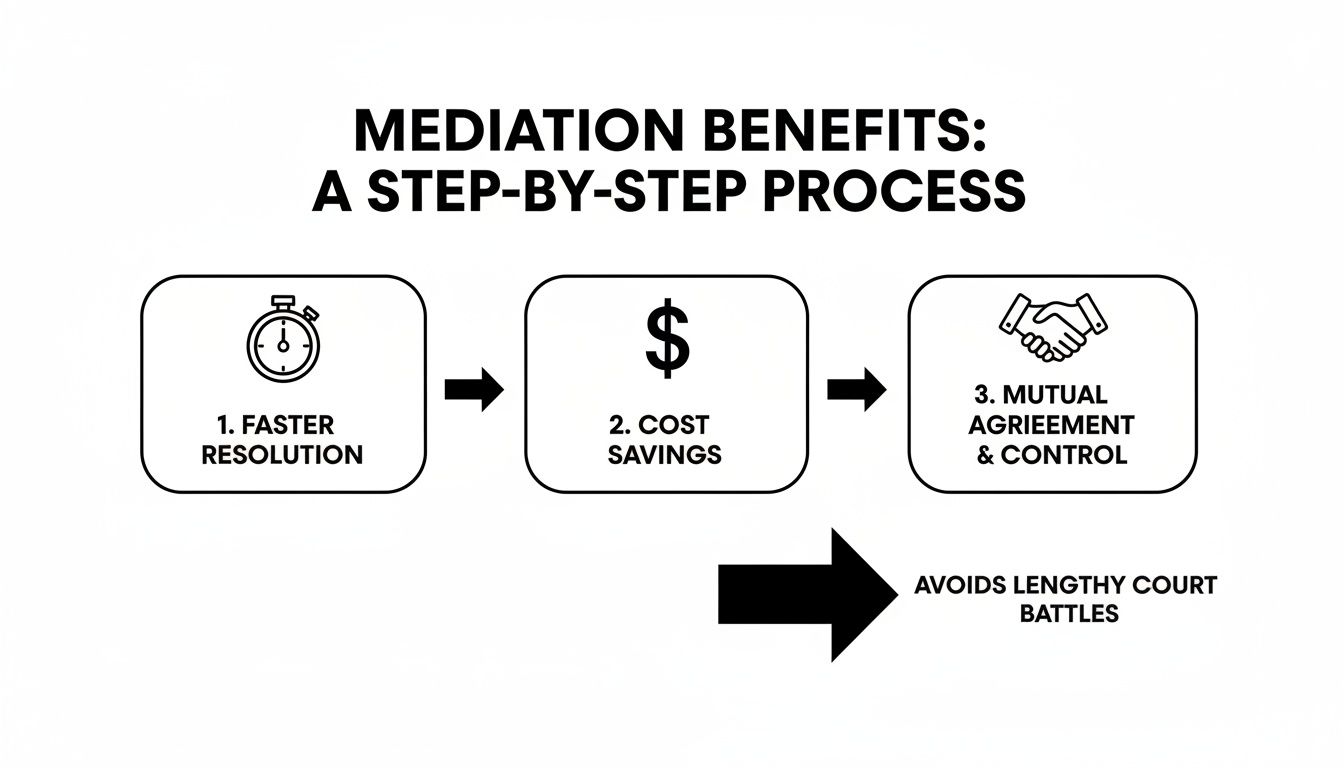
Mediation isn't just about compromise; it's about taking back control. It's faster, cheaper, and keeps you out of a courtroom where a judge makes the final call.
Step 3: The Mediation Day—Opening Statements and Caucuses
On the day of the mediation, the process is straightforward. It usually starts with everyone together in one room.
- The Mediator’s Introduction: The mediator will lay out the ground rules, emphasizing that the process is confidential and that they are a neutral party.
- Opening Statements: Your attorney will present a brief, uninterrupted summary of your position. This isn’t about winning an argument; it’s about setting the stage and showing you’re there to find a workable solution.
After the opening statements, the real work begins. The mediator will separate both sides into different rooms for private meetings, a process known as a "caucus."
A caucus is a confidential meeting with just you, your lawyer, and the mediator. This is your safe space to speak honestly about your goals, frustrations, and what you’re willing to compromise on. Nothing you say here will be shared with the other side unless you specifically authorize it.
The mediator acts as a go-between, shuttling between the two rooms. They’ll relay offers, ask tough questions, and help each side see the dispute from a fresh perspective, nudging everyone closer to an agreement.
Step 4: Finalizing a Legally Binding Settlement Agreement
When you finally reach a deal, it’s not sealed with a handshake. It’s put into a formal, written document.
The mediator will help draft a Mediated Settlement Agreement (MSA). This document spells out every single detail of your resolution—who pays what, move-out dates, repair deadlines, and any other terms you've agreed upon.
Once you and the other party sign the MSA, it becomes a legally binding contract under Texas law. This is the most important part: an MSA is just as enforceable as a judge's final order. It means the fight is officially over.
To learn more about how these agreements provide finality, you can explore the essentials of real estate mediation in our guide. An MSA delivers the peace of mind you need to finally close this chapter and move on.
What the Texas Property Code Says About Your Rights
Walking into mediation armed with just your side of the story isn’t enough. In a landlord-tenant dispute, feelings don't win arguments—the law does.
The Texas Property Code is the official rulebook that dictates your rights and your landlord's obligations. Knowing it is like holding a winning hand before the cards are even dealt. It transforms your complaints into legally enforceable demands, and a good mediator knows the difference.
Tenant Rights Under Chapter 92
For tenants, Chapter 92 of the code (Residential Tenancies) is your shield. It lays out exactly what your landlord is required to do and what you can do when they fail. This isn't about being confrontational; it's about being prepared.
Consider these real-world scenarios:
- The Duty to Repair: Your landlord is ignoring your pleas to fix a leaky roof or a broken AC in the middle of a Texas summer. Section 92.052 says they can’t. Citing this law in mediation turns your request into a legal obligation, giving you the high ground when negotiating for rent reductions or a guaranteed repair date.
- Security Deposit Disputes: If your landlord is holding your deposit hostage without providing an itemized list of deductions, you’re not powerless. Section 92.103 and Section 92.109 are your best friends. These laws don’t just require a detailed accounting within 30 days—they punish landlords who act in "bad faith." Simply mentioning this statute in mediation often gets a deposit returned fast.
These aren't just suggestions; they are powerful legal tools that protect your rights as a tenant.
Landlord Obligations Under Chapter 24
For landlords, the law provides a clear process for managing your property, but it demands you follow it to the letter. This is especially true for evictions, which are strictly governed by Chapter 24. Even in mediation, there’s no room for error here.
A Common Landlord Mistake: You want a tenant out for not paying rent. But did you provide a formal, written "Notice to Vacate" exactly as required by Section 24.005? If you missed a step or did it incorrectly, a tenant’s lawyer will spot it immediately. Your entire case could crumble right there at the mediation table.
When you can prove you’ve followed every legal step—from the initial notice to filing with the court—you walk into mediation from a position of power. It sends a clear message to the tenant that going to court is a losing battle for them, making a reasonable move-out agreement far more likely. A Texas eviction attorney ensures you've checked every single box before you ever sit down to negotiate.
This level of preparation is critical right now. With Texas evictions jumping by 15% in 2023, courts are swamped. Mediators are resolving security deposit fights—where claims average $1,200—in 65-75% of cases, completely bypassing the 90-day court wait. It proves that a solid, legally-backed strategy in mediation gets results and stops problems from getting worse.
Preparing for Success: Your Mediation Checklist
Success in mediation isn’t about luck. It’s about preparation.
Walking into that room organized and ready gives you control. It turns a stressful situation into an opportunity to fight for the outcome you deserve. You wouldn't just show up to court and hope for the best, and mediation is no different.
This checklist will help you get ready.

Step 1: Gather Your Documents
Evidence tells your story for you. Before you even open your mouth, your paperwork should build the foundation of your case. A mediator needs to see proof, not just hear you make claims.
Your document file is your arsenal. It must include:
- The Lease Agreement: This is the contract. It’s the rulebook for your entire tenancy. Highlight every clause that’s relevant to your dispute.
- Photos and Videos: A picture is worth a thousand words, especially when you’re proving property damage or a landlord’s failure to make repairs. Make sure every single one is dated.
- Emails, Texts, and Letters: Put together a complete timeline of every conversation. This record proves you tried to resolve the issue in good faith before things escalated.
- Receipts and Invoices: Have proof for every dollar you've spent. This includes repairs the landlord ignored or professional cleaning you paid for to get your security deposit back.
For example, a string of emails asking for a repair, followed by a time-stamped photo of the still-broken pipe, makes it almost impossible for your landlord to deny their inaction.
Step 2: Define Your Goals
You can't get what you want if you don't know what it is.
Before the negotiation starts, you need to know exactly what a "win" looks like for you. It's not just about being right; it's about finding a resolution that lets you move on.
Your goal is not just to "win," but to find a resolution that allows you to move forward. Knowing your best-case scenario and your absolute bottom line gives you the flexibility to negotiate effectively without giving away too much.
Work with your attorney to lock down two critical numbers:
- Your Ideal Outcome: If you could get everything you’re asking for, what would that be? A full security deposit refund plus extra for your trouble? A lease termination with zero penalties? Be specific.
- Your Bottom Line: This is your walk-away number—the absolute minimum you will accept. Knowing this stops you from taking a bad deal just because you're tired, frustrated, or pressured.
Step 3: Outline Your Opening Statement
Your opening statement sets the tone for everything that follows.
This is your first—and best—chance to tell your side of the story calmly and professionally. This is not the time for anger or accusations. It's the time for strategy.
A powerful opening statement is short and sticks to three key points:
- A quick, clear summary of the dispute.
- A firm statement that you are there to negotiate in good faith.
- An invitation to work together to find a practical solution.
By organizing your thoughts, your documents, and your goals, you take back control. You stop being a passive victim of the situation and become the person driving toward a resolution. You’ll be ready to work with real estate mediators to get a final, favorable outcome.
How to Choose the Right Real Estate Mediator in Texas
The person you choose to guide your negotiation can make or break the entire process. It’s that simple.
A good mediator finds a way forward and builds the trust needed to get there. The wrong one just wastes your time and money, leaving you right back where you started—or worse. Making the right choice is one of the most critical decisions you’ll make in your dispute.
After all, a great mediator isn't just a good listener. They understand the legal battlefield you're trying to stay out of. Your choice has a direct impact on whether you can reach a fair agreement without ever setting foot in a courtroom.
Look for a Lawyer First
When your dispute involves a lease agreement, a security deposit, or an eviction notice, your best bet for a mediator is almost always an experienced Texas landlord-tenant lawyer.
Why? Because they live and breathe the Texas Property Code every single day. They aren't just guessing what a judge might do; they know from firsthand experience.
A mediator with a legal background in this specific area doesn't just understand conflict—they understand your legal rights and obligations inside and out.
They can:
- Instantly tell when an argument is legally weak or strong.
- Clearly explain to both sides the real-world consequences of walking away from the table and going to court.
- Draft a settlement agreement that’s not only fair but completely legally sound.
Choosing a mediator who is also a practicing attorney in landlord-tenant law gives you a serious strategic advantage. They can pressure-test arguments against actual Texas statutes, helping everyone move past emotional stances and toward solutions that will actually hold up.
Essential Questions to Ask Potential Mediators
Don’t ever feel hesitant to interview a real estate mediator before hiring them. This is your chance to make sure they’re the right fit for your specific conflict.
A good mediator will welcome your questions and give you clear, direct answers. Here are the questions you absolutely must ask:
- What percentage of your landlord-tenant mediations actually result in a settlement? This cuts right to the chase and shows you their track record. A high success rate, typically over 70%, proves they know how to close deals.
- How familiar are you with the Texas Property Code, specifically Chapters 24 and 92? Their answer will tell you everything you need to know about their expertise in eviction and residential tenancy laws—the very foundation of your dispute.
- How do you handle it when one party is being completely unreasonable or the conflict is high? This reveals their style. Are they purely facilitative (just guiding the conversation), or are they evaluative (offering educated opinions on the legal merits of each side’s position)?
- Can you describe your experience with cases just like mine? You need someone who has seen this movie before—whether it's a fight over repairs, a security deposit, or an eviction. You don't want a generalist learning on your dime.
Finding the right professional is a crucial step toward protecting your rights and your finances. Our firm can guide you in selecting a qualified mediator with the right experience and temperament to give you the best shot at a successful outcome.
Common Questions About Real Estate Mediation in Texas
As you weigh your options, you’re bound to have questions. It’s a big decision. Here are the straight answers to the questions we hear most from Texas landlords and tenants about the mediation process.
What Happens If We Don’t Reach an Agreement?
It happens. While most mediations end in a deal, sometimes both sides are just too far apart. But if you walk away without a signed settlement, the dispute doesn’t just go away.
Your case simply moves forward to court. This is exactly why having a Texas landlord tenant lawyer who has prepared your case for litigation from day one is such a powerful strategic advantage. All the preparation isn't wasted—it just strengthens your position for the courtroom battle to come.
Is the Mediated Agreement Legally Binding?
Once it’s signed, it’s ironclad. A Mediated Settlement Agreement (MSA) becomes a fully enforceable contract under Texas law the moment both parties put their signatures on it.
An MSA carries the same legal weight as a judge's order. If the other party breaks the deal, you can take them to court to enforce it, just like any other contract. This finality is one of the biggest reasons to choose mediation.
Do I Really Need a Lawyer at Mediation?
While the law doesn't force you to have a lawyer, showing up without one is a huge risk. The mediator is neutral—they can’t give you legal advice or tell you if you're getting a fair deal. Their job is to find a middle ground, not protect your specific interests.
Your own eviction attorney is the only person in the room with one job: protecting you. They will:
- Defend your rights under the Texas Property Code.
- Analyze every offer and counteroffer to make sure it’s fair.
- Check the final agreement for loopholes or language that could hurt you later.
Don't walk into negotiations unprotected. Your lawyer is your advocate and your shield.
How Are the Mediator’s Fees Paid?
In Texas, the standard practice is simple: both parties split the cost 50/50. The payment structure is laid out and agreed to before the session even starts, so there are no surprises. This shared cost gives both sides skin in the game, encouraging a good-faith effort to find a resolution.
If you need help with an eviction, lease issue, or rental dispute, contact The Law Office of Bryan Fagan, PLLC for a free consultation today. You can get more information on our services by visiting our website.