An apartment lease is a legally binding contract that sets the rules for living in a rental home in Texas. It defines each side's rights and duties, and after move-out, Texas law requires a landlord to refund a security deposit on or before the 30th day after the tenant surrenders the premises if the law's conditions are met.
If you're staring at a lease, dealing with a rent dispute, or wondering whether your landlord or tenant is crossing a line, that stress is real. Most rental conflicts don't start in court. They start with a lease that someone didn't fully understand, didn't follow, or assumed meant something it does not.
What is the meaning of apartment lease? In plain English, it's the rulebook for the rental relationship. It tells you who pays, who repairs, who can live there, how long the tenancy lasts, and what happens if things go wrong. For both tenants and landlords, understanding that document is one of the best ways to protect your home, your money, and your rights under the Texas Property Code.
Your Lease Is More Than Just Paperwork
A lease often looks like a stack of dense pages full of small print. In practice, it's much simpler than that. It is the written agreement that controls one of the most important legal relationships many Texans have: the relationship between the person who owns or manages the property and the person who lives in it.
When clients ask me what a lease really means, I tell them this. It's not just paperwork for move-in day. It's the document a judge will examine when there's a disagreement about rent, repairs, guests, pets, move-out, property damage, or possession of the apartment.
Practical rule: If a problem comes up, start with the lease, then compare it to the Texas Property Code.
That matters because a lot of disputes are predictable. A tenant believes a repair should happen immediately. A landlord believes the tenant caused the problem. A tenant thinks they can move out early without consequences. A landlord assumes they can change the locks to force payment. The lease usually answers part of the problem, and Texas law fills in the rest.
For landlords and property managers, organized records help you enforce the lease consistently. A simple tool like this INTELLI rent roll template can help track units, rent status, and occupancy so lease issues don't turn into documentation problems later.
Why understanding the lease changes outcomes
A lease works best when both sides read it before there's conflict. That sounds obvious, but many people only pull it out after tempers rise.
Here's what usually works:
- Read the financial terms closely: Know when rent is due, how it must be paid, and what the lease says about charges tied to late payment.
- Check the use rules: Guest limits, pet rules, smoking rules, and parking terms often cause trouble because people skim them.
- Look for end-of-lease terms: Renewal, notice to vacate, cleaning expectations, and move-out procedures affect whether a dispute starts at the very end.
What doesn't work is relying on text messages, verbal side deals, or assumptions. If it matters, it should be in writing.
The Anatomy of a Texas Apartment Lease
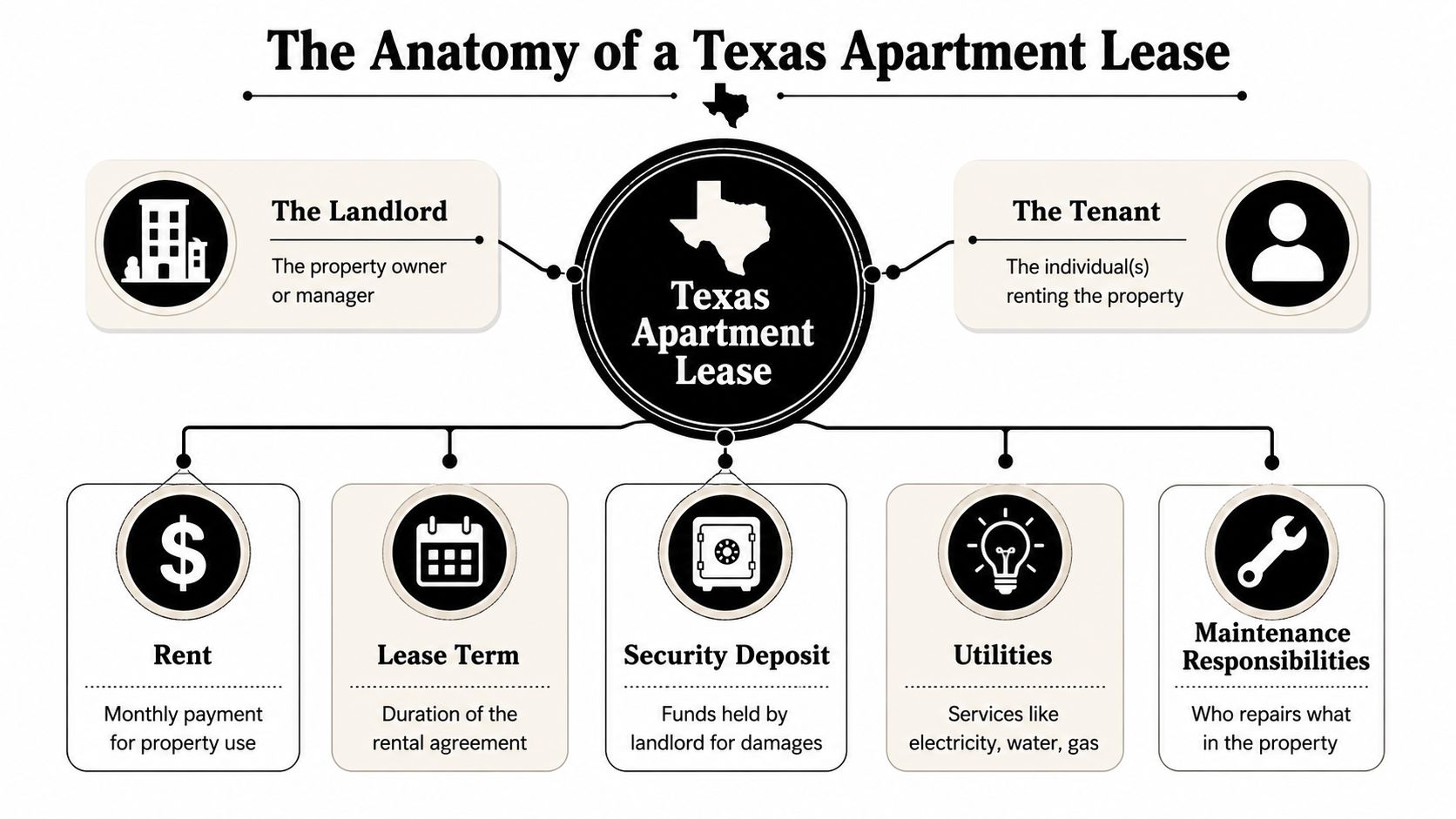
A Texas apartment lease is easiest to understand when you break it into parts. Think of it as a blueprint. The document identifies the people involved, the property involved, the payment arrangement, and the rules for using and caring for the home.
The parties and the property
Every lease starts with the core players.
- Landlord or lessor: The owner or property manager with the right to rent the unit.
- Tenant or lessee: The person allowed to occupy the apartment under the lease terms.
The lease should also clearly identify the apartment itself. That sounds basic, but accuracy matters. If the address, unit number, or listed occupants are wrong, confusion can spread into notice issues, access disputes, and move-out conflicts.
Fixed-term and periodic leases
Most residential leases in Texas fall into one of two broad categories.
| Lease type | How it works | Best for | Main trade-off |
|---|---|---|---|
| Fixed-term lease | Runs for a set period stated in the contract | People who want predictability | Less flexibility if plans change |
| Periodic lease | Renews from period to period, often month to month | People who need flexibility | Less long-term certainty |
A fixed-term lease is usually better for stability. The tenant knows they have the right to stay for the stated term if they follow the lease. The landlord benefits from more predictable occupancy.
A periodic lease gives more flexibility. That can help a tenant who may relocate soon or a landlord who wants shorter commitments. The downside is that short-term flexibility often means more uncertainty.
A lease term shapes leverage. Stability helps when both sides want predictability. Flexibility helps when circumstances may change.
The clauses that make the relationship work
The most important lease parts usually include rent, the lease term, utilities, maintenance, occupancy limits, and the security deposit. If any of those terms are vague, disputes become much more likely.
If you want a practical checklist, what to include in a lease agreement is a useful starting point. For a broader look at the key terms and required disclosures in a Texas residential lease, see What a Texas Lease Should Include.
Key Clauses Every Texan Should Understand
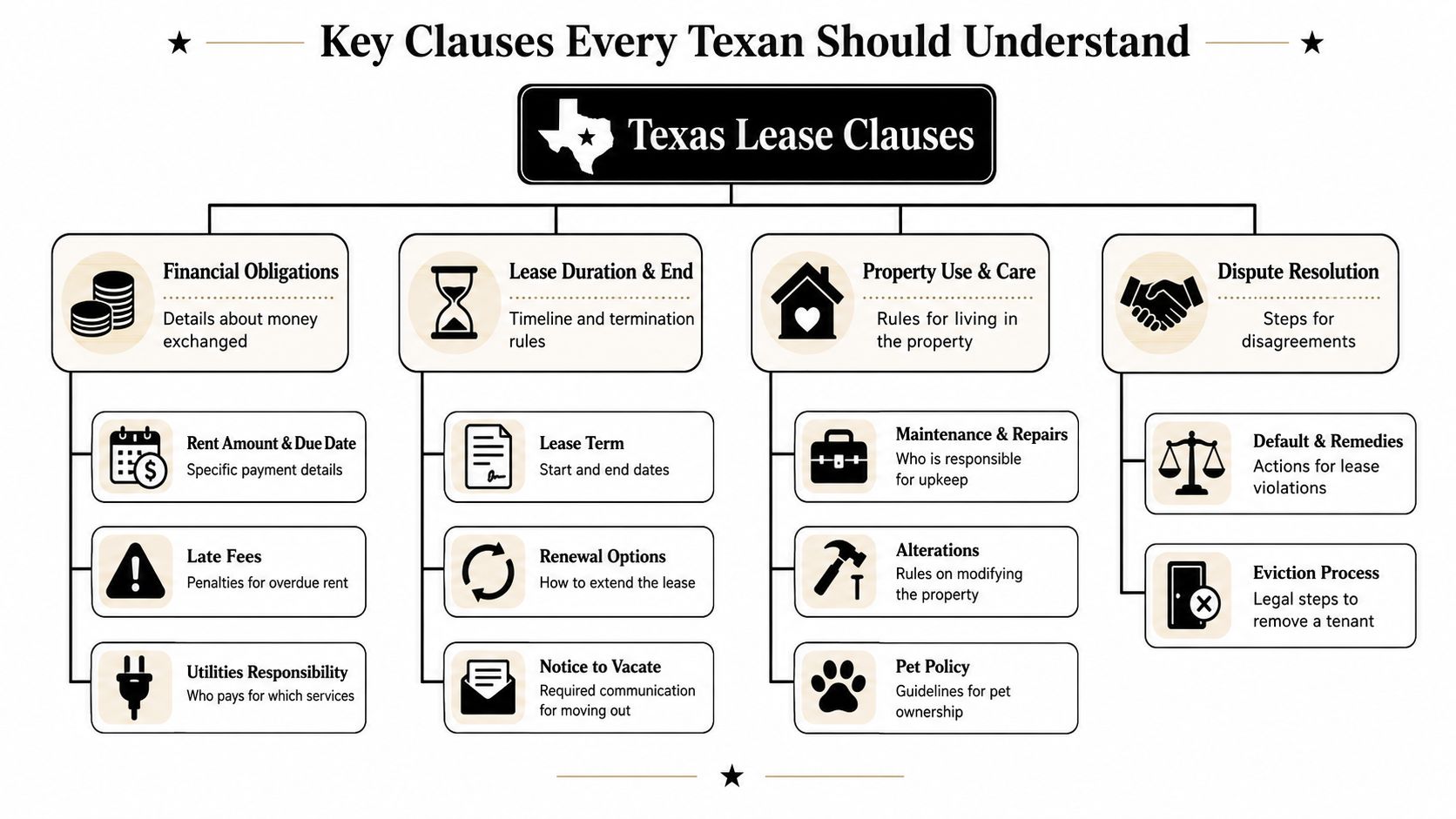
The meaning of an apartment lease becomes clearer when you stop reading it as one long document and start reading it clause by clause. Each clause has a job. Some control money. Some control behavior. Others decide what happens when something breaks or when someone wants out.
A quick visual can help you spot the sections that matter most.
Rent and payment terms
A rent clause should answer basic but critical questions. When is rent due? How must it be paid? What counts as nonpayment? Are there rules about partial payments?
Consider a common dispute. A tenant pays most of the rent and promises the rest a few days later. If the lease says partial payment doesn't waive the landlord's rights, that detail matters. If the lease requires online payment and the tenant insists on cash, that matters too.
What works is clarity before move-in. What fails is assuming “close enough” payment will be treated the same as full compliance.
Security deposit language
The security deposit clause often becomes the most important paragraph in the whole lease after move-out. It should describe the deposit's purpose and the conditions for deductions.
Under Texas Property Code § 92.103, a landlord must refund a security deposit to the tenant on or before the 30th day after the date the tenant surrenders the premises. That deadline matters for both sides. Tenants should document surrender and provide a forwarding address. Landlords should inspect promptly, document the condition of the unit, and process the deposit carefully.
Later disputes often come from poor documentation, not just disagreement over damage.
Here's a short explainer that gives a practical framework to understand security deposit rules, especially when you're comparing ordinary wear with damage that may support a deduction.
A short video can also help if you're sorting out how lease terms differ in related occupancy arrangements.
For readers weighing occupancy options, lease vs. sublease is a useful distinction to understand before you let another person move in.
Repairs, entry, and occupancy rules
If the sink starts leaking late at night, the repairs clause becomes real very quickly. A good lease tells the tenant how to report problems and tells the landlord what kinds of upkeep remain the tenant's responsibility.
Entry terms matter too. Tenants want privacy. Landlords need access for repairs, inspections, and emergencies. Problems usually start when one side assumes access is unlimited or, on the other hand, that access can always be refused. The lease should set a process.
Occupancy and subletting rules are just as important. If an approved occupant moves out and a new person moves in without permission, that can create a lease violation even if rent is still being paid. Quiet lease clauses often drive loud disputes.
Your Rights and Responsibilities Under Texas Law
A lease is powerful, but it does not override Texas law. The Texas Property Code sets baseline rules that apply even when the parties disagree about what seems “fair.” If you understand those baseline duties, you're in a stronger position whether you're a tenant trying to protect your home or a landlord trying to manage risk lawfully.
Landlord duties in plain English
A landlord's job is not just collecting rent. In a Texas residential tenancy, the landlord has legal duties tied to the condition of the property and the way the tenancy is managed.
That usually includes these practical obligations:
- Provide a livable home: The rental unit should be safe and suitable to live in.
- Address qualifying repair problems: When a condition affects health or safety, proper notice from the tenant matters.
- Follow the lease and the law when enforcing rights: Even when a tenant is behind, the landlord must use legal procedures.
A real-world example makes the point. If the apartment heater stops working during cold weather and the problem affects livability, a landlord should treat that as more than an inconvenience. Waiting too long or ignoring proper notice can create legal exposure.
Tenant duties that courts take seriously
Tenants have rights, but they also carry duties that matter in every dispute. A strong legal position usually starts with clean hands.
The basics are straightforward:
- Pay rent as agreed: Most lease problems begin here.
- Take reasonable care of the unit: Tenants should avoid causing damage and should keep the property in ordinary condition.
- Follow use restrictions: Extra occupants, unauthorized pets, and prohibited alterations can trigger conflict even when rent is current.
A simple example is the difference between a burned-out lightbulb and a broken window. Replacing a standard lightbulb is usually day-to-day upkeep. A shattered window caused by a tenant or guest is a very different issue. The lease and the facts decide who bears that cost.
Keep a paper trail. Repair requests, rent receipts, photos, move-in notes, and written notices often decide disputes more than angry conversations do.
Where people get into trouble
Many landlord-tenant disputes are avoidable. They grow because one side stops documenting, stops communicating clearly, or takes shortcuts.
Common mistakes include:
- Relying on oral promises: If a landlord says, “Don't worry about this month,” or a tenant says, “I'll fix it later,” those statements are risky unless confirmed in writing.
- Ignoring notice requirements: Rights often depend on notice being given the right way.
- Treating inconvenience like a legal emergency: Not every frustration is a violation, and overstating a claim can weaken your position.
If you need legal guidance on lease drafting, enforcement, or disputes, one available resource is The Law Office of Bryan Fagan, PLLC, which handles Texas landlord-tenant matters for both landlords and tenants.
Navigating Common Landlord-Tenant Disputes
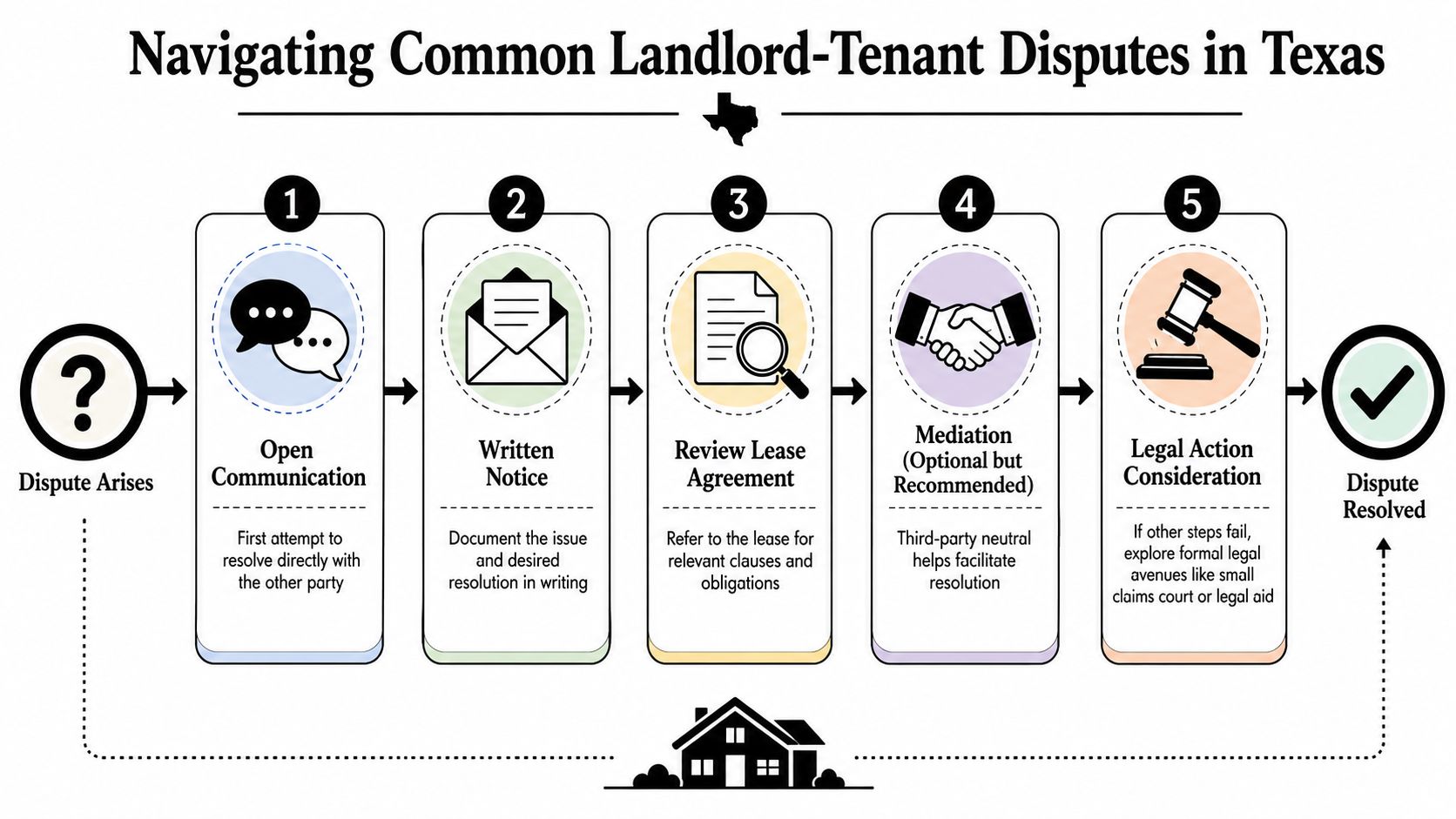
Most lease disputes fall into familiar patterns. The names change, but the conflict usually comes down to one of three things: money, repairs, or possession. The right first step is usually not a threat. It's documentation.
This flow is a practical way to approach the problem before it gets worse.
Security deposit disputes
Tenants often call after moving out because they expected their deposit back and either received nothing or received deductions they believe are improper. Landlords often call because the tenant left the unit in poor condition and now disputes the charges.
A practical response looks like this:
- Review the lease and your move-out records. Look at cleaning terms, damage provisions, photos, and any inspection notes.
- Confirm surrender and forwarding information. Deposit issues often turn on whether the move-out process was completed clearly.
- Send a written demand if needed. Keep it factual. Identify the property, your move-out date, and the specific issue.
- Preserve the paper trail. Save texts, emails, receipts, and photographs.
What works is a calm written demand supported by records. What doesn't work is a vague accusation with no proof.
Repair disputes
Repair disputes often go sideways because the tenant reports the issue casually and assumes that's enough, while the landlord disputes whether proper notice was ever given.
A better approach is methodical:
- Put the repair request in writing: Be specific about the problem and how it affects the unit.
- State the impact clearly: If the condition affects health or safety, say so plainly.
- Keep copies of all communication: Screenshots, portal confirmations, and emails matter.
- Allow access for repairs: A landlord can't fix what the tenant won't let them inspect.
Small repair issues become large legal issues when neither side documents the timeline.
For landlords, the mistake is ignoring the request or treating every complaint as exaggerated. For tenants, the mistake is assuming a verbal complaint in passing created a clear legal record.
Eviction disputes
An eviction is not just “the landlord wants you out.” In Texas, it is a legal process. A landlord must follow that process, and a tenant should take every notice seriously.
At a high level, the process usually begins with a notice to vacate, followed by a court filing if the tenant does not leave. The landlord cannot lawfully skip straight to forcing the tenant out through intimidation or self-help tactics.
That means these shortcuts are dangerous:
- Changing locks to force surrender without following the law
- Shutting off utilities to pressure a move-out
- Removing property without legal authority
- Threatening immediate removal without using the court process
For tenants, the worst response is ignoring court papers. For landlords, the worst response is trying to “handle it yourself” outside the legal process. An experienced Texas landlord tenant lawyer or eviction attorney can often spot problems early, before the case becomes more expensive and more hostile.
Special Lease Rules You Need to Know in Texas
Texas lease law includes several rules that people often learn about only after a crisis starts. These rules can shift the balance of power quickly. If you miss them, you may give up a right you had or take action that creates liability.
Early termination is not one-size-fits-all
Many people assume breaking a lease always means automatic liability until the original end date. That is too simple. Texas law recognizes certain special situations, and some leases also contain their own early-termination procedures.
For that reason, a tenant should never assume they have no options, and a landlord should never assume the lease language alone answers the question. Before acting, review Texas lease agreement laws carefully and compare the lease language to the statute.
Lockouts and leverage
Lockouts create panic fast. A tenant who cannot access the apartment may feel pressured to surrender rights just to get back inside. A landlord may believe a lock change is a quick solution to nonpayment or lease violations.
That's where legal mistakes happen. Texas has rules on residential lockouts, and those rules matter. The safer course is to stop, review the lease, document what happened, and get legal advice before escalating.
Mitigation matters when someone leaves early
Another Texas-specific issue that many landlords and tenants miss is the duty to mitigate. In practical terms, if a tenant leaves early, the landlord generally cannot sit back and let damages pile up without trying to re-rent the unit.
That point changes negotiations. A tenant who leaves early may still face exposure, but the analysis should not stop with “you owe everything left on the lease.” A landlord should also document efforts to fill the unit. Good records support reasonable claims. Poor records weaken them.
The lease gives structure, but Texas law often decides who has the stronger position once the relationship breaks down.
When to Get Help from a Texas Tenant Lawyer
Some lease problems can be solved with a clear email, a copy of the lease, and a realistic conversation. Others should move to legal review quickly.
You should strongly consider speaking with a Texas landlord tenant lawyer if you've received an eviction notice, you're dealing with repeated illegal entry, you believe a lockout was improper, major repairs affecting safety are being ignored, or a security deposit dispute has become entrenched. Landlords should get help when a tenant stops paying, violates occupancy rules, causes serious damage, or challenges enforcement in a way that could expose the landlord to counterclaims.
The key point is simple. An apartment lease is not just a rental form. It is the foundation of a legal relationship, and once conflict begins, every line in that document can matter. If you understand your lease and act early, you protect your rights far better than if you wait for the problem to explode.
If you need help with an eviction, lease issue, or rental dispute, contact The Law Office of Bryan Fagan, PLLC for a free consultation today.