Verbal rental agreements in Texas can be enforceable, but only if the lease term is one year or less. That makes handshake deals legally possible, but still risky for both landlords and tenants because disputes usually turn on memory, missing proof, and unclear expectations.
A common version of this problem looks simple at first. A tenant moves in after a conversation, starts paying rent, and both sides think they have an understanding. Months later, they disagree about the move-out date, repairs, pets, guests, or whether the arrangement was supposed to renew.
That's when people start searching for verbal rental agreements Texas are they enforceable, usually because the disagreement has already become expensive. The hard truth is that oral leases can matter under the Texas Property Code, but they often create the kind of conflict that a written lease would have prevented from the start. If you're a renter worried about your tenant rights, or a landlord trying to avoid an avoidable eviction fight, clarity matters more than optimism.
Understanding Your Rights with Verbal Leases
A tenant rents a garage apartment after meeting the owner through a friend. They agree on rent, when it's due, and that the tenant can move in right away. Nothing is signed because both sides want to “keep it simple.”
For a while, it works.
Then the air conditioning fails in summer. The tenant says the landlord promised to handle major repairs. The landlord says the tenant accepted the place as-is for lower rent. Both believe they're right. Neither has a lease to point to.
This is the main problem with verbal leases in Texas. The issue usually isn't that no agreement existed. The issue is that the parties often remember different terms once money, repairs, or move-out become contentious.
What rights still exist
Texas law does recognize that a lease can be oral or written. That means a verbal agreement isn't automatically meaningless. In the right circumstances, it can create real obligations.
For tenants, that may mean you can't be pushed out because nothing was signed. For landlords, it may mean a tenant can't rewrite the deal later by claiming terms that were never discussed.
Practical rule: A verbal lease may be legally meaningful, but it's only as strong as the proof behind it.
Why these cases get messy fast
A written lease usually answers basic questions before anyone has to argue:
- Rent terms: How much is due, when, and how it must be paid.
- Repairs: Who handles what, and how repair requests should be made.
- Occupancy rules: Whether guests, roommates, or pets are allowed.
- Ending the tenancy: What notice is required and what happens if someone stays.
Without those terms in writing, both sides often spend more time arguing about what the agreement was than solving the actual problem. That's why a Texas landlord tenant lawyer or eviction attorney often sees oral-lease cases after the relationship has already broken down.
The One-Year Rule and the Statute of Frauds
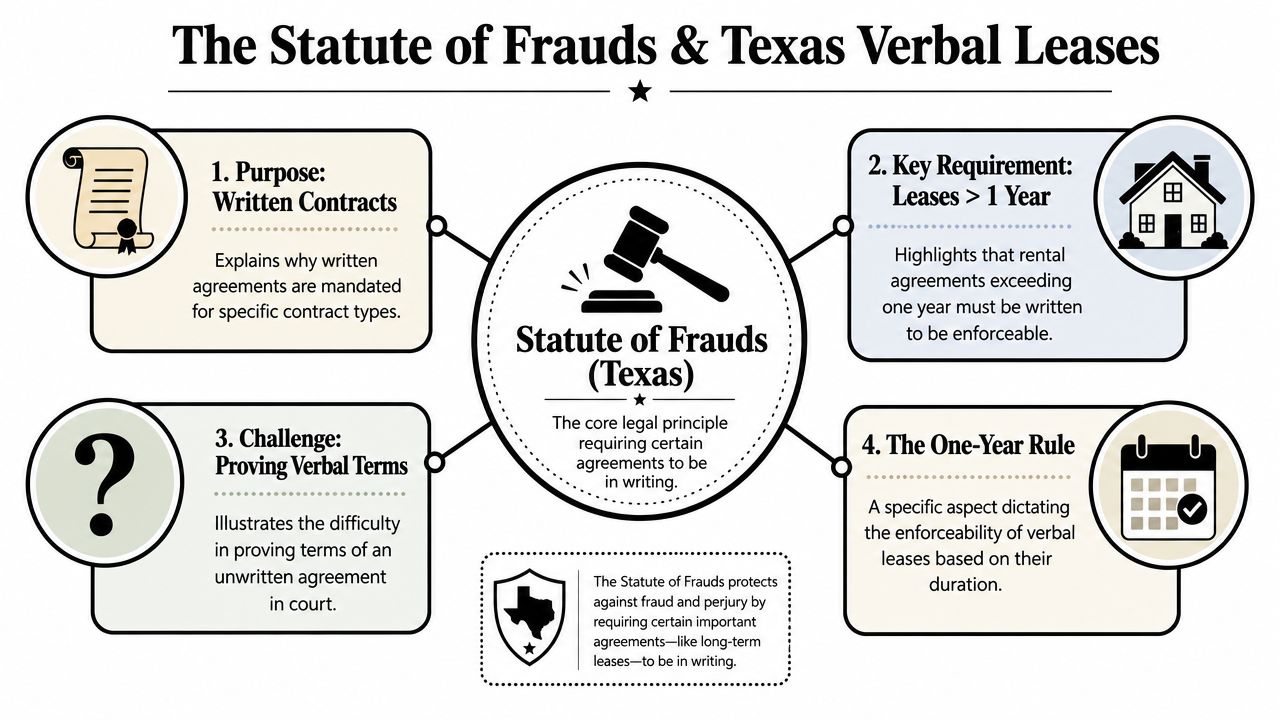
The most important legal line in Texas is simple. A verbal lease is enforceable only if it can be performed within one year. The Texas State Law Library's explanation of leases under Texas law states that leases longer than one year must be in writing, while oral lease terms that fit within a one-year period can still qualify as valid lease agreements under Texas Property Code Section 92.001 and the Statute of Frauds.
What that means in plain English
Think of the rule like a gate.
If the full lease term can be completed within a year, the gate may stay open. If the agreement is for longer than a year, the gate closes unless the lease is written and signed.
A few examples make this easier:
| Situation | Likely result |
|---|---|
| Oral month-to-month rental | Can be enforceable |
| Oral agreement for several months | Can be enforceable |
| Oral agreement for exactly one year or more | Writing becomes critical |
| Oral promise to rent for a longer fixed term | Likely unenforceable without writing |
That one-year boundary is the point many people miss. Texas allows oral leases in some situations, but it does not treat a long-term verbal promise the same way it treats a shorter arrangement.
Why the law draws that line
The Statute of Frauds exists to reduce disputes over important agreements. Real estate and lease arrangements affect possession of property, ongoing payments, and legal obligations. Once the term stretches beyond a year, Texas requires more certainty.
If you want a broader look at how Texas treats unwritten agreements generally, this guide on verbal contracts in Texas gives helpful context.
The one-year rule doesn't make short oral leases safe. It only means they may be enforceable.
Where people get confused
People often assume that staying in the property for many months automatically turns an oral arrangement into an invalid long-term lease. That isn't always the right way to analyze it. The better question is what the original term was, whether the tenancy became month-to-month, and whether proper notice was later given.
That distinction matters in real disputes. A rolling oral arrangement may still be treated differently from a single oral promise for a fixed term beyond one year.
The Challenge of Proving a Verbal Agreement
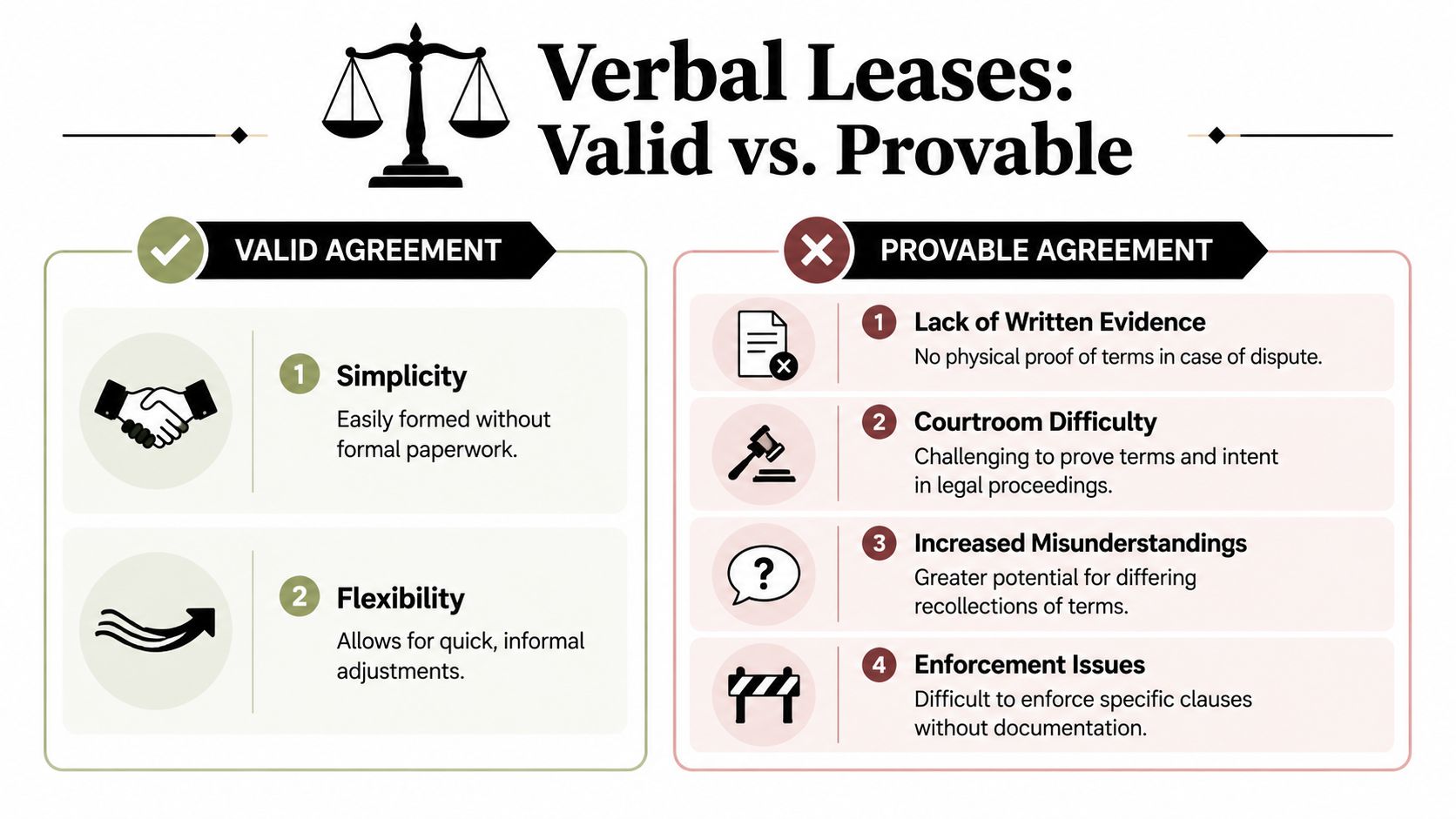
Even when an oral lease falls on the enforceable side of the one-year rule, a second problem appears immediately. Can you prove what was agreed?
The discussion of verbal agreements under Texas law at Sul Lee Law makes the point clearly. The practical enforceability problem is proof, not just validity. Courts can uphold an oral lease only when the landlord or tenant can establish offer, acceptance, consideration, and mutual intent. Without a signed document, evidence like witness statements, correspondence, and payment records becomes critical.
What evidence usually matters
In a courtroom, general statements like “we had a deal” rarely carry the day by themselves. Specific proof matters more.
The strongest evidence often includes:
- Texts or emails: Messages that mention rent, move-in, repairs, or how long the tenant could stay.
- Payment records: Receipts, bank transfers, or app payments showing a regular rental pattern.
- Witnesses: Someone who heard the agreement or later discussions about its terms.
- Conduct: The tenant moved in, paid rent, got keys, or made requests consistent with a landlord-tenant relationship.
What usually doesn't work well
Some facts feel important but don't resolve the central dispute:
- Assumptions: “That's how rentals usually work.”
- Unspoken expectations: One side expected utilities or lawn care to be included, but no one explicitly said so.
- Memory alone: Confident testimony can still conflict with equally confident testimony from the other side.
If the judge has to choose between two different memories and there's little paper trail, neither side should feel comfortable.
The real litigation trade-off
Oral leases often become expensive. A case may be legally arguable, but still hard to win cleanly. That uncertainty affects settlement, eviction strategy, and whether it makes sense to fight over the issue at all.
For landlords, weak documentation can slow enforcement. For tenants, weak documentation can make it harder to prove what rights you were promised. In practice, a verbal lease often creates a “he said, she said” case that consumes time and money before anyone reaches the underlying issue.
Common Disputes Arising from Oral Leases
Most oral-lease fights don't start with abstract legal doctrine. They start with a practical disagreement that a written lease would have answered in one paragraph.

Rent and due-date disputes
A landlord says rent was due on the first. The tenant says there was always a grace understanding because the tenant gets paid later in the month. Payments were accepted inconsistently, so now both sides claim the course of dealing supports them.
This kind of dispute becomes dangerous when the landlord files for possession and the tenant argues there was never a default under the actual agreement.
Repairs and habitability arguments
A tenant reports a plumbing problem or broken air conditioning. The landlord says the tenant caused the issue or accepted responsibility for small repairs. The tenant says the landlord agreed to handle major systems.
Without a written lease, the parties often end up debating conversations instead of addressing the condition itself. That can spiral into claims involving repairs, withheld rent arguments, or allegations of retaliation.
Deposit and move-out confusion
Security deposit fights are common even with good paperwork. Without a signed lease, they get worse.
The parties may disagree about:
- Whether a deposit was paid at all
- What the deposit was meant to cover
- What condition the unit had to be in at move-out
- Whether cleaning, keys, or damage were discussed
A written lease usually creates a cleaner record of the deal. An oral one often leaves both sides accusing the other of changing the story.
Guests, pets, and extra occupants
One of the most frequent flashpoints is occupancy. A tenant believes a partner or family member could move in because the landlord “didn't object.” The landlord says permission was never given.
The same thing happens with pets. A tenant may hear “that should be fine” and treat it as approval. A landlord may view the conversation as tentative or conditional. Once property damage or neighbor complaints enter the picture, the disagreement hardens.
A short explanation of these risks can help if you're sorting through a live dispute:
Reality check: Oral leases often work best right up until the first serious disagreement.
Holdovers and informal renewals
Another costly problem appears at the end of the arrangement. The tenant stays, the landlord keeps accepting rent, and no one clearly states whether the old terms still apply.
That's where people confuse three different issues:
- Original term length
- Holdover status
- Notice to terminate
Those distinctions drive real disputes in Texas housing cases. A person may have started under a valid short oral arrangement, then shifted into a month-to-month tenancy, then faced a notice problem that neither side understood. That lifecycle issue is why oral leases remain so risky even when they begin lawfully.
How to Legally End a Month-to-Month Verbal Tenancy
Many oral rental arrangements in Texas operate as month-to-month tenancies. Ending one still requires a legal process. A commonly cited rule in Texas landlord-tenant practice is the 30-day written notice for ending a month-to-month tenancy under Texas Property Code Section 91.001, as discussed in this Texas analysis of verbal real estate agreements.
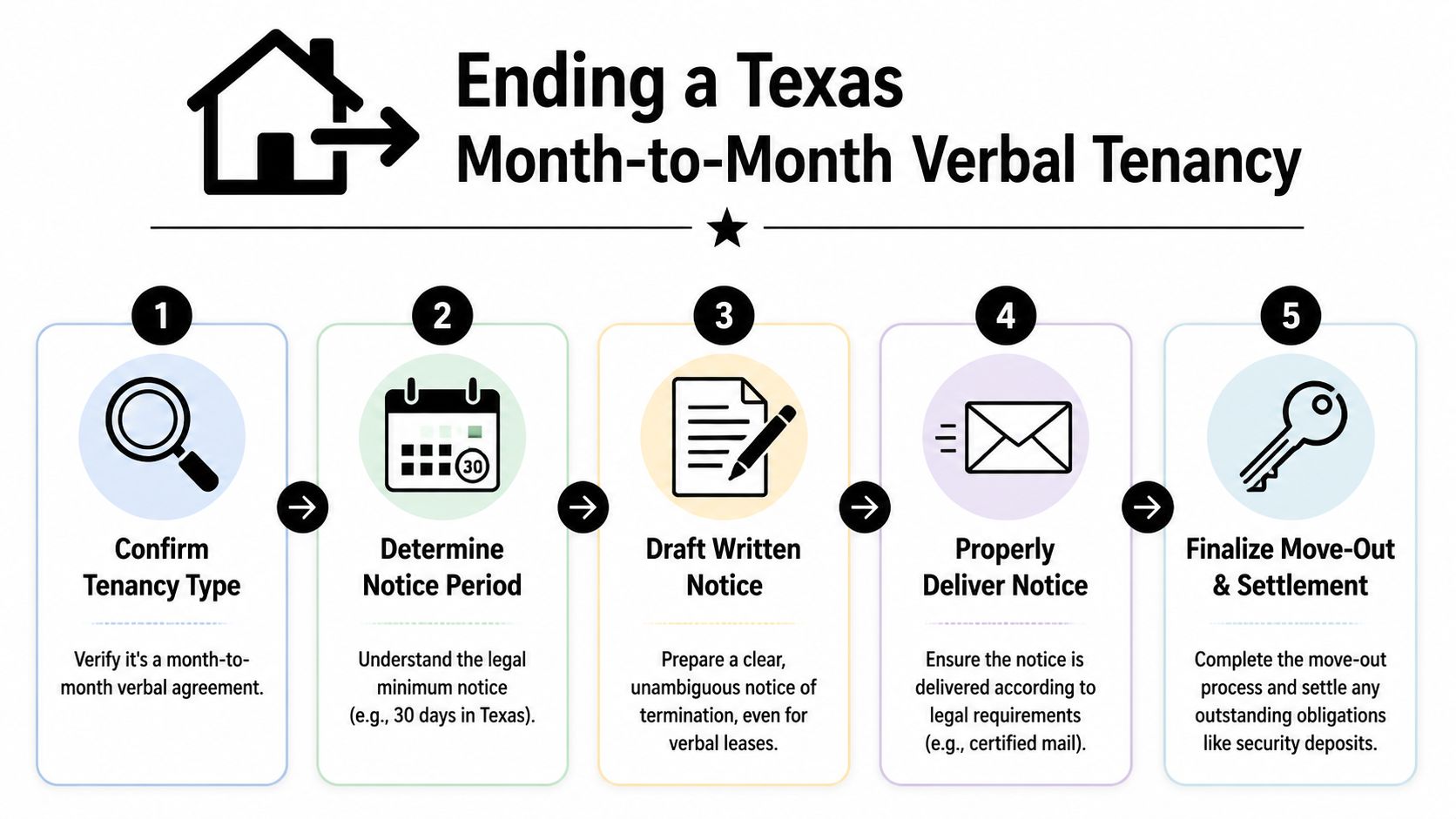
A practical five-step approach
Confirm the tenancy type
Make sure the arrangement is month-to-month and not a disputed fixed-term promise.Prepare written notice
Even though the lease was oral, the termination should be in writing. Clear notice reduces later arguments about timing and intent.State the move-out date clearly
Vagueness causes avoidable disputes. The notice should plainly say when the tenancy ends.Deliver the notice in a way you can prove
Keep a copy. Save texts, emails, mailing records, or other evidence showing the other side received it.Document the move-out process
Inspect the property, preserve payment records, and confirm possession has been surrendered.
What landlords and tenants often get wrong
Some landlords think an oral tenant can be told to leave immediately. Some tenants think an unwritten tenancy means notice rules don't apply. Both assumptions can create legal trouble.
If the tenancy is month-to-month, the lack of a signed lease doesn't erase the need for proper notice. It means you need to be even more careful about documenting the end of the relationship.
For a fuller discussion of this tenancy structure, this article on what a month-to-month tenancy means in Texas is a useful starting point.
When to pause before filing or moving out
If there's a dispute about whether the tenancy already ended, whether rent was accepted after notice, or whether the occupant became a holdover under different terms, slow down and document everything. That's often the point where a Texas landlord tenant lawyer or eviction attorney can help prevent a procedural mistake from becoming a larger case.
Why a Written Lease Is Your Best Protection
The legal answer to verbal rental agreements in Texas isn't just yes or no. The more useful answer is that oral agreements may be valid, but they become harder to manage as time passes, people stay over, terms shift, and notice issues arise. That practical distinction between term length, holdover status, and termination often drives the actual dispute, as noted in this discussion of verbal leases in Texas practice.
What a written lease solves
A written lease protects both sides because it fixes the terms before stress, money, and frustration distort the conversation.
It should clearly address:
- The rental term
- The amount of rent and when it is due
- Repair responsibilities
- Occupancy and pet rules
- Notice requirements
- Move-out expectations
If you're drafting or updating a rental agreement, this checklist on what to include in a lease agreement helps identify the clauses that often prevent disputes.
What works better in the real world
Handshake deals work only when both sides continue to cooperate. Written leases work even when they don't.
That's the difference.
A clear lease doesn't signal mistrust. It creates a shared record. For landlords, that means better enforcement and fewer surprise arguments. For tenants, that means stronger protection of your tenant rights and less room for informal rule changes later. If a dispute has already started, The Law Office of Bryan Fagan, PLLC can evaluate the communications, payment history, and tenancy structure to determine what can realistically be enforced under the Texas Property Code.
Put the deal in writing while everyone is still getting along. That's when prevention is cheapest.
If you need help with an eviction, lease issue, or rental dispute, contact The Law Office of Bryan Fagan, PLLC for a free consultation today. A Texas attorney can help you assess whether an oral lease is enforceable, whether proper notice was given, and what steps will best protect your rights moving forward.