Dealing with a landlord dispute or eviction can be stressful—but understanding your rights under Texas law can make all the difference. You've worked hard to build your rental property portfolio in Texas. But as your success grows, so does your risk. All it takes is one tenant dispute over an eviction or a security deposit at a single property to put your entire investment portfolio on the line.
A Series LLC in Texas is the legal armor savvy landlords use to protect themselves. It allows you to build a legal firewall around each property, containing any single liability so that a problem at one location can't sink your whole real estate business.
Don't Let One Lawsuit Destroy Your Entire Real Estate Portfolio
Landlord-tenant disputes are stressful enough. But when you own multiple properties under your personal name or a single, traditional LLC, you're creating a massive, unnecessary risk. A lawsuit from one tenant—maybe over a slip-and-fall or a lease argument—can legally target every other property you own, and even your personal bank accounts and home.
This is where smart asset protection isn't just a good idea; it's essential. The goal is to isolate each property's risk from the others. Think of it like this: right now, all your properties are individual cabins on one giant ship. If one cabin springs a leak, the whole ship could go down. The Series LLC turns each property into its own separate, watertight vessel. If one takes on water, the others sail on, completely unaffected. To get a better handle on the basics, it's worth understanding the fundamentals of single-member LLC liability protection.
A Texas-Specific Solution for Smart Investors
The Texas Business Organizations Code provides a powerful tool designed for exactly this situation: the Series Limited Liability Company (Series LLC). It functions as a master "umbrella" LLC that can create an unlimited number of internal divisions, known as a "series."
Under this structure, each individual series can:
- Hold the title to its own specific property.
- Maintain its own separate bank accounts, books, and records.
- Be legally shielded from the debts, liabilities, and lawsuits of every other series.
This gives you the powerful liability protection of having separate companies for each property without the cost and administrative nightmare of forming and maintaining dozens of individual LLCs. It's a proactive strategy for smarter, more secure property ownership. For any landlord serious about safeguarding their investments, digging deeper into general asset protection strategies is a critical step.
This guide will show you how The Law Office of Bryan Fagan, PLLC helps investors leverage the Series LLC to manage risk, streamline their operations, and protect their hard-earned assets with confidence. If you're facing a lease dispute, an eviction, or any other rental issue, our team of experienced Texas landlord-tenant lawyers is ready to provide the clear, direct guidance you need.
How a Texas Series LLC Works for Landlords
Let’s cut through the legal noise. To understand how a Series LLC in Texas can shield your rental properties, think of it like this: you start with one sturdy, fireproof box. That box is your main or “Master” LLC—the single entity you file with the state.
Inside that main box, you can create as many smaller, independent boxes as you need. Each one of these is a “Series.” You place one rental property into each small box, complete with its own bank account, its own lease, and its own set of books. This simple act of separation is the entire foundation of powerful asset protection.
Containing Risk One Property at a Time
Now, imagine a problem blows up at one of your rentals—say, a nasty tenant dispute over repairs at "123 Oak Street," governed by the Texas Property Code. If that argument spirals into a lawsuit, the legal fight is trapped inside the "123 Oak Street" box.
Because each series is a legally distinct container, the assets in all your other boxes (your other properties) are walled off and safe. The liability shield stops a fire at one property from burning down your entire portfolio. This is precisely why we use a Series LLC to protect your rights and investments as a landlord.
Without this separation, a single lawsuit can put every property you own on the line.
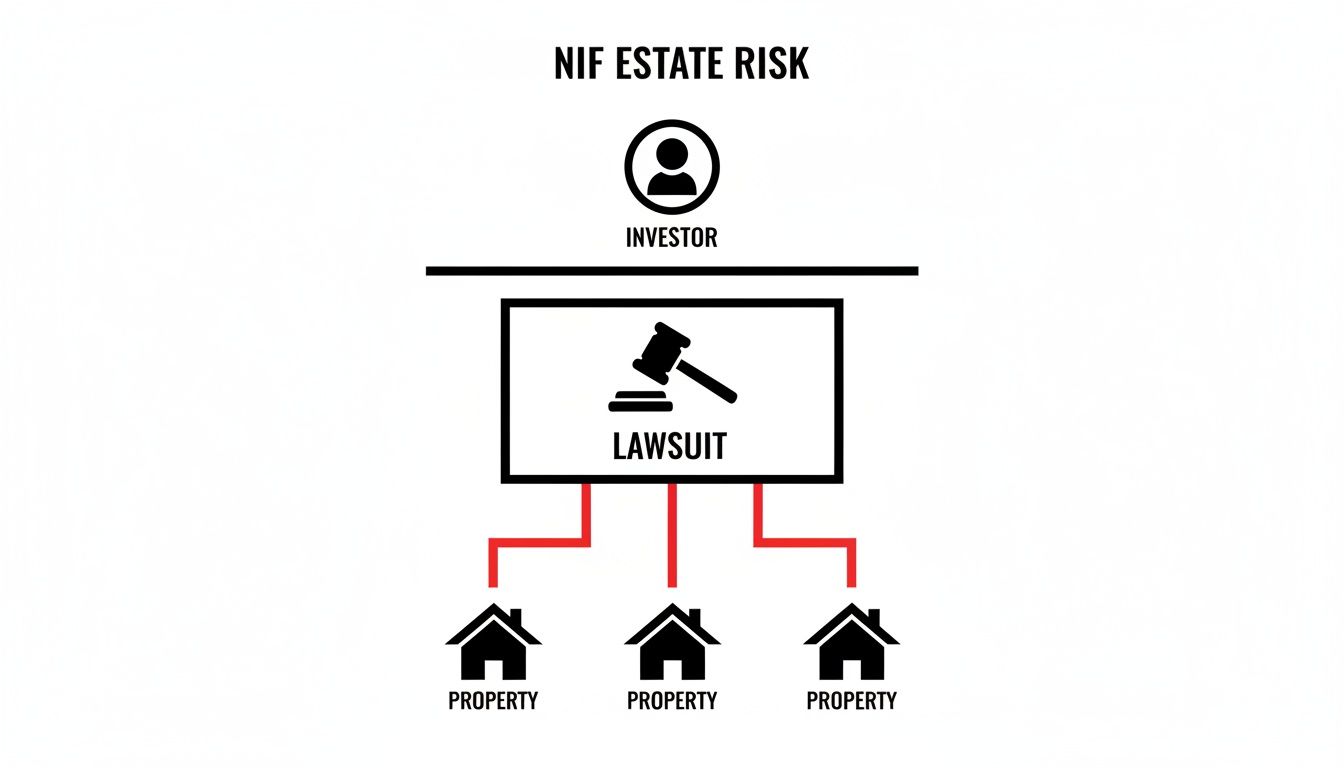
The image says it all: without the compartments a Series LLC provides, your properties are dangerously linked together and completely vulnerable.
What the Texas Business Organizations Code Says About Series LLCs
Texas law gives you two options for creating these internal "boxes," and the right choice depends on your goals. For a long time, the only choice was the "protected series."
- Protected Series: You create these internally by amending your LLC's own Operating Agreement. There’s no separate filing with the state for each one, which makes them private, incredibly fast, and cheap to set up.
Real-World Scenario: Let's say you're closing on a new rental property next week and need to get it under a protected liability shield immediately. You can create a new protected series in a matter of hours just by updating your internal company documents—no extra state filing fees, no waiting for approval.
The downside? Because they weren't on public record, some banks and title companies got nervous about dealing with them. To fix that, Texas rolled out a new option.
As of June 1, 2022, Senate Bill 1523 officially created the "registered series." It works just like a protected series, but with one crucial difference: you file a “Certificate of Registered Series” with the Texas Secretary of State.
- Registered Series: This filing puts the series on the public record, proving it exists. It gives banks, lenders, and title companies something concrete to look at, which can make getting a loan or selling a property much smoother.
A Texas Innovation for Landlords
Texas was a trailblazer here, authorizing the Series LLC structure all the way back in 2009. This move, laid out in Section 101.633 of the Texas Business Organizations Code, was a game-changer for real estate investors in Houston, Austin, and across the state.
Instead of setting up ten different LLCs for ten properties—and paying a $300 state filing fee each time—a landlord could now file one Master LLC for $300 and create the individual series internally. The savings add up to thousands in fees alone. It's a major reason why an experienced Texas landlord tenant lawyer will almost always bring up this structure. You can explore more about the specifics of Texas Series LLCs on venturesmarter.com.
Key Benefits for Texas Real Estate Investors
Why are so many savvy Texas real estate investors choosing the Series LLC? It’s not about following a trend. It’s because the advantages are practical, powerful, and purpose-built for landlords managing more than one rental property.
If you own multiple properties, this is your first step toward smarter asset protection and far less administrative hassle.
Isolate Your Risk and Protect Your Portfolio
The single biggest reason investors make the switch is for bulletproof liability protection. This is the core function of a Series LLC, and it addresses the one nightmare scenario every property owner wants to avoid.
Imagine you own three rental homes in Houston. A tenant at Property A slips on a wet walkway and decides to sue you for negligence. If you hold all three properties in your personal name or even under one traditional LLC, that single lawsuit can legally go after the equity in all three homes, not to mention your personal bank accounts, vehicles, and other assets.

Now, let's run that same scenario with a properly structured Texas Series LLC. Property A is in its own designated series, Property B is in another, and Property C is in a third.
- The tenant at Property A files their lawsuit.
- That lawsuit—and any potential judgment—is legally trapped within the series holding Property A. It can only touch the assets of that specific series.
- The equity in your other two properties, your family home, and your personal savings are completely walled off and safe.
This "internal liability shield" acts like a set of legal firewalls, preventing a fire at one property from burning down your entire portfolio. It’s the kind of peace of mind that lets you sleep at night, knowing each investment is secured from the risks of the others and your tenant rights as a landlord are protected.
Streamline Your Business and Slash Your Costs
Beyond the powerful asset protection, the Series LLC delivers incredible efficiency. Sure, you could form a separate LLC for every property you buy, but that strategy gets expensive fast and buries you in a mountain of paperwork.
A Series LLC gives you the asset protection of multiple LLCs but with the simplicity of managing just one company. You get the best of both worlds.
With a single Series LLC, you only have one primary company to file with the state. This immediately translates into huge savings, both in time and money. It's a structure perfectly suited for Texas, where 3.52 million small businesses drive our economy. Texas courts recognize and uphold these internal liability shields, which can help landlords slash administrative costs by up to 90% compared to setting up a new LLC for every rental.
Let's look at how the numbers stack up for an investor holding five properties. The difference is night and day.
Traditional LLC vs. Series LLC for a 5-Property Portfolio
| Feature | Five Traditional LLCs | One Texas Series LLC |
|---|---|---|
| State Filing Fees | 5 x $300 = $1,500 | 1 x $300 = $300 |
| Annual Reports | Five separate reports to track and file. | One consolidated report. |
| Registered Agent Fees | Potentially five separate annual fees. | One annual fee. |
| Administrative Burden | High. Managing five entities, bank accounts, and compliance deadlines. | Low. Managing one entity with separate internal records. |
The cost savings aren’t just a one-time thing; they’re immediate and ongoing. As you add more properties to your portfolio, those savings multiply, freeing up capital you can reinvest in your business.
This structure also simplifies your day-to-day legal life. When it's time to draft new rental agreements, managing the paperwork under a single business umbrella is far more straightforward. You can learn more about the specifics of rental contracts in our guide to Texas lease agreement laws.
Navigating Texas Franchise Tax and IRS Rules
Let’s be honest—the thought of filing taxes for a growing real estate portfolio is enough to give any landlord a headache. More properties usually mean more paperwork, more complexity, and more costs. But this is where a Texas Series LLC truly shines. It’s designed to simplify your financial life, not complicate it.
For federal taxes, the IRS sees your entire Series LLC—the main company and every individual property series under it—as a single business. Whether it’s taxed as a sole proprietorship, a partnership, or an S-Corp, you file just one federal tax return. No more juggling separate returns for every single rental. That alone is a massive win for busy investors.
Understanding the Texas Franchise Tax
The good news continues at the state level. In Texas, you're only on the hook for one consolidated Texas Franchise Tax report for the entire Series LLC. You don’t file separately for each series.
This report combines the revenue from the master LLC and all its individual series. But for most landlords, it gets even better.
The Texas Comptroller has a "no tax due" threshold. If your Series LLC's total revenue falls below this cutoff, you owe nothing. For the vast majority of real estate investors, this means you just file a simple No Tax Due Report online each year.
Forget about wrestling with complex tax forms. This rule transforms a dreaded annual task into a straightforward information filing that saves you time and stress.
The Financial Power of a Simplified Tax Structure
This tax efficiency is what makes the Texas Series LLC a workhorse for property investors. It treats your entire portfolio as one pass-through entity, requiring a single income tax return and one consolidated franchise tax report. It’s built for scaling your rental business without multiplying your tax burdens.
As long as your total gross receipts stay under the current $1.13 million annual threshold, you owe no franchise tax. You just file the No Tax Due Report by May 15th on the Comptroller's website. That frees up cash you would have spent on accounting fees—money you can now put toward property maintenance, dealing with an eviction, or covering other operational costs.
This practical, tax-friendly structure, first created in 2009 and enhanced in 2022 with SB 1523, is a huge reason why Texas is a magnet for real estate investors. It’s why 99.8% of businesses in the state are small firms and why Texas saw over 86,000 new businesses launch in 2023-2024. If you want to dive deeper into the latest updates, you can learn more about registered series LLCs in Texas.
By consolidating your tax and reporting obligations, the Series LLC gives you the financial clarity you need to protect your assets and grow your bottom line. An experienced eviction attorney can make sure your entity is set up correctly from day one to maximize every one of these benefits.
Common Mistakes That Can Cost You Everything
A Series LLC is one of the most powerful tools a Texas landlord can have for asset protection. But that power comes with a catch: it only works if you use it perfectly. Think of it as a legal fortress. It’s strong, but it’s not indestructible. One wrong move, one lazy shortcut, and the whole thing can come crashing down.
That’s what lawyers call “piercing the corporate veil.” It’s a disastrous outcome where a court decides to ignore the separation between your properties, and suddenly a lawsuit against one rental can threaten your entire portfolio. Avoiding these mistakes isn’t just good practice—it’s absolutely critical to protecting everything you’ve worked for.

Mistake 1: Commingling Funds
This is, without a doubt, the number one mistake landlords make. It’s also the fastest way to demolish your liability shield. Commingling funds simply means mixing money between your different series, or between a series and your personal bank account. It sounds like a technical legal term, but it happens with simple, everyday actions.
Real-World Scenario: You collect rent from your property on Elm Street (Series A) but use it to pay for a new water heater at your Maple Avenue rental (Series B). You just commingled funds. By failing to treat Series A and Series B as completely separate financial entities, you’ve handed a plaintiff’s attorney the perfect argument: that your “separate” companies are a total sham.
To keep that firewall standing, you must follow these rules without a single exception:
- Each series needs its own dedicated, separate bank account. No excuses.
- Income generated by a property must be deposited into and stay in that property's series account.
- All expenses for a property must be paid only from that specific property's series account.
This strict financial separation is the very foundation of your asset protection strategy.
Mistake 2: Sloppy Record-Keeping
When you have a Series LLC, you must operate as if you’re running multiple, distinct businesses—because you are. If your records don't prove that reality, a court won't believe it, either. The strength of your series llc texas structure depends entirely on your ability to show, with clean paperwork, that each series stands on its own.
Key Takeaway: If you can’t produce separate, organized financial records for each series on demand, your liability protection is on shaky ground. A judge will see messy books as proof that you never really treated the series as separate businesses in the first place.
This means you absolutely must maintain:
- Separate Financial Statements: Every series needs its own profit and loss statement and balance sheet.
- Separate Leases: The lease for a property must clearly name the specific series that owns it (e.g., "My Texas Rentals, LLC, Series A") as the landlord.
- Separate Maintenance Logs: Keep detailed records of all repairs and expenses for each property, linking them directly to that property's series.
Sloppy paperwork screams that you treat your portfolio as one big company, inviting a court to do the same.
Mistake 3: Improperly Titling Assets
This is a classic—and fatal—error that happens right at the start. It can invalidate your entire setup before it even gets off the ground. When you buy a new rental, it's not enough to just "assign" it to a series in your operating agreement. You have to formally transfer legal ownership to that specific series.
In practice, this means the property’s deed must be recorded in the name of the individual series, like "My Texas Rentals, LLC, Series A." If the deed is still in your personal name or just the name of the master LLC without the series designation, then the series does not legally own the property. Period.
The scary result? The liability shield for that property never existed. It's a tiny detail that an experienced Texas landlord tenant lawyer knows to verify immediately to make sure your fortress is actually built. An error like this could even prevent you from enforcing legal actions, like when a landlord needs to file for a Texas abstract of judgment to collect a debt. The correct entity must be named in every legal document, or your case could be dead on arrival.
Step-by-Step: How to Form a Series LLC in Texas
So, you’re ready to take the next step and form a Series LLC in Texas. It can feel like a massive legal project, but breaking it down into a clear roadmap makes all the difference. Think of this as your high-level guide, not a DIY instruction manual.
When you’re building a legal fortress to protect your properties, every single brick matters. One mistake, one missed filing, or one poorly worded document can bring the whole structure crashing down when you need it most. Precision isn't just a good idea—it's everything.
Step 1: Create Your Master LLC
Your first move is to officially bring the "Master LLC" into existence. This is the umbrella company that will act as the parent for all your individual property cells.
Choose a Unique Business Name: Before you can file anything, you need a name. It must be unique in the state of Texas and can't be misleadingly similar to another registered business. Critically, it also has to include a proper designator like “Limited Liability Company” or simply “LLC.”
File the Certificate of Formation: This is where it becomes real. You’ll file a Certificate of Formation (Form 205) with the Texas Secretary of State. This document formally creates your Master LLC, but there’s a catch. It absolutely must include a "notice of series" provision, which explicitly states the LLC has the authority to establish individual series.
CRITICAL STEP: If that specific notice isn’t in your initial filing, you have zero legal power to create any series down the road. This is a non-negotiable requirement under the Texas Business Organizations Code. Getting this wrong from the start renders the entire strategy useless.
Step 2: Draft Your Operating Agreement
If the Certificate of Formation is the frame of your vehicle, the Operating Agreement is the engine, the transmission, and the steering wheel all in one. This internal document is, without a doubt, the most important piece of your entire asset protection puzzle. A generic template you find online just won't cut it.
Your Series LLC Operating Agreement is the private legal document that gives you the power to actually establish each individual series. It sets the rules of the road for how each series will be managed, how its assets will be handled, how profits are distributed, and—most importantly—how its separateness from the other series will be maintained.
This is where the expertise of a Texas landlord tenant lawyer becomes invaluable. A custom-drafted agreement should clearly spell out:
- The exact process for creating a new series.
- The management structure for each individual series.
- Strict rules for maintaining separate books, records, and bank accounts.
- Procedures for adding or selling properties held within a series.
Step 3: Finalize the Structure for Each Property
Once the Master LLC is formed and you have a rock-solid operating agreement, it's time to activate and fund each individual series.
First, you officially establish each series as laid out in your operating agreement. Then comes the most crucial step: you must formally deed each property into its specific, designated series. The legal owner of "123 Main Street" must become "Your Company, LLC, Series A," not just "Your Company, LLC" or your personal name. If you skip this, the liability shield for that property doesn’t exist.
Finally, you must open a separate bank account for each and every series. No exceptions. This isn’t optional—it’s mandatory for proving the financial separation needed to protect your assets in court. This entire process shows why having a firm like The Law Office of Bryan Fagan, PLLC draft these foundational documents isn't an expense; it's the most important investment you can make in your real estate business.
Your Top Questions About Texas Series LLCs, Answered
The idea of a Series LLC makes sense on paper. But when it comes to the real world of managing rental properties, the details are what make or break your asset protection. We get a lot of questions from landlords trying to figure out if this structure is right for them. Here are the answers to the ones we hear most often.
Can I Change My Old LLC into a Texas Series LLC?
Yes, you can. Texas law allows for the conversion of a traditional LLC to a Series LLC. The process involves filing a Certificate of Amendment with the Texas Secretary of State. But the real work—and the real risk—is in drafting a rock-solid new operating agreement that gives your company the power to create individual series.
This isn't just a paperwork shuffle. Every single one of your properties must be painstakingly retitled into its own new series. One mistake here can unravel the entire liability shield you’re trying to build. This is precisely why you need an experienced Texas landlord tenant lawyer to make sure the conversion is done right from the start.
Does Each Property Series Really Need Its Own Bank Account?
Yes. One hundred percent. This is not a suggestion—it’s the single most important rule you must follow to protect your assets. If a lawsuit ever comes, the other side's attorney will look for any reason to "pierce the corporate veil" and argue your separate series are a sham.
To keep your liability shields strong, you have to do the following for each series:
- Open a completely separate bank account in that series' name.
- Deposit all rental income for a property directly into its dedicated series account.
- Pay all of that property's expenses only from that same series account.
Real-World Scenario: Mixing funds between series, even just once, is called commingling. It’s the ammunition a plaintiff’s lawyer needs to attack your entire portfolio. Disciplined, separate accounting is your best line of defense.
What Happens When I Sell One of the Properties?
This is where the flexibility of the Series LLC really shines. When you sell a property, the sale is handled only by the individual series that holds the title. It’s clean and straightforward.
All the money from that sale belongs to that one series and that series alone. The transaction has zero legal or financial effect on the main LLC or any of your other properties. This clean separation makes buying and selling properties much simpler and safer as you grow your real estate business.
If you need help with an eviction, lease issue, or rental dispute, contact The Law Office of Bryan Fagan, PLLC for a free consultation today.