Dealing with a landlord dispute can be stressful — but understanding your rights under Texas law can make all the difference. The last thing you need after a move is the added headache of a landlord refusing to return your security deposit.
But here’s the good news: in Texas, your rights as a tenant are clearly protected by law. Your landlord doesn’t just get to decide if and when you get your money back—they have to follow a specific process.
The most important rule? Your landlord must return your deposit within 30 days of you moving out and giving them a forwarding address.
What the Texas Property Code Says About Security Deposit Refunds
Fighting over a security deposit can feel like an uphill battle, but knowing your rights under the Texas Property Code changes the game.
The Texas Property Code isn't just a suggestion; it lays out specific, non-negotiable rules for how landlords must handle your deposit. This gives you a clear roadmap to getting your money back. It's not a courtesy on their part—it's their legal duty. A knowledgeable Texas landlord tenant lawyer can help you enforce these rights.
Allowable vs. Improper Deductions
A huge point of conflict is what a landlord can legally take out of your deposit. Texas law is very clear on this. They can only deduct for actual damages that go beyond “normal wear and tear.”
So, what does that look like in a real-world scenario?
- Normal Wear and Tear (Not Deductible): Imagine minor scuffs on the paint where your couch was, carpets that are slightly worn in high-traffic areas, or blinds that have faded a bit from the sun. These are the expected signs of someone actually living in a home.
- Actual Damages (Deductible): This is the serious stuff. A large hole punched in a wall, a shattered window, or deep gouges in a hardwood floor from dragging a metal bed frame without protection.
Bottom line: your landlord cannot use your security deposit to pay for their routine maintenance or to upgrade the property on your dime. For a deeper dive into these protections, it’s worth reviewing the core principles of the Texas Property Code and tenant rights.
The 30-Day Refund Deadline Explained
According to Texas Property Code § 92.103, your landlord gets exactly 30 days from the day you move out to refund your security deposit. But there's a critical step for you: that 30-day clock only starts ticking after you’ve provided a written forwarding address.
If they keep any portion of it, they can’t just pocket the cash. They are legally required to give you a written, itemized list explaining every single charge. This prevents landlords from making up vague "cleaning fees" without proof.
To keep these timelines straight, here’s a step-by-step guide.
Texas Security Deposit Timeline At a Glance
This table breaks down the key deadlines both tenants and landlords must follow in Texas. It’s a handy reference to make sure everyone is playing by the rules.
| Action | Tenant Responsibility | Landlord Responsibility |
|---|---|---|
| Move-Out | Leave the property in a clean condition, aside from normal wear and tear. | Conduct a final inspection to assess for any damages. |
| Provide Forwarding Address | Give the landlord a written forwarding address for the deposit return. This is critical. | Acknowledge receipt of the forwarding address. The 30-day clock starts now. |
| Deposit Return Window | Wait for the deposit or an itemized list of deductions. | Return the full security deposit or provide an itemized list of deductions within 30 days of receiving the forwarding address. |
| Disputing Deductions | If you disagree with the deductions, send a written dispute letter to the landlord. | Must be able to prove the deductions were for actual damages beyond normal wear and tear. |
Understanding this timeline is the first step in protecting your tenant rights and ensuring you get your money back without a fight.
A Step-by-Step Guide to Securing Your Refund
The process of getting your security deposit back often begins before you even hand back the keys. If you want your money back without a hassle, you need to be proactive. Your goal is to build such a clear, undeniable case that your landlord has zero room to argue about the property's condition.
Think of it like this: you're creating a bulletproof "before and after" story. You documented how things looked when you moved in, right? Now, it's time to do the exact same thing on your way out. This isn't just a good idea—it's your most powerful evidence.
Step 1: Document Everything on Your Way Out
Your smartphone is your single best friend in this process. Once the place is completely empty, do one final, detailed walkthrough and record everything.
- Take Timestamped Photos and Videos. Don't just snap a few quick pictures. Go room by room, capturing wide shots and close-ups. Get the walls, the floors, inside the appliances, and all the fixtures. Timestamped proof is incredibly hard for a landlord to refute.
- Narrate a Video. As you record your walkthrough, talk out loud. State the date and describe what you're seeing. For example, "This is the master bedroom on May 31st. As you can see, the carpet is clean, and there are no new stains. The walls are free of scuffs."
- Compare with Your Move-In Records. Pull up the photos you took when you first moved in. If there was a scratch on the floor then, make sure your move-out video shows it hasn't changed. This is how you stop them from charging you for pre-existing damage.
To really seal the deal, consider hiring professional move-out cleaning services. A receipt from a cleaning company is a powerful piece of evidence proving you went the extra mile to meet your lease obligations.
The number one reason landlords keep security deposits is because of disputes over the property's condition. Your photos and videos aren't just for your memories—they are legal proof that can shift the entire burden of proof onto the landlord.
Step 2: Give Them Your Forwarding Address in Writing
This part is absolutely critical under Texas law, and you can't skip it. The 30-day countdown for your landlord to return your deposit does not start until you provide a forwarding address in writing.
This infographic breaks down the simple, crucial flow of the move-out process.
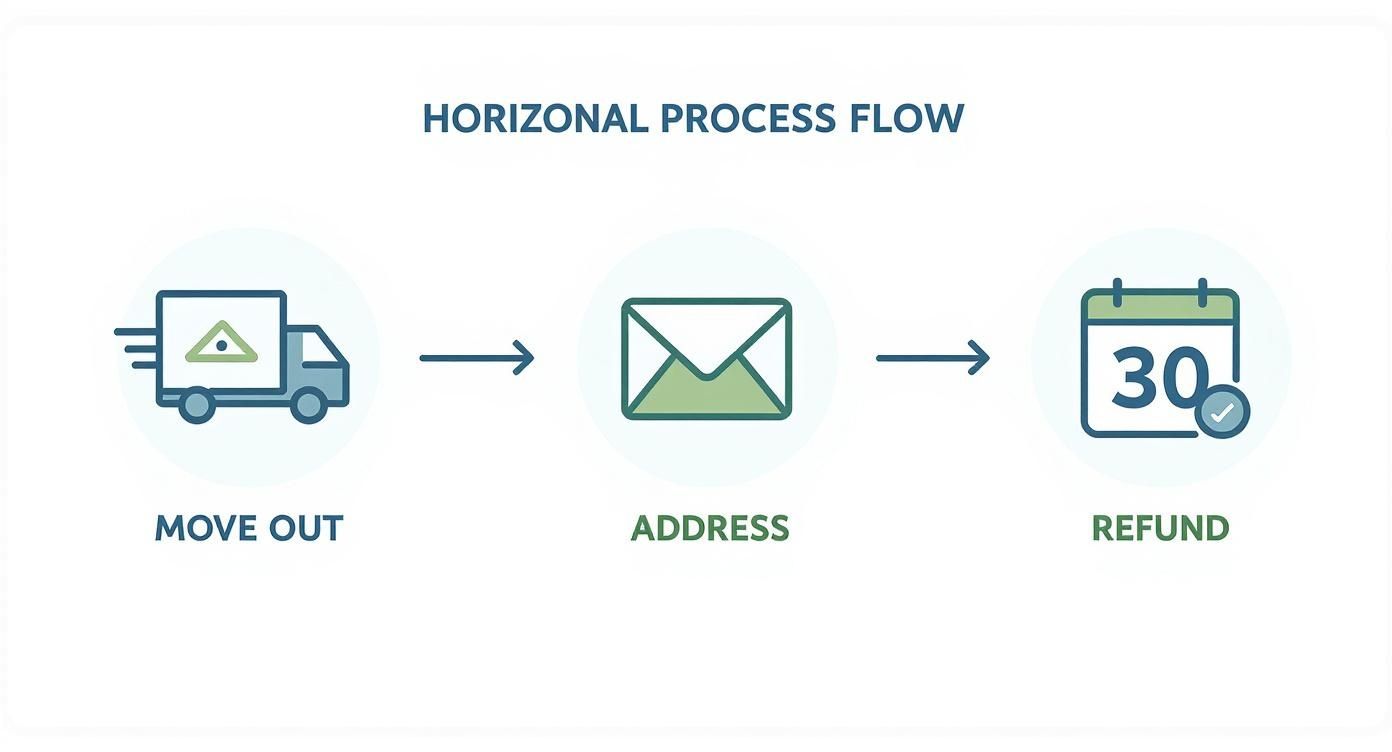
As you can see, giving them your new address is the official trigger. Don't just text it or mention it in passing. Send it by certified mail with a return receipt requested. An email also works if you get a confirmation of receipt. Without that paper trail, a landlord can simply claim they never got your address and hold your money indefinitely.
How to Handle Improper Security Deposit Deductions
It’s one of the most frustrating moments for any tenant: you get a check in the mail for a fraction of your security deposit, along with a cryptic list of "damages" and "cleaning fees" that just don't add up. It can feel like a straight-up cash grab.
But you have rights. Under Texas Property Code § 92.104, your landlord is legally required to give you a written, itemized list explaining every single deduction. This isn't a courtesy; it's the law.
Your first move is to put that list under a microscope and figure out what’s a legitimate cost versus what’s an improper charge. Knowing the difference is your key to fighting back.
Distinguishing Fair Charges from Unfair Deductions
So, what separates a fair deduction from an attempt to make you pay for routine property maintenance? It all boils down to one simple concept: "normal wear and tear" versus actual damage you caused.
- Legitimate Costs: These are for things you broke or damaged beyond normal use. For example, a cracked window, a huge hole you punched in the drywall, or a large, permanent pet stain on the carpet—these are the kinds of things your landlord can likely use your deposit to fix.
- Improper Deductions: This is where some landlords get creative. They can’t charge you for routine carpet cleaning between tenants, painting over minor scuffs from furniture, or replacing a 10-year-old dishwasher that finally gave out. Those are their costs of doing business, not yours.
This isn’t just a Texas problem; security deposit disputes are a huge issue for renters nationwide.
If a charge on that list looks more like a property upgrade than a repair for something you actually damaged, it's almost certainly an improper deduction. You are not responsible for financing your landlord's renovations.
Challenging these bogus charges is your right. If you’re convinced your landlord is wrongfully keeping your money, it's time to take the next step. To see what that looks like, check out our guide on how to file a complaint against your landlord in Texas. Knowing the process will give you the confidence to stand up for yourself.
How to Write an Effective Demand Letter
So, your polite calls and emails have gone nowhere. Maybe the landlord isn't responding at all, or worse, they sent you a ridiculously unfair list of "damages" they deducted from your deposit. It's time to get serious.
Your next move isn't a heated phone call or a frustrated text message. It's a formal, written demand letter. This isn't just you complaining—this is a crucial legal document that signals you know your rights and you're prepared to enforce them.
Think of this letter as putting your landlord on official notice. You're creating a paper trail that proves they failed to follow the law. Sending it via certified mail (with return receipt requested) is non-negotiable. It creates ironclad proof of when they received your demand, which is gold if you end up in court. If you're dealing with a landlord who is hard to reach, you might even need to figure out how to send a fax online to cover all your bases.
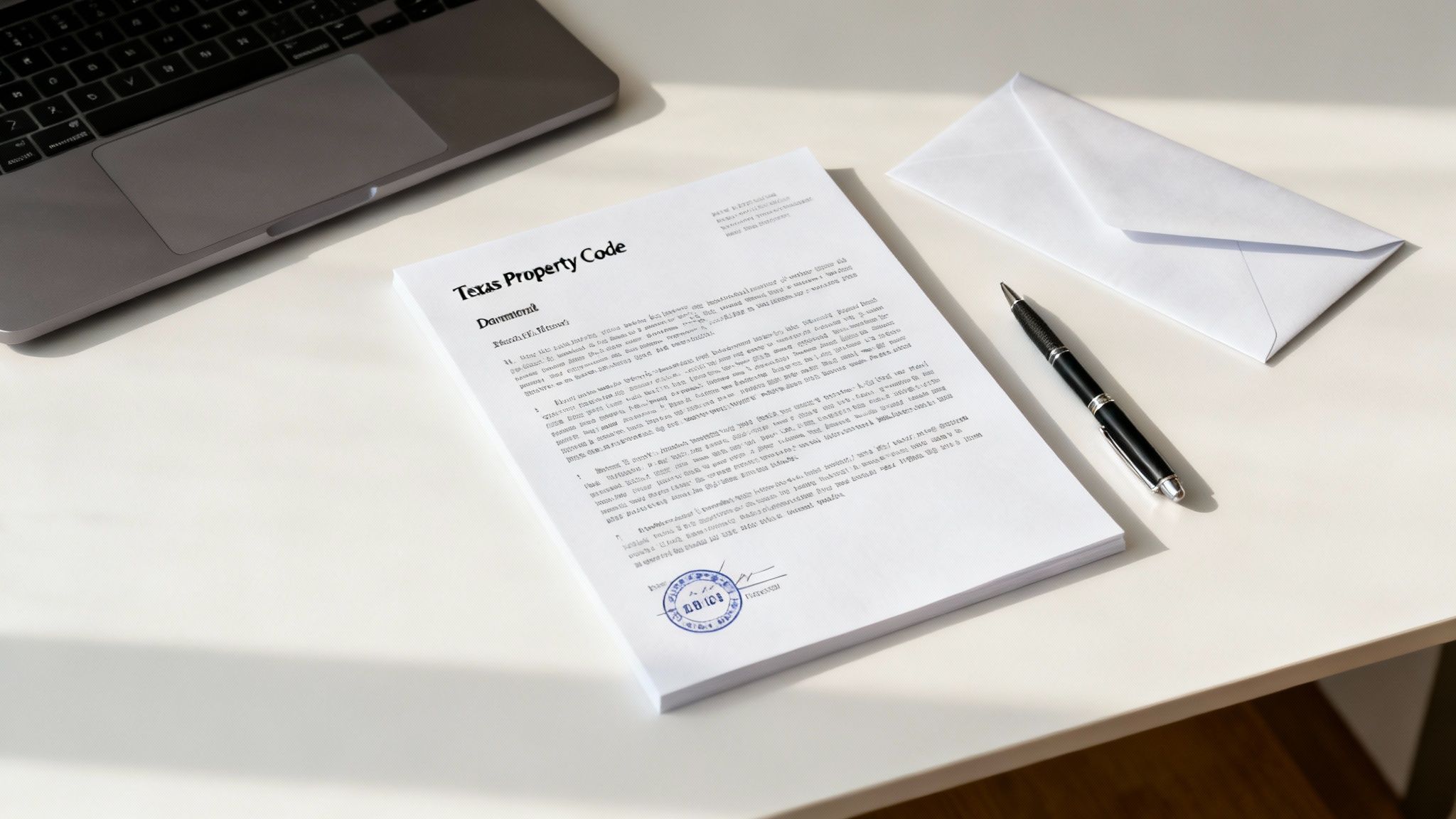
Key Elements of a Strong Demand Letter
A good demand letter is professional, factual, and firm. Leave the emotion out of it. Your goal is to clearly and calmly state the facts of your case and what you're legally owed.
Here's exactly what your letter needs to include:
- A direct reference to Texas law. Don't just ask for your money back—demand it under Texas Property Code § 92.109. This shows them you've done your homework and that you take your tenant rights seriously.
- The exact amount you are owed. Be specific. State the full amount of your original deposit and clarify the total you believe is being wrongfully withheld.
- Critical dates. You must include the date you officially moved out and, most importantly, the date you provided your landlord with your written forwarding address.
- A firm but reasonable deadline. Give them a clear timeframe to fix their mistake. Something like 10 business days is standard. Make it clear that if they miss this deadline, you're prepared to take the next step.
Let's be clear: the goal here is to get your money back without going to court. A powerful, well-drafted demand letter from you or an eviction attorney often does the trick. It shows the landlord that you understand Texas law and that fighting you will be more expensive and troublesome than simply writing you a check.
Taking Your Landlord to Small Claims Court
https://www.youtube.com/embed/SB7Vmm5iPno
So, you’ve sent a formal demand letter, and your landlord still won’t do the right thing. Don't give up. You have one more powerful option left on the table.
Texas law gives you a clear path forward in small claims court, which is officially called Justice Court. Filing a lawsuit might sound intimidating, but the process is actually designed for everyday people to represent themselves without needing a lawyer. This is where the law really stacks the deck in your favor.
The "Bad Faith" Penalty: Your Biggest Leverage
Under Texas Property Code § 92.109, if a landlord withholds your security deposit in "bad faith," the penalties get serious, fast.
So, what exactly is "bad faith"? It’s not just an honest mistake or a simple disagreement over a cleaning charge. It means the landlord intentionally or dishonestly ignored your legal rights as a tenant.
A classic example is a landlord who ghosts you—never sending the deposit back and never providing an itemized list of deductions. They know they've blown past the 30-day deadline but are gambling on you not knowing your rights or not being willing to fight back.
If a judge agrees your landlord acted in bad faith, you could be awarded:
- Three times the amount of the deposit they wrongfully kept.
- An additional $100 penalty.
- Your reasonable attorney's fees and any court costs.
This triple-damages rule isn't just about getting your money back. It's designed to be a powerful deterrent, making it a huge financial risk for landlords to illegally hang onto tenant funds. It turns a simple refund dispute into a problem they can't afford to ignore.
Clear rules like this are crucial for protecting consumers. Just look at earnest money deposits in real estate—rules ensure that these funds are handled fairly. You can see how these financial protections work in other real estate situations over at nar.realtor.
While small claims court is incredibly effective, it's not the only option. For more complicated landlord-tenant conflicts, exploring alternatives like real estate mediation can offer a structured path to resolution without heading into a formal court battle.
Common Questions About Texas Security Deposits
Navigating the rules around security deposits can feel like a maze. To help you find your way, here are quick, straightforward answers to the questions Texas tenants ask us most.
What Is Normal Wear and Tear in Texas?
Think of normal wear and tear as the gentle footprint of everyday life. It’s the natural, minor decline in a property's condition that happens when you live in it responsibly.
It's things like:
- Faded paint from sunlight hitting the walls.
- Minor scuffs where a couch rested against the drywall.
- Slightly worn carpet in hallways and main living areas.
What it is not is damage. Damage comes from negligence, accidents, or abuse. A landlord can't legally charge you for the routine upkeep that comes from someone simply living in a space. Big holes in the wall, a shattered window, or deep pet scratches gouged into a door? That's damage, and that's on you.
What Happens if My Landlord Misses the 30-Day Deadline?
This is a big one. If your landlord fails to return your deposit or give you an itemized list of deductions within 30 days of you moving out (and providing a forwarding address), the law works in your favor.
Under the Texas Property Code, this failure creates a legal presumption that the landlord acted in "bad faith."
This isn't just a slap on the wrist. It’s a serious violation that gives you significant leverage. It opens the door for you to sue for three times the amount of the deposit, plus a $100 penalty and your attorney's fees.
Can a Landlord Charge Me for Professional Cleaning?
Generally, no. If you leave the unit in a reasonably clean or "broom-swept" condition, they can't hit you with a bill for professional cleaning services. Normal tidying up is part of their cost of doing business.
The only real exception is if your lease contains a specific, legally enforceable clause requiring it. For example, some leases require professional carpet cleaning or mandatory pet treatments. Without that specific language in your lease, they can't deduct it.
Do I Really Have to Provide a Forwarding Address in Writing?
Yes. This is non-negotiable and one of the most critical steps in the entire process.
The landlord’s 30-day clock to return your deposit doesn't even start ticking until you provide a forwarding address in writing. A quick text message won’t cut it. Send an email or, even better, a certified letter. You need an undeniable record that proves you fulfilled your legal obligation.
If you need help with a lease issue, rental dispute, or eviction, contact The Law Office of Bryan Fagan, PLLC for a free consultation today. https://texastenantlawyers.com