Unexpected rental fees usually show up at the worst time. You pay rent, plan your month, and then a new charge appears on your ledger for a “processing fee,” an inflated late fee, or a move-out deduction that doesn't make sense.
That's when many tenants start searching for what fees are illegal for landlords in Texas. Landlords ask the same question for a different reason. They want to collect what the lease allows without stepping into a Texas Property Code problem that turns a small charge into a larger dispute.
Texas law doesn't ban every landlord fee. It does something more practical. It asks whether the fee is authorized, disclosed, and handled the right way. Some fees are clearly allowed. Some are clearly capped. Some become illegal because the landlord skipped a required step.
Navigating Rental Fees in Texas Can Be Stressful
A common situation looks like this. A tenant applies for an apartment, pays a screening charge, and later learns the landlord never gave the required tenant-selection criteria. Or a renter falls behind by a couple of days and gets hit with a late fee that seems far too high. On the other side, a landlord may assume a standard form or office policy is enough, only to learn that Texas law requires more than “this is how we always do it.”

Those disputes feel personal because they affect housing. If you're a tenant, you may worry that pushing back will lead to retaliation or an eviction filing. If you're a landlord, you may worry that one accounting mistake will create legal exposure you didn't expect.
Why these disputes get messy fast
Fees often look small in isolation. But rental disputes rarely stay small. A questionable charge can affect whether a tenant renews, whether a payment ledger is accurate, and whether a move-out dispute escalates into court.
That's also why overcharge issues often connect to other tenant-rights problems. If you're dealing with rent-related billing issues, this guide on tenant rights for overcharging rent in Texas can help you spot the bigger pattern.
Many fee disputes aren't really about the fee alone. They're about whether one side followed the lease and the Texas Property Code from the start.
The practical question
The right question usually isn't “Can a landlord charge fees in Texas?” The better question is, which fees are enforceable, and which ones become illegal because the lease or the law doesn't support them?
That distinction matters. Texas gives landlords room to structure leases, but it also puts clear limits on some charges and imposes consequences when required disclosures are missing.
The Foundation of Legal Fees in Texas
In most Texas rental disputes, the first document that matters is the written lease. If a charge isn't in the lease, a landlord usually starts on weak ground when trying to collect it. Texas landlord-tenant law treats the lease like the rulebook for the tenancy. If the rule isn't there, enforcing it becomes much harder.
That doesn't mean every fee written into a lease is automatically valid. A lease can't override the Texas Property Code. If state law sets a condition for charging a fee, that condition still controls.
Start with the lease language
When I review fee disputes, I usually begin with three practical questions:
- Is the fee named in the lease?
- Does the lease explain when the fee applies?
- Does Texas law place a limit or disclosure requirement on that fee?
If the answer to the first question is no, the landlord has a problem. If the answer to the third question is yes, then the lease alone isn't enough.
Here's a simple way to think about it.
| Question | Why it matters |
|---|---|
| Is the fee in writing? | Texas courts and justice courts focus heavily on the written agreement. |
| Is the trigger clear? | A vague fee is harder to enforce than one tied to a specific event. |
| Does state law regulate it? | Some fees are lawful only if statutory conditions are met. |
What works and what doesn't
A fee is more likely to hold up when the lease clearly says what it is, when it can be charged, and how it is calculated. A fee is more likely to be challenged when it appears for the first time after move-in, gets added by office policy, or functions more like a penalty than compensation tied to the lease.
Practical rule: If a landlord wants to charge a fee, the safest approach is to put it in the signed lease in plain language and make sure no Texas statute limits or conditions it.
For tenants, this means your first move shouldn't be arguing from memory. Pull the lease. Read the sections on rent, defaults, applications, deposits, addenda, and any community policies incorporated into the agreement.
The role of reasonableness
Texas law is especially clear in certain areas, but even outside those areas, “because it's in the lease” doesn't solve everything. A charge that looks punitive or disconnected from any actual lease term invites scrutiny. That's often where disputes over administrative charges, notice fees, ledger add-ons, and move-out billings start.
For landlords, consistency matters. Charging one tenant one way and another tenant differently creates avoidable conflict. For tenants, documentation matters just as much. Save the lease, payment records, notices, and account screenshots. They often tell the whole story better than either side's memory.
Explicitly Capped or Illegal Fees Under Texas Law
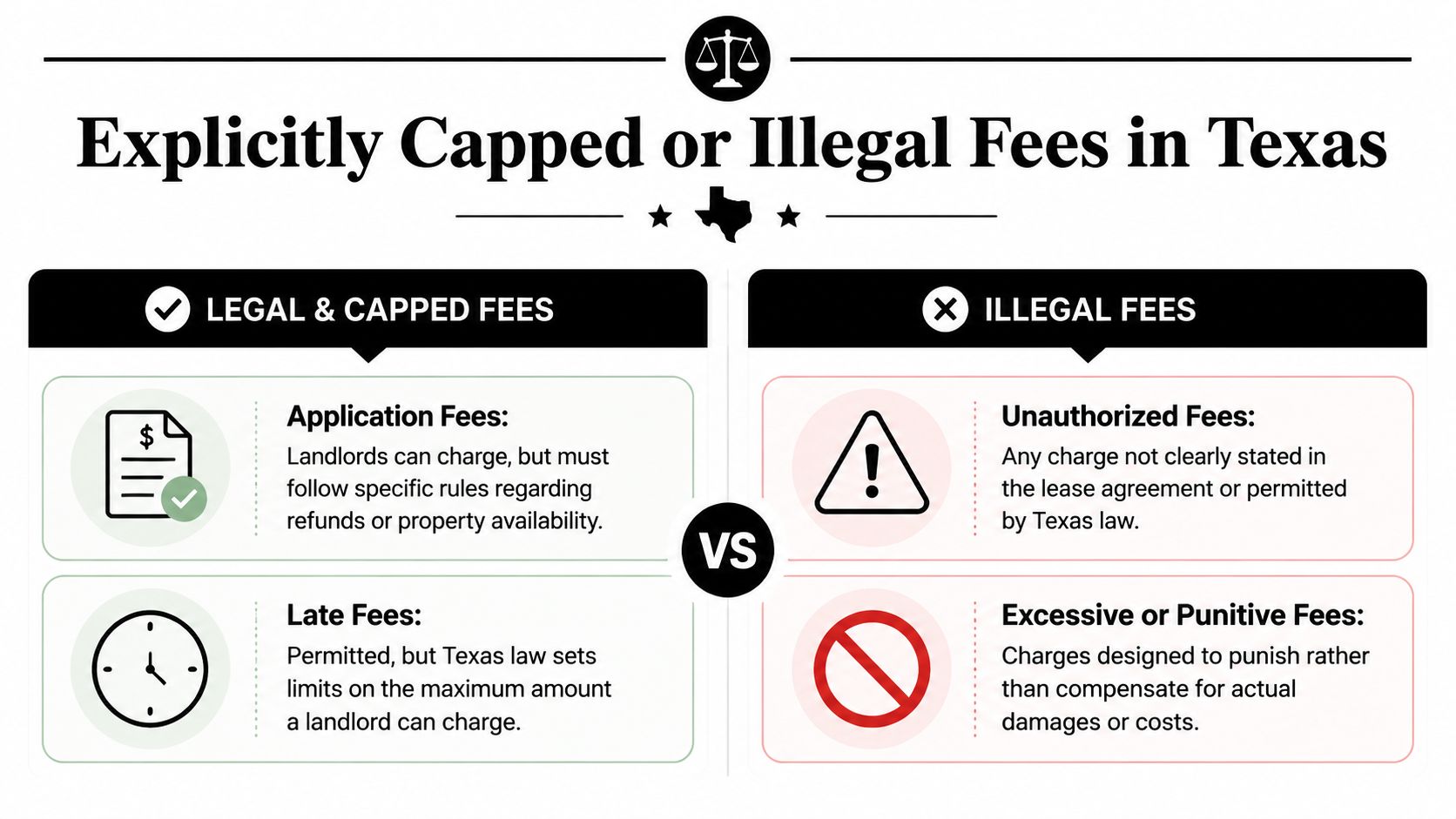
Some fee disputes are judgment calls. Two categories are not. Texas law gives unusually specific rules for late fees and for what landlords must do before keeping money tied to a rental application.
Late fees under Texas Property Code Section 92.019
Late fees are one of the easiest charges to check because the statute gives a practical test. Under Texas Property Code Section 92.019, a landlord can charge a late fee only if the lease is in writing, the lease authorizes the fee, and the rent remains unpaid for more than two full days after the due date. The statute also sets a safe-harbor cap of 12% of one month's rent for properties with 1 to 4 units and 10% for properties with 5 or more units, as explained in Texas Tenant Advisor's summary of Section 92.019.
The timing rule matters. If rent is due on the first, charging a late fee on the second is too early. Guidance discussing Section 92.019 from the Apartment Association makes that point clearly.
The cap matters too. A landlord cannot avoid the statute by splitting the charge into labels such as a flat late fee, daily late charge, ledger fee, or admin fee if the total operates like an excessive late penalty. In a dispute, the question is usually simple: what was charged, when was it charged, and does the lease and statute allow it?
If a late fee breaks those rules, the tenant may have a claim for $100, three times the unlawful portion of the fee, and reasonable attorney's fees.
Application fees and screening practices
Texas usually allows landlords to collect application fees. The problem starts when the screening process does not follow the statute. Before taking an application fee or application deposit, the landlord must give the applicant the required notice of tenant-selection criteria. If that notice was not provided, the landlord may have to return the application fee and application deposit. Bad-faith retention can create liability under Texas Property Code Section 92.3515.
For tenants, this is a strong pressure point because the paper trail is usually short. Ask for the written screening criteria, the application receipt, and any denial notice. For landlords, this is one of the easiest disputes to avoid. Give the notice first, keep a copy, and make sure staff use the same intake process every time.
For a closer look at that issue, see this guide on Texas law on application fees for rentals.
Charges that deserve immediate scrutiny
Other fees may not have a neat statutory cap, but they still raise legal risk fast.
- Fees added after move-in without lease support. If the signed lease does not authorize the charge, collection gets much harder.
- Charges labeled as administrative but functioning as penalties. Courts and lawyers look past the label.
- Application-related charges that block access to housing without clear disclosure. Concerns about junk fees and high-risk fees are discussed in the University of Texas Housing Policy Clinic report on combatting junk fees in rental housing.
From a practical standpoint, tenants should challenge a suspicious fee in writing and ask for the lease clause or statute that authorizes it. Landlords should be ready to point to both. If neither side can identify a clear basis for the charge, that dispute often gets resolved quickly once someone asks for the supporting language.
When Security Deposit Deductions Become Illegal
Security deposit fights often feel different from fee fights, but they usually involve the same core issue. The landlord deducts money and calls it justified. The tenant sees ordinary use of the property and calls it overcharging.
Texas law allows landlords to deduct for damage a tenant is legally responsible for. It does not allow a landlord to treat normal wear and tear like tenant-caused damage.
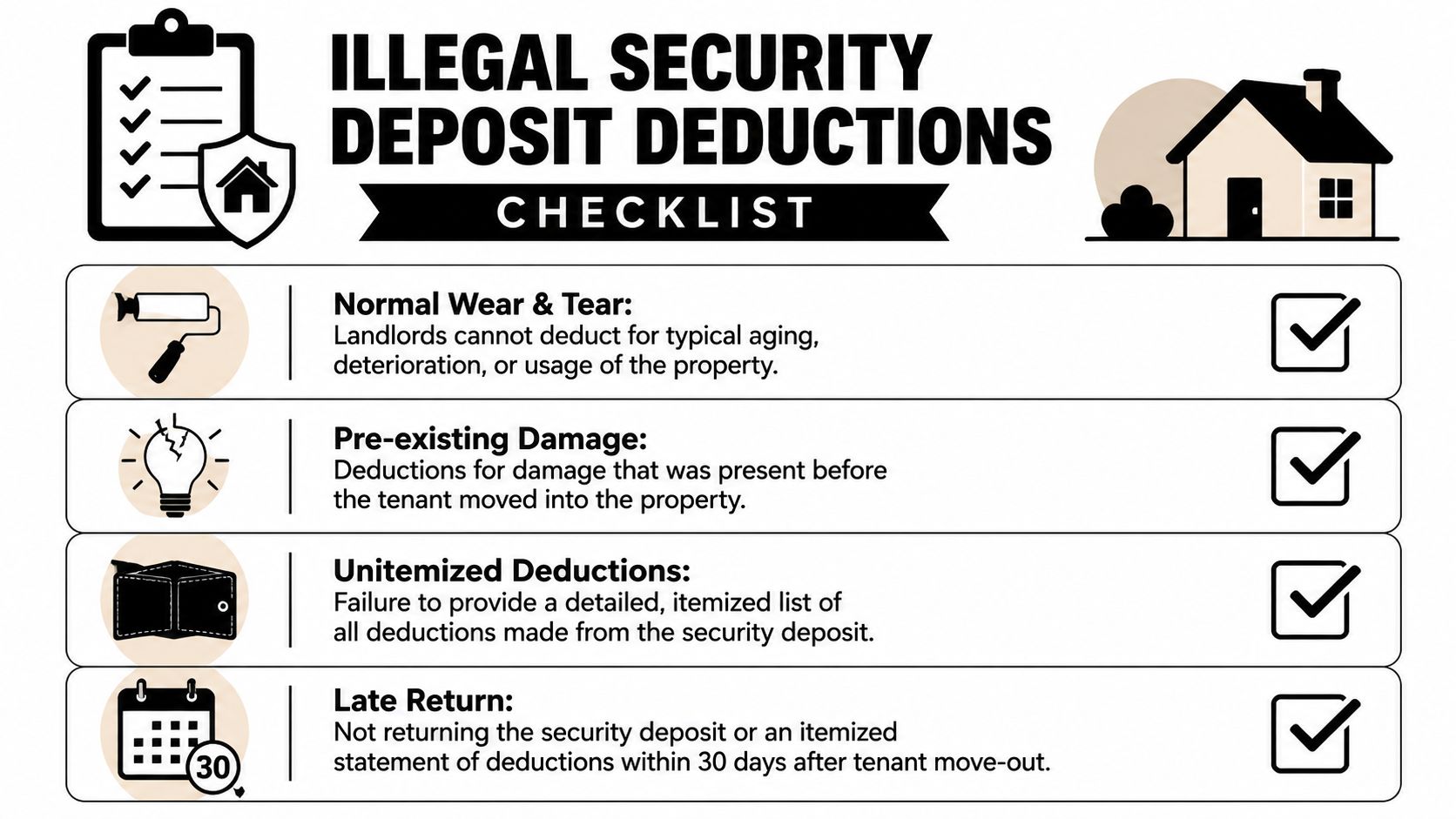
Normal wear and tear versus actual damage
Many disputes hinge on this distinction. Minor carpet wear, faded paint, loose door handles from ordinary use, and small scuffs from living in the unit usually fall closer to wear and tear. Large wall holes, broken fixtures, missing items, or heavy stains are easier for a landlord to characterize as damage.
A useful way to test the deduction is to ask: did this condition happen because someone lived in the property, or because someone misused it?
Common examples
| Usually not a valid deduction | Often a valid deduction |
|---|---|
| Minor wall scuffs | Large holes in drywall |
| Ordinary carpet wear | Significant burns or stains |
| Faded paint over time | Deliberate paint damage |
| Loose hardware from age | Broken doors or fixtures from impact |
The itemized-list requirement matters
A landlord who deducts from a deposit should be prepared to explain each charge clearly. Vague descriptions like “repairs,” “cleaning,” or “damages” often create avoidable conflict. A detailed, written itemization gives the tenant a fair chance to evaluate what was withheld and why.
That's one reason deposit cases are often document cases. Move-in photos, move-out photos, inspection notes, repair invoices, and the written deduction list usually matter more than broad accusations from either side.
A landlord's strongest deposit file includes a signed lease, a move-in condition record, clear photos, and a written itemization that ties each deduction to a specific condition.
If you're facing this issue, this guide to Texas security deposit law can help you evaluate whether a deduction looks proper or inflated.
What tenants and landlords should do differently
For tenants:
- Photograph the unit at move-in and move-out: Focus on walls, flooring, appliances, and any existing defects.
- Request written clarification: If a deduction is vague, ask for the basis in writing.
- Keep your forwarding address updated: Deposit disputes get harder when the paper trail is incomplete.
For landlords:
- Use specific descriptions: “Bedroom wall repair for hole” is better than “maintenance.”
- Separate wear from damage: Routine turnover costs shouldn't be mixed in with tenant-caused loss.
- Stay organized: The cleaner the file, the easier the dispute is to resolve early.
Many deposit disputes settle once both sides compare photos and actual invoices. They escalate when the deduction list is thin, the records are poor, or the charges read like routine turnover passed on to the tenant.
Your Step-by-Step Guide to Disputing an Illegal Fee
A common Texas rental dispute starts small. A tenant sees a charge on the ledger that does not match the lease, asks about it by text, gets a vague answer, and then the balance grows into a bigger problem. The better approach is to slow down, document the issue, and make the dispute easy to evaluate on paper.
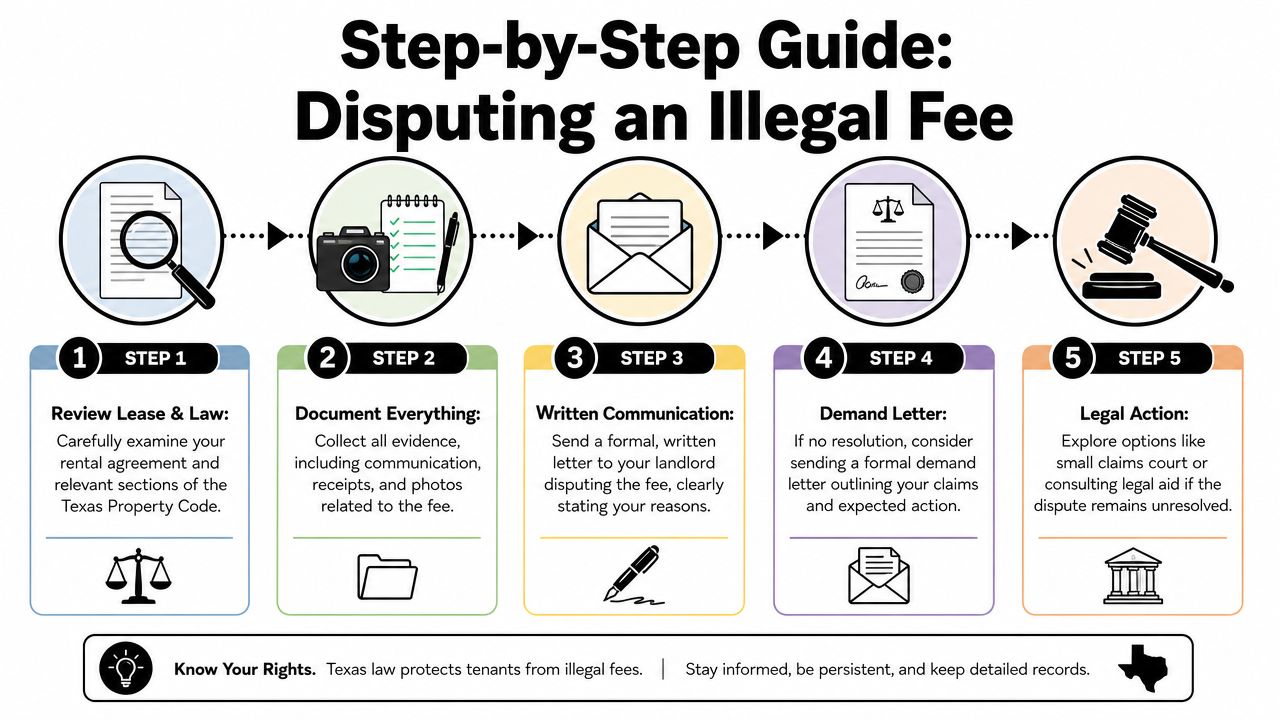
Step 1 through Step 3
Read the lease carefully
Find the exact provision the landlord may rely on. Check the main lease, addenda, community rules incorporated into the lease, payment terms, and any move-out language. If the fee is not clearly authorized, that matters.Compare the charge to the legal rule that applies
Identify what kind of fee you are dealing with. Late fee, application fee, cleaning charge, administrative fee, utility-related charge, and move-out bill disputes each raise different questions. Use the rules discussed earlier in this article to see whether the amount, timing, or basis for the charge appears improper.Build your file before contacting the landlord
Pull together the lease, account ledger, receipts, notices, screenshots, emails, text messages, and photos. In practice, the side with the cleaner paper trail usually has the stronger position.
Step 4 through Step 5
Send a written dispute letter
Keep it short and specific. Identify the fee, state why you dispute it, attach supporting documents if helpful, and give a reasonable deadline for a written response. A focused demand letter often resolves disputes that go nowhere by phone.Decide whether the dispute is still just a billing issue
If the landlord corrects the ledger, confirms the charge was removed, or explains the basis with documents that match the lease, the matter may end there. If the landlord ignores the letter, keeps adding the fee to the account, reports a balance as unpaid, or threatens eviction based on the disputed amount, the risk has changed. At that stage, it often makes sense to speak with legal aid, an attorney who handles Texas rental disputes, or the local court clerk about procedure.
Sample demand letter language
You do not need a long letter. You need a usable one.
Sample language:
“I dispute the fee charged to my account described as [name of fee]. My lease does not authorize this charge, or the charge does not comply with Texas law. Please remove the charge and provide written confirmation by [date]. If you believe the fee is valid, please send the lease provision and any records supporting it.”
If the issue involves an application fee, keep the point narrow. As noted earlier, Texas law requires return of the application fee and any application deposit if the required tenant-selection notice was not given before the fee was collected. In bad-faith cases, the landlord may face added monetary exposure and attorney's fees. That is one reason application-fee disputes should be raised in writing, with dates and records attached.
How to send the letter
Use a method you can prove later. Certified mail is often useful, and email can help if that is how the parties usually communicate.
A short checklist:
- Send it in a trackable way: Choose a delivery method that creates a record.
- Keep a complete copy: Save the letter, attachments, delivery receipt, and any reply.
- Stay professional: Clear facts work better than accusations.
- Ask for a specific fix: Removal of the fee, correction of the ledger, or written support for the charge.
- Set a realistic deadline: Long enough for review, short enough to keep the issue moving.
In my experience, fee disputes resolve faster when the letter gives the landlord or property manager a fair chance to correct the problem without losing face. They harden when the communication is emotional, vague, or mixed with unrelated complaints.
Tenants should also be careful about self-help. Do not withhold rent or another amount you clearly owe just because one fee looks wrong, unless a lawyer has advised you to do so. Landlords should take the same practical view from the other side. If a charge is weak, unsupported, or not in the lease, removing it early is usually cheaper than defending it later.
Why You May Need a Texas Landlord Tenant Lawyer
A fee dispute stops being routine once it threatens possession of the unit, your credit history, or a larger claim for unpaid rent.
Legal help often makes sense if the landlord will not answer in writing, adds the disputed charge to a notice to vacate, folds it into an eviction filing, or keeps part of a security deposit without a clear basis. Landlords should also get counsel involved when a tenant raises a credible challenge to a fee practice that may not match the lease or the Texas Property Code. Early advice can prevent a small ledger issue from turning into a bad-faith claim, attorney's fees exposure, or a case that is harder to defend than it should be.
A lawyer's role is practical. Review the lease. Compare the charge to the governing statutes. Send a demand letter that states the problem clearly, cites the relevant rule, and asks for a specific fix by a date certain. If that does not resolve the matter, counsel can prepare for justice court, county court, or a security-deposit claim with the records organized the right way from the start.
That timing matters.
I often tell clients to call for legal review when the dispute changes from "Is this fee valid?" to "What happens if I refuse to pay it?" That is usually the point where the wrong move, especially withholding rent that is otherwise due, can create a second problem. The right strategy depends on the amount at stake, the lease language, the paper trail, and whether the other side is still acting reasonably.
The Law Office of Bryan Fagan, PLLC, advises Texas tenants and landlords on lease disputes, eviction-related conflicts, security deposit issues, and fee enforcement questions.
If the fee issue is tied to an eviction notice, a move-out balance, collections activity, or repeated unsupported charges, legal counsel is less about escalating the conflict and more about protecting your position before the record gets worse.