Dealing with a rent increase notice can feel personal fast. One day your housing costs seem settled, and the next day you're asking whether you have to accept it, whether the timing is legal, or whether your landlord is pushing too far. Landlords face a different version of the same stress. They're trying to keep up with taxes, insurance, maintenance, and vacancy risk without stepping into a dispute that could have been avoided with better paperwork.
That's why a good rent increase laws Texas 2026 guide has to do more than repeat “Texas has no rent control.” That answer is only partly useful. In real life, the outcome usually turns on the lease, the notice, local rules, and whether the increase crosses into retaliation or discrimination.
If you're a tenant, your rights don't disappear just because Texas follows a market-based system. If you're a landlord, broad discretion still comes with limits. The safest path in either direction is to read the lease like a contract, treat notice like evidence, and address problems before they turn into eviction or holdover litigation.
Navigating Rent Increases in Texas The 2026 Landscape
Texas takes a contract-first approach to residential rent. There is no statewide rent control, which means landlords generally may raise rent by any amount when a lease is renewed or when a month-to-month tenancy changes, but they usually can't impose that increase during a fixed term unless the lease itself allows it, according to Texas rent increase guidance from TenantCloud.
That rule sounds simple. It isn't always simple in practice.
The first question I'd ask a worried client is not, “How much did the rent go up?” It's, “What kind of tenancy do you have, and what does the lease say?” In Texas, the written agreement usually decides whether the rent is locked in, when a renewal offer must be sent, and what notice language matters.
The lease controls more than most people think
Under the Texas Property Code, a lease is the agreement that sets the basic terms for occupancy. In plain English, that means the lease is the operating manual for the rental relationship. If the tenant is in a fixed-term lease, the price is generally part of that bargain for the life of the term unless the contract allows a change.
For readers who want a clearer grounding in the statute itself, this overview of Texas Property Code Chapter 92 is a helpful place to start.
Practical rule: In Texas, “no rent control” doesn't mean “no rules.” It means the lease and notice process usually carry most of the legal weight.
Notice still matters
Even in a market-based state, timing matters. The same TenantCloud guidance says Texas practice commonly calls for at least 30 days' written notice before a rent increase takes effect, and the notice should state the new amount and effective date.
That notice requirement is where many disputes begin. A landlord may have the right to raise rent, but poor timing or vague language can create unnecessary conflict. A tenant may feel trapped, but a close look at dates and lease terms often answers whether the increase is immediate, delayed, or invalid as written.
It's comparable to changing the rules of a subscription. A company can change the next billing cycle if the agreement allows it and proper notice is given. It generally can't rewrite what you already prepaid for. Residential leases work much the same way.
Understanding Your Lease and Required Notice Periods
The biggest practical difference in Texas rent cases is the difference between a month-to-month tenancy and a fixed-term lease. People often blend them together. That's a mistake.
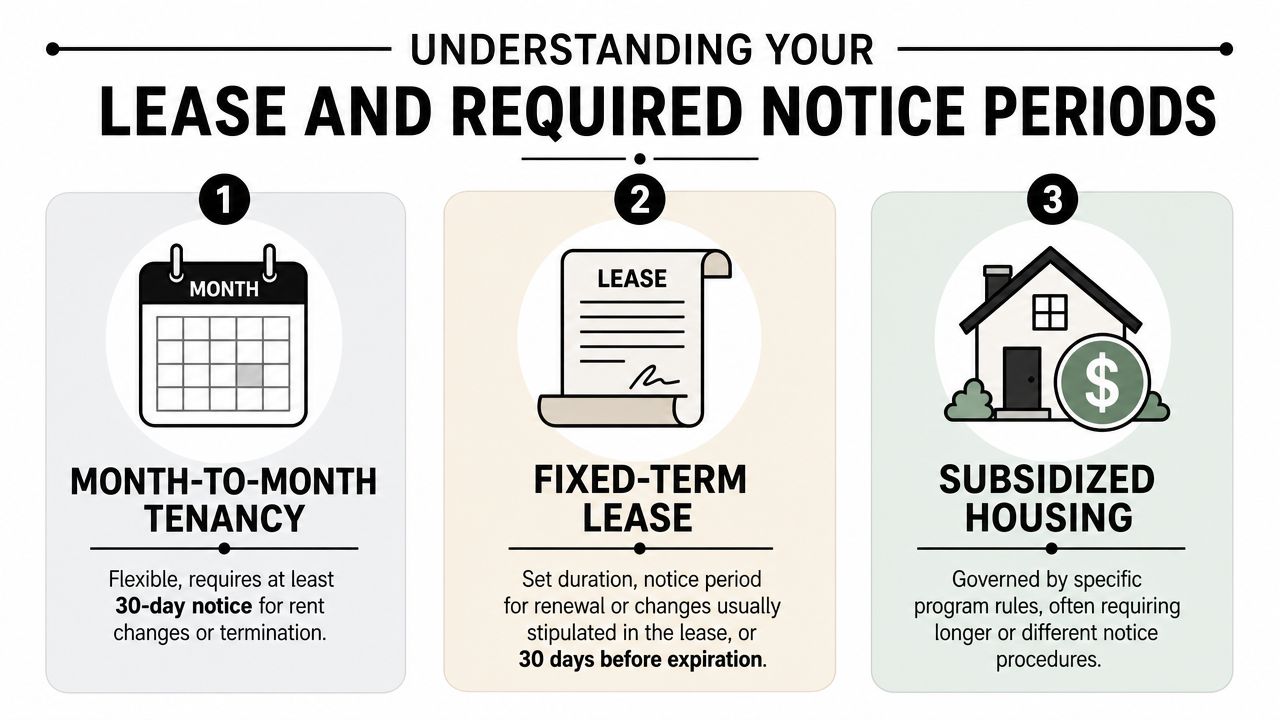
Month-to-month tenancies
A month-to-month arrangement is flexible by design. That flexibility helps both sides, but it also means pricing can change more easily than in a term lease. In Texas practice, written notice is the core protection. A common rule is at least 30 days' written notice before the new rent takes effect.
A simple example helps. If a landlord wants higher rent to begin on March 1, the cleaner approach is to give written notice before February 1. That gives the tenant a fair chance to decide whether to stay, negotiate, or move.
What works here is clarity. What doesn't work is a text message that says “rent is going up next week” with no date, no amount, and no paper trail.
Fixed-term leases
A fixed-term lease works differently. The rent is usually locked for the agreed term. If the lease runs through a set end date, the landlord typically waits until renewal to change the amount unless the lease contains language allowing an increase during the term.
That's why the renewal section matters so much. Some leases say when a renewal offer must be sent. Others explain what happens if the tenant stays after expiration. Those details often decide whether the tenant is moving into a renewal, a holdover arrangement, or a month-to-month period with different pricing rules.
Here's a quick comparison:
| Tenancy type | Usual rent-change timing | Main document to check |
|---|---|---|
| Month-to-month | Before the next rental period after proper written notice | Current rental agreement and notice |
| Fixed-term lease | Usually at renewal, unless the lease allows a mid-term change | Lease renewal and amendment clauses |
| Subsidized housing | Program rules may control process | Lease plus housing program documents |
What to check in the paperwork
Start with these items:
- Effective date: Does the notice clearly say when the new rent starts?
- Rent amount: Is the new monthly amount stated plainly?
- Lease status: Are you still inside a fixed term, or has the lease converted?
- Renewal language: Does the lease require notice from either side before expiration?
If you're drafting or reviewing a lease from scratch, a standard lease agreement form can help you identify the clauses that usually control notice, renewal, and rent terms. It shouldn't replace legal advice for a disputed case, but it's useful for spotting missing basics.
A lease dispute often turns on a page nobody read closely when move-in day felt routine.
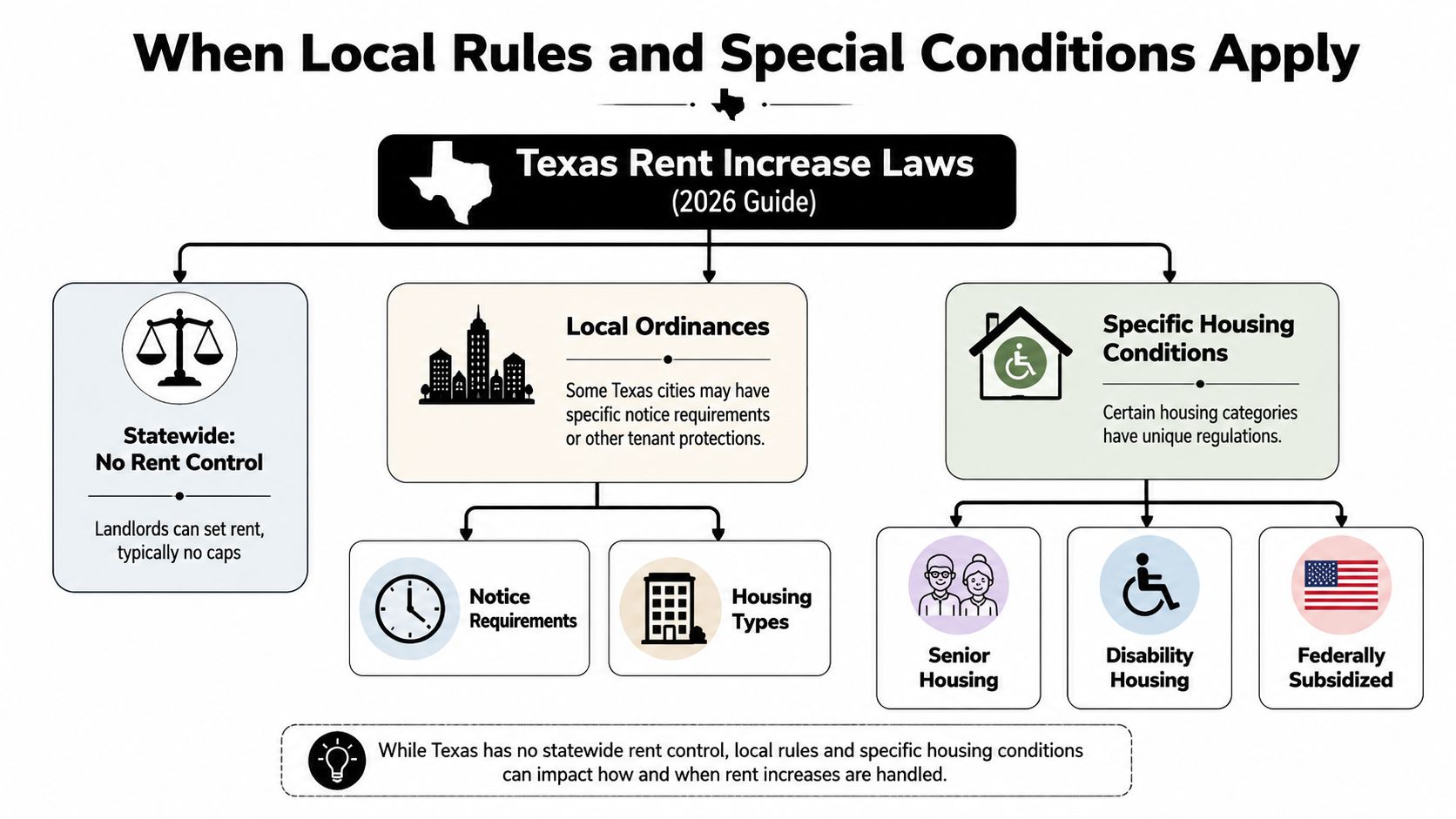
When Local Rules and Special Conditions Apply
A statewide rule is only the starting point. The harder questions usually come from exceptions, especially in larger cities and in specialized housing arrangements.
Dallas and local notice rules
Some local practice materials add notice requirements beyond the usual baseline. In available 2026-oriented guidance, market-based annual increases are often described in the 3% to 10% range, while some Dallas-specific landlord guidance says a 10% or more increase within a year can trigger a 75-day written notice requirement, according to Hemlane's Texas rent control overview.
That doesn't create a statewide cap. It does create a practical warning. If you only ask, “Can I raise the rent?” you may miss the more important question, which is, “What notice applies in this city and this housing setup?”
Subsidized and regulated housing
Special housing programs can change the analysis entirely. A landlord in federally subsidized housing generally doesn't have the same freedom as a landlord in a private market unit. Program rules, agency approvals, and notice procedures may apply before a tenant's portion changes.
The key point is qualitative, but important. In subsidized housing, the lease is not the only document that matters. The program paperwork matters too. If you're a tenant using rental assistance, or a landlord participating in a housing program, don't assume ordinary private-market rules answer the whole question.
A better way to analyze the problem
Use this checklist before acting:
- City first: Does your city have a local notice practice or ordinance that affects timing?
- Housing type next: Is the property private-market, subsidized, senior housing, or tied to another regulated program?
- Lease after that: Does the contract add notice obligations beyond the local baseline?
- Paper trail last: Can you prove what notice was given and when?
This layered approach saves people from expensive mistakes. Tenants sometimes focus only on the amount and overlook a notice defect. Landlords sometimes rely on a general Texas rule and overlook a city-specific requirement that delays enforcement.
Illegal Rent Increases Retaliation and Discrimination
A rent increase can be properly timed and still be unlawful. That surprises many people.
The law doesn't only care about when a landlord raises rent. It also cares about why. If the increase is tied to retaliation or discrimination, the dispute moves beyond a lease-renewal question and into a rights-enforcement problem.
Retaliation is a real issue
Retaliation usually comes up after a tenant exercises a legal right. A common example is a tenant who reports a serious repair problem, contacts code enforcement, or pushes back on unsafe conditions, and then receives a sudden rent increase or other pressure from the landlord.
That kind of timeline matters. A landlord may say the increase was routine. A tenant may see it as punishment. The facts, records, and sequence of events become central.
If you're dealing with that kind of pattern, this discussion of landlord retaliation and Texas tenant rights is a useful next step.
If the message behind the rent increase is “stop complaining,” the problem is no longer just the rent.
Discrimination can hide inside a pricing decision
Discrimination claims can be more subtle. A landlord can't lawfully charge or increase rent because of a tenant's race, religion, national origin, sex, disability, familial status, or another protected classification under fair housing law. The same concern can arise if tenants in similar situations are treated differently for unlawful reasons.
In practice, these cases are rarely proved by one sentence alone. They're usually built from patterns, inconsistent treatment, documents, and communications. For tenants, saving emails, texts, notices, and notes about conversations can matter a great deal. For landlords, consistent written criteria matter just as much.
Warning signs to take seriously
Some facts deserve closer review right away:
- Close timing: The increase arrives soon after a repair complaint or code report.
- Unequal treatment: Similar tenants are offered different terms without a clear business reason.
- Targeted comments: Statements tied to children, disability, religion, or another protected trait.
- Sudden policy changes: New charges or terms appear only after a dispute.
What works is consistent policy and documented business reasons. What doesn't work is reacting emotionally to a difficult tenant or making ad hoc decisions that can be read as punishment.
A Landlord's Guide to Raising Rent Without Risk
Landlords usually get into trouble not because the increase itself was impossible, but because the process was sloppy. Good process lowers conflict.

Use a compliance checklist
The most reliable approach is boring on purpose. Review the lease, confirm the tenancy type, check local rules, draft a clear notice, and deliver it in a way you can later prove.
According to Steadily's Dallas rent increase guidance, the highest-value control is a documented delivery method such as hand delivery or certified mail with return receipt, and the notice should specify the new rent amount, effective date, and tenant or unit identifiers.
That advice lines up with what works in disputes. Judges and opposing counsel care about paper. Memory is weak evidence. Dated writing is much stronger.
A practical landlord checklist
- Review the lease first: Confirm whether the unit is month-to-month, fixed-term, or approaching renewal.
- Check local practice: Don't assume state-level guidance is the only rule that matters.
- Draft a complete notice: Include the tenant name, unit, new rent amount, and exact effective date.
- Choose provable delivery: Hand delivery with acknowledgment or certified mail creates a stronger record.
- Keep a copy: Save the signed notice, mailing receipt, and file note of when delivery occurred.
A simple notice can say that the rental rate is changing under the lease or renewal terms and identify the date the new rate begins. The wording doesn't need to be fancy. It needs to be clear.
For owners managing multiple units, systems matter. If you're evaluating tools that help track renewals, notices, and tenant communications, it can be useful to compare property management software before your next renewal cycle.
What landlords should avoid
Three mistakes cause avoidable problems.
First, don't send vague notices. “Rent is going up soon” is not enough. Second, don't rely on casual delivery if you can avoid it. Third, don't send an increase right after a tenant dispute without stepping back and making sure the timing can be defended.
This short video gives a useful visual overview before you issue notices.
Risk check: The cleaner your notice file is, the less likely a routine increase turns into a contested case.
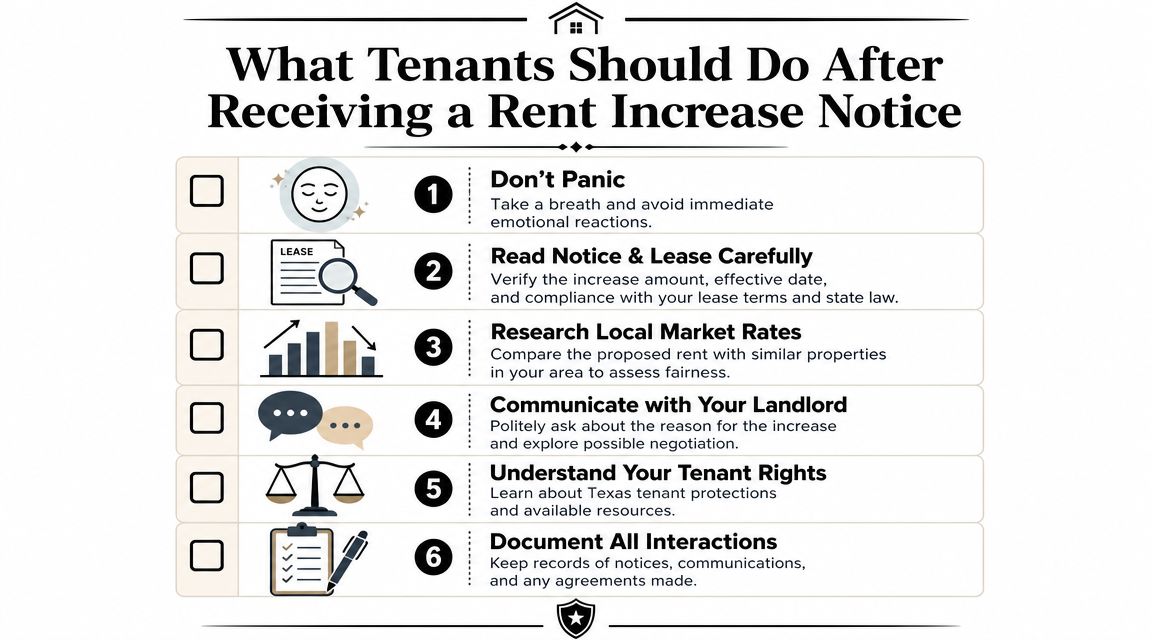
What Tenants Should Do After Receiving a Rent Increase Notice
When tenants get a notice, the first impulse is often anger or panic. Neither helps. A better response is to slow down and verify the basics before making a decision.
Start with the documents
Read the notice carefully. Then read the lease. You're looking for three things first: the amount, the effective date, and whether you're still in a fixed term or moving into a renewal period.
The Texas State Law Library confirms there is no statewide cap on rent increases at renewal, while also noting that Texas allows local rent control only in limited situations, which is why the question is often notice in your city rather than a statewide ceiling, as summarized in the Texas State Law Library rent guide.
That means your best first move is not arguing about fairness in the abstract. It's checking whether the notice fits your lease status and local rules.
Then decide how to respond
A calm written response often works better than a heated phone call. Ask for clarification if the notice is unclear. If the increase is legal but difficult, you can try to negotiate. Some landlords would rather keep a reliable tenant than risk vacancy and turnover.
You can say something like this:
I received the notice of rent increase and want to understand the effective date and renewal terms. I've paid on time and taken care of the unit. Is there room to discuss a smaller increase or a longer renewal term?
That kind of message keeps the door open.
If you want more practical language and strategy, this guide on how to negotiate a rent increase can help you prepare.
A tenant action plan
Pause and organize
Save the notice. Screenshot texts. Gather your lease and any renewal emails.Check the timing
Compare the notice date with your lease end date or monthly rental cycle.Look for local issues
City-specific rules and special housing conditions can change the answer.Communicate in writing
Ask questions politely. Written communication creates a record.Watch for red flags
If the increase followed a repair complaint or feels targeted, treat that seriously.Get legal help if needed
If the notice seems retaliatory, discriminatory, or contrary to the lease, speak with a Texas landlord tenant lawyer before the situation escalates.
What doesn't work is ignoring the notice and hoping the problem goes away. If you plan to move, give proper notice under your lease. If you plan to stay and object, do it early and in writing.
Protect Your Rights with an Experienced Texas Attorney
Rent increases in Texas are rarely just about the number on the page. The primary issues are the lease, the notice, the local rule that may have been missed, and whether the landlord's reason crosses a legal line. For tenants, that can mean spotting retaliation or a notice defect before it turns into an eviction problem. For landlords, it means handling renewals in a way that is professional, consistent, and enforceable under the Texas Property Code.
If you're unsure whether a rent increase is valid, or you want help drafting notices and renewal terms that reduce risk, legal guidance can save time and conflict. A Texas landlord tenant lawyer can review the facts, explain your options, and help you act before the dispute gets more expensive.
If you need help with a rent increase dispute, lease issue, tenant rights concern, or enforcement question under the Texas Property Code, contact The Law Office of Bryan Fagan, PLLC for a free consultation today. Whether you're a tenant seeking protection or a landlord trying to avoid mistakes, an experienced eviction attorney and Texas landlord tenant lawyer can help you move forward with clarity.