
Dealing with a landlord dispute or eviction can be stressful — but understanding your rights under Texas law can make all the difference. While landlords have the right to evict tenants for valid reasons, they must follow a strict legal process. When they ignore these rules, it's not just unfair; it's illegal.
A wrongful eviction occurs when a landlord tries to remove you from your home using illegal tactics instead of going through the courts. This could mean changing the locks, shutting off your utilities, or retaliating against you for asking for a necessary repair. Knowing how to spot these actions is the first step in protecting yourself and your home.
The Difference Between a Legal and an Illegal Eviction
It's easy to feel powerless when you're in a dispute with your landlord. However, understanding your rights under the Texas Property Code is a powerful tool.
Yes, a landlord can legally evict a tenant for legitimate reasons, such as failing to pay rent or violating the lease. But they must follow the formal court process. They are not allowed to take matters into their own hands.
Any attempt to force you out of your home without an official court order is known as a "self-help" eviction, and it is illegal in Texas. This isn't a minor technicality; it’s a critical protection for your tenant rights and ensures you have a fair chance to respond.
Spotting Illegal Landlord Actions
It's crucial to recognize when a landlord's actions cross the line from a standard dispute into illegal behavior. These tactics are often designed to make living in your home so difficult that you feel you have no choice but to leave.
Here are some of the most common wrongful eviction tactics we see:
- Changing the locks on your doors before a court has issued a formal Writ of Possession.
- Shutting off essential utilities like electricity, water, or gas to make the home unlivable.
- Removing your personal belongings from the property and putting them on the curb.
- Threatening or intimidating you to scare you into moving out.
These actions are direct violations of your rights as a tenant. Sometimes, a single illegal act is part of a larger pattern of abuse. If you feel your landlord is constantly pushing the boundaries, you may be dealing with a bigger issue like landlord harassment in Texas.
To make the distinction clear, let's break down the key differences between a proper eviction and one that breaks the law.
Legal Eviction vs. Wrongful Eviction at a Glance
This table shows the stark contrast between the lawful court-ordered process and the illegal "self-help" methods some landlords try to use.
| Action | Legal Eviction Process | Potential Wrongful Eviction |
|---|---|---|
| Notice | Tenant receives a formal, written "Notice to Vacate" as required by Texas law. | No formal notice is given, or the notice is verbal and improper. |
| Court Filing | Landlord files an eviction lawsuit (Forcible Detainer) with the Justice of the Peace court. | Landlord skips the court process entirely and takes direct action. |
| Tenant Removal | A judge issues a final judgment, and if the tenant doesn't leave, a Constable executes a Writ of Possession to remove them. | Landlord changes the locks, removes doors, or physically bars the tenant from entry without a court order. |
| Utilities | Utilities remain connected throughout the legal process. | Landlord intentionally shuts off water, electricity, or gas to force the tenant out. |
| Personal Property | Tenant's belongings are handled according to legal procedures, even after a formal eviction. | Landlord throws out the tenant's possessions or places them outside without permission. |
A landlord’s frustration over late rent or a broken rule never gives them a free pass to ignore the law. The eviction process exists to be fair to both sides, and any landlord who tries to bypass it can, and should, be held accountable. Knowing what a wrongful eviction looks like is the first step toward protecting your rights.
What the Texas Property Code Says About Legal Evictions
Before you can spot an illegal eviction, you have to know what a legal one looks like. In Texas, a landlord must follow a specific, step-by-step procedure laid out in the Texas Property Code.
Think of this process as a roadmap. When you understand the proper route, you’ll immediately recognize when your landlord is trying to take an illegal shortcut—which is often the first sign of a wrongful eviction.
The First Step: The Notice to Vacate
The legal eviction process begins with a formal document called a Notice to Vacate. This isn't a casual text message or a verbal warning. Under Texas Property Code § 24.005, it is a strict legal requirement.
For the notice to be valid, it must:
- Be in writing.
- Give you a clear deadline to move out (usually three days, unless your lease states otherwise).
- Clearly state the reason you are being asked to leave, such as unpaid rent.
- Be delivered correctly—either in person, by mail, or posted on the inside of your front door.
Receiving a Notice to Vacate is stressful, but it is not the eviction itself. It’s a legally required warning that gives you a short window to either fix the problem (like paying rent) or prepare to move.
What Happens Next: The Eviction Lawsuit
If you remain in the property after the notice period expires, the landlord’s only legal option is to file an eviction lawsuit with the local Justice of the Peace (JP) court. This is often called a "forcible detainer suit" in Texas.
After the lawsuit is filed, a sheriff or constable must formally serve you with a citation. This is your official summons to appear in court and is your opportunity to defend yourself. Ignoring it is a mistake, as the judge can issue a default judgment against you, meaning you lose without ever telling your side of the story. You can learn more about what to expect in our guide to the eviction process in Texas.
This infographic breaks down the standard, lawful eviction timeline.
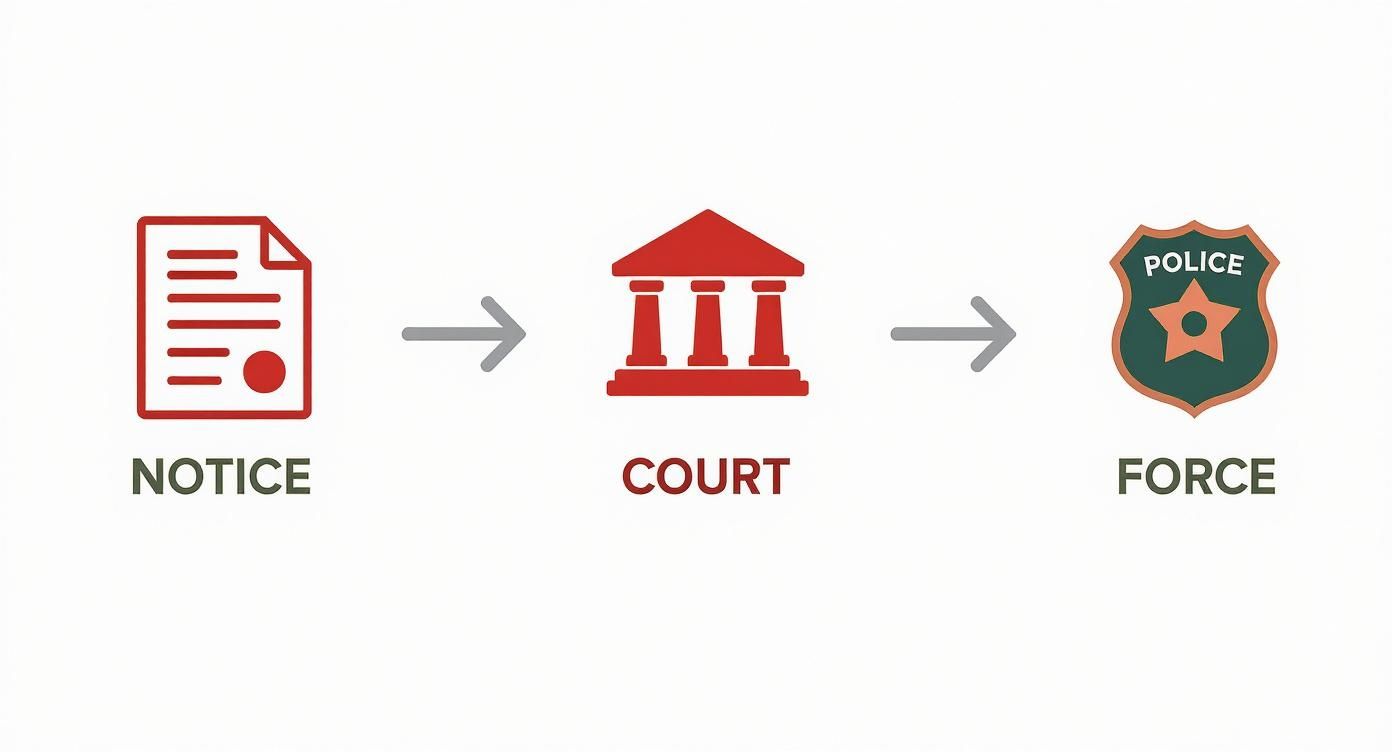
Each stage is mandatory. A landlord cannot legally jump from a disagreement straight to removing you—the courts must be involved.
The Final Steps: The Court Hearing and Writ of Possession
At the eviction hearing, both you and your landlord will present your cases to the judge. If the judge rules in the landlord’s favor, they will be granted a judgment for possession. Even then, you do not have to leave immediately.
You typically have five days to appeal the decision or move out. If you do neither, the landlord can request a Writ of Possession. This is a court order authorizing a constable or sheriff to physically remove you and your belongings from the property. Only at this point can law enforcement legally force you to leave. This structured process protects your rights and prevents illegal lockouts.
Common Examples of Illegal Evictions

It’s one thing to understand the legal process on paper, but it's another to recognize an illegal eviction when it's happening to you. When landlords get frustrated, they sometimes take matters into their own hands. These actions are illegal power plays designed to force you out of your home.
"Self-Help" Evictions: Force, Lockouts, and Intimidation
The most blatant form of wrongful eviction is a "self-help" eviction. This is any action a landlord takes to physically remove you or make your home unlivable without a court order. The Texas Property Code has zero tolerance for these tactics.
Example Scenario: Imagine coming home from work to find a new lock on your door and your key no longer works. This is a classic illegal lockout. Your landlord cannot legally change the locks, remove your front door, or shut off your utilities to force you to leave.
Common examples of illegal self-help evictions include:
- Changing the locks or adding a new one to keep you out.
- Piling your personal belongings on the curb.
- Shutting off your water, electricity, or gas.
- Using threats or harassment to scare you into moving.
A landlord's frustration over late rent is not an excuse to break the law. An experienced Texas landlord tenant lawyer can help you hold them accountable.
Retaliatory Evictions: Punished for Standing Up for Your Rights
Another illegal tactic is retaliation. This happens when a landlord tries to evict you as punishment for exercising your legal rights as a tenant. Under Texas Property Code § 92.331, this is strictly forbidden.
Example Scenario: Your air conditioner breaks in the middle of a hot Texas summer. You send your landlord a formal, written request for repairs as required by law. Instead of fixing it, your landlord gives you a notice to vacate, claiming they are not renewing your lease.
If an eviction notice arrives right after you've made a legitimate repair request, joined a tenants' union, or filed a formal complaint, it’s a major red flag. The law protects you from being punished for demanding a safe and habitable home. An eviction attorney can argue that the eviction was not about a lease violation—it was about getting even.
Discriminatory Evictions: Violating Fair Housing Laws
Finally, an eviction is illegal if it is based on discrimination. Both federal and Texas Fair Housing Acts protect tenants from being treated differently based on their identity.
A landlord cannot legally evict you based on your:
- Race or color
- National origin
- Religion
- Sex (including gender identity and sexual orientation)
- Familial status (e.g., having children)
- Disability
If any of these scenarios feel familiar, you may be the victim of a wrongful eviction. Don't wait—seek legal help immediately to protect your rights.
How the Texas Property Code Protects You
https://www.youtube.com/embed/2iE9KwrBwlo
Your rights as a tenant aren't just suggestions—they are specific protections written into state law. When a landlord tries to evict you illegally, the Texas Property Code is your shield. Understanding these key statutes is the first step toward defending your home. Two of the most critical laws in wrongful eviction cases are § 92.0081 and § 92.331.
The Law Against Illegal Lockouts
One of the most powerful protections for tenants is Texas Property Code § 92.0081, which covers the "Removal of Property and Exclusion of Residential Tenant." This law makes it clear: landlords cannot take matters into their own hands.
This statute forbids a landlord from changing your locks or removing your belongings to keep you out of your home unless they have a court order. A landlord who violates this law can be held liable for serious damages. This is the legal backbone that stops "self-help" evictions.
"A landlord may not remove a door, window, or attic hatchway cover or a lock, latch, hinge, hinge pin, doorknob, or other mechanism connected to a door, window, or attic hatchway cover… except for a bona fide repair or replacement." – Texas Property Code § 92.0081(b)
This means your landlord must go through the proper legal channels, guaranteeing you the due process you deserve. An eviction attorney will use this exact statute to prove that a lockout was a direct violation of state law.
Your Right to Be Free from Retaliation
What happens when you stand up for your rights, like requesting a necessary repair? The law protects you.
Texas Property Code § 92.331 is our state’s anti-retaliation law. It is designed to ensure you aren’t punished for being a responsible tenant who speaks up. This law prohibits a landlord from retaliating against you for taking actions you are legally allowed to take, such as:
- Requesting necessary repairs in writing.
- Filing a formal complaint with a government authority about a housing code violation.
- Establishing or participating in a tenant organization.
If your landlord tries to evict you right after you’ve taken one of these protected actions, the law presumes their motive is retaliatory. This is a powerful advantage, as it shifts the burden of proof to the landlord to prove their eviction was for a legitimate, non-retaliatory reason. These statutes are the foundation of your tenant rights and the tools we use to protect you.
Your Step-by-Step Action Plan for a Wrongful Eviction

If you believe your landlord is trying to evict you illegally, you must act quickly and strategically. The key is to move from a state of panic to a position of strength by creating a solid record of everything that is happening.
Step 1: Document Everything Immediately
In any landlord-tenant dispute, evidence is your best friend. Start documenting every interaction, threat, and event related to the eviction. You are building a clear timeline that an attorney or judge can easily follow.
- Take Photos and Videos: If the landlord changed the locks or left your belongings outside, use your phone to record it. Ensure every file is time-stamped.
- Save Written Communication: Keep every email, text message, and formal letter from your landlord. Do not delete anything, as it is all part of the story.
- Keep a Detailed Log: Use a notebook to journal every conversation or action your landlord takes. Note the date, time, what was said or done, and who witnessed it.
This paper trail is what separates a "he said, she said" argument from a fact-based case backed by undeniable proof.
Step 2: Communicate Formally and in Writing
From this point forward, insist on communicating with your landlord only in writing. A phone call leaves no official record. Emails and certified letters create a paper trail that proves what was discussed and when. If your landlord confronts you in person, follow up immediately with a summary email, such as: "To confirm our conversation, you stated you would be changing the locks on my apartment tomorrow. Please be advised that this is not permitted under Texas law without a court order."
Step 3: Know When to Involve Law Enforcement
If your landlord has physically locked you out, cut off your utilities, or started removing your property, they have crossed a line and created what the law calls a "breach of the peace." In these extreme situations, you should call the police. While officers cannot resolve a civil eviction case, they can intervene to stop an illegal act in progress, document the lockout, and sometimes order the landlord to let you back in.
Step 4: File a Lawsuit to Assert Your Rights
You don’t have to wait for your landlord to take you to court—you can take the offensive. If you've been illegally locked out, a Texas tenant rights lawyer can help you file a lawsuit to regain entry and recover damages. Filing a complaint is a powerful way to enforce your rights. You can learn more in our guide on how to file a complaint against your landlord in Texas.
Legal Remedies and Compensation for Tenants
Fighting a wrongful eviction isn't just about stopping it; it's about getting justice and compensation for the harm your landlord caused. The Texas Property Code gives you powerful tools to hold them accountable.
What You Can Sue For
If your landlord performs an illegal lockout or another "self-help" eviction, you can take them to court. A successful lawsuit can result in a court order for:
- A writ of reentry: A judge's order allowing you back into your home.
- Actual damages: Money to cover your real-world losses, such as hotel bills, spoiled food, or damaged property.
- Statutory penalties: The law sets specific penalties to punish illegal behavior. You could be awarded one month’s rent plus $1,000, in addition to your actual damages.
- Court costs and attorney’s fees: The court can order your landlord to pay for your legal representation.
These remedies are designed to send a clear message: illegal evictions have serious financial consequences for landlords in Texas.
The Broader Impact of Evictions
Wrongful evictions create more than just immediate financial and emotional turmoil; they are part of a larger systemic issue affecting vulnerable Texans. Housing instability has a ripple effect on families and communities.
A 2024 study linking 38 million eviction cases to U.S. Census data revealed that 2.9 million children face the threat of eviction annually. The study also highlighted deep racial disparities, with Black renters being evicted far more frequently than white renters. While not all of these are illegal evictions, these numbers show just how critical strong tenant protections are. You can discover more insights about these eviction trends and their community impact.
When you stand up to a wrongful eviction, you aren't just fighting for your home—you're reinforcing the legal protections that ensure housing stability for everyone. An experienced eviction attorney is your best ally, using the full force of the law to secure the compensation you deserve.
If you need help with an eviction, lease issue, or rental dispute, contact The Law Office of Bryan Fagan, PLLC for a free consultation today.

![Graphic design featuring the title "8 Valid Reasons to Break a Lease in Texas [2025 Guide]" with decorative elements like a pen and paper, emphasizing tenant rights and legal guidance in Texas.](https://texastenantlawyers.com/wp-content/uploads/2025/11/featured-image-7ebe2aec-eacb-4e61-8e85-9c298b07ad11.jpg)