
Dealing with a property dispute, especially with family or a former partner, can be stressful—but understanding your rights under Texas law can make all the difference. When you own property with someone else and can't agree on what to do with it, you might feel stuck. Maybe one of you wants to sell and the other refuses, or you're deadlocked on how to manage the property.
This is where a partition action comes in. It’s a legal tool designed to untangle a messy co-ownership situation when everyone is at a standstill. Think of it as a court-supervised way to finally end a property dispute and allow everyone to move on.
What a Partition Action Means for Your Rights

Owning property with another person—whether it’s a family member, a former partner, or a business associate—creates shared rights and responsibilities. But when disagreements bring everything to a grinding halt, a partition lawsuit allows one co-owner to ask the court to step in and force a resolution. The goal isn't to punish anyone; it's to provide a clear, final path forward so everyone can protect their investment and part ways.
What the Texas Property Code Says About the Right to Partition
Here’s the critical thing to understand about Texas law: the right to partition is considered absolute.
This means if you are a joint owner of real estate, you have a legal right to file a partition lawsuit. The other co-owners generally can't stop you from doing it. This gives you a powerful way out when communication has completely broken down. A partition action is the formal legal process where a court either physically divides the property or, more commonly, orders it to be sold. It’s often the last resort in disputes over:
- Inherited family property
- Co-owned investment properties
- Homes shared before a divorce or separation
You can learn more about the specifics of the legal process in this guide on partition actions.
The key takeaway is that you are not stuck. The Texas Property Code provides a legal mechanism to untangle co-ownership disputes and allow all parties to move on with their separate financial lives.
This process ensures that no single co-owner can be held hostage in an unwanted or unproductive property investment. It brings a definitive end to disputes that could otherwise drag on for years.
When a Partition Action Becomes Necessary

Filing a lawsuit against a co-owner can feel like a last resort. It's a big step. But when you're stuck in a deadlock over a shared property and every conversation goes nowhere, a partition action isn't just a drastic measure—it's a necessary solution. It provides a clear, court-supervised path forward when informal agreements have completely broken down.
These disputes are rarely just about money. They're often tangled up in family history and frayed relationships, which makes finding common ground feel impossible. A partition lawsuit cuts through the emotion and provides a structured way to get a fair outcome for your rights.
Real-World Scenarios That Lead to a Partition
Every property dispute has its own story, but certain situations come up again and again. If any of these sound familiar, it might be time to start thinking about your legal options.
Inherited Property: This is probably the most common trigger. Siblings inherit a family home together, but they can't agree on what to do next. One wants to sell and take the cash, another wants to live there, and a third sees it as a rental investment. When no one will budge, a partition is often the only way out. The challenges of inheriting a house with siblings are well-documented.
Unmarried Partners Separating: A couple buys a home, builds a life, and then decides to go their separate ways. Without a marriage to guide the division of assets, what happens to the house? A partition forces a sale, allowing both people to get their equity back and move on financially.
Failed Business Investments: Two partners buy a commercial property with a shared vision. Years later, their goals have changed. One needs to sell to fund a new business, while the other is convinced holding on is the right move. A partition can break that stalemate and dissolve the joint investment.
A partition lawsuit becomes the necessary last resort when co-owners cannot agree on selling or managing a real estate asset. Statistically, these actions often involve siblings or family members who have inherited or co-purchased a property, making it a critical tool for resolving deadlocks.
It's also worth noting that a partition might be triggered if one co-owner's financial trouble puts a lien on the property. A creditor could force a sale to collect their debt, impacting all owners. You can learn more about how liens work in our article on the Texas abstract of judgement.
Understanding Partition in Kind vs. Partition by Sale
When you file a partition lawsuit in Texas, the court essentially has two tools in its toolbox to solve the problem. How it chooses to divide the property will result in one of two outcomes: a partition in kind or a partition by sale. Figuring out which one applies to your situation is the key to knowing what comes next for your rights.
Partition in Kind: The Court’s Preferred Method
A partition in kind means the court physically divides the property itself. Think of it like a pie—the judge slices it up, and each co-owner gets their own piece to take home.
Texas courts lean heavily toward this option. Why? Because it honors a person's original right to own actual land, not just a check for its cash value. This is the go-to solution when a property can be split fairly and practically.
- Real-World Example: Let's say two brothers inherit a 20-acre rectangular tract of undeveloped land from their parents. A court could easily draw a line down the middle, creating two separate 10-acre parcels. Each brother would then become the sole owner of his own tract.
This method works best when the property is uniform and large enough to be divided without losing its overall value.
Partition by Sale: When You Can't Slice the Pie
A partition by sale is exactly what it sounds like. The court orders the property sold, and the cash proceeds are split among the co-owners according to their ownership shares. This is the far more common outcome for properties that just can't be physically divided.
The court will only force a sale if it decides that a physical split is impossible or would be deeply unfair to one or more of the owners. For most homes, this is the only realistic answer.
You can't just saw a single-family house in half and give one person the kitchen and the other the bedrooms. It wouldn't work. The same goes for small city lots, properties with only one water well, or land that’s subject to zoning rules that prevent it from being subdivided.
Many properties are also protected by homestead laws, which can make a physical division even trickier. You can learn more about how that works in our guide to Texas homestead laws. In these scenarios, a forced sale is the only path forward to give everyone the value of what they own.
Comparing Partition in Kind vs. Partition by Sale
Here's a side-by-side look at the two potential outcomes of a Texas partition lawsuit to help you understand what might happen with your property.
| Feature | Partition in Kind (Physical Division) | Partition by Sale (Forced Sale) |
|---|---|---|
| What Happens | The property is physically split into separate tracts for each owner. | The entire property is sold, and the cash proceeds are divided. |
| Best For | Large, undeveloped tracts of land (like farmland or timberland). | Single-family homes, condos, small lots, or unique properties. |
| Legal Preference | Strongly preferred by Texas courts. | Used as a last resort when physical division is impractical or unfair. |
| Key Outcome | Co-owners receive actual real estate. | Co-owners receive cash from the sale proceeds. |
| Main Advantage | Preserves a person's right to own the land itself. | Ensures everyone gets the fair market value of their share. |
| Main Disadvantage | Can be impossible for developed properties or small lots. | Forces co-owners to give up the property, even if they want to keep it. |
Ultimately, whether the court orders a physical division or a sale depends entirely on the unique facts of your property.
How to Navigate the Texas Partition Process Step-by-Step
Facing a lawsuit is intimidating, but knowing what to expect can make all the difference. The Texas partition process isn't random; it follows a clear legal roadmap designed to bring a fair and final resolution for everyone involved. Understanding these steps will demystify the journey and empower you to protect what's yours.
The whole thing kicks off when one co-owner, called the plaintiff, files a formal petition with the court. This is the legal document that officially starts the clock.
This infographic breaks down the fundamental choice a court has to make: either physically divide the property or order a sale.
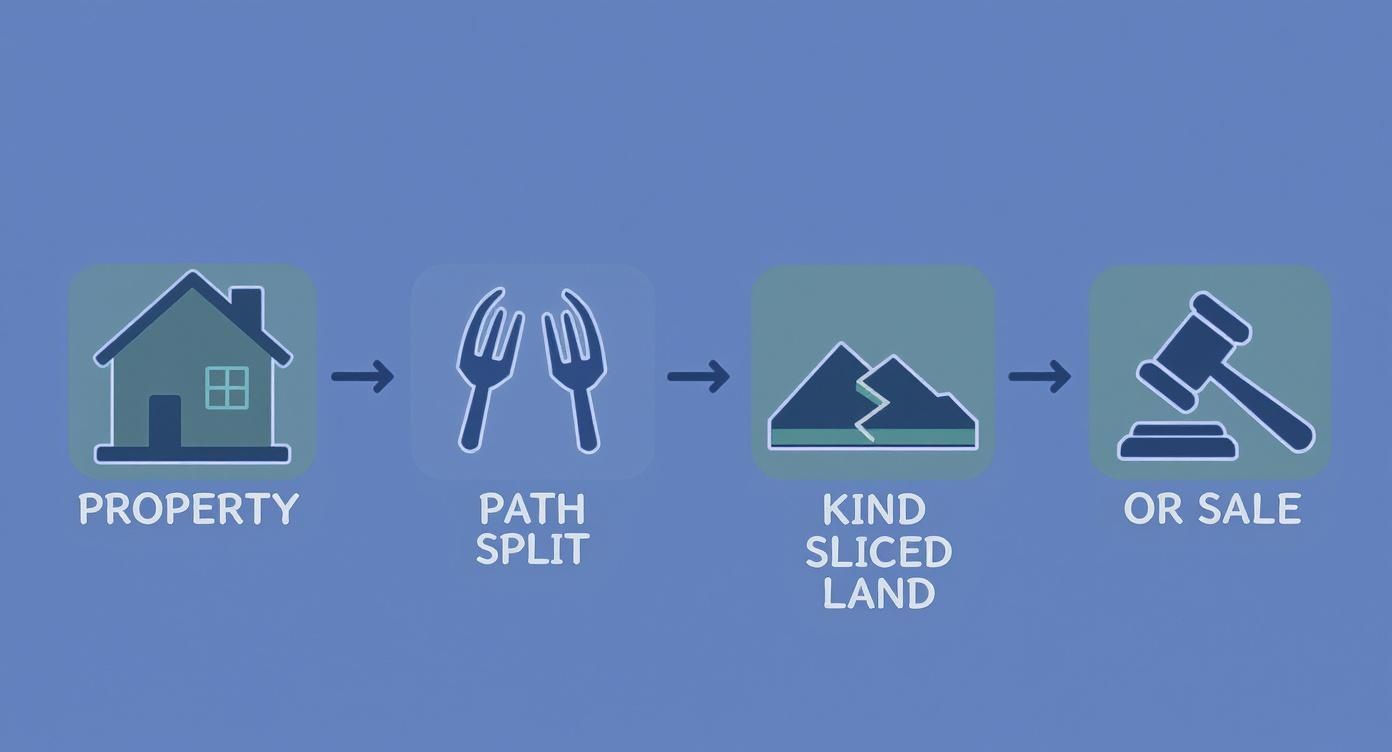
As you can see, the entire case hinges on one question: Can the property be fairly "sliced up" (partition in kind), or does it have to be sold so the money can be divided (partition by sale)?
Step 1: Initial Court Proceedings
Once the petition is filed, the journey through the court system begins. This first phase is all about setting the stage for the final outcome.
Serving the Other Owners: The plaintiff has to legally notify all the other co-owners (the defendants) about the lawsuit. It’s called "service of process," and it’s a critical step to ensure everyone gets a fair chance to participate.
The First Court Hearing: The court then holds an initial hearing to figure out two key things: the ownership interest of each person (is it a 50% share? A 25% share?) and whether the property can be physically divided without hurting its value.
If the court decides the property can be fairly divided, it issues an order to start that process. If not, it declares the property must be sold. This initial ruling is a major turning point that decides which path the case will take.
Step 2: Appointing Commissioners and Finalizing the Division
After that first ruling, the court gets the ball rolling. If a partition in kind was ordered, the court will appoint three or more neutral third parties, known as commissioners, to come up with a plan for dividing the land fairly.
These aren't just random people. The commissioners will actually visit the property, evaluate it, and then recommend a specific way to split it up according to each owner's share. They submit this detailed plan back to the court for review.
But if the court ordered a sale, it will typically appoint a receiver or an officer to manage the sale. This usually means hiring a real estate agent or holding a public auction.
Finally, the court issues a final judgment. This order either approves the commissioners' division plan or confirms the sale and dictates how the money gets distributed. This final order is what officially closes the book on the lawsuit.
Cost-Effective Alternatives to a Lawsuit
Jumping straight into a partition lawsuit isn’t always the right first move. While it's a powerful tool for ending co-ownership disputes, it's not the only one. Lawsuits can be expensive, slow, and emotionally draining—especially when family is on the other side.
The good news is, you have practical alternatives that can help you and the other owners find a solution without ever stepping foot in a courtroom. Exploring these options can save you a mountain of time and legal fees while keeping important relationships intact. The goal isn't to find the most aggressive solution; it's to find the right one for your situation.
Mediation: A Path to Mutual Agreement
Mediation is one of the most effective ways to sidestep a lawsuit. It’s a process where a neutral, third-party expert—the mediator—sits down with you and the other co-owners to guide the conversation. A mediator doesn't take sides or make decisions for you. Their job is simply to help everyone find common ground.
The entire process is confidential and far less formal than a court hearing, which empowers everyone to have a real say in the final outcome. For property owners looking for different ways to handle disagreements, understanding various strategies for property dispute resolution can provide helpful insights. You can learn more about how it works in our guide to real estate mediation in Texas.
Voluntary Buyout Agreements
Another common-sense solution is a voluntary buyout agreement. This is exactly what it sounds like: one co-owner agrees to buy the ownership shares of the others.
A buyout is often the cleanest and fastest way to settle a dispute. It lets one person take full control of the property while giving the others immediate cash for their equity.
Here’s how it typically works:
- You agree on a fair market value for the property, usually determined by a professional appraisal.
- You draft a formal agreement that lays out all the purchase terms.
- The buying co-owner secures the financing needed to complete the purchase.
Courts and mediators almost always encourage voluntary settlements first. In fact, research shows that trying mediation before filing a lawsuit can slash partition litigation costs by up to 30% and leads to much higher satisfaction among the co-owners.
Your Top Questions About Texas Partition Actions, Answered
When you're staring down a conflict over a shared property, your mind is probably racing with questions. Getting straight answers can help you see the path forward and ease some of that stress. Here are the most common concerns we hear from Texas property owners facing this exact situation.
What Does a Partition Action Really Cost in Texas?
There's no single price tag. The final cost depends almost entirely on how much the co-owners are willing to fight. Your main expenses will be attorney's fees, court filing fees, and sometimes, the cost of court-appointed commissioners to assess the property.
If everyone can find some common ground, the costs stay manageable. But if the dispute turns into a drawn-out court battle, the expenses will naturally climb. A candid conversation with a Texas landlord tenant lawyer about the potential costs is one of the most important first steps you can take.
Can I Stop My Co-Owner From Filing a Partition Action?
Here’s the hard truth: in Texas, the right to partition is considered absolute. That means you generally can't block a co-owner from starting the lawsuit. But that absolutely does not mean you’re powerless.
While you can't stop the case from being filed, you have every right to jump in and protect your financial stake. This is your chance to shape the outcome.
You can—and should—make your case for how the property should be divided. Argue for a physical split (a "partition in kind") instead of a forced sale. You can also challenge the ownership percentages or demand reimbursement for expenses you've shouldered alone, like property taxes, insurance, or major repairs.
What Happens to the Money After a Partition Sale?
The cash from a partition sale doesn't get split up right away. First, the court makes sure all the bills related to the lawsuit and the sale get paid. This covers things like attorney’s fees, court costs, and any outstanding liens on the property, like a mortgage.
Next comes the "accounting." This is a crucial step where the court adjusts the numbers to make things fair. If you paid more than your share for the property’s upkeep over the years, this is when you get reimbursed. Only after all those costs and adjustments are settled does the court distribute the remaining money to the co-owners based on their legal ownership shares.
How a Property Law Attorney Can Help You
Trying to navigate a property dispute on your own is a recipe for stress and confusion. One wrong step, one missed deadline, and your investment could be at risk.
Whether you’re the one filing for a partition or you’ve just been served with a lawsuit, having an experienced eviction attorney or property lawyer in your corner isn't a luxury—it's essential. This isn't a DIY project.
A skilled property lawyer makes sure every step follows the strict procedures laid out in the Texas Property Code. They’ll dig into the details to accurately determine ownership shares, handle negotiations with the other co-owners, and fight for the best possible outcome in court. That might mean a fair buyout, a physical split of the land, or ensuring a court-ordered sale is managed properly to protect your equity. Your attorney becomes your advocate, focused on one thing: securing your financial interests and giving you a clear path forward.
If you're stuck in a deadlock over a shared property, don't wait for things to get worse. Your rights and your investment are far too important to leave to chance.
If you need help with an eviction, lease issue, or rental dispute, contact The Law Office of Bryan Fagan, PLLC for a free consultation today.

![Graphic design featuring the title "8 Valid Reasons to Break a Lease in Texas [2025 Guide]" with decorative elements like a pen and paper, emphasizing tenant rights and legal guidance in Texas.](https://texastenantlawyers.com/wp-content/uploads/2025/11/featured-image-7ebe2aec-eacb-4e61-8e85-9c298b07ad11.jpg)