
Dealing with a landlord dispute can be stressful—but understanding your rights under Texas law can make all the difference. One of the most common sources of friction between tenants and landlords is the security deposit, a topic often packed with confusion and potential conflict.
But here’s the bottom line: under Texas law, your landlord has a legal duty to refund your security deposit within 30 days after you move out and provide them with a forwarding address. That’s not a guideline—it's a hard deadline meant to protect your money and your rights.
Understanding Your Security Deposit Rights in Texas

Whether you’re a tenant trying to get your money back or a landlord managing a property, knowing the rules is the only way to ensure a fair outcome. The Texas Property Code, specifically Section 92, lays out exactly how security deposits must be handled. This law exists to create a clear, predictable process for everyone involved and to stop disagreements before they turn into expensive legal fights.
Think of your security deposit as a safety net for the landlord, not a personal slush fund. It’s there to cover specific, legitimate costs after you leave, like unpaid rent or damage that goes beyond normal wear and tear. It is not meant for routine maintenance, cosmetic upgrades, or covering the landlord’s operating costs.
How Much Can a Landlord Actually Charge for a Deposit in Texas?
Here’s a fact that surprises many renters: Texas has no statewide cap on security deposits. Unlike many other states, landlords here are not limited to charging one or two months' rent.
While one month's rent is still the common practice, landlords can ask for more based on local market demand or a tenant's credit history. This gives property owners flexibility, but it also means you might face steep upfront costs in competitive rental markets. The one non-negotiable rule? Your deposit must be refundable unless your lease explicitly states otherwise in bold, underlined text.
Your Fundamental Rights and Responsibilities as a Tenant
Protecting your security deposit isn’t something you do just at move-out. It starts the day you sign the lease and get the keys. As a tenant, your responsibilities are straightforward:
- Pay your rent on time, every time.
- Leave the property in good shape, accounting for normal wear and tear.
- Give your landlord a written forwarding address once you’ve moved out.
Getting these basics right is essential. The entire legal framework protecting your tenant rights is laid out in the Texas Property Code, which covers everything from repairs to evictions. To get a complete picture, you can learn more about your rights under the Texas Property Code in our detailed guide.
Key Security Deposit Rules at a Glance
To make things even clearer, let's break down the most critical rules into a quick-reference table. This helps both landlords and tenants see their rights and obligations side-by-side.
| Rule | What the Texas Property Code Says (§ 92) | Key Takeaway for You |
|---|---|---|
| Refund Deadline | Landlords must refund the deposit within 30 days of the tenant moving out. | The clock starts after you move out and provide a forwarding address. |
| Deductions | Landlords can only deduct for damages beyond "normal wear and tear" and other lease breaches. | Faded paint is wear and tear; a giant hole in the wall is damage. |
| Itemized List | If deductions are made, the landlord must provide a written, itemized list of all damages and charges. | No vague claims. The landlord must specify what was fixed and what it cost. |
| Bad Faith | Landlords who wrongfully withhold a deposit in bad faith can be sued for 3 times the deposit, $100, and attorney's fees. | The law has serious teeth for landlords who intentionally break the rules. |
| Forwarding Address | You must provide a written forwarding address to trigger the landlord's 30-day refund obligation. | Without this, the landlord doesn't have a legal deadline to return your money. |
This table isn't a substitute for legal advice from a qualified eviction attorney, but it gives you a solid foundation for understanding the process. Knowing these rules is the first step toward protecting your rights.
The Critical 30-Day Security Deposit Return Rule

When it comes to Texas security deposit laws, one number matters more than any other: 30.
Under Texas Property Code § 92.103, a landlord has exactly 30 days after you move out to refund your security deposit. This isn’t a suggestion. It's not a guideline. It's a hard deadline baked into state law.
This 30-day clock is the bedrock of your rights as a tenant. It’s designed to stop landlords from holding your money hostage, leaving you wondering for months what happened to your deposit. For landlords, it creates a clear, predictable end to a tenancy.
But the clock doesn’t start automatically.
Starting the 30-Day Clock: Your Responsibility
The countdown doesn’t begin the second you hand over the keys. For that 30-day timer to officially start ticking, two things absolutely must happen:
- You have to formally surrender the property—that means you’ve moved out completely and returned the keys.
- You must give your landlord a written forwarding address where they can mail the refund.
That second point trips up a lot of tenants. A quick text message or a verbal "I'll be at…" won't hold up in court. You need to provide your new address in writing. If you don't, the landlord’s obligation to refund your deposit is legally on pause until you do.
Pro Tip: Send your forwarding address using certified mail with a return receipt requested. This is your silver bullet. It creates an undeniable paper trail, proving exactly when your landlord received your address and the 30-day clock officially started.
What Happens Within Those 30 Days
Once you've done your part, the ball is in the landlord's court. They have one of two choices: return your deposit in full, or send you a written, itemized list of deductions explaining why they're keeping some or all of it.
If they fail to do either of those things within the 30-day window, they generally forfeit the right to keep any of your deposit. The law is strict here. Whether they owe you a full refund or plan on making deductions, the deadline is the same. This system pushes landlords to handle deposit returns promptly and in good faith. You can discover more insights about security deposit deadlines to see how Texas law stacks up against other states.
Real-World Scenarios to Consider:
- You move out early: You break your lease and leave on the 15th of the month, but your lease officially ends on the 30th. Your landlord still has a full 30 days from the 30th (the end of the lease term) to refund your deposit.
- The 30th day lands on a weekend or holiday: The deadline usually rolls over to the next business day. But a smart landlord won’t wait until the last minute and risk a dispute over postmark dates.
- The landlord claims they never got your address: This is exactly why certified mail is so crucial. That little green return receipt is your proof. It shuts down this argument before it even starts.
The Consequences of Missing the Deadline
Texas law does not take this rule lightly. A landlord who blows past the 30-day deadline without refunding the deposit or providing an itemized list is legally presumed to be acting in "bad faith."
"Bad faith" isn't just a turn of phrase—it's a legal determination that the landlord intentionally and dishonestly ignored your rights.
If you have to take your landlord to court and can prove they acted in bad faith, the penalties are steep. A judge can order the landlord to pay you:
- Three times the amount of the deposit they wrongfully kept.
- A flat $100 penalty.
- Your reasonable attorney's fees.
These aren't just slaps on the wrist. They're powerful deterrents designed to make landlords think twice before illegally holding onto your money. Understanding this 30-day rule is the first and most important step in protecting your rights.
What Landlords Can Legally Deduct From Your Deposit
https://www.youtube.com/embed/cHkcyKpWltQ
The line between "damage" and "normal wear and tear" is where most security deposit arguments begin. To protect your money, you must understand this difference and know when a landlord’s claims are legitimate.
Under Texas Property Code § 92.104, landlords have the right to deduct for damages you are legally responsible for. But the law is just as clear about what they can't do: they are explicitly forbidden from keeping your deposit to cover normal wear and tear.
So, what’s the difference? Think of it like a pair of shoes. Walking in them every day will cause the soles to wear down and the color to fade a bit—that's normal wear. But if you kick a rock and tear a hole in them, that's damage. The same logic applies to your rental property.
Defining "Normal Wear and Tear" in Texas
Normal wear and tear is simply the natural decline of a property's condition that happens from living in it as intended. It’s the unavoidable result of a place being occupied. Landlords are expected to cover these costs as a part of doing business.
Examples of normal wear and tear usually include:
- Faded paint or minor scuffs on the walls.
- Carpet that's slightly worn in high-traffic areas.
- Loose grout between bathroom tiles that has occurred over time.
- Light scratches on wood floors from regular use.
A landlord cannot charge you to repaint an entire room just because the paint has aged. They also can't bill you for replacing a 10-year-old carpet that has simply lived out its natural life. These are maintenance issues, and you can learn more about general landlord responsibilities in Texas in our other guide.
What Constitutes Actual Damage
Damage, on the other hand, is the result of negligence, carelessness, accidents, or abuse. These are problems caused by a tenant’s actions (or lack of action) that go beyond the expected effects of just living somewhere. This is exactly what a security deposit is intended to cover.
Legally deductible damages often include:
- Large holes punched in walls or doors.
- Broken windows, doors, or appliances.
- Deep scratches, burn marks, or major stains on floors and countertops.
- Damage from pets, like chewed baseboards or urine-stained carpets.
- Excessive filth or trash left behind that requires a deep cleaning.
Real-world scenario: A tenant is moving out and decides to drag a heavy dresser across the hardwood floor, leaving a deep, 10-foot-long gouge in the wood. This is not normal wear and tear; it is damage caused by negligence. The landlord can legally deduct the cost of repairing the floor from the security deposit.
Unpaid Rent and Other Lease Violations
It's not just about physical damage. Your landlord can also use your security deposit to cover other financial losses you caused. The most common deduction is for unpaid rent. If you move out owing a month's rent, your landlord can absolutely take that amount from your deposit.
Other charges laid out in your lease can also be deducted, like unpaid utility bills that were your responsibility or late rent fees. The key is that the landlord must be able to point to a specific clause in your lease that says you're liable for those specific charges.
A Crucial Point on Itemization: If your landlord withholds any amount from your deposit, they are legally required to give you a written, itemized list of every single deduction. Vague charges like "general cleaning" or "miscellaneous repairs" often won't hold up in court if you challenge them.
The Importance of a Move-Out Inspection
Your best defense against unfair deductions is a rock-solid record of the property's condition when you leave. A thorough move-out inspection isn't just a good idea—it's essential. Walk through the entire unit, room by room, and take detailed photos and videos of everything.
Document the cleanliness of the oven, the inside of the fridge, the condition of the walls, floors, and fixtures. This visual evidence creates a powerful baseline that can instantly disprove a false claim of damage. To really cover your bases, considering professional move-in/out cleaning services can be a smart move. Having that receipt strengthens your case even further, showing you left the property in good shape.
Deposits vs. Fees: What's the Difference?
When you’re applying to rent a place, it can feel like you're writing a check for every piece of paper you sign. But here’s something you need to know: not every dollar you hand over to a landlord is a "security deposit." Texas law is very specific about this, drawing clear lines to protect both you and the landlord from nasty surprises down the road.
Getting these terms straight isn’t just about semantics—it’s about protecting your rights and your money. Let’s break down the three main types of payments you’ll run into.
The Security Deposit
This is the big one, the payment everyone knows. A security deposit is a refundable chunk of money you give the landlord to guarantee you’ll hold up your end of the lease agreement. Think of it as a safety net for the property owner.
Its purpose is to cover very specific costs after you move out, like:
- Unpaid rent you still owe.
- Repairs for damages that go beyond normal wear and tear.
This is your money held in trust. It's not the landlord's personal fund for painting the house a new color or upgrading the countertops. Its job is strictly to cover financial losses you directly caused. And unless your lease specifies otherwise, this deposit is 100% refundable.
The Application Fee
Next up is the application fee. Unlike a security deposit, this payment is non-refundable, and for good reason. It’s meant to cover the landlord’s out-of-pocket costs for screening you as a potential tenant.
This fee pays for the legwork: running your background check, pulling a credit report, and verifying your employment and rental history. You’re essentially paying for a service. Once they’ve run those checks, the fee is considered earned—you don’t get it back, even if they decide not to rent to you.
The Application Deposit
This is where things can get a little murky. An application deposit is a completely different animal from both a security deposit and an application fee. You pay this to the landlord to essentially take the property off the market while they process your application.
Here's the critical difference: an application deposit is refundable if the landlord rejects your application. If they turn you down, they have to give it back. But if they approve you and you’re the one who decides to back out, you’ll almost certainly forfeit that money.
Texas law keeps these payments separate to ensure everyone is treated fairly. As laid out in the Texas Property Code § 92, a security deposit secures the lease, an application deposit holds the unit, and an application fee covers screening costs. To dig deeper, you can learn more about the legal distinctions between tenant fees in Texas and make sure you know your rights.
A Modern Twist: The Monthly Fee
Things are always changing, and security deposit laws in Texas have evolved, too. Under a newer law, Texas Property Code § 92.111, landlords can now give you the choice to pay a small, recurring monthly fee instead of a big, upfront security deposit.
This can be a huge help for tenants who don’t have a lump sum of cash ready for move-in. But you’ve got to weigh the pros and cons carefully.
- The Good: Your move-in costs are much lower, making it easier to get into a new home without draining your savings.
- The Bad: You’re paying money every single month that you will never see again. Over a long lease, these fees can easily add up to more than a traditional deposit would have cost.
If a landlord offers you this option, they are required by law to tell you—in writing—that you still have the right to pay a normal security deposit instead. The choice is yours, and they can’t strong-arm you into the monthly fee. It’s a flexible option for modern renters, but you need to do the math and decide what makes the most sense for your wallet in the long run.
How to Dispute a Wrongfully Withheld Security Deposit
It’s a frustrating experience: you’ve moved out, left the place in great shape, and then… nothing. Your landlord has kept your security deposit without a good reason, leaving you feeling powerless and taken advantage of.
But you're not powerless. Under Texas law, you have a clear, step-by-step process to get your money back. This isn't just about fairness; it's about holding your landlord accountable. Here’s exactly what you need to do.
Step 1: Send a Formal Demand Letter
Before you even think about going to court, your first move is to send your landlord a formal demand letter. This isn't an angry email or a quick text—it's an official piece of correspondence that creates a legal paper trail.
Think of it as putting your landlord on formal notice. You're officially stating that they've wrongfully withheld your deposit and you expect a full refund. This step is a non-negotiable part of the process under Texas security deposit laws.
You absolutely must send this letter via certified mail with a return receipt requested. That little green card you get back in the mail is your golden ticket—it’s undeniable proof your landlord received your demand. If this ends up in front of a judge, that receipt is critical evidence.
What to Include In Your Demand Letter
You don't need to sound like a lawyer here. Just be clear, professional, and make sure to include these key pieces of information:
- Your Forwarding Address: State it clearly, even if you’ve already given it to them.
- The Deposit Amount: Specify the exact dollar amount of the security deposit you paid.
- A Reference to the Law: Briefly mention that under Texas Property Code § 92.103, they had 30 days to either return your deposit or provide an itemized list of deductions.
- A Clear Demand for Action: Tell them you expect a full refund by a specific date (giving them 10 business days is reasonable) to resolve the matter.
Often, this letter does the trick. Many landlords, when faced with a tenant who clearly knows their rights, will simply send the check to avoid further hassle. Sometimes, exploring a less confrontational route like real estate mediation can also help both parties find a resolution without going to court.
It's important to remember what a security deposit is for. It's your money, held in trust, not a bonus for the landlord.
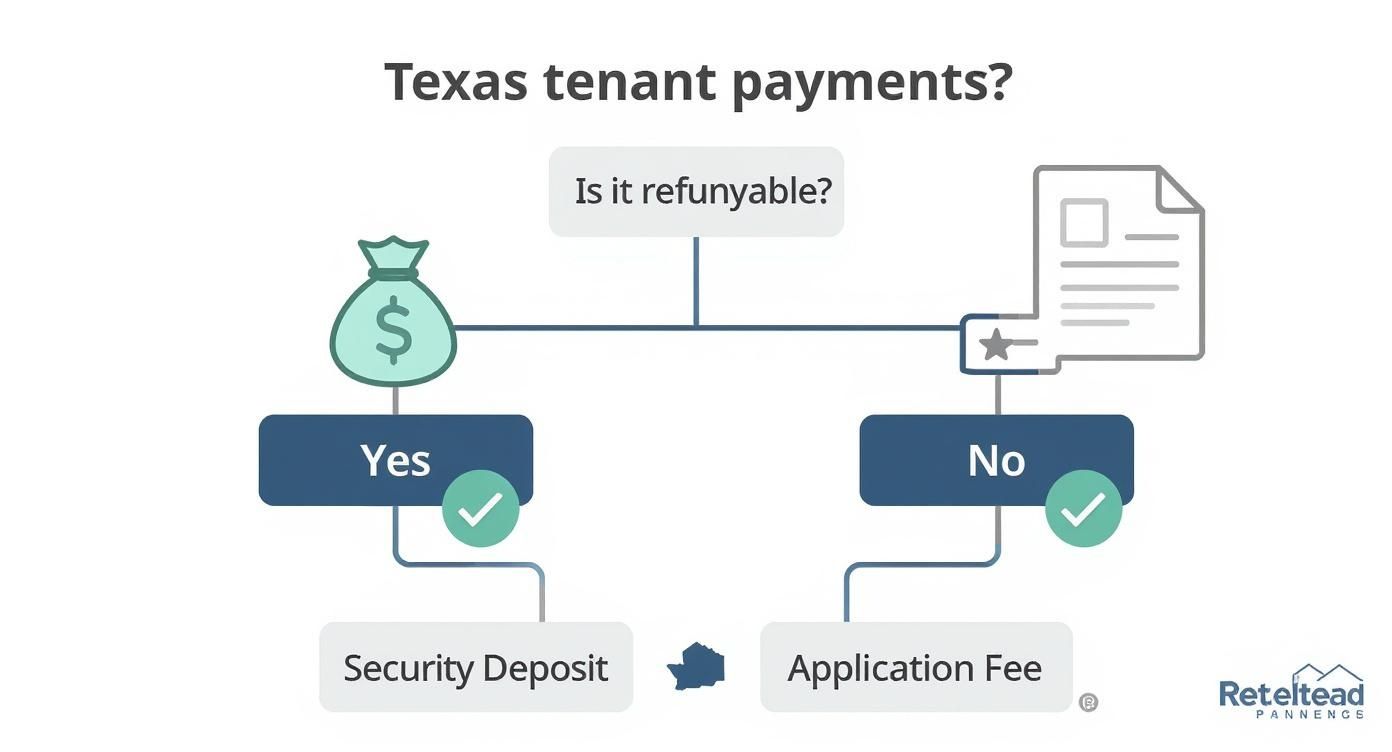
Unlike a non-refundable application fee, which covers the landlord’s costs for things like credit checks, the security deposit is meant to be returned.
Step 2: Filing a Claim in Justice Court (Small Claims Court)
If your demand letter is ignored or your landlord refuses to pay, it’s time for the next step: filing a claim in a Texas Justice of the Peace Court, also known as small claims court. This is where you can formally sue for the return of your deposit.
Filing is simpler than you might think and is designed for people to handle without hiring an attorney. You’ll fill out a form called a petition, pay a small filing fee, and the court will ensure the landlord gets served with the lawsuit.
To win, you need to be organized. Start gathering all your evidence now:
- A copy of your signed lease agreement.
- Your move-in and move-out photos and videos.
- Copies of all communication (emails, texts, letters) with your landlord.
- That all-important certified mail receipt from your demand letter.
When a dispute escalates, some people want to dig deeper. While not directly part of the security deposit process, understanding how to conduct background checks can be a separate, useful skill for vetting individuals in various contexts.
Tenant's Security Deposit Dispute Checklist
Follow these steps methodically if you believe your security deposit has been wrongfully withheld by your landlord in Texas.
| Step | Action to Take | Why It's Important |
|---|---|---|
| 1. Review Lease & Records | Re-read your lease agreement and gather all communication, photos, and payment records related to your tenancy and deposit. | This confirms your rights and helps you build a factual timeline of events for your case. |
| 2. Send a Demand Letter | Draft a formal letter demanding the return of your deposit. Send it via certified mail with a return receipt requested. | This creates an official paper trail and is a legal prerequisite for suing for bad faith damages in Texas. |
| 3. Wait for a Response | Allow the landlord a reasonable time to respond (e.g., 10-14 days) after they receive your letter. | This shows you've made a good faith effort to resolve the issue before escalating it to the courts. |
| 4. File a Petition | If there's no response or a refusal, file a petition in the local Justice of the Peace Court (small claims court). | This officially begins the legal process to recover your deposit and any potential penalties. |
| 5. Prepare for Court | Organize all your evidence: the lease, photos, the certified mail receipt, and copies of all communications. | A well-organized case is easier for the judge to understand and significantly increases your chances of winning. |
Following this checklist keeps you organized and ensures you don't miss a critical step in asserting your rights.
Proving "Bad Faith" for a Larger Judgment
Now, here’s where the Texas Property Code gives tenants some real leverage.
Under Texas Property Code § 92.109, if a landlord withholds your deposit in "bad faith," the penalties get serious. Bad faith isn’t just a mistake; it means the landlord intentionally and dishonestly ignored your legal rights.
A landlord is legally presumed to have acted in bad faith if they fail to return the deposit or provide an itemized list of deductions within 30 days of you moving out and providing a forwarding address.
The burden is on them to prove they didn't act in bad faith, not on you to prove they did.
If you can show the judge the landlord acted in bad faith, you could be awarded:
- Three times the amount of the deposit they wrongfully kept.
- An extra $100 penalty.
- Your reasonable attorney's fees and the court costs.
This powerful provision turns a simple dispute over your deposit into a major financial risk for a landlord who breaks the rules. By following these steps, you can confidently stand up for your rights and get back what's rightfully yours.
Common Questions on Texas Security Deposit Laws
Navigating the ins and outs of security deposit laws in Texas can be confusing. Whether you're a tenant trying to protect your money or a landlord trying to follow the rules, a few key questions always come up. Let’s provide some clear answers.
Does my landlord have to pay interest on my security deposit?
No. Texas law does not require landlords to pay you interest on your security deposit. The money is held as a guarantee during your lease, but your landlord isn’t obligated to place it in a special interest-bearing account for you. They also don't have to keep it in a separate bank account from their own funds, though it's good practice. The only mandate is that they must be able to refund the full amount, minus any legitimate deductions, within the 30-day window after you move out.
What happens if I never give my landlord a forwarding address?
This is a critical point that many tenants miss. Your landlord's legal duty to return your security deposit within 30 days does not start until you provide them with a written forwarding address. If you move out and forget this step, their obligation is effectively paused. They don't get to keep your money forever, but the 30-day clock isn't ticking. This is why you should always provide your new address in writing.
Legal Tip: The best way to protect your rights is to send your forwarding address via certified mail with a return receipt requested. This gives you a legal paper trail proving exactly when your landlord received it, which officially starts the 30-day countdown.
Can a landlord charge a cleaning fee if I already cleaned the property?
This is a common point of dispute. A landlord can only legally deduct cleaning costs from your deposit if the property requires cleaning that goes beyond "normal wear and tear." Your responsibility is to leave the property reasonably clean, not in brand-new, mint condition. For example, a landlord cannot charge you for minor scuffs on the wall or slightly worn carpet. However, if you leave behind significant trash, stained appliances, or strong pet odors, they can absolutely deduct the cost of professional cleaning to fix those specific issues.
Your best defense against unfair cleaning fees is solid proof. Before you hand over the keys, take detailed photos and a walkthrough video of the entire unit after you've cleaned. This documentation can be invaluable if you need to dispute improper charges.
What if my landlord sells the property?
If your rental property is sold to a new owner while you're still living there, the responsibility for your security deposit transfers to the new landlord. According to Texas Property Code § 92.105, the old owner is required to hand over the deposit to the new one. Once the sale is final, the new owner assumes all the previous landlord’s responsibilities. They are now legally on the hook for your deposit and must follow all the same security deposit laws in Texas for deductions and returns. The new owner cannot require you to pay another deposit unless it was a specific condition in your original lease. If you're facing issues during an ownership change, an experienced Texas landlord tenant lawyer can help protect your rights.
Get Help With Your Landlord-Tenant Dispute
Trying to navigate landlord-tenant law on your own can be an uphill battle, especially when your hard-earned money is on the line. You may have done your research and followed the rules, but your landlord is still refusing to return your deposit.
While this guide provides a solid framework, every dispute has unique details. If you’ve sent a demand letter and hit a wall, it may be time to get legal help. An experienced Texas landlord-tenant lawyer can analyze the specifics of your case, explain your legal options, and ensure your rights under the Texas Property Code are protected. Hiring a legal professional isn't just about getting your deposit back—it's about holding a landlord accountable for acting in bad faith.
If you need help with an eviction, lease issue, or rental dispute, contact The Law Office of Bryan Fagan, PLLC for a free consultation today.

![Graphic design featuring the title "8 Valid Reasons to Break a Lease in Texas [2025 Guide]" with decorative elements like a pen and paper, emphasizing tenant rights and legal guidance in Texas.](https://texastenantlawyers.com/wp-content/uploads/2025/11/featured-image-7ebe2aec-eacb-4e61-8e85-9c298b07ad11.jpg)