
Dealing with a landlord dispute or eviction can be stressful — but understanding your rights under Texas law can make all the difference. A landlord in Texas cannot simply lock you out or toss your belongings on the curb. They must follow a strict, formal legal process laid out by the state. You have specific rights at every single stage, and this guide is here to walk you through them.
At The Law Office of Bryan Fagan, PLLC, we believe knowledge is your first and best line of defense. Knowing your rights is the first step toward protecting your home.
Your Guide to Texas Tenant Rights During Eviction

Facing the possibility of losing your home is a heavy burden, and you’re not alone. In recent years, Texas has seen a flood of eviction filings, soaring well above pre-pandemic numbers. After the statewide rent relief program ended, landlords filed over 177,000 eviction cases across the Houston, Dallas, Austin, and Fort Worth metro areas alone.
This tough environment makes it more critical than ever to know your legal protections. The entire process is controlled by the Texas Property Code, a set of laws designed to keep things fair for both tenants and landlords. If your landlord fails to follow these rules to the letter, it can become a powerful defense for you in court.
What the Texas Property Code Says About Eviction
Before you do anything else, you need to understand what an eviction actually is—and what it isn’t.
- An Eviction Is a Lawsuit: This isn't just a letter on your door. An eviction is a formal legal process. To legally remove you, a landlord has to file a lawsuit against you in a Justice of the Peace court.
- You Have the Right to Respond: You are legally entitled to get official notice of that lawsuit and have your opportunity to show up in court and tell your side of the story. The worst thing you can possibly do is ignore it. Our guide on how to respond to an eviction notice walks you through those crucial first steps.
- Only Law Enforcement Can Remove You: A landlord, a property manager, or their agent can never physically force you out or remove your property themselves. Only a constable or sheriff, armed with a specific court order called a "Writ of Possession," has the legal authority to do that.
The bedrock principle of Texas tenant rights eviction law is that due process must be followed. This means every step has a rule, every action has a timeline, and every mistake by a landlord has a consequence for their case.
This guide will walk you through these rules, helping you understand the eviction timeline, your potential defenses, and how to stand up for your rights.
If you need help with an eviction, lease issue, or rental dispute, contact The Law Office of Bryan Fagan, PLLC for a free consultation today.
Step-by-Step Guide to the Legal Eviction Process
A landlord can't just decide you're out and change the locks. Eviction in Texas is a formal legal journey, and landlords have to follow every single step perfectly. If they make a procedural mistake, it can become a key part of your defense.
Let's walk through exactly what that process looks like, so you know what’s coming and how to protect your rights.
Step 1: The Notice to Vacate
Think of the Notice to Vacate as the legal starting gun. It's not the eviction itself—it's the official warning that kicks everything off. This document must tell you why the landlord wants you to leave (like unpaid rent or another lease violation) and give you a deadline to either fix the problem or move.
For unpaid rent cases, Texas Property Code § 24.005 is crystal clear: the landlord must give you at least a three-day notice to move out, unless your lease specifically allows for a shorter period. That three-day clock doesn't start until the day after they deliver the notice.
How they deliver it matters—a lot. The landlord or their agent must do it in one of these ways:
- Give it directly to you or someone in your home who is at least 16 years old.
- Send a copy by regular mail, certified mail, or registered mail (with a return receipt).
- Post it securely to the inside of your main entrance.
If none of those methods work, they are allowed to tape it to the outside of your front door, but they must also mail a copy that same day. If they fail to follow these delivery rules, the notice could be invalid.
Step 2: Filing the Eviction Lawsuit
If you haven't paid rent or moved out by the deadline, the landlord's next move is to file an eviction lawsuit. In Texas, this is officially called a "Forcible Detainer" suit, and it's filed in the local Justice Court (often called the JP court).
Once the suit is filed, you will be served with a legal document called a citation. This is your formal notification about the lawsuit. It will state when and where your court hearing is and give you a deadline to file an "answer"—your formal response to the landlord's claims.
Crucial Tip: Whatever you do, do not ignore the citation. If you don't show up to court or file an answer, the landlord almost always wins by default. It’s one of the biggest and most costly mistakes a tenant can make.
Step 3: The Eviction Hearing in Justice Court
This is your day in court. The eviction hearing is where both you and your landlord get to present your case to the Justice of the Peace. You should come prepared to tell your side of the story and back it up with any proof you have.
Good evidence to bring includes:
- Rent receipts or bank statements showing you paid.
- Photos or videos of unsafe conditions if you are arguing the landlord failed to provide a habitable home.
- Copies of emails or letters you sent requesting repairs.
- The Notice to Vacate itself, if you believe it was delivered incorrectly.
Real-World Scenario: Let's say your landlord just slapped the notice on the outside of your door but never mailed a copy. This is a clear procedural mistake. You can point that out to the judge, and there's a good chance the judge will dismiss the case. The landlord would then have to start the entire eviction process over from the beginning. An experienced Texas landlord-tenant lawyer is an expert at spotting these kinds of critical errors.
Texas Eviction Process Timeline
This table breaks down the typical timeline for a standard eviction case in Texas based on non-payment of rent. Keep in mind that timelines can vary based on the specifics of your case, the court's schedule, and whether either party appeals the decision.
| Step | What Happens | Typical Timeframe | Relevant Texas Property Code / Rule |
|---|---|---|---|
| 1. Notice to Vacate | Landlord delivers a written notice demanding the tenant pay rent or move out. | At least 3 days | § 24.005 |
| 2. Filing Lawsuit | If the tenant doesn't comply, the landlord files a Forcible Detainer suit in Justice Court. | 1-3 days after notice period ends | § 24.0051 |
| 3. Serving the Tenant | A constable or sheriff serves the tenant with the lawsuit citation and court date. | A few days after filing | Rule 510.4, T.R.C.P. |
| 4. Court Hearing | Both parties present their case to a Justice of the Peace. | 10-21 days after the suit is filed | Rule 510.6, T.R.C.P. |
| 5. Judgment & Appeal | The judge issues a ruling. Either party has 5 days to appeal the decision. | 5 days | § 24.0052 |
| 6. Writ of Possession | If the landlord wins and the tenant doesn't appeal, the landlord can request a Writ of Possession. | At least 6 days after judgment | § 24.0061 |
| 7. Final Removal | A constable posts a 24-hour warning, then can physically remove the tenant and their belongings. | 24 hours after writ is posted | § 24.0061(d) |
Understanding this sequence is the first step toward building a strong defense. The law has rules for a reason, and knowing them is your best protection.
If you need help with an eviction, lease issue, or rental dispute, contact The Law Office of Bryan Fagan, PLLC for a free consultation today.
Common Legal Defenses Against Eviction in Texas
Receiving an eviction notice feels final, but it’s not. It's the beginning of a legal process, and you have the right to defend yourself in court. Many tenants successfully challenge evictions because their landlord did not follow the Texas Property Code precisely. Knowing your rights—and common landlord mistakes—is your best defense. A strong legal argument can get the entire eviction lawsuit dismissed, buying you time or forcing the landlord to start over correctly.
An eviction is a series of steps, not a single action. Each step is an opportunity for you to stand up for your rights.
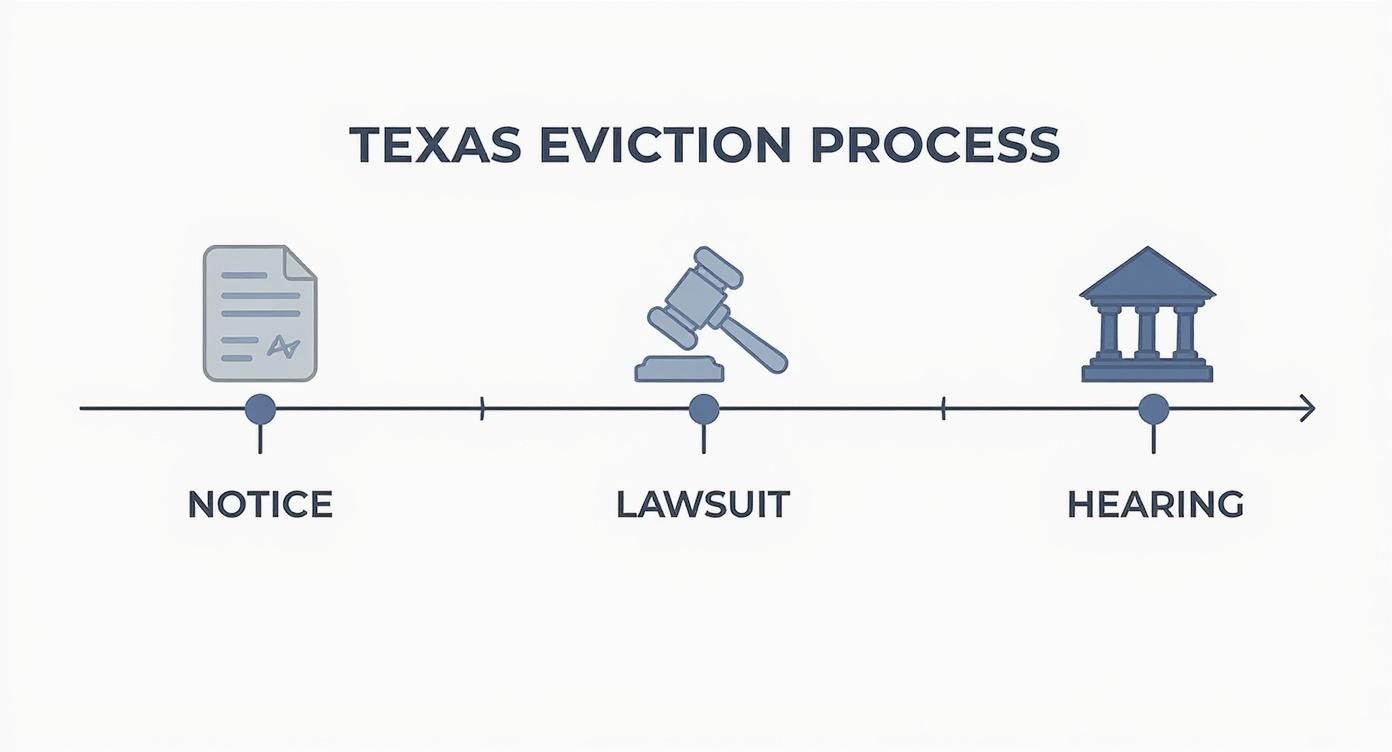
This formal court process is what gives you a fighting chance. Let's look at common ways to defend your case.
Improper Notice to Vacate
One of the most frequent and effective defenses is proving the landlord served you an improper Notice to Vacate. Texas law is very specific about what this notice must say and how it must be delivered. If the landlord makes a mistake here, their whole case can fall apart.
Common landlord mistakes include:
- Wrong Timeline: For unpaid rent, the notice must give you at least three days to move out, unless your lease states otherwise. The clock starts the day after they deliver the notice.
- Improper Delivery: The landlord cannot just leave the notice on your doormat. They must hand it to you (or someone 16 or older at home), mail it, or post it on the inside of your front door. If they tape it outside, it's only valid if they also mail a copy.
- Vague Language: The notice must clearly state why you are being evicted and demand that you leave. A confusing or vague notice may not be legally valid.
If you can prove any of these flaws to the judge, they will likely dismiss the eviction. However, this is often a temporary victory, as the landlord can correct the mistake and start the process over.
Retaliatory Eviction
Texas law prohibits landlords from punishing you for exercising your legal rights. This is called retaliatory eviction, and it's illegal under Texas Property Code § 92.331.
A landlord cannot legally evict you just because you:
- Requested necessary repairs they are required to make.
- Filed a legitimate complaint with a housing authority or health department.
- Formed or joined a tenants' rights group.
Real-World Scenario: Your heater breaks in the middle of winter. You send a certified letter to your landlord requesting a repair. A week later, the apartment is still freezing, and instead of a repair person, you receive an eviction notice. This is a classic example of potential retaliation. Your repair request becomes powerful evidence that the eviction is simply payback.
Proving your landlord's motive can be challenging, which is why documenting every conversation, email, and letter is crucial. If you believe you are a victim of retaliation, you can learn more about what qualifies as a wrongful eviction in our detailed guide.
Landlord's Failure to Make Repairs (Breach of Warranty of Habitability)
In Texas, every residential lease includes an "implied warranty of habitability." This is a legal guarantee that your rental unit is safe and livable. When a landlord fails to fix a problem that seriously threatens your health or safety, they have breached this warranty.
This can be a powerful defense against an eviction for non-payment of rent, but you must follow these steps perfectly:
- Your rent must be paid up when you first notify the landlord of the problem.
- You must inform the landlord about the issue in writing (certified mail is best for proof).
- You must give them a reasonable amount of time to make the repair.
If you have done all of this and your landlord still hasn't fixed a major issue—like a severe mold outbreak or a faulty electrical system—and then tries to evict you for withholding rent, you have a strong defense. A judge might agree that you are entitled to a rent reduction or decide that the landlord’s failure to provide a safe home is a valid defense against the eviction itself.
Illegal Lockouts and Security Deposit Disputes
Beyond the formal eviction lawsuit, some landlords may try to take matters into their own hands. It is critical to know that Texas law imposes harsh penalties on landlords who attempt to force you out illegally. Your rights are fiercely protected against illegal lockouts and the mishandling of your security deposit.

A landlord cannot simply change the locks, throw your belongings out, or prevent you from entering your home without a court order. These "self-help" tactics are strictly forbidden and carry serious consequences for the landlord.
What Is an Illegal Lockout?
Under Texas Property Code § 92.0081, it is illegal for a landlord to change the locks to keep you out. The only exception is for a legitimate repair or emergency, and even then, they must provide you with a new key immediately. A landlord who locks you out for any other reason, especially without going through the proper eviction process, is performing an illegal lockout.
This protection is a cornerstone of Texas tenant rights eviction law. It ensures that only a constable with a court order (a Writ of Possession) can legally remove you from the property.
If you are illegally locked out, you can take immediate legal action to regain entry and sue the landlord for damages. A judge can award you:
- An order forcing the landlord to give you a new key.
- Payment for any actual damages you suffered.
- A penalty of one month's rent plus $1,000.
- Your court costs and attorney's fees.
How to Handle Security Deposit Disputes
Texas law is also very specific about the return of your security deposit. Landlords cannot invent reasons to keep your money; they must follow a strict set of rules.
The Texas Property Code gives a landlord a 30-day deadline. From the day you move out and provide a forwarding address, they have 30 days to either return your full security deposit or provide you with a written, itemized list of all deductions.
If they miss that deadline or act in "bad faith," they can lose their right to withhold any of the deposit and may face penalties.
Real-World Scenario: Maria moves out of her apartment on May 31st and gives her landlord her new address in writing that day. Her landlord has until June 30th to send her the deposit or an itemized list of deductions. If July 1st arrives and Maria has heard nothing, the landlord is likely acting in bad faith. She could then sue for three times the amount of the deposit, plus a $100 penalty and her attorney's fees.
It is also important to know that deposit disputes often overlap with maintenance issues. Understanding your specific tenant rights regarding pest control, for instance, can help clarify a landlord’s responsibilities and prevent them from unfairly charging you for problems they were obligated to fix. A landlord can only deduct for actual damages beyond normal wear and tear—not for routine cleaning or maintenance.
What Happens After an Eviction Judgment
When a judge rules against you in an eviction case, it can feel like the end of the road. But it’s not. What happens next is a critical part of the process, and understanding your rights here can make a significant difference. A judgment does not mean you have to be out on the street that same day.
Your Right to Appeal the Decision
If the Justice of the Peace rules against you, you have the absolute right to challenge that decision. In Texas, you have five calendar days after the judgment is signed to file an appeal. This is a very strict deadline that includes weekends and holidays, so you must act quickly.
Filing an appeal moves your case from the Justice Court to the County Court for a completely new trial, called a "trial de novo." This gives you a second chance to argue your case, present new evidence, and have a different judge review everything. It is a powerful tool for tenants who believe the initial ruling was incorrect.
However, appealing involves several steps:
- You must file a notice of appeal with the Justice Court that heard your case.
- You generally need to post an appeal bond or file a "Pauper's Affidavit" if you cannot afford the court costs.
- You must continue to pay your rent into the court's registry while the appeal is pending.
The process can be complex, but it provides crucial time and a legitimate opportunity to defend your home. You can learn more about how to appeal an eviction in Texas.
Understanding the Writ of Possession
If you do not appeal within the five-day window or if you lose the appeal, your landlord can take the final step to have you physically removed. They will ask the court to issue a legal document called a Writ of Possession.
A Writ of Possession is a court order that gives a law enforcement officer—usually a constable or sheriff—the legal authority to remove you and your belongings from the property.
Once the judge signs the Writ, it goes to the local constable's office. A constable will then post a 24-hour warning notice on your front door. This notice states the date and time after which they can legally enter the property and supervise your removal. That 24-hour period is your final opportunity to move out on your own.
The Long-Term Impact on Your Record
An eviction judgment follows you long after you have moved out. The lawsuit becomes a public court record, which can make finding a new home incredibly difficult for years. Most landlords use tenant screening services that will flag an eviction filing, often leading to an automatic denial.
This is a major problem for renters across the state. In Travis County alone, eviction filings recently soared to a record 13,209 in a single year—a 25% increase from the previous year. This reflects the intense pressure renters are under, with nearly half already struggling just to pay rent.
Even if you move out before the constable arrives, the judgment can still appear on your rental history and credit report for up to seven years. That is why fighting the eviction in court or negotiating a settlement is so important. A skilled eviction attorney can often work out a "move-out agreement" where the landlord agrees to dismiss the case if you leave by a certain date, keeping that damaging judgment off your record entirely.
If you need help with an eviction, lease issue, or rental dispute, contact The Law Office of Bryan Fagan, PLLC for a free consultation today.
Your Texas Eviction Questions, Answered
Navigating an eviction can feel like trying to solve a legal puzzle on a tight deadline. This section provides clear, straightforward answers to the most common questions we hear from Texas tenants. Our goal is to empower you with the information you need to make smart decisions.
Can I be evicted for being one day late on rent?
Technically, yes. If your lease does not include a grace period, your rent is legally late the day after it is due. At that point, a landlord can legally give you a "Notice to Vacate" and begin the eviction process.
However, most Texas leases include a grace period, usually three to five days. Check your lease to be certain. If you can pay the full amount owed within the three-day notice period, the eviction must stop. The best approach is to communicate with your landlord as soon as you know you will be late.
What if my landlord tries to evict me without a court order?
Any attempt to force you out without a judge's order is an illegal "self-help" eviction and a serious violation of your tenant rights. This includes changing the locks, shutting off your utilities, or removing your belongings.
If this happens to you:
- Call the police immediately and report an illegal lockout.
- Contact an experienced eviction attorney right away to discuss your legal options.
Texas law allows you to sue a landlord for an illegal lockout. A judge can order them to let you back in and award you significant damages, including one month's rent plus $1,000, compensation for any actual damages, and your attorney's fees.
The law is clear: A landlord cannot be the judge, jury, and executioner. They must follow the court process.
Does my landlord have to make repairs if I'm behind on rent?
Yes. A landlord's duty to repair conditions that threaten your health and safety is separate from your obligation to pay rent. However, you cannot simply stop paying rent to force your landlord to make repairs. If you do, you will likely face a valid eviction for non-payment.
To use a landlord’s failure to repair as a defense, the Texas Property Code requires that you were current on your rent when you first sent them written notice about the problem. If you fall behind after sending that notice, your defense becomes much weaker. This is a complex situation where guidance from a Texas landlord-tenant lawyer is invaluable.
How long does an eviction stay on my record?
An eviction filing is a public court record and can follow you for years. The final judgment can be reported to credit bureaus and tenant screening companies for up to seven years, making it very difficult to rent a new home.
Even if your case is dismissed, the initial filing may still appear on background checks. While it is sometimes possible to have the record sealed, there is no guarantee a court will agree. The best way to protect your rental history is to prevent a final eviction judgment, either by winning in court or negotiating a settlement with your landlord.
If you need help with an eviction, lease issue, or rental dispute, contact The Law Office of Bryan Fagan, PLLC for a free consultation today.

![Graphic design featuring the title "8 Valid Reasons to Break a Lease in Texas [2025 Guide]" with decorative elements like a pen and paper, emphasizing tenant rights and legal guidance in Texas.](https://texastenantlawyers.com/wp-content/uploads/2025/11/featured-image-7ebe2aec-eacb-4e61-8e85-9c298b07ad11.jpg)