
Dealing with a landlord dispute or needing to move unexpectedly can be stressful—but understanding your rights under Texas law can make all the difference. If you're trying to figure out how to get out of a lease in Texas, the process almost always starts with a single, crucial document: your signed lease agreement.
That contract is the most powerful tool you have for understanding your rights, your landlord's obligations, and the pathways you can take to terminate your lease early.
Your Lease Agreement Holds the Keys
Facing a dispute with your landlord or a sudden need to move is incredibly stressful. Before you do anything else, your first and most important step is to sit down and read your lease from start to finish. This isn't just a piece of paper; it's a legally binding contract that lays out the specific rules for ending your tenancy.
You'd be surprised how many leases have clauses that cover this exact situation. A careful review will give you the clarity you need to plan your exit and avoid making a costly mistake.
Clauses to Look For in Your Lease
As you read through your agreement, you're on a hunt for specific language that deals with early termination. Keep a sharp eye out for these sections, because they directly control your options and what this might cost you.
- Early Termination Clause: Some leases have a "buyout" or "early termination" clause built right in. This is often the most straightforward way out, but it comes at a price—usually a fee equal to one or two months' rent. If your lease has this, it clearly outlines your path to a clean break.
- Reletting Fee Clause: This is very common in Texas leases. A reletting fee is not a penalty for breaking the lease. Instead, it's a charge meant to cover the landlord's actual costs of finding a new tenant, like advertising or screening applicants. This fee is separate from any rent you owe.
- Notice Requirements: Your lease will spell out exactly how much advance written notice you need to give your landlord. You must follow this to the letter. Failing to do so could invalidate your termination attempt, leaving you responsible for more rent.
- Subletting or Assignment Clause: Your lease might allow you to find someone to take over your rental. It's important to know the difference: subletting means you act as a landlord to the new tenant (while remaining responsible to your landlord), while an assignment transfers your entire lease to them. Nearly every lease requires the landlord's written permission first.
Real-World Scenario: A client recently discovered a pre-negotiated buyout option buried deep in their lease agreement. That single clause saved them thousands of dollars in future rent payments and helped them avoid a stressful legal fight. Never underestimate the power of the fine print.
Understanding Your Contractual Obligations
Reading your lease closely is non-negotiable. For instance, Texas Property Code § 91.006 requires landlords to "mitigate damages," which means they must make a reasonable effort to re-rent the unit after you leave. However, until they find a new, qualified tenant, you are still legally responsible for the rent. Knowing the specifics in your lease helps you understand exactly what your financial exposure looks like.
To get a better feel for what's standard, it can be helpful to look at some free rental agreement templates. Comparing these with your own lease can help you spot any unusual or non-standard terms your landlord might have included.
A deep dive into your contract is the bedrock of any successful lease termination strategy. The details you uncover will dictate your next moves, whether that means negotiating with your landlord, invoking a specific legal right, or just preparing for the financial hit. For a more detailed breakdown of what goes into a Texas lease, check out our guide on Texas lease agreement laws in our comprehensive guide. This initial review is your best defense and the roadmap for everything that comes next.
How to Legally Break a Lease in Texas
While your lease is the primary rulebook for your tenancy, it's not the final word. The Texas Property Code provides powerful, legally protected reasons that allow you to terminate your lease early without penalty.
These aren't loopholes. They are your statutory rights, designed to protect you in specific, often serious, situations. When certain conditions are met, Texas law gives you a clear legal path to walk away from your lease. This means you can move out and stop paying rent without facing a lawsuit or a hit to your credit—as long as you follow the correct legal steps.
This visual guide can help you map out your first moves when planning a lease exit.
As you can see, the first step is always the same: start with your lease agreement. What’s in that document dictates everything that comes next.
Before we dive into the details, here's a quick overview of the most common legal grounds for breaking a lease in Texas.
Valid Legal Reasons for Lease Termination in Texas
| Legal Reason | Governing Law/Statute | Key Tenant Requirement |
|---|---|---|
| Military Service | Servicemembers Civil Relief Act (SCRA) & Texas Property Code § 92.017 | Provide written notice and a copy of official orders for PCS or deployment of 90+ days. |
| Family Violence | Texas Property Code § 92.016 | Provide landlord with a copy of a protective order or similar court/professional documentation. |
| Uninhabitable Conditions | Texas Property Code § 92.056 | Provide written notice of the issue and give the landlord reasonable time to make repairs. |
| Landlord Harassment/Privacy Violation | Texas Property Code § 92.0081 | Landlord enters unlawfully after receiving written notice to stop. |
These are your core rights under Texas law. Now, let's break down exactly what you need to do for each.
Military Service Obligations
One of the most clear-cut reasons for terminating a lease involves military service. Both federal law—the Servicemembers Civil Relief Act (SCRA)—and Texas Property Code § 92.017 protect active-duty military members who receive official orders.
If you are in the armed forces and get orders for a permanent change of station (PCS) or to deploy for 90 days or more, the law is on your side. You have the right to break your lease.
Here is the step-by-step process:
- Give your landlord written notice of your intent to terminate the lease.
- Provide a copy of your official military orders with the notice.
Once you have provided this documentation, your lease will terminate 30 days after the first day of the next rent payment period. For example, if you give notice and your orders on September 15th and your rent is due on October 1st, your lease officially ends on October 31st.
Protection for Survivors of Family Violence
Texas law provides critical protections for tenants who are survivors of family violence, sexual assault, or stalking. Under Texas Property Code § 92.016, you can break your lease without penalty if you find yourself in one of these dangerous situations. This right ensures that a rental contract never traps someone in an unsafe environment.
To legally terminate your lease under this law, you must provide your landlord with written notice and one of the following documents:
- A copy of a protective order
- Documentation from a licensed healthcare provider or victim services advocate related to the violence
- A copy of a temporary injunction
After giving the proper notice and documentation, you are free to terminate the lease. This is a vital protection that puts the safety and well-being of Texans first.
When Your Rental Becomes Uninhabitable
You have a right to a safe and livable home. If your rental unit becomes legally uninhabitable because of a condition that materially affects your physical health and safety, you may have grounds to break the lease—but only if your landlord fails to make repairs.
This is sometimes called a "constructive eviction," but you can't just declare the place unlivable and walk away. The Texas Property Code § 92.056 outlines a specific process you must follow.
- Give Written Notice: You must inform your landlord in writing about the repair needed. Send it via certified mail to create a legal paper trail proving they received it.
- Allow Reasonable Time for Repair: After receiving your notice, the landlord has a reasonable amount of time to fix the problem.
- Send a Second Notice (If Needed): If the repair still isn't made, you may need to send a second written notice declaring your intent to terminate the lease if the issue isn't resolved.
If the landlord still fails to act, you may have the right to terminate. Understanding the details of a landlord's breach of lease is crucial in these situations, as these cases can get complicated. Proving a property is truly uninhabitable is a high bar, making advice from an experienced Texas landlord tenant lawyer incredibly valuable.
Negotiating a Lease Buyout or Sublease Agreement
So, you don't have a legally protected reason to move out. What now? Your next best option is often a direct, professional conversation with your landlord. Many tenants assume a lease is an iron-clad contract, but you’d be surprised how often a reasonable negotiation can open doors.
The key is to frame your request as a solution to a mutual problem. Landlords dislike uncertainty and vacant units. If you can offer them a clean break with a buyout or present a pre-vetted new tenant, you're helping them minimize their financial disruption—a language every property owner understands.

Proposing a Lease Buyout
A lease buyout, or a mutual termination agreement, is a straightforward deal: you pay a one-time fee, and in return, your landlord agrees to end the lease early. It's a clean slate for both of you.
This fee is negotiable, but a good starting point is typically between one and two months' rent.
When you approach your landlord, present it as a win-win. Explain that the buyout fee covers their immediate costs and gives them time to find a new renter without losing rental income. This predictability often saves them the hassle of chasing you for rent after you've moved.
Real-World Scenario: We recently helped a client who landed a new job out of state with six months left on her lease. We drafted a professional letter proposing a buyout equal to two months' rent. She explained her situation, pointed to her perfect payment history, and showed how the buyout was a better deal for the landlord than a potential vacancy gap. The landlord agreed because it was the smarter business decision.
Get It in Writing. Always.
This is critical: whatever you agree to verbally, get it in writing. A handshake deal means nothing when it comes to a lease.
The written agreement must clearly state the final move-out date, the exact buyout amount, and a clause releasing you and the landlord from all future obligations under the original lease. Without this document, a landlord could claim you abandoned the property and sue you for the remaining rent.
Exploring Subletting and Assignment
If a buyout isn't an option, your lease might allow you to find a replacement tenant. This usually happens through subletting or assignment. While people use these terms interchangeably, they are legally very different. Check your lease carefully—most require landlord approval for either.
- Subletting: This makes you a landlord. You find a new tenant (the sublessee) who pays rent to you, and you continue paying the property owner. The critical thing to remember is that you remain 100% responsible for the original lease. If your sublessee damages the property or stops paying rent, your landlord will pursue you for the costs.
- Assignment: This is a much cleaner break. An assignment transfers your entire lease—all rights and responsibilities—to a new person. Once the landlord approves the assignment and signs the paperwork, you are typically released from any future liability.
Before you go down this road, you need to understand exactly what you're getting into. For a closer look, you can review our guide on the sublease rights and responsibilities for Texas tenants.
How to Approach the Negotiation
When you start the conversation, be prepared, polite, and professional. Explain why you need to leave, present your proposed solution (buyout, sublease, etc.), and be ready to negotiate. If you've been a great tenant with a solid payment history, you have more leverage than you think. Your goal is to make it easy for your landlord to say "yes."
The High Cost of Just Walking Away
When you feel backed into a corner, the idea of just packing up and leaving can seem like the easiest way out. This is legally known as abandonment, and in Texas, it’s one of the worst mistakes a tenant can make.
It might feel like a quick fix, but the fallout can haunt you for years, both financially and legally.
Walking away without a legal reason or a written agreement from your landlord isn't a clean break. It’s a breach of contract, and Texas law gives landlords powerful tools to collect what they're owed. The smart move is always to find a proper legal exit or negotiate a formal release with the help of a Texas tenant rights attorney.
What the Texas Property Code Says About Abandonment
There’s a common myth that if you leave early, you’re automatically on the hook for every single month left on the lease, no questions asked. That's not quite how it works.
Under Texas Property Code § 91.006, landlords have a legal "duty to mitigate damages."
In plain English, this means they can't let the apartment sit empty just to run up your bill. They must make commercially reasonable efforts to find a new, qualified tenant to take your place as quickly as possible. However, "reasonable" is the key word. They are not required to rent to the first person who shows up; they only need to use their standard screening process.
The Financial Nightmare of an Improper Exit
Until a new tenant is in and paying rent, that financial responsibility is still yours. The costs can pile up fast and go well beyond just the rent you owed.
- The Remaining Rent: You are liable for rent for every month the unit is empty. If you had eight months left on your lease at $1,500 a month, you could be facing a $12,000 lawsuit.
- Reletting Fees: Check your lease, because it almost certainly has a reletting fee clause. This is a fee—often 85% of one month's rent—that you have to pay to cover the landlord's costs for advertising and screening to find your replacement.
- Legal and Collection Costs: If your landlord has to take you to court to get their money, a judge can order you to pay for their attorney's fees and court costs on top of everything else.
A landlord's duty to find a new tenant helps, but it doesn't get you off the hook. You're responsible for every dollar of lost rent and every administrative cost until that unit is occupied again.
The Long-Term Damage to Your Credit and Renting History
The immediate financial hit is bad enough, but breaking a lease the wrong way creates a ripple effect that can follow you for years.
First, expect a lawsuit. If your landlord sues and wins—which is likely if you abandoned the property—they’ll get a civil judgment against you. This is a court order officially stating you owe the debt.
That judgment will then be reported to credit bureaus, causing serious damage to your credit score. A low score makes it harder and more expensive to get a car loan, a credit card, or even a mortgage.
Perhaps the most painful consequence is that you'll find it incredibly difficult to rent another apartment. A broken lease and a judgment are massive red flags for property managers. Most will reject your application immediately, leaving you with few, and often undesirable, housing options.
How to Protect Yourself When Terminating a Lease
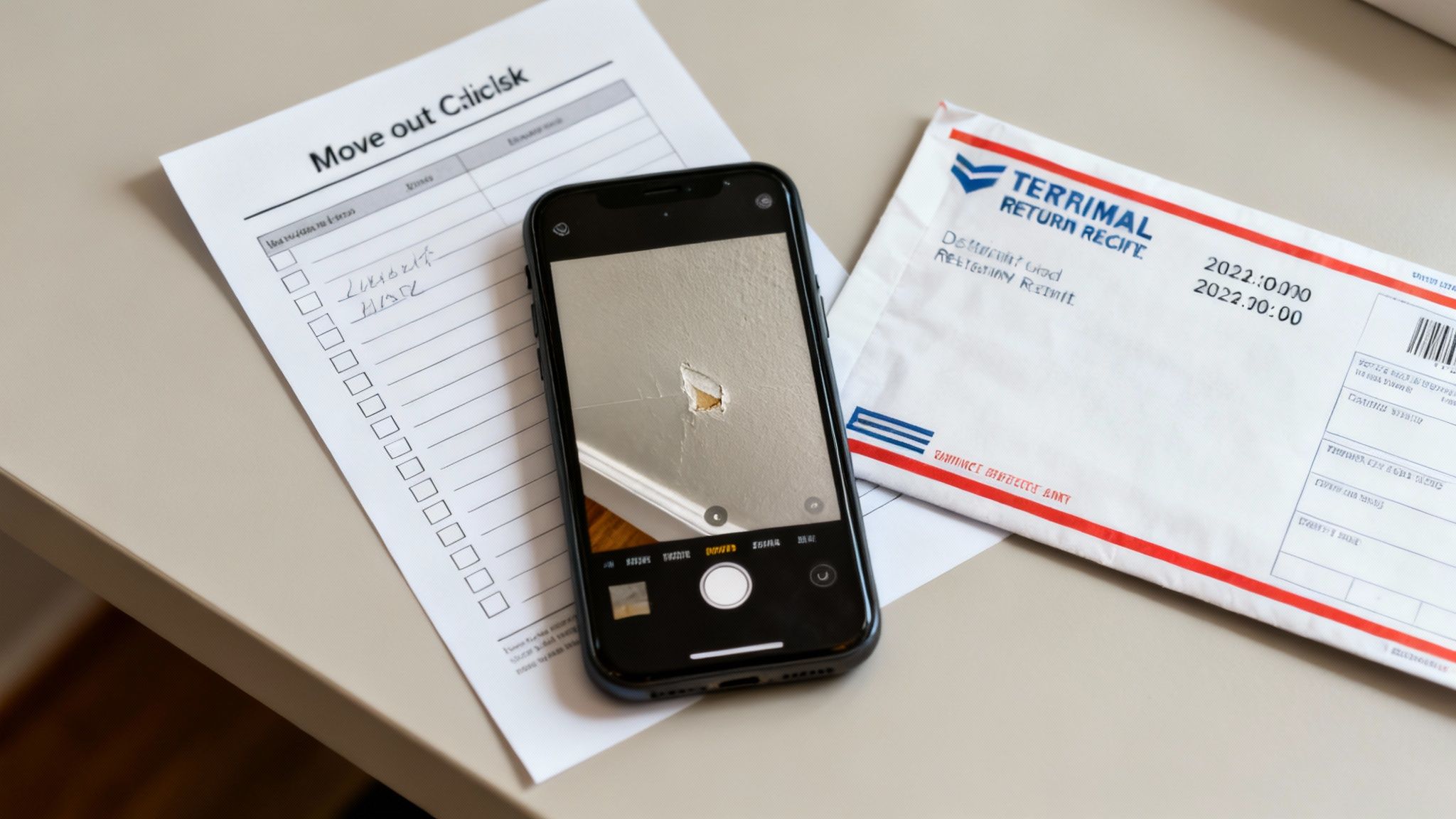
Getting out of a lease isn't just about finding a legal reason or striking a deal. It's about proving you did everything by the book. If you end up in a dispute, the person with the clearest evidence wins.
Meticulous documentation isn't just a good idea—it's your best defense against losing your security deposit or facing a lawsuit.
Put Everything in Writing
In landlord-tenant disputes, a verbal agreement is essentially worthless. Your landlord might sound understanding on the phone, but memories fade and verbal promises are not legally binding.
Every single piece of communication must be in writing. From your initial notice to every follow-up, get it documented.
Expert Tip: Never rely on a handshake deal to terminate a lease. The only thing that legally releases you from your obligations is a written agreement signed by both you and your landlord. Without it, they can pursue you for rent months later.
Use Certified Mail for Official Notices
When you send a formal notice, such as your intent to vacate, send it via certified mail with a return receipt requested.
Why is this so critical?
- It's Undeniable Proof: The return receipt postcard is signed by your landlord, proving they received your letter on a specific date.
- It Holds Up in Court: This method is the gold standard for legal notices in Texas. It eliminates any "I never received it" excuses.
- It Creates a Timeline: This establishes a clear, documented timeline, which is vital if you need to prove you gave the required notice.
File that receipt and a copy of your letter somewhere safe. It's the kind of concrete evidence that a Texas eviction attorney can use to build a strong case if a conflict arises.
Conduct a Thorough Move-Out Inspection
One of the most common disputes between tenants and landlords is over the security deposit. A landlord can legally deduct for damages beyond "normal wear and tear," but you need proof to fight back against unfair claims. This is where a detailed move-out inspection comes in.
Using a comprehensive moving out of rental checklist can be a lifesaver here, ensuring you don't miss a single detail that could cost you money.
Your step-by-step inspection process should be forensic-level detailed:
- Take Photos and Videos: Use your smartphone to take high-resolution photos and videos of every single room. Document everything—inside cabinets, behind doors, and the condition of floors, walls, and fixtures. Narrate the video, stating the date and pointing out the property's condition as you walk through.
- Use a Written Checklist: Fill out a move-out condition form. Note every scuff, stain, or minor issue. If possible, have your landlord do a final walk-through with you and sign the form on the spot.
- Document Returning the Keys: Get a written receipt or send a follow-up email confirming when and how you returned the keys. This prevents claims that you held onto the property longer than you did.
This mountain of evidence makes it incredibly difficult for a landlord to wrongfully keep your deposit for damages you didn't cause.
Burning Questions About Breaking a Lease in Texas
Even with a solid game plan, you're bound to have questions. Here are the answers to the most common questions we hear from Texas tenants trying to get out of a lease.
Will Breaking My Lease Wreck My Credit?
This is a major concern, and the answer is: it depends on how you do it.
If you end your lease the right way—by using a legal reason under the Texas Property Code, signing a buyout agreement, or if your landlord finds a new tenant right away—there should be zero impact on your credit score. You haven't defaulted on a financial obligation, so there is nothing negative to report.
However, if you just pack up and leave (abandonment), the consequences are severe. If your landlord wins a civil judgment against you for unpaid rent and fees, that judgment can be reported to the credit bureaus. This can seriously damage your credit score for years, making it difficult to get future housing, loans, or credit cards.
What Exactly Is a Reletting Fee?
A reletting fee is a standard clause in most Texas leases, but it is widely misunderstood. To be clear: it is not a penalty for breaking your lease.
Under Texas law, a reletting fee is a contractual charge designed to cover the landlord's actual time, effort, and expenses in finding a replacement tenant after you’ve moved out early. Think of it as compensation for their advertising and administrative work.
This fee is completely separate from the rent you might owe while the unit is empty. For example, if you leave with four months left on your lease and it takes your landlord one month to find a new renter, you will owe that one month's rent plus the reletting fee specified in your lease.
Is a Handshake Deal to End a Lease Good Enough?
Absolutely not. In Texas property law, verbal agreements are notoriously difficult to enforce. The "Statute of Frauds" requires agreements involving real estate—including lease terminations—to be in writing to be legally binding.
A friendly chat where your landlord says, "Don't worry about it," means nothing in a courtroom.
You must get any agreement to end your lease early in a signed, written document. That paper is your proof. It should clearly spell out:
- The final, official move-out date.
- The total amount of any final payment.
- A clear statement releasing both you and the landlord from any further obligations under the original lease.
What Happens to My Security Deposit?
When you break a lease, your security deposit is handled the same way it would be at the end of a normal lease term. A landlord can only make deductions for damages that go beyond "normal wear and tear."
They cannot legally keep your deposit to cover their lost rent unless your lease specifically contains a clause allowing it, or you agree to it as part of your written termination agreement.
If you fulfill all your obligations under a buyout or another valid termination, your landlord must return your security deposit within 30 days of you moving out, minus any legitimate deductions for damages.
If you need help with an eviction, lease issue, or rental dispute, contact The Law Office of Bryan Fagan, PLLC for a free consultation today.

![Graphic design featuring the title "8 Valid Reasons to Break a Lease in Texas [2025 Guide]" with decorative elements like a pen and paper, emphasizing tenant rights and legal guidance in Texas.](https://texastenantlawyers.com/wp-content/uploads/2025/11/featured-image-7ebe2aec-eacb-4e61-8e85-9c298b07ad11.jpg)