
Dealing with a landlord dispute can be stressful—but understanding your rights under Texas law can make all the difference. If your landlord isn't upholding their end of the lease, you have options. Before you jump to filing a formal complaint, however, it's critical to lay the proper groundwork. Taking a few key steps first doesn't just make you look reasonable—it builds a rock-solid foundation for your case and gives you the leverage you need.
Think of it as creating an undeniable paper trail that backs up every claim you make.
Your First Moves in a Landlord Dispute
When a serious issue pops up, the temptation is to react emotionally. That's understandable, but a calm, strategic approach will serve you much better in the long run. Rushing to file a complaint without first building your case can seriously weaken your position.
Instead, your initial moves should be all about creating a clear, factual record of the problem and every attempt you've made to get it fixed. This isn't just about complaining; it's about methodically proving that your landlord has failed to meet their legal duties under Texas law.
Step 1: Go Back to Your Lease Agreement
Your signed lease is the most important document you have. It's the contract that governs your entire relationship with your landlord, spelling out the duties and responsibilities for both of you. Before you do anything else, pull it out and read it carefully. You need to know exactly what your lease says about repairs, maintenance, and how you're supposed to communicate.
Look for specific clauses covering:
- Notice requirements: Does the lease demand written notice? Is there a specific way you have to deliver it?
- Repair timelines: Some leases specify how long a landlord has to address certain issues.
- Landlord responsibilities: The lease should reaffirm the landlord’s fundamental duty to provide a safe and habitable home, as required by the Texas Property Code.
Confirming what your landlord agreed to in writing is the first step in proving they've failed to live up to it.
Step 2: Document Everything—Seriously, Everything
From the very first moment a problem starts, documentation becomes your absolute best friend. Memories can be unreliable, but a dated photo or a saved text message is hard evidence. You need to keep a detailed log of every single interaction—phone calls, emails, texts, and even face-to-face conversations.
Key Takeaway: In any landlord-tenant dispute, the person with the better records almost always has the stronger case. A detailed timeline with proof to back it up can make or break your argument if you end up in court.
Real-World Scenario: Let's say you're dealing with a recurring roof leak. Every time it rains and a new water spot appears, snap a photo or take a quick video. Note the date and time. Log every single call or email you send to your landlord about it. This level of detail establishes a clear pattern of negligence that’s nearly impossible for them to deny.
For more guidance on this, you can learn more about handling repair and maintenance issues on our services page.
Step 3: Send a Formal Written Notice
Finally, and this part is crucial, you must send a formal, written notice via certified mail with a return receipt requested. This is a non-negotiable step required by the Texas Property Code. The letter needs to clearly describe the problem and formally demand that the landlord make the necessary repairs.
Sending it by certified mail gives you legal, verifiable proof that your landlord received your formal request. That receipt is your golden ticket if you need to take further legal action.
Know Your Rights: What the Texas Property Code Says
Before you file a complaint, you have to know what your landlord is actually required to do by law. This isn't about what feels unfair; it's about what's legally enforceable under the Texas Property Code. Think of it as the official rulebook for your relationship. Knowing what's inside is what separates a legitimate legal grievance from just another frustration.
At the very heart of your rights as a tenant is a powerful legal concept called the “implied warranty of habitability.” This isn't some flimsy suggestion—it's a promise baked into every residential lease in Texas, whether it's written down or not. It means your landlord has a non-negotiable duty to provide a home that is safe, sanitary, and livable. This is the foundation for most successful tenant complaints.
The Warranty of Habitability in Action
So, what does "habitable" actually look like in the real world? We're not talking about minor inconveniences like a dripping faucet. The law focuses on conditions that materially affect the physical health or safety of an ordinary tenant.
Real-World Scenario: Your air conditioning unit dies in the middle of a brutal Texas August. That's not just uncomfortable; it's a genuine health risk, especially if you have children or elderly family members. A landlord who drags their feet on fixing it is almost certainly violating the warranty of habitability.
The same goes for other serious problems:
- Raw sewage backing up from neglected plumbing.
- Serious mold growth that the landlord ignores.
- A broken heater when a winter freeze rolls in.
- A major pest infestation that makes the home unsanitary.
The Texas Property Code demands that your landlord fix conditions threatening your health and safety. If you've sent them proper notice and they've done nothing, you likely have the legal grounds you need to file a formal complaint.
Protections Against Landlord Misconduct
The Texas Property Code goes way beyond just repairs. It gives you specific protections against some of the most stressful situations a renter can face. To give you a clearer picture, here’s a simple explanation of key Texas laws that protect your tenant rights.
Common Tenant Issues and Relevant Texas Laws
| Common Tenant Issue | Governing Texas Property Code Section | What It Means for You |
|---|---|---|
| Security Deposit Not Returned | Section 92.103 | Your landlord must return your deposit within 30 days of you moving out and can only deduct for damages beyond "normal wear and tear." |
| Illegal Lockout | Section 92.0081 | A landlord cannot legally change your locks to keep you out. They must go through the formal eviction process in court. |
| Retaliation for Requesting Repairs | Section 92.331 | If you ask for a necessary repair, your landlord cannot retaliate by evicting you, raising your rent, or cutting off services. |
This table is just a starting point, but it shows how specific the law can be. A landlord who wrongfully keeps your security deposit is breaking the law. So is one who tries to lock you out without a court order from a judge. And crucially, the law protects you from payback. Understanding the rules around landlord retaliation and illegal entry is absolutely critical to standing up for your rights without fear.
Knowing these specific sections of the code gives you power. You're no longer just an upset tenant; you're an informed citizen with the law squarely on your side.
How to Build a Rock-Solid Case Against Your Landlord
When it's your word against your landlord's, evidence is the only thing that matters. A powerful complaint isn’t built on frustration—it's built on a foundation of cold, hard proof. Taking the time to gather and organize everything is the single most important step you can take. It turns a complaint that gets ignored into one that demands a response.
Step 1: Use Visual Evidence
A picture or video can show the reality of a problem faster than any written description. Your cell phone is your best friend here. Every photo and video comes with a date and time stamp, which is exactly what you need to build a credible timeline.
Go ahead and document everything:
- Pest Infestations: Get clear shots of pests (dead or alive), droppings, or nests.
- Structural Damage: Take a video that shows the full extent of a roof leak, a crack in the foundation, or a broken window.
- Appliance Failures: Film yourself trying to use the broken refrigerator or showing that the heater won't turn on.
Visuals are objective. They make it nearly impossible for a landlord to downplay how bad the situation really is.
The infographic below breaks down the key steps for getting your proof in order.
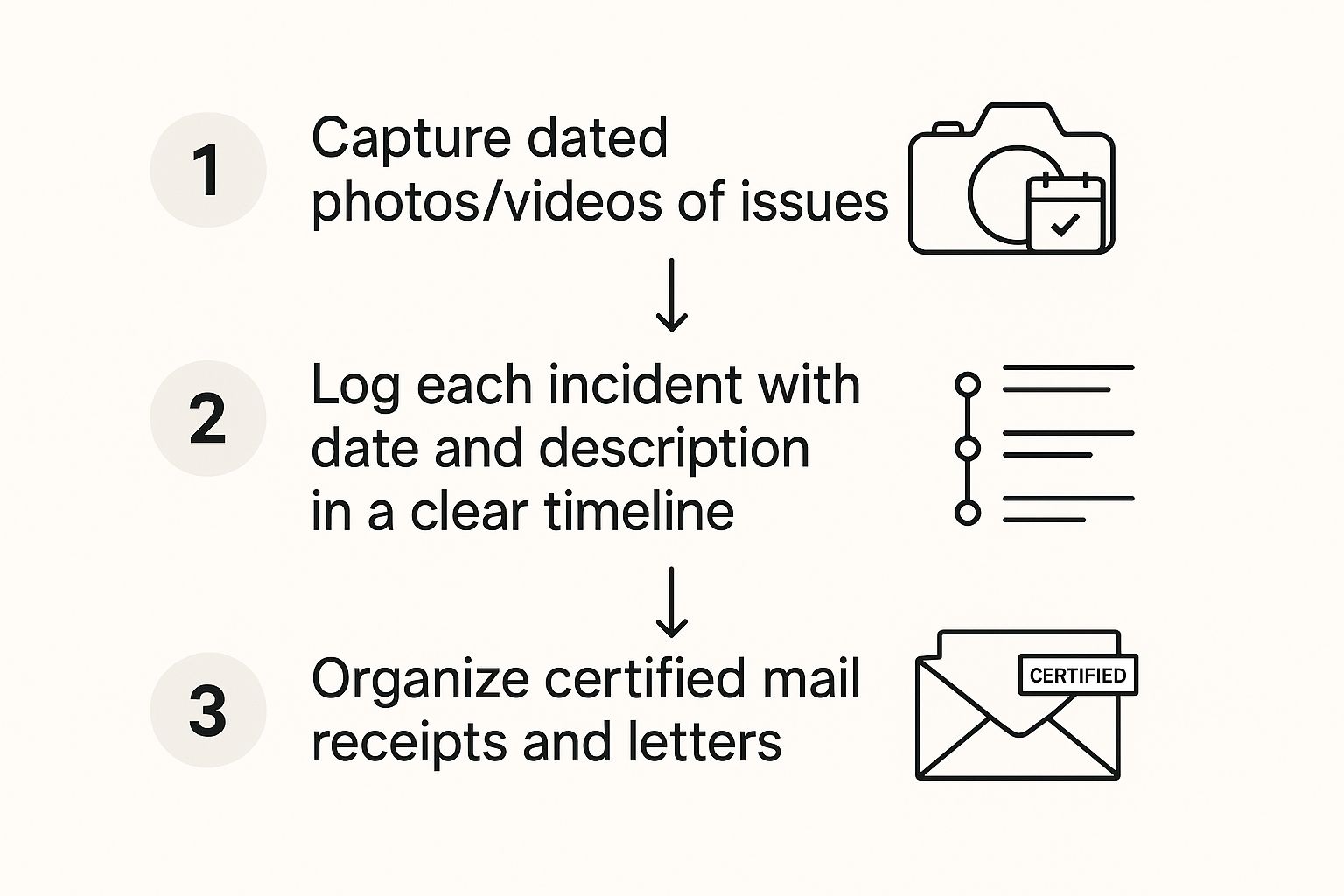
Think of this as your game plan. From snapping photos to logging every interaction, a systematic approach is what gives your case its strength.
Step 2: Create an Unbreakable Paper Trail
Beyond pictures, your written records form the backbone of your case. Keep a detailed log of every time you communicate with your landlord. Write down the date, time, who you talked to, and what was said. Save every email and text message.
This becomes absolutely critical when you send formal notices. The Texas Property Code requires you to send repair requests via certified mail. That little green return receipt you get back? That's gold. It's your legal proof that the landlord was officially notified. Keep a copy of the letter you sent and that receipt tucked away somewhere safe.
Don't underestimate the power of outside validation. A report from a city code inspector confirming a violation or a written statement from a neighbor who witnessed the problem can add significant weight to your complaint.
This isn't just a Texas problem. As rental markets get tighter everywhere, these kinds of disputes are spiking. For instance, the UK's Housing Ombudsman saw a massive 38% jump in landlord complaints in early 2023, mostly over repair delays and bad communication. You can dig into the landlord complaint statistics from their official report.
The Official Step-by-Step Process for Filing Your Complaint
Once you’ve gathered all your evidence and documented everything, it’s time to take formal action. Knowing exactly where to file your complaint is a huge part of the battle. Different agencies and courts handle different problems, so choosing the right venue from the start will save you time and give your case the best chance at a real resolution.
Step 1: Start with Local Texas Agencies
When you're dealing with issues that violate city or county rules—things like no hot water, a serious pest infestation, or dangerous structural problems—your first stop should always be local government agencies. These are the people on the front lines, tasked with enforcing the basic housing standards that keep renters safe.
In most Texas cities, you'll be looking for one of two departments:
- Code Enforcement or Code Compliance: This is your go-to for building code violations. Think faulty wiring, broken plumbing, or anything that makes the structure itself unsafe.
- Health Department: For problems that pose a direct health risk—like rampant mold, sewage backups, or a severe pest problem—this is the department to call.
Filing a complaint with them usually triggers an official inspection of your rental. An inspector's report is a powerful piece of evidence. It's an official, third-party confirmation of the problem, which can be invaluable if you end up in court later.
A recent consumer survey showed that repair failures and pest infestations are among the most common tenant grievances nationwide. In one case, a tenant with a newborn was dealing with a daily roach infestation. After filing a complaint, she successfully negotiated an agreement to break her lease without penalty, saving herself around $4,200. You can dig into more of these issues in the 2024 Consumer Complaint Survey Report.
Step 2: Take Your Landlord to Justice Court
For many disputes, especially when money is on the line, the most direct path to a solution is filing a lawsuit in a Texas Justice of the Peace (JP) court. This is where the majority of landlord-tenant cases, from evictions to security deposit fights, are handled.
Justice court is designed to be more accessible for people without lawyers. The rules are simpler and the process is much faster than in higher courts, making it the right place for most tenants to get a binding decision.
Filing in JP court is the right move for issues like:
- Wrongfully Withheld Security Deposits: Your landlord didn't return your deposit within 30 days or took deductions they weren't entitled to.
- Illegal Lockouts or Utility Shutoffs: The landlord tried to take matters into their own hands instead of following the legal eviction process.
- Failure to Make Repairs: You can sue to get a judge to order your landlord to fix major problems that affect your health and safety.
The process involves filing a petition, paying a small fee, and making sure your landlord is formally "served" with the lawsuit. While you can represent yourself, having a Texas landlord tenant lawyer in your corner can make a world of difference.
A final note: while you can log a complaint with the Better Business Bureau (BBB), they have no legal authority. They can't force your landlord to do anything. To actually enforce your tenant rights under the Texas Property Code, you need to file with the right city agency or in JP court.
When You Need a Texas Landlord Tenant Lawyer

You can handle many disputes by following the official process yourself. But some situations are just too serious to face alone. Knowing when to call in a professional is key to protecting your rights and your home. If your landlord's actions feel aggressive, illegal, or are actively harming you, it’s time to seek legal help.
Red Flags That Signal You Need an Attorney
Certain actions from a landlord are immediate red flags that demand a swift, strong response. If you're facing any of these scenarios, you should contact an experienced Texas landlord tenant lawyer right away. These situations go beyond simple disagreements and enter the realm of illegal conduct.
Be on the lookout for these warning signs:
- Illegal Eviction Attempts: This includes changing your locks, removing your belongings, or shutting off your utilities without a court order. These "self-help" evictions are strictly forbidden under the Texas Property Code.
- Direct Harassment or Threats: If your landlord is threatening you, showing up unannounced repeatedly, or otherwise making your home life unbearable, legal intervention is necessary.
- Clear Retaliation: Your landlord suddenly tries to evict you or jacks up the rent right after you requested a critical repair or filed a complaint with code enforcement.
- Serious Health and Safety Risks: The problem involves severe mold, raw sewage, or other serious dangers that the landlord refuses to fix, putting your family’s health on the line.
These aren't just Texas-sized problems. A recent report from England revealed a shocking 474% surge in complaints against social landlords between 2019-2025, mostly due to failures in handling major repairs. You can see how these are systemic housing issues in the full report.
How a Lawyer Can Change the Game
Hiring an attorney does more than just give you advice; it completely changes the power dynamic. A lawyer can immediately escalate your complaint by sending a formal demand letter—something landlords take far more seriously than a tenant's email or phone call.
An experienced attorney knows how to use the Texas Property Code to your advantage, demanding not just action but also seeking financial damages for what you've endured.
They will negotiate directly on your behalf, represent you in Justice Court, and make sure your case is presented with the strongest possible evidence. A skilled eviction attorney can halt an illegal eviction in its tracks or even countersue a landlord for breaking the law.
In many cases involving landlord misconduct, Texas law allows you to recover your attorney's fees from the landlord if you win. This provision helps level the playing field, ensuring you can get top-tier legal protection without bearing the full cost. With an expert like attorney Bryan Fagan on your side, you can confidently stand up for your rights.
Common Questions About Filing a Complaint
When you’re up against a landlord issue, it’s normal to have questions. Let’s get you some straight answers to the most common concerns Texas tenants face.
Can my landlord evict me just for complaining?
No. Under the Texas Property Code (Section 92.331), your landlord is legally forbidden from retaliating against you for exercising your tenant rights. This includes making a repair request or filing a formal complaint with a housing authority. If your landlord tries to evict you, raise your rent, or cut services within six months after you’ve complained, the law automatically assumes it’s retaliation. This gives you a powerful defense in court.
How much does it cost to sue my landlord in JP Court?
Going to court sounds expensive, but the Justice of the Peace (JP) court system is designed to be accessible. Costs vary by county, but you’re generally looking at two main fees: a filing fee (around $54) and a service fee to have the landlord served with the lawsuit (around $75-$100). If you cannot afford these costs, you can ask the court to waive them by filing a "Statement of Inability to Afford Payment of Court Costs."
What if my landlord just ignores my certified letter?
This can actually work in your favor. When a landlord completely ignores a formal, certified letter asking for repairs, they are handing you a major piece of evidence. It shows a judge that you followed the law and gave them a fair chance to fix the problem, and they chose to do nothing. This is often the turning point where you would file a lawsuit in JP court to get an order compelling the repairs or sue for money damages. Once your certified letter is ignored, it’s a good time to talk to a tenant rights attorney.
Can I stop paying rent if they won’t make repairs?
This is a critical question, and the answer is almost always no. In Texas, you generally cannot withhold rent, no matter how bad the repair issue is. If you stop paying, you are giving your landlord a clear reason to evict you for non-payment, which will damage your case and your rental history. While there is a "repair and deduct" option under Texas law, the rules are incredibly strict and very easy to get wrong. Always speak with a lawyer before you consider stopping your rent payments.
If you need help with an eviction, lease issue, or rental dispute, contact The Law Office of Bryan Fagan, PLLC for a free consultation today.

![Graphic design featuring the title "8 Valid Reasons to Break a Lease in Texas [2025 Guide]" with decorative elements like a pen and paper, emphasizing tenant rights and legal guidance in Texas.](https://texastenantlawyers.com/wp-content/uploads/2025/11/featured-image-7ebe2aec-eacb-4e61-8e85-9c298b07ad11.jpg)