
Dealing with a landlord dispute or eviction can be stressful — but understanding your rights under Texas law can make all the difference. An eviction notice isn't just a piece of paper; it's the start of a legal process, and your first move is your most powerful one.
Before you do anything else, take a breath. Ignoring the notice is the single biggest mistake you can make. The key isn't to panic; it's to get strategic. The best immediate action is to understand your rights under Texas law and find an "eviction attorney near me" who can help you fight back.
What to Do When You Get an Eviction Notice
When your home is on the line, knowing your rights under the Texas Property Code is your best defense. That notice isn't an order to pack your bags and leave tomorrow. It's the start of a formal legal process—a process with strict rules your landlord must follow.
This is your moment to act, not to wait. It’s easy to feel overwhelmed, but you’re not alone. When you're facing a potential eviction, getting prompt legal help is critical.
Your First Steps Toward a Strong Defense
What you do in the next few days sets the stage for your entire defense. The first, most crucial step is to get familiar with your legal standing. Understanding your fundamental tenant rights and responsibilities is the foundation for a confident, effective response.
Here's a step-by-step guide on what to do right away:
- Don't Ignore It. Seriously. The deadlines on that notice are real. If you miss them, your landlord can win by default, making your fight much harder.
- Review Your Lease. Your lease is a legally binding contract. Read it over and look for any clauses related to the reason they claim they're evicting you. The answer might be right there in the fine print.
- Document Everything. Start a file immediately. Save every email, text, and letter from your landlord. Take pictures of the property, especially if there are repair issues they've ignored. Create a timeline of events.
- Call an Eviction Attorney. A Texas landlord-tenant lawyer understands this area of law inside and out. They can spot procedural mistakes your landlord made from a mile away—and even a small error on the notice can be enough to get the case dismissed.
The most powerful tool you have is knowledge. Texas law provides specific protections for tenants, but you have to assert them. An eviction attorney ensures your side of the story is heard in court and that your rights are defended every step of the way.
An attorney can help you figure out what comes next and build a response strategy. For a more detailed breakdown, check out our guide on how to respond to an eviction notice. You can turn this moment of crisis into a plan of action, and it all starts with a single phone call.
What the Texas Property Code Says About Evictions
Before you can build a defense, you need to understand the rules of the process. The eviction process in Texas isn't arbitrary—it's a strict sequence of legal steps your landlord must follow perfectly. Understanding these stages is the first step to protecting your rights and spotting holes in your landlord's case.
The entire process is governed by the Texas Property Code, Chapter 24. This section lays out the precise rules for "Forcible Entry and Detainer" cases, which is the legal term for evictions. These aren't just technicalities; they are real safeguards designed to protect you.
This timeline breaks down the first critical moves you should make the moment an eviction notice lands in your hands.
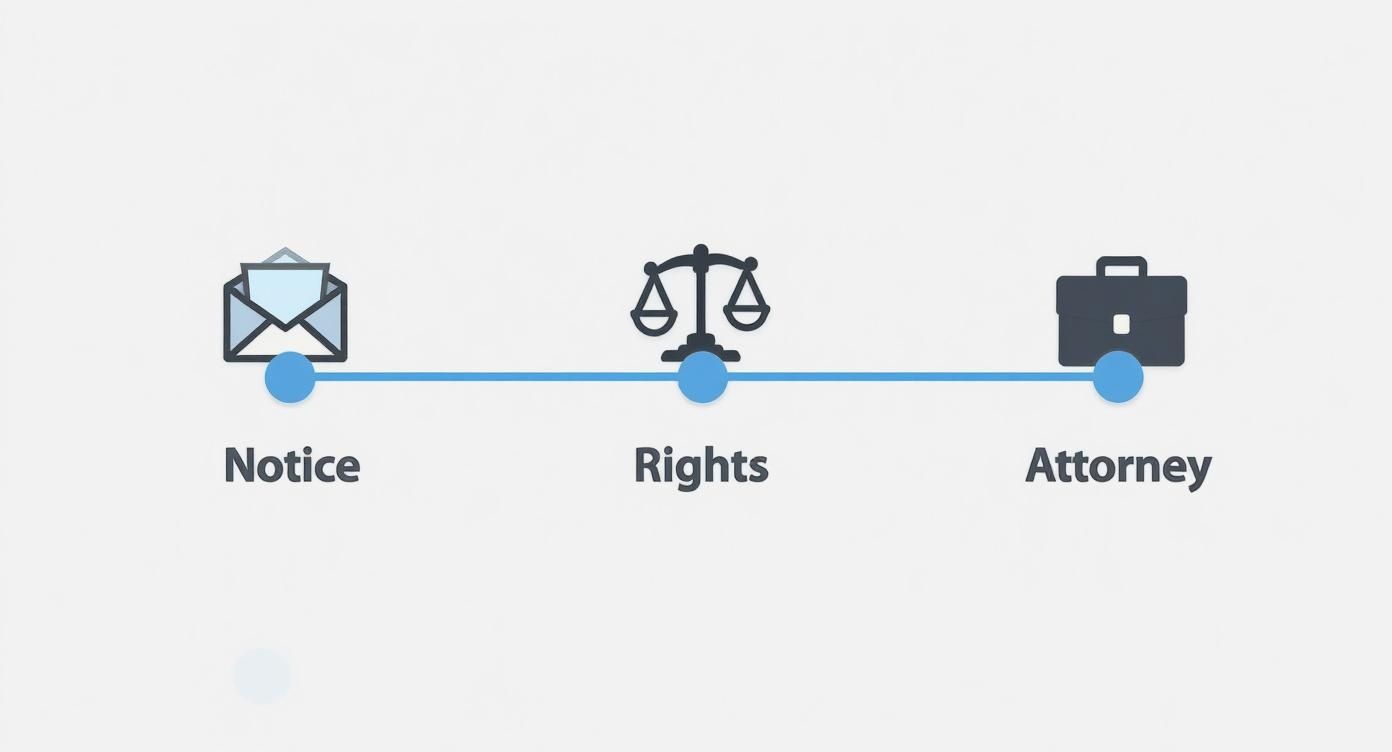
As you can see, what you do first—analyzing the notice, knowing your rights, and calling an attorney—sets the entire tone for a successful defense.
The Notice to Vacate Is Not a Final Order
Let's get one thing straight: the first document you receive, a Notice to Vacate, is not an eviction order. It’s a legally required warning, and a verbal "you need to get out" holds absolutely no legal weight in Texas.
For this notice to be valid, Texas Property Code Section 24.005 requires that it meet several key criteria:
- It must be in writing.
- It must give you at least three days to move, unless your lease specifically states a different time frame.
- It must clearly state the reason for the eviction.
- It must be delivered properly—either handed to you, mailed, or posted on the inside of your front door.
A tiny misstep here can invalidate the landlord's entire case. For example, if your landlord texts you on a Tuesday that you have until Wednesday to leave, that is an invalid notice. An experienced eviction attorney can use that mistake as a powerful, immediate defense.
An eviction is a lawsuit, not just a demand from your landlord. They cannot legally change your locks, shut off your utilities, or remove your belongings without a court order. These are illegal "self-help" eviction tactics, and a lawyer can help you fight back if your landlord tries them.
What Happens When You Go to Justice Court
If you remain in the property after the notice period ends, your landlord’s next step is filing an eviction lawsuit in the local Justice of the Peace (JP) court. You will then be served with a citation, a formal document telling you exactly when and where the court hearing is scheduled.
This hearing is your chance to tell your side of the story. A sharp eviction attorney knows how to challenge the landlord's claims, present your evidence (like photos of that leaky roof you've been complaining about or rent payment receipts), and highlight every procedural corner the landlord cut. For a deeper dive, check out our full guide on the eviction process in Texas.
Having a Texas landlord-tenant lawyer in your corner is more critical than ever. With housing stability being a major issue, having a legal expert to protect your rights can make all the difference.
How to Find and Vet the Right Local Attorney
When your housing is on the line, a quick Google search is just the start. Finding the right legal expert isn’t about falling for a sales pitch; it's about locating a Texas landlord-tenant lawyer with real, proven experience in the local Justice Courts where your case will be heard.
Skilled legal help is essential for protecting your rights and avoiding an eviction judgment that can follow you for years, making it difficult to rent in the future.
Starting Your Search for an Eviction Attorney
Your search for an "eviction attorney near me" should start with sources you can trust. A quick search is a good way to get an initial list, but you need to dig deeper to find qualified, local professionals who genuinely know this area of law. It can even be helpful to understand how attorneys rank for 'near me' searches just so you know what you're seeing in the results.
Here are a few solid places to start building your shortlist:
- The State Bar of Texas Website: This should be your first stop. You can instantly verify that an attorney is licensed, in good standing, and check for any public disciplinary history. It’s the ultimate source of truth.
- Local Bar Associations: County-level bar associations often have excellent lawyer referral services. These can connect you with attorneys who specifically focus on landlord-tenant law right in your community.
- Reputable Online Directories: Websites like Avvo and even Google Reviews can be valuable for client testimonials and peer endorsements. Look for patterns—consistent positive feedback about communication, professionalism, and results.
Finding an attorney isn't just about credentials; it's about finding a strategic partner. You need someone who knows the local JP court judges and understands the specific nuances of how eviction cases are handled in your county.
Questions to Ask During Your Consultation
Think of your initial consultation as an interview—you're the one doing the hiring. This is your chance to see if an attorney has the right experience and approach for your case. Walk into that meeting prepared with a list of targeted questions designed to get you real answers.
To help you get started, we've put together a table of key questions. Use this as a checklist during your free consultations to vet potential attorneys.
Key Questions to Ask a Potential Eviction Attorney
| Question Category | Specific Question to Ask | Why It's Important |
|---|---|---|
| Direct Experience | "How many tenant eviction cases have you handled in the past year?" | This tells you if they are actively practicing in this area of law, not just dabbling in it. |
| Specialization | "What percentage of your practice is dedicated to landlord-tenant law?" | You want a specialist, not a generalist. An attorney focused on tenant defense will know the Texas Property Code inside and out. |
| Local Knowledge | "Are you familiar with the judges at the local Justice of the Peace court where my case will be heard?" | This is critical. An attorney who knows the local court's tendencies can build a much stronger strategy. |
| Case Assessment | "Based on what I’ve told you, what are the potential strengths and weaknesses of my case?" | This tests their ability to think strategically and gives you a realistic preview of what to expect. |
| Costs & Fees | "What is your fee structure, and can you provide an estimate of the total costs?" | You need to understand the financial commitment upfront to avoid any surprises. |
These questions help you cut through the noise and gauge an attorney’s direct experience and their familiarity with the local legal landscape—both of which are crucial for success.
For more on building a strong case, check out our guide on tenant rights in Texas during an eviction. Having this knowledge will help you work with your attorney to protect your home.
Preparing for Your Initial Consultation
That first meeting with a potential eviction attorney is more than just an introduction; it's a strategy session. It’s where the foundation of your entire case is built.
Walking in prepared can turn a stressful meeting into a productive one. Your goal is simple: give the attorney the whole story so they can give you a clear, honest assessment of your legal options. To do that, you need to bring the right documents.

What to Bring to Your First Meeting
Think of this consultation as laying out the facts. The more organized you are, the faster your attorney can spot weaknesses in the landlord's case—or strengths in yours. A good Texas landlord-tenant lawyer will want to see the complete paper trail.
Here’s a checklist of the essentials to gather:
- Your Lease Agreement: This is the most important document. It's the contract that governs your tenancy and outlines the duties for both you and your landlord under Texas law.
- All Written Notices: Bring every single document the landlord has given you, especially the official “Notice to Vacate.” The wording, dates, and delivery methods are critical.
- Communication Records: Show, don't just tell. Print out any emails, text messages, or letters between you and the landlord or property manager.
- Photos and Videos: If your dispute involves property damage, unrepaired appliances, or unsafe living conditions, nothing speaks louder than pictures or videos.
- Payment Records: Gather your rent receipts, bank statements, or any other proof of payment, especially if the eviction is for alleged non-payment.
An experienced attorney isn’t just reading the words on the page. They're looking for procedural mistakes. A small error in the Notice to Vacate or a clear violation of your lease by the landlord could be the key to getting your case dismissed.
A Real-World Landlord Scenario
To understand the landlord's perspective, imagine a property owner in Houston who needs to evict a tenant. The lease agreement clearly states the property is for residential use only, but the tenant is running an auto repair business out of the garage, which is a clear violation.
Before calling an attorney, the landlord gathers:
- The signed lease agreement with the "residential use only" clause highlighted.
- A copy of the written warning they sent the tenant about the violation.
- Dated photos of cars being worked on in the driveway.
- Email records where the tenant acknowledged the warning but continued the business.
By walking into the consultation with this evidence, the landlord allows the attorney to immediately confirm a clear lease violation occurred and start outlining the proper steps for a legal eviction under the Texas Property Code. This level of preparation turns a simple Q&A into a focused strategy session for either side.
How Your Attorney Will Build a Strong Defense
Hiring an experienced eviction lawyer is a huge first step, but the real work starts when you build your case together. Think of it as a partnership. Your attorney brings the legal strategy and courtroom knowledge; you bring the facts and evidence that tell your side of the story.

This is where your ignored repair requests, an improper notice, or unfair accusations get translated into a powerful legal argument a judge can understand. Your role in gathering every text message, email, and photo is just as critical as your attorney’s performance in court.
Filing the Answer and Stating Your Case
Once your landlord files the eviction lawsuit, the clock starts ticking—fast. You have a very short window, often just a few days, to file a formal document with the court called an "Answer." This is your attorney's first official move, responding to the landlord’s claims and laying out your defenses.
This isn’t just a simple “I disagree” form. A skilled attorney uses the Answer to frame the entire case, raising specific legal arguments right from the start, such as:
- The eviction notice was legally defective.
- The eviction is retaliation for you requesting critical repairs.
- The eviction is based on illegal discrimination.
- The landlord breached the lease agreement first.
Filing a detailed, professional Answer sends a clear message to the court and the landlord: you are serious about defending your rights.
A Real-World Tenant Scenario: Uncovering a Winning Defense
Let's say you're being evicted for not paying rent. What the lawsuit doesn't mention is that for months, you’ve been begging your landlord to fix a severe roof leak that’s now causing mold in your child's bedroom. You sent texts and emails, but nothing happened. Feeling you had no other choice, you withheld rent.
During your first meeting, your attorney will zero in on those communications. They won't just see an inconvenience; they'll see a potential violation of the "warranty of habitability" under Texas Property Code Section 92.052. This law requires landlords to repair conditions that threaten a tenant's health and safety.
A landlord’s failure to make legally required repairs can be an incredibly powerful defense against an eviction for non-payment of rent. Your documented requests for help become the key evidence that can turn the entire case in your favor.
From Negotiation to Trial Preparation
Armed with this proof, your attorney now has serious leverage. Their first move likely won't be preparing for a courtroom battle, but to negotiate. They will contact the landlord's lawyer, present the evidence of the leak and the ignored requests, and lay out the facts.
Suddenly, the landlord is facing proof of their own legal violation. This often makes them far more willing to negotiate a better outcome for you, which could include:
- Case Dismissal: The landlord agrees to drop the eviction lawsuit.
- Rent Abatement: You get a credit for rent paid while living in unsafe conditions.
- Repair Agreement: The landlord finally agrees to make all necessary repairs on a strict timeline.
- A Neutral Move-Out: You might still agree to move, but the eviction is wiped from your record, and the landlord may even help with moving costs.
If the landlord refuses to negotiate, your attorney will then prepare for the hearing in Justice Court, organizing your evidence and building a compelling argument for the judge.
Your Questions About Hiring an Eviction Attorney, Answered
Hiring a lawyer is a big decision, and it’s completely normal to have questions about the process, costs, and potential outcomes. Let's address some of the most common concerns we hear from tenants like you.
How Much Does an Eviction Attorney Cost in Texas?
The cost depends on your specific situation. Many firms, including ours, offer a free initial consultation for this very reason. It allows us to understand your case and provide a clear, upfront picture of the costs involved, with no surprises.
Generally, you'll see two types of fee structures:
- Flat Fee: For a straightforward eviction defense, many attorneys charge a single, flat fee. This provides certainty and helps you budget without worrying about a running clock.
- Hourly Rate: If your case is more complex—perhaps involving counterclaims against the landlord or extensive negotiation—an hourly rate is more common.
An investment in a good lawyer can save you significant trouble down the road. A formal eviction on your record can lead to higher security deposits and fewer housing options for years to come.
How Long Does an Eviction Case Take?
An eviction in Texas can move very quickly, but it can also take several months. If a tenant doesn't respond, the entire process can be over in as little as three to four weeks. This is why acting fast is so important.
When you and your attorney file an Answer and raise legitimate defenses, you ensure the proper legal process is followed. That extra time can be invaluable, giving you breathing room to negotiate with the landlord or plan your next steps without being rushed.
An eviction is not an overnight process. Texas law has a series of steps and deadlines that must be followed. Your attorney’s job is to hold your landlord accountable to every single rule, which often gives you the critical time needed to build a defense or negotiate a better outcome.
Can an Eviction Be Stopped After a Judge Rules?
This is a critical moment. Once a Justice of the Peace (JP) has ruled against you, your options narrow, but the fight isn't necessarily over. You have a very tight window—typically just five days—to file an appeal.
Appealing moves the case to the County Court for a completely new trial. This is a complex legal step that requires an attorney to handle correctly. If you miss that five-day deadline, the landlord can get a "Writ of Possession," which is the final order allowing a constable to physically remove you and your belongings from the property. Time is everything at this stage.
What Is the Long-Term Impact of an Eviction?
An eviction judgment is a public record that can follow you for years. When you apply for a new apartment, almost every landlord will run a background check. An eviction is one of the biggest red flags they look for and can lead to immediate application denials or demands for much higher security deposits.
This is why fighting an eviction is about so much more than your current home; it’s about protecting your ability to find stable housing in the future.
If you need help with an eviction, lease issue, or rental dispute, contact The Law Office of Bryan Fagan, PLLC for a free consultation today.



![Graphic design featuring the title "8 Valid Reasons to Break a Lease in Texas [2025 Guide]" with decorative elements like a pen and paper, emphasizing tenant rights and legal guidance in Texas.](https://texastenantlawyers.com/wp-content/uploads/2025/11/featured-image-7ebe2aec-eacb-4e61-8e85-9c298b07ad11.jpg)